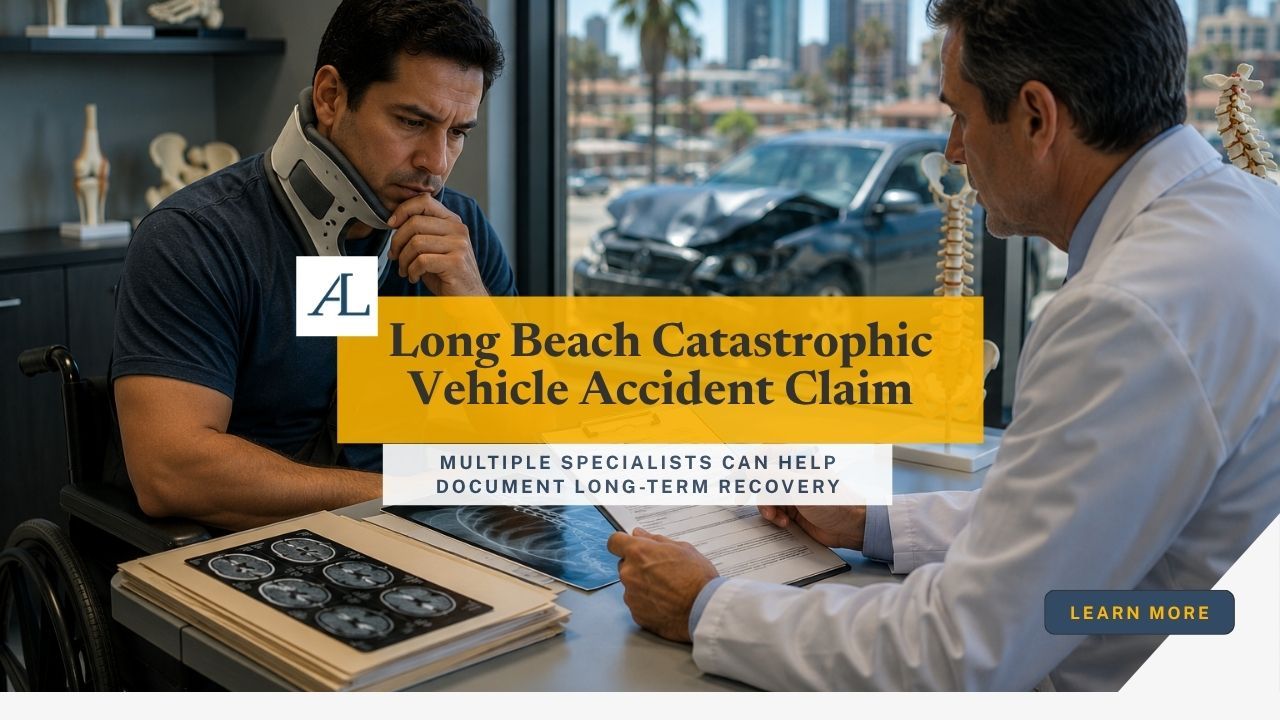
A Long Beach catastrophic vehicle accident claim can become complicated quickly because serious injuries rarely involve one doctor, one appointment, or one clear recovery date. After a severe crash, an injured person may be rushed to emergency care, admitted to the hospital, referred to surgeons, evaluated by neurologists, treated by orthopedic specialists, discharged with restrictions, and placed into months or years of rehabilitation. While the injured person and their family are focused on survival, mobility, pain, and daily care, insurance companies may already be reviewing records for gaps, inconsistencies, and reasons to reduce the claim.
Catastrophic injury claims are different from ordinary vehicle accident claims because the long-term consequences can affect every part of a person’s life. A crash on I-710, I-405, Ocean Boulevard, Pacific Coast Highway, Anaheim Street, Long Beach Boulevard, or near port and downtown traffic corridors can leave someone facing traumatic brain injury symptoms, spinal trauma, fractures, nerve damage, internal injuries, mobility limitations, chronic pain, or permanent disability. A Long Beach catastrophic vehicle accident claim must document not only what happened at the crash scene, but also what recovery will require over time.
When a catastrophic vehicle accident leaves you or someone you love facing a long recovery, choosing the right legal representation matters. An experienced Long Beach personal injury lawyer at Avrek Law Firm can help preserve evidence, organize medical documentation, communicate with insurers, identify responsible parties, and pursue compensation that reflects the full impact of the injury.
Call 866-598-5548, start a live chat, or request a free case review today. There are no upfront fees, and you do not pay unless we win.
Why Catastrophic Injury Claims Often Involve Many Providers
A Long Beach catastrophic vehicle accident claim often involves many providers because serious injuries do not follow a simple treatment path. The first doctor may stabilize the injured person, but later providers may diagnose additional injuries, recommend surgery, track neurological symptoms, prescribe therapy, evaluate mobility, or explain how the injury affects work and daily function. Each provider may document a different piece of the same injury story.
This is one reason catastrophic injury claims can be aggressively disputed. Insurance companies may compare records from different providers and argue that symptoms are inconsistent, treatment is excessive, or future care is uncertain. In reality, catastrophic recovery often changes over time. A person may begin with emergency trauma care, then move into orthopedic treatment, pain management, physical therapy, occupational therapy, cognitive therapy, vocational planning, and long-term follow-up.
Medical recovery may also involve a team approach. MedlinePlus Rehabilitation explains that rehabilitation can help people regain or improve abilities needed for daily life after injury, including physical, mental, and cognitive abilities, and that rehabilitation programs may involve different providers working together on needs, goals, and treatment plans. In a Long Beach catastrophic vehicle accident claim, that team-based recovery process can become central to proving future care needs, daily limitations, and the true value of the claim.
Emergency Care, Surgeries, Rehabilitation, and Specialist Follow-Ups
After a catastrophic vehicle accident, emergency care is often only the beginning. First responders may transport the injured person to a trauma center, where doctors focus on stabilizing life-threatening injuries, ordering imaging, treating bleeding, managing fractures, evaluating head trauma, or preparing for surgery. Those records are important, but they may not capture every long-term problem the injured person will face.
Surgeries and specialist follow-ups may add more detail. An orthopedic surgeon may document fractures, hardware placement, joint damage, or mobility restrictions. A neurologist may evaluate headaches, memory problems, dizziness, nerve symptoms, or traumatic brain injury concerns. A spine specialist may assess disc injuries, spinal cord trauma, radiating pain, or the need for injections or surgery. A pain management doctor may track chronic symptoms that continue after the initial injury phase.
Rehabilitation records often show what daily recovery actually looks like. Physical therapy may document strength, balance, walking ability, and range of motion. Occupational therapy may document difficulties with bathing, dressing, cooking, driving, or returning to household routines. Cognitive therapy may document memory, attention, processing speed, or executive-function problems after a brain injury. A Long Beach catastrophic vehicle accident claim becomes stronger when these records are preserved and connected into one clear recovery narrative.
Why Different Providers May Document Different Parts of the Injury
Different providers often document different parts of the injury because each specialist focuses on a specific medical issue. That can create confusion when an insurer reviews the claim. An emergency room record may focus on acute trauma. A surgeon may focus on hardware and healing. A physical therapist may focus on mobility. A neurologist may focus on symptoms that do not appear on a basic X-ray. A primary care doctor may focus on medication, referrals, and overall follow-up.
Insurance companies may use these differences to argue that the records do not match. For example, if the emergency room record emphasizes fractures but later therapy records emphasize back pain or balance problems, the insurer may claim the later symptoms are unrelated. If a neurologist documents cognitive symptoms months after the crash, the insurer may argue they were not present immediately. A Long Beach catastrophic vehicle accident claim must explain how complex injuries can evolve and how each provider’s notes fit into the larger recovery picture.
This is especially important when the injury affects more than one body system. A crash victim may have orthopedic injuries, brain injury symptoms, emotional trauma, sleep disruption, and work limitations at the same time. No single provider may document every issue in every visit. A strong claim organizes records so the insurer cannot isolate one note and ignore the full medical history.
How Long Recovery Timelines Can Complicate Claim Valuation
Long recovery timelines can complicate claim valuation because insurers often want to settle before the future is clear. In a catastrophic injury case, the injured person may not know for months whether they will need additional surgery, whether they can return to work, whether pain will become chronic, whether mobility will improve, or whether cognitive symptoms will resolve. A quick settlement may not account for the full medical and financial impact.
A Long Beach catastrophic vehicle accident claim should not be valued only by early bills. Early bills may show ambulance care, emergency treatment, and initial hospitalization, but they may not include future therapy, home modifications, assistive devices, pain management, vocational retraining, caregiver needs, psychological support, or lost earning capacity. The value of the claim depends on both current losses and reasonably supported future needs.
This is where multiple specialists can make a major difference. A surgeon may discuss future procedures. A therapist may document functional limitations. A neurologist may explain cognitive restrictions. A vocational expert may evaluate work capacity. A life care planner may help identify long-term care needs. The claim should be built around a complete picture, not an insurer’s early estimate.
Medical Records That Can Help Tell the Full Injury Story
A Long Beach catastrophic vehicle accident claim depends heavily on medical records because serious injuries must be documented over time. The goal is not simply to prove that the person was hurt. The goal is to show how badly they were hurt, how the injuries changed their life, what care has been provided, what care may still be needed, and why the accident caused those losses.
Medical records should be organized by provider, date, diagnosis, treatment plan, restrictions, referrals, and future recommendations. This helps prevent insurers from claiming that records are incomplete or confusing. It also helps the legal team identify missing records before settlement discussions begin.
Hospital Discharge Materials and Specialist Treatment Plans
Hospital discharge materials are important because they often explain the transition from emergency care to ongoing recovery. These records may include diagnosis summaries, medication instructions, activity restrictions, wound care instructions, follow-up appointments, referrals, mobility warnings, and signs that require urgent medical attention. In a Long Beach catastrophic vehicle accident claim, discharge records can show that serious injuries required continued care beyond the hospital stay.
Specialist treatment plans can be even more important. A surgeon’s plan may identify expected healing timelines, future imaging, hardware concerns, or surgical follow-up. A neurologist’s plan may recommend cognitive testing, rest, symptom tracking, medication, or additional imaging. A spine specialist may recommend injections, therapy, or surgical evaluation. A rehabilitation physician may coordinate recovery across multiple disciplines.
The insurance company may not fully understand the seriousness of the case unless these records are gathered and explained together. A catastrophic injury claim should show the progression from hospital stabilization to specialist evaluation to long-term recovery planning.
Therapy Notes, Medication Records, and Assistive Device Recommendations
Therapy notes can be some of the most practical records in a catastrophic injury case. They often show what the injured person can and cannot do in daily life. A physical therapist may document gait problems, weakness, pain levels, difficulty standing, limited range of motion, balance issues, or inability to complete certain exercises. An occupational therapist may document trouble dressing, bathing, lifting, cooking, writing, or using stairs. A speech or cognitive therapist may document memory problems, word-finding issues, concentration limits, or slowed processing.
Medication records can also matter because they show ongoing pain, inflammation, nerve symptoms, sleep disruption, anxiety, depression, or muscle spasms. If the injured person needs prescription medication, injections, or changing medication plans, those records can help show that recovery is still active and medically managed.
Assistive device recommendations are important because they show functional limitations. A cane, walker, brace, wheelchair, shower chair, hospital bed, home ramp, mobility aid, or adaptive equipment may support the argument that the injury affects daily independence. In a Long Beach catastrophic vehicle accident claim, those recommendations can help prove that the crash changed how the injured person lives, moves, and depends on others.
Provider Notes About Work Limits, Mobility, and Daily Function
Provider notes about work limits, mobility, and daily function are critical because catastrophic claims are not only about medical bills. They are also about how the injury affects a person’s ability to work, care for family, drive, walk, sleep, and participate in normal life. A doctor may restrict lifting, bending, standing, walking, screen time, driving, or returning to work. Those restrictions should be preserved.
Work-limit notes can help document lost wages and reduced earning capacity. If a person cannot return to their prior job, can only work reduced hours, or must change careers, the claim may require employer records, vocational evaluation, and financial documentation. If the injured person was self-employed, records may need to show missed contracts, reduced business activity, or inability to perform physical tasks.
Mobility records can also show long-term consequences. A person who cannot walk without assistance, climb stairs, sit through a workday, lift a child, drive safely, or complete household tasks may face losses that extend far beyond the first hospital bill. A Long Beach catastrophic vehicle accident claim should preserve every provider note that explains these limitations.
Non-Medical Records That May Support the Claim Review
A Long Beach catastrophic vehicle accident claim should include non-medical records as well as medical records. Medical providers document diagnoses and treatment, but family members often see the day-to-day impact more clearly. A spouse, parent, child, caregiver, friend, coworker, or employer may observe changes that do not always appear in medical charts.
Non-medical records can help show what recovery looks like outside the clinic. They may document transportation problems, missed work, caregiving needs, home routine changes, difficulty with childcare, emotional strain, financial pressure, and milestones or setbacks during recovery. These records help explain the human side of catastrophic injury.
Caregiver Schedules, Transportation Logs, and Missed Work Notes
Caregiver schedules can show how much help the injured person needs. If a family member must help with bathing, dressing, meals, medication, transportation, wound care, mobility, or household tasks, that time matters. If professional caregivers are needed, invoices and schedules should be preserved. If family members provide unpaid care, calendars and written notes can help document the burden.
Transportation logs may also be useful. Catastrophic injuries often require frequent medical appointments, therapy sessions, imaging, specialist visits, pharmacy trips, and follow-ups. If the injured person cannot drive, someone else may need to provide transportation. Ride receipts, mileage logs, appointment calendars, and caregiver notes can help show the practical impact of treatment.
Missed work notes should include both the injured person’s lost work and any family member’s missed work due to caregiving. If a spouse or parent must leave work early to drive to appointments or provide care, those records may help show the broader family impact of the crash. A Long Beach catastrophic vehicle accident claim becomes more complete when these losses are tracked from the beginning.
Home Routine Changes and Family Support Documentation
Catastrophic injuries can change a household overnight. A person who once handled cooking, cleaning, childcare, shopping, driving, home repairs, or caregiving may suddenly need help with those same tasks. Family support documentation can show how the injury changed responsibilities inside the home.
These records do not need to be complicated. A calendar, notes app, caregiver journal, or shared family schedule can document who helped with meals, transportation, mobility, medication reminders, children, errands, and appointments. Photos of home modifications, assistive devices, or rearranged sleeping areas may also help show the reality of recovery.
Insurers may undervalue these changes because they do not always appear on bills. A family member may provide hours of unpaid care without an invoice. That does not mean the impact is not real. A Long Beach catastrophic vehicle accident claim should document home changes clearly so insurers cannot reduce the claim to medical bills alone.
Photos, Calendars, and Journals Showing Recovery Milestones
Photos, calendars, and journals can help show recovery milestones and setbacks. Photos may document visible injuries, scars, braces, mobility aids, vehicle damage, hospital stays, therapy equipment, and changes in daily life. Calendars can show appointments, missed work, surgery dates, medication changes, pain flare-ups, and therapy progress. Journals can track symptoms, fatigue, sleep disruption, pain levels, emotional distress, and daily limitations.
A recovery journal should be honest and consistent. It does not need to exaggerate pain or describe every moment. It should help show patterns over time. For example, the injured person may be able to walk short distances one week but suffer increased pain after therapy the next. They may return to part-time work but experience severe fatigue. They may look physically better while still struggling with memory, headaches, or chronic pain.
These details can be important when insurers argue that recovery is complete because the person is no longer hospitalized. A Long Beach catastrophic vehicle accident claim should show the long-term path, not only the emergency phase.
Insurance Challenges in Long Beach Catastrophic Injury Claims
Insurance challenges are common in catastrophic vehicle accident claims because the potential value of the claim may be high. Serious injuries can involve extensive medical care, future treatment, lost income, reduced earning capacity, pain and suffering, disability, and long-term support needs. Insurers know the stakes and often defend these cases aggressively.
A Long Beach catastrophic vehicle accident claim may involve disputes about liability, causation, prior conditions, treatment necessity, future care, and the amount of compensation needed. The insurer may request broad medical records, challenge specialist recommendations, delay settlement discussions, or make an offer before the long-term recovery picture is clear.
Requests for Extensive Medical Records
Insurers often request extensive medical records in catastrophic injury claims. Some records may be necessary to evaluate the claim, but broad requests can create problems if they reach far beyond the injuries caused by the crash. An insurer may search older records for prior back pain, headaches, joint problems, mental health issues, or previous injuries and then argue that the current condition was not caused by the crash.
A Long Beach catastrophic vehicle accident claim should respond to record requests carefully. Relevant medical records should be gathered and organized, but broad authorizations should be reviewed before they are signed. The goal is to provide documentation that supports the claim without giving insurers unnecessary access to unrelated medical history.
This issue is similar to the records concerns discussed in Avrek’s Oxnard motor vehicle accident medical authorization form blog. In catastrophic cases, the stakes are even higher because a broad medical-record request may involve years of records and multiple providers.
Disputes About Future Care, Ongoing Limitations, or Medical Necessity
Future care is often one of the most disputed parts of a Long Beach catastrophic vehicle accident claim. Insurers may accept past medical bills but challenge future surgery, therapy, pain management, assistive devices, home modifications, or long-term caregiver support. They may argue that the injured person will improve, that treatment is excessive, or that a specialist’s recommendation is not medically necessary.
These disputes should be answered with evidence from qualified providers. Future care recommendations should be supported by medical records, therapy notes, imaging, specialist opinions, functional assessments, and recovery history. If the injured person has not reached maximum medical improvement, the claim should not be valued as if recovery is complete.
Ongoing limitations should be documented in practical terms. Can the injured person work? Drive? Walk without help? Lift? Sleep? Care for children? Manage household tasks? Return to hobbies? These questions matter because catastrophic injuries affect life beyond the treatment room.
Settlement Pressure Before Long-Term Recovery Is Clear
Settlement pressure before long-term recovery is clear can be dangerous. Insurers may offer money early when the family is under financial strain, medical bills are arriving, and the injured person is unsure how long recovery will take. A quick offer may seem helpful, but it may not include future treatment, future lost income, permanent disability, or long-term care needs.
A Long Beach catastrophic vehicle accident claim should not be settled until the evidence supports a full valuation. That does not mean every case must wait forever. It means the claim should be evaluated with enough medical and financial information to understand the likely future impact. Once a release is signed, the injured person usually cannot reopen the claim later because the injuries turned out to be worse than expected.
This is especially important when the catastrophic injury resulted from a truck crash, motorcycle crash, hit-and-run, or multi-vehicle collision. Related Avrek resources such as Long Beach port delivery truck accident claim, Long Beach motorcycle freeway merge accident claim, and Long Beach hit-and-run pedestrian accident claim show how different crash types can involve different evidence and insurance issues. When a catastrophic injury overlaps with one of those accident patterns, the claim should be investigated from both the injury and liability sides.
Reporting and Deadlines After a Long Beach Catastrophic Vehicle Accident
A catastrophic crash must be documented through official records as well as medical records. The police report, insurance claim file, vehicle damage records, and medical documentation can all affect how the claim is evaluated. If the accident involved serious injuries, multiple vehicles, commercial drivers, pedestrians, cyclists, or public property, early reporting and evidence preservation become even more important.
The California DMV SR-1 Accident Reporting page states that a driver, insurance agent, broker, or legal representative must complete and submit an SR-1 report within 10 days if anyone is injured or killed, or if property damage is over $1,000. The DMV also notes that the SR-1 is required in addition to any report made to police, CHP, or an insurance company.
A Long Beach catastrophic vehicle accident claim should also be reviewed for legal deadlines. California Code of Civil Procedure Section 335.1 Personal Injury Deadline generally provides a two-year deadline for an action involving injury to, or death of, an individual caused by another person’s wrongful act or neglect. That deadline is important, but evidence can disappear much sooner.
Video footage may be overwritten. Vehicle data may be lost. Trucking records may be deleted. Witnesses may become harder to locate. Medical records may become harder to organize if treatment is scattered across many providers. A catastrophic injury claim should be investigated early so records, evidence, and deadlines are protected.
Frequently Asked Questions About a Long Beach Catastrophic Vehicle Accident Claim
How do multiple specialists affect a Long Beach catastrophic vehicle accident claim?
Multiple specialists can affect a Long Beach catastrophic vehicle accident claim because each provider may document a different part of the injury and recovery process. Emergency doctors may document immediate trauma. Surgeons may document procedures and hardware. Neurologists may document brain or nerve symptoms. Physical therapists may document mobility. Occupational therapists may document daily function. Pain specialists may document chronic symptoms and long-term treatment needs.
The claim becomes stronger when those records are organized into one clear injury story. Without that organization, insurers may argue that the records are inconsistent or that future care is uncertain.
What medical records matter most after a catastrophic vehicle accident?
Important records may include ambulance reports, emergency department records, hospital discharge materials, imaging, surgery records, specialist notes, therapy records, medication lists, work restrictions, assistive device recommendations, and future care plans. A Long Beach catastrophic vehicle accident claim may also require billing records and documentation from every provider involved in the recovery.
The goal is to show the full medical timeline from the crash through ongoing recovery. Missing records can give insurers an excuse to dispute the claim.
Why do insurers challenge long recovery plans?
Insurers challenge long recovery plans because future care can significantly increase claim value. They may argue that therapy is excessive, surgery is speculative, pain management is unnecessary, or the injured person will improve without additional care. These arguments are common in high-value injury claims.
A Long Beach catastrophic vehicle accident claim should respond with provider recommendations, treatment history, functional limitations, medical opinions, and records showing why ongoing care is reasonable.
Can non-medical records help prove a catastrophic injury claim?
Yes. Non-medical records can help show how the injury affects daily life. Caregiver schedules, missed work notes, transportation logs, calendars, journals, photos, family statements, and employer records may all support the claim. These records can show losses that medical bills alone do not capture.
For example, a spouse’s caregiving schedule may show how much help the injured person needs at home. A work restriction note may show why income was lost. A journal may show pain, fatigue, or mobility problems over time.
What if different doctors describe my injuries differently?
Different doctors may describe injuries differently because they focus on different parts of the recovery. That does not automatically weaken the claim. A surgeon, neurologist, therapist, and primary care provider may each document separate but related issues. The key is organizing those records so the overall injury story is clear.
A Long Beach catastrophic vehicle accident claim should explain how the records fit together rather than allowing insurers to isolate one note and ignore the rest.
Should I accept a settlement before my recovery plan is complete?
It is usually risky to accept a settlement before the recovery plan is clear. If future surgery, therapy, work limitations, or caregiver needs are still unknown, the settlement may not cover the full impact of the injury. Once a release is signed, the claim is usually closed.
Before accepting any settlement, the injured person should understand current medical costs, future care needs, lost income, reduced earning capacity, pain and suffering, and long-term limitations.
How long do I have to file a catastrophic vehicle accident claim in California?
Many California personal injury claims are subject to a two-year deadline, but evidence can disappear much sooner. If a public entity may be involved, shorter notice deadlines may apply. A Long Beach catastrophic vehicle accident claim should be reviewed quickly so legal deadlines and evidence deadlines are protected.
Early review can help preserve video, vehicle data, witness statements, medical records, and insurance communications.
Do I need a lawyer for a catastrophic vehicle accident claim?
Yes, especially if the crash caused serious injuries, multiple specialists are involved, future care is uncertain, or the insurer is pressuring you to settle. Catastrophic claims often involve high medical costs, future damages, multiple defendants, and aggressive insurance defenses.
A Long Beach personal injury lawyer can help preserve evidence, organize medical records, work with providers, handle insurance communications, and pursue compensation that reflects the full impact of the injury.
Call or Contact Avrek Law Firm 24/7 for a Free Consultation and Pay Nothing Unless We Win
A Long Beach catastrophic vehicle accident claim can become difficult when medical records are scattered across multiple specialists, recovery is still ongoing, and insurers are pressuring the injured person to settle before the full impact is known. These cases require careful documentation, fast evidence preservation, and a legal strategy that accounts for both current losses and future care.
Avrek Law Firm helps injured people and families after serious crashes involving cars, trucks, motorcycles, pedestrians, rideshare vehicles, commercial drivers, and multi-vehicle collisions. Our team can move quickly to preserve evidence, organize specialist records, identify every available insurance policy, and pursue compensation for medical bills, lost income, future care, pain and suffering, and long-term recovery needs.
If you or someone you love suffered catastrophic injuries in a Long Beach vehicle accident, Avrek Law Firm is ready to help.
Call 866-598-5548, start a chat, or complete our online form today for a free, no-obligation consultation. There are no upfront fees, and you do not pay unless we win.
Serving the Long Beach Community
Avrek Law Firm represents injured people throughout Long Beach and surrounding communities. Local context matters in a Long Beach catastrophic vehicle accident claim because the location of the crash often shapes the evidence, the responding agency, the medical timeline, and the insurance issues.
A catastrophic crash in Downtown Long Beach may involve business cameras, parking garages, rideshare traffic, pedestrians, and multiple witnesses. A crash near the Port of Long Beach or the 710 corridor may involve commercial trucks, container traffic, employer records, and vehicle data. A crash on I-405, Pacific Coast Highway, Ocean Boulevard, Anaheim Street, Long Beach Boulevard, or near Belmont Shore, Bixby Knolls, East Village Arts District, Alamitos Beach, or the waterfront may involve different traffic patterns, cameras, and insurance issues.
A Long Beach catastrophic vehicle accident claim should be handled with urgency, precision, and attention to the long-term recovery evidence insurers often minimize. Avrek Law Firm can meet with injured clients by phone, video, or in person, and our team can assist clients who are unable to travel because of their injuries.
- 📩 Submit a request through our online form
- 📞 Call 866-598-5548 now to speak with our team
- 💬 Start a live chat for immediate assistance
There are no upfront fees, and you don’t pay unless we win.