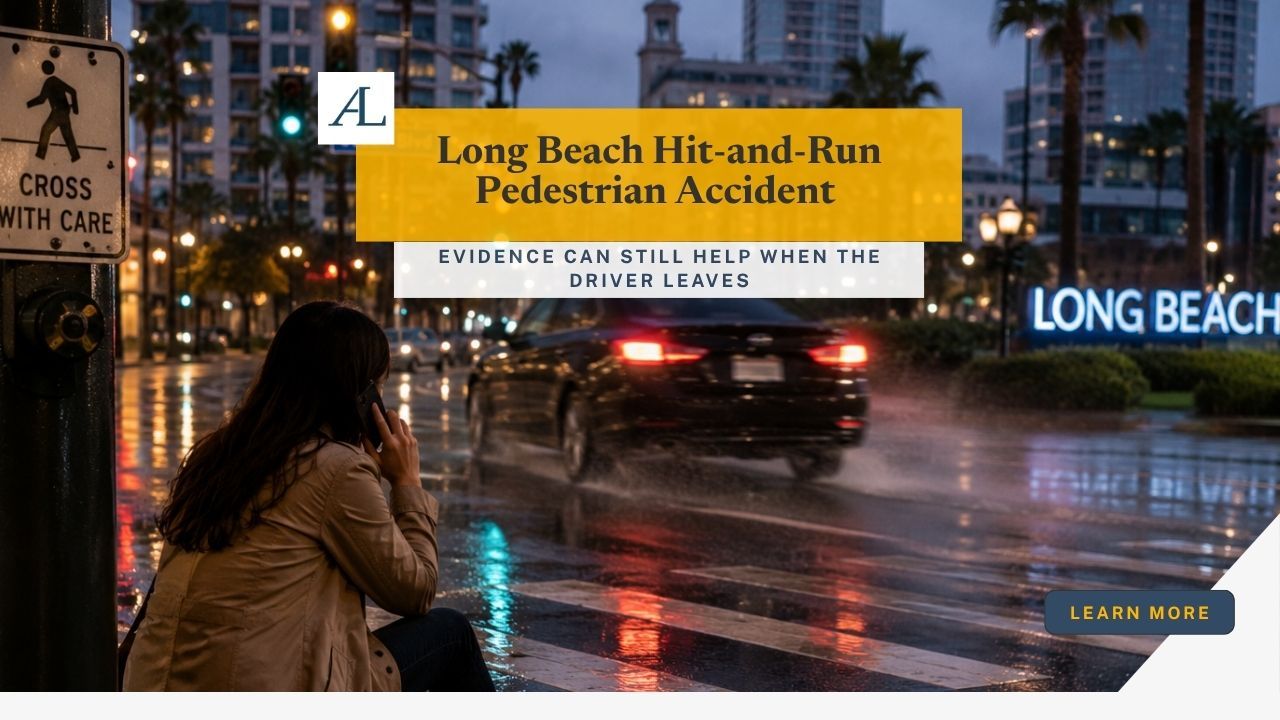
A Long Beach hit and run pedestrian accident claim can feel overwhelming because the person who caused the injury may disappear before the victim, witnesses, or police can identify them. A pedestrian may be crossing near a busy intersection, walking through a parking lot, leaving a restaurant, heading toward a hotel, walking near a transit stop, or crossing near the waterfront when a driver strikes them and leaves the scene. In that moment, the injured pedestrian may be left with pain, confusion, medical bills, and no clear answer about who will pay.
A hit-and-run does not mean the claim is hopeless. It means the evidence must be preserved quickly and investigated carefully. Video footage, witness statements, license plate fragments, paint transfer, vehicle debris, nearby business cameras, dashcams, rideshare records, police reports, and insurance coverage can all help support a Long Beach hit and run pedestrian accident claim even when the driver is not immediately found. The strongest cases often come from fast action before footage is erased, witnesses leave, and physical evidence disappears.
California law requires a driver involved in an accident causing injury or death to immediately stop at the scene and fulfill legal duties under the Vehicle Code. California Vehicle Code Section 20001 states that a driver involved in an accident resulting in injury to someone else, or death, must immediately stop at the scene and fulfill the requirements of related sections. The same statute also identifies penalties for leaving after an injury or fatal crash.
When a hit-and-run pedestrian accident leaves you injured, choosing the right legal representation matters. An experienced Long Beach pedestrian accident lawyer at Avrek Law Firm can act quickly to investigate the crash, preserve available video, work to identify the driver, review insurance coverage, and pursue compensation for the full impact of your injuries.
Call 866-598-5548, start a live chat, or request a free case review today. There are no upfront fees, and you do not pay unless we win.
H2: Why a Long Beach Hit-and-Run Pedestrian Accident Claim Is So Difficult
A Long Beach hit and run pedestrian accident claim is difficult because the driver’s decision to leave immediately creates gaps in the evidence. In a typical pedestrian accident, the driver may remain at the scene, provide insurance information, speak with police, and allow investigators to inspect the vehicle. In a hit-and-run, the injured pedestrian may have only seconds to notice the vehicle’s color, direction of travel, body style, or partial license plate before the driver disappears.
Insurance companies may use those gaps against the victim. They may argue that the pedestrian cannot prove what happened, that another vehicle may have been involved, that the injuries came from a fall, or that the pedestrian cannot identify a responsible driver. If uninsured motorist coverage may apply, the insurer may demand proof that an unknown vehicle actually caused the injury. That is why a Long Beach hit and run pedestrian accident claim must be built from every available piece of evidence, not just the victim’s memory.
Hit-and-run pedestrian crashes also tend to happen in places with heavy movement and limited time to react. Downtown Long Beach, Pine Avenue, Ocean Boulevard, Long Beach Boulevard, Anaheim Street, Pacific Coast Highway, Belmont Shore, Alamitos Beach, the East Village Arts District, waterfront parking areas, hotel zones, transit stops, and restaurant corridors all place pedestrians near vehicles, rideshares, delivery drivers, buses, scooters, and cyclists. If the driver leaves, the accident scene may return to normal quickly unless someone documents it right away.
A Fleeing Driver Changes the Evidence Strategy
A Long Beach hit and run pedestrian accident claim requires a different strategy from the beginning. The investigation must focus not only on fault, but also on identity. Who was driving? What vehicle was involved? Where did the driver go? Did cameras capture the car before or after impact? Did witnesses see a plate number or direction of travel? Did the vehicle leave behind broken parts, paint, glass, bumper fragments, mirror pieces, or tire marks?
The driver’s identity may come from unexpected sources. A business camera may not capture the impact, but it may show the fleeing car turning onto a side street. A nearby dashcam may capture the license plate while sitting at a light. A parking garage camera may show a damaged vehicle entering after the crash. A rideshare driver, delivery worker, hotel valet, or security guard may have seen the vehicle leaving the area. A strong Long Beach hit and run pedestrian accident claim connects these pieces before they disappear.
The Driver Leaving Does Not Erase Liability
A driver who leaves the scene may create a criminal investigation, but the injured pedestrian may still need a civil claim for medical bills, lost income, pain, and long-term recovery. The criminal case and civil claim are separate. Police may search for the driver and prosecutors may decide whether to bring charges, but the injured pedestrian still needs evidence to pursue compensation.
A Long Beach hit and run pedestrian accident claim may proceed against the at-fault driver if they are found. If the driver is not found or has no insurance, the claim may involve the injured pedestrian’s own uninsured motorist coverage, depending on the policy and facts. The key point is that the driver’s disappearance should not stop the investigation. It should make evidence preservation more urgent.
Pedestrians Are Often Blamed Even When the Driver Fled
Insurance companies may still try to blame the pedestrian. They may argue the pedestrian crossed outside a marked crosswalk, entered the street suddenly, wore dark clothing, looked at a phone, or failed to use caution. These arguments can be especially frustrating when the driver left the injured person behind.
A Long Beach hit and run pedestrian accident claim should respond with evidence. Crosswalk photos, signal timing, witness statements, lighting conditions, camera footage, vehicle debris, road markings, and medical records can help show that the driver caused the crash and that the pedestrian’s injuries were not the result of careless conduct. The fact that the driver fled may also support the need for a deeper investigation into why they left.
What Evidence Can Help If the Driver Leaves After Hitting a Pedestrian in Long Beach?
The best evidence in a Long Beach hit and run pedestrian accident claim is often gathered in the first hours and days after the crash. Even if the injured pedestrian is taken by ambulance and cannot collect evidence personally, family members, witnesses, or an attorney may be able to preserve key information. The goal is to reconstruct what happened, identify the vehicle, and prove the connection between the hit-and-run and the pedestrian’s injuries.
Evidence can come from the scene, nearby businesses, traffic corridors, vehicle debris, law enforcement records, medical records, insurance documents, and witness statements. A single clue may not be enough by itself, but several clues together can support a strong Long Beach hit and run pedestrian accident claim.
Surveillance Video From Nearby Businesses and Buildings
Video is often the most valuable evidence in a hit-and-run pedestrian case. In Long Beach, potential video sources may include restaurants, bars, hotels, apartment buildings, parking garages, convenience stores, gas stations, office towers, transit areas, waterfront businesses, security cameras, doorbell cameras, and public-facing building cameras. Even if no camera captured the actual impact, video may show the vehicle before or after the crash.
A Long Beach hit and run pedestrian accident claim should identify cameras facing the intersection, sidewalk, parking lot, alley, or street where the injury occurred. It should also look along the likely escape route. A vehicle with fresh front-end damage, a broken headlight, missing mirror, or damaged bumper may appear on video blocks away from the scene. Because many businesses overwrite footage quickly, preservation requests should be sent immediately.
Witness Statements and Partial License Plate Information
Witnesses can provide details that injured pedestrians may not remember. A bystander may notice the vehicle color, make, model, plate number, direction of travel, driver description, or whether the vehicle slowed before leaving. A witness may also describe the pedestrian’s position, the signal, the crosswalk, the speed of the vehicle, or whether the driver appeared distracted.
Partial license plate information can still help. Even a few characters, combined with vehicle color and body type, may narrow the search. A Long Beach hit and run pedestrian accident claim should preserve witness names, phone numbers, and written statements as soon as possible. Witnesses near restaurants, hotels, events, cruise areas, shopping districts, or transit stops may leave quickly and become difficult to locate later.
Vehicle Debris, Paint Transfer, and Physical Evidence
A fleeing driver may leave evidence behind. Broken plastic, mirror pieces, headlight fragments, paint chips, bumper parts, glass, license plate frame pieces, tire marks, and vehicle fluids may help identify the type of vehicle involved. Paint transfer on clothing, bags, shoes, mobility devices, or nearby objects may also help connect a vehicle to the collision.
A Long Beach hit and run pedestrian accident claim should document physical evidence before it is swept away, driven over, cleaned up, or removed. Photos should show the location of debris relative to the crosswalk, sidewalk, curb, lane markings, traffic signal, and final resting position of the injured pedestrian if known. If physical parts are collected, they should be preserved carefully.
Dashcams, Rideshare Cameras, and Delivery Vehicle Footage
Many vehicles now carry cameras. A rideshare driver may have a dashcam. A delivery van may have forward-facing video. A commercial truck may have telematics or camera systems. A bus, shuttle, taxi, or private vehicle may have recorded the fleeing driver. These sources can be especially helpful in busy Long Beach corridors where businesses may not have a clear view of the street.
A Long Beach hit and run pedestrian accident claim should investigate whether nearby vehicles were stopped at the light, parked near the curb, passing through the area, or waiting in traffic at the time of the crash. Even if the footage does not show the impact, it may show the fleeing vehicle, a partial plate, or the direction of travel.
Police Reports and Incident Numbers
A police report can help document the hit-and-run, the location, witness information, injury details, and any initial evidence collected by officers. In Long Beach, responding law enforcement may document debris, canvass for video, speak with witnesses, and create a report that insurers later request. The report may not contain every answer, but it can provide a formal foundation for the Long Beach hit and run pedestrian accident claim.
If the injured pedestrian is transported for medical care, a family member should try to obtain the incident number, responding agency information, and officer contact details. The sooner the legal team can connect with the police investigation, the better the chance of identifying available evidence before it disappears.
Common Long Beach Hit-and-Run Pedestrian Accident Scenarios
A Long Beach hit and run pedestrian accident claim can arise in many settings. Some involve high-speed impacts on major roads. Others happen in parking lots, crosswalks, alleys, hotel areas, or near nightlife districts. The location matters because it affects the evidence sources, witness pool, lighting, traffic pattern, and potential defendants.
Hit-and-run drivers may leave because they are uninsured, impaired, driving a stolen vehicle, using a company vehicle without permission, distracted, unlicensed, or afraid of consequences. The reason they fled may be important, but the injured pedestrian’s claim should focus on proving the collision, identifying all coverage, and documenting damages.
Crosswalk Hit-and-Run Accidents
Crosswalk crashes are among the most serious Long Beach hit and run pedestrian accident claim scenarios. A driver may turn right or left through a crosswalk, strike a pedestrian, and leave before anyone can record the full plate. These crashes may happen near Downtown Long Beach, transit stops, shopping areas, schools, waterfront destinations, or busy intersections where pedestrians are expected.
The evidence should focus on signal timing, crosswalk markings, pedestrian position, vehicle turn path, traffic light phase, witness observations, and nearby cameras. If the driver claims later that the pedestrian was outside the crosswalk or crossed against the light, video and witness statements can be critical.
Parking Lot and Garage Hit-and-Run Pedestrian Accidents
Some pedestrian hit-and-run claims happen in parking lots or garages. A driver may back into a pedestrian, strike someone near a crosswalk inside a lot, hit a person walking behind a vehicle, or drive away after a low-speed impact. These crashes may be dismissed by insurers as minor, but they can cause fractures, head injuries, hip injuries, knee injuries, back injuries, and serious falls.
A Long Beach hit and run pedestrian accident claim in a parking lot should investigate security cameras, parking booth records, license plate reader data if available, payment records, hotel or retail surveillance, and witness statements. A vehicle may not be seen on a public road camera, but it may be recorded entering or leaving a garage.
Nightlife, Hotel, and Waterfront Hit-and-Run Accidents
Long Beach nightlife and waterfront areas can create pedestrian risks, especially near restaurants, bars, hotels, rideshare pickups, event venues, and parking structures. A driver may strike a pedestrian after a pickup, while leaving a curb, while turning near a hotel entrance, or while moving through an area with heavy foot traffic. If the driver leaves, witness memories and video sources become extremely important.
A Long Beach hit and run pedestrian accident claim in these areas should identify nearby businesses quickly. Restaurants, hotels, valet stands, parking garages, and apartment buildings may have cameras pointing toward the street. Rideshare receipts, phone location data, and witness photos may also help establish the timeline.
Major Roadway Hit-and-Run Accidents
Some of the most severe pedestrian injuries happen on larger roads where vehicles travel faster. Long Beach Boulevard, Pacific Coast Highway, Anaheim Street, Atlantic Avenue, Cherry Avenue, Ocean Boulevard, and other major corridors may involve high-speed impacts, reduced visibility, and multiple lanes of traffic. If the driver leaves, the pedestrian may be critically injured before they can describe the vehicle.
These claims require immediate evidence preservation. Nearby traffic cameras, business surveillance, debris fields, skid marks, roadway lighting, and witness vehicles may be essential. A Long Beach hit and run pedestrian accident claim involving a major roadway should also investigate whether another driver, poor lighting, or unsafe road condition contributed to the crash.
Insurance Coverage After a Long Beach Hit-and-Run Pedestrian Accident
Insurance coverage can be confusing after a hit-and-run. If the fleeing driver is identified, the claim may be brought against that driver and their insurer if coverage exists. If the driver is not found, has no insurance, or cannot be confirmed, the injured pedestrian may need to review their own insurance policies to determine whether uninsured motorist coverage may apply.
A Long Beach hit and run pedestrian accident claim may involve auto insurance even if the injured person was walking. Some uninsured motorist policies may cover a policyholder or household member injured as a pedestrian, depending on the policy language and facts. Insurance companies may still demand proof that an unidentified vehicle caused the injuries, which is why police reports, witness statements, video, medical records, and physical evidence are so important.
If the Driver Is Found
If the hit-and-run driver is found, the civil claim may proceed against that driver and any available insurance coverage. The driver’s decision to leave may also become important context in the case, especially if the insurer tries to minimize fault. The driver may claim they did not know they hit someone, thought they struck an object, or panicked. Those explanations should be tested against the evidence.
A Long Beach hit and run pedestrian accident claim should still investigate all possible responsible parties. If the driver was working, driving a company vehicle, leaving a delivery route, using a rideshare app, or operating a borrowed vehicle, additional insurance coverage may be available.
If the Driver Is Not Found
If the driver is never identified, the claim does not automatically end. The injured pedestrian may still have options through uninsured motorist coverage, health insurance, medical payment coverage, or other available benefits. The available path depends on policy terms, household coverage, and the evidence showing that a hit-and-run vehicle caused the injury.
A Long Beach hit and run pedestrian accident claim with an unknown driver must be documented carefully. The insurer may require prompt notice, a police report, witness support, and medical documentation. Waiting too long can make the claim harder because the insurer may argue that the evidence is incomplete.
If Multiple Parties Contributed
Some hit-and-run pedestrian accidents involve more than one party. A driver may flee after striking the pedestrian, but another vehicle may have blocked visibility. A property owner may have poor lighting near a parking lot. A public or private construction zone may have directed pedestrians into an unsafe route. A business may have cameras or records that help establish what happened.
The fleeing driver may be the primary wrongdoer, but a Long Beach hit and run pedestrian accident claim should still examine whether other parties contributed to the danger or hold evidence needed to prove the claim.
What to Do After a Hit-and-Run Pedestrian Accident in Long Beach
After a hit-and-run pedestrian accident, medical safety comes first. Call 911 or ask someone nearby to call immediately. If you are injured, do not try to chase the driver or move unless necessary for safety. If you are a witness, try to record the vehicle description, license plate, direction of travel, and any visible damage without putting yourself in danger.
If possible, document the scene. Take photos of the crosswalk, street, traffic signal, debris, skid marks, vehicle parts, lighting, nearby cameras, and visible injuries. Ask witnesses for names and phone numbers. If nearby businesses may have cameras, write down the names and addresses so preservation requests can be sent quickly.
California DMV states that an SR-1 report must be completed and sent within 10 days if someone is injured, killed, or property damage is over $1,000, and the DMV states that the SR-1 is required in addition to any police, CHP, or insurance report.
A pedestrian may not be the driver responsible for filing an SR-1, but the injured person should still preserve all police report information, medical records, insurance communications, photos, witness information, and evidence of the hit-and-run. Documentation can become especially important if the driver remains unknown.
Get Medical Care Immediately
A pedestrian hit by a vehicle can suffer serious injuries even when the crash appears low-speed. Common injuries include traumatic brain injuries, fractures, spinal injuries, hip injuries, knee injuries, shoulder injuries, internal injuries, nerve damage, facial injuries, dental injuries, lacerations, bruising, and emotional trauma. Some symptoms may appear immediately, while others worsen over time.
Prompt medical care protects your health and creates records connecting your injuries to the hit-and-run. If treatment is delayed, an insurer may argue that the injuries were not caused by the crash or were not serious. A Long Beach hit and run pedestrian accident claim should include emergency care, imaging, specialist referrals, therapy, work restrictions, and follow-up treatment.
Report the Crash and Preserve the Police Information
A hit-and-run should be reported to law enforcement as quickly as possible. The police report may identify witnesses, list evidence, record the location, document injuries, and note whether officers found debris, video, or a vehicle description. If the driver is found later, the original report can help connect that driver to the crash.
A Long Beach hit and run pedestrian accident claim should preserve the report number, responding agency, officer name if available, and any supplemental reports. If police later identify a suspect vehicle, the claim may need to move quickly before that vehicle is repaired or hidden.
Do Not Assume the Case Is Over Because the Driver Left
Many injured pedestrians feel discouraged when the driver flees. That reaction is understandable, but it is not the end of the case. A Long Beach hit and run pedestrian accident claim may still be supported by video, witnesses, debris, insurance coverage, and police investigation. The sooner an attorney becomes involved, the more options may be available.
The most important mistake to avoid is waiting. Businesses may erase video, witnesses may leave, debris may be cleaned, and insurance notice issues may arise. Fast action gives the claim the best chance of success.
Deadlines in a Long Beach Hit-and-Run Pedestrian Accident Claim
A Long Beach hit and run pedestrian accident claim must be handled before legal deadlines expire. California Code of Civil Procedure Section 335.1 generally provides two years for an action involving injury to, or death of, an individual caused by another person’s wrongful act or neglect.
That two-year deadline is important, but evidence deadlines are often much shorter. Surveillance footage may be overwritten in days or weeks. Police may need timely witness information. Insurance policies may require prompt notice. The unknown vehicle may be repaired before it is found. The injured pedestrian’s memory and witness details may fade. A Long Beach hit and run pedestrian accident claim should be investigated quickly even when the lawsuit deadline seems far away.
If the crash may involve public property, public transportation, public roadway conditions, or a government vehicle, special rules and shorter deadlines may apply. That issue should be reviewed early so the injured person does not lose a potential claim before the full facts are known.
Frequently Asked Questions About a Long Beach Hit-and-Run Pedestrian Accident Claim
What evidence can help if the driver leaves after hitting a pedestrian in Long Beach?
Helpful evidence may include surveillance video, dashcam footage, witness statements, partial license plate information, vehicle color and body style, debris, paint transfer, police reports, medical records, nearby business cameras, parking garage footage, rideshare records, and photos of the accident scene. A Long Beach hit and run pedestrian accident claim often depends on evidence gathered quickly before it disappears.
Even if no one saw the full license plate, smaller details can still help. Vehicle fragments, direction of travel, camera footage from nearby streets, and witness statements may help identify the driver or support an uninsured motorist claim.
Can I still recover compensation if the hit-and-run driver is never found?
Possibly. If the driver is not found, the injured pedestrian may still have options through uninsured motorist coverage or other available insurance, depending on the policy and facts. These claims usually require strong documentation showing that a hit-and-run vehicle caused the injury.
A Long Beach hit and run pedestrian accident claim with an unknown driver should be reported promptly, documented carefully, and reviewed by a lawyer before speaking extensively with insurers.
What should I do immediately after a hit-and-run pedestrian accident?
Call 911, get medical help, and report the crash to law enforcement. If possible, write down the vehicle description, license plate characters, direction of travel, and driver description. Take photos of the scene, debris, crosswalk, traffic signal, injuries, and nearby cameras. Ask witnesses for contact information.
Do not chase the driver or put yourself in danger. Your safety and medical care come first.
What if the driver is later identified?
If the driver is identified, the claim may proceed against the driver and any available insurance coverage. The driver’s vehicle should be inspected for damage, paint transfer, broken parts, or repairs. Police records, witness statements, and video may help connect the driver to the crash.
A Long Beach hit and run pedestrian accident claim should still investigate whether the driver was working, using a company vehicle, driving for a rideshare or delivery platform, or covered by additional insurance.
What if the insurance company says there is not enough proof?
Insurance companies may deny or reduce hit-and-run claims by arguing that the vehicle cannot be identified or that the evidence does not prove a vehicle caused the injury. That is why early evidence preservation is critical. Police reports, video, witnesses, medical records, debris, and photos can help prove the crash happened as reported.
A Long Beach pedestrian accident lawyer can help gather evidence, send preservation letters, communicate with insurers, and build the claim before the insurer controls the narrative.
What injuries are common in hit-and-run pedestrian accidents?
Common injuries include fractures, traumatic brain injuries, concussions, spinal injuries, internal injuries, hip injuries, knee injuries, shoulder injuries, nerve damage, facial trauma, dental injuries, lacerations, bruising, and emotional distress. The emotional impact can be especially severe because the driver left the injured person at the scene.
Prompt medical care is important even if symptoms seem manageable at first. Medical documentation helps connect the injuries to the hit-and-run.
How long do I have to file a Long Beach hit-and-run pedestrian accident claim?
Many California personal injury claims are subject to a two-year deadline, but evidence can disappear much sooner. Insurance notice requirements may also apply, especially if uninsured motorist coverage is involved. If a public entity may be involved, shorter deadlines may apply.
The safest step is to speak with an attorney quickly so evidence, reports, insurance notices, and deadlines can be protected.
Do I need a lawyer for a Long Beach hit-and-run pedestrian accident claim?
Yes, especially if the driver has not been found, the insurer disputes the claim, or the injuries are serious. Hit-and-run pedestrian claims often involve police investigations, video preservation, witness searches, uninsured motorist coverage, medical documentation, and disputed fault.
A Long Beach pedestrian accident lawyer can investigate the crash, identify available insurance coverage, preserve evidence, and pursue compensation for medical bills, lost income, pain and suffering, future care, and long-term recovery needs.
Call or Contact Avrek Law Firm 24/7 for a Free Consultation and Pay Nothing Unless We Win
A Long Beach hit and run pedestrian accident claim can become difficult when the driver disappears, witnesses leave, video is overwritten, or insurers argue there is not enough proof. These cases often depend on fast evidence preservation, including surveillance footage, police reports, vehicle debris, witness statements, medical records, insurance notices, and scene photographs.
Avrek Law Firm helps injured pedestrians and families investigate serious hit-and-run accidents throughout Long Beach. Our team can move quickly to preserve evidence, communicate with law enforcement when appropriate, identify available insurance coverage, and pursue compensation for the full impact of your injuries.
Speaking with a Long Beach pedestrian accident lawyer may help you understand whether your claim also involves a Long Beach personal injury lawyer, especially when the driver is unknown, uninsured, or multiple parties may hold important evidence.
If you or someone you love was injured in a hit-and-run pedestrian accident in Long Beach, Avrek Law Firm is ready to help.
Call 866-598-5548, start a chat, or complete our online form today for a free, no-obligation consultation. There are no upfront fees, and you do not pay unless we win.
Serving the Long Beach Community
Avrek Law Firm represents injured pedestrians throughout Long Beach and surrounding communities. Local context matters in a Long Beach hit and run pedestrian accident claim because the location often determines where evidence may be found.
A hit-and-run pedestrian accident in Downtown Long Beach may involve business cameras, parking garage footage, rideshare activity, and witnesses leaving restaurants or events. A crash near Belmont Shore, Alamitos Beach, Naples, East Village Arts District, Bixby Knolls, or the waterfront may involve pedestrians, cyclists, tourists, hotel guests, delivery drivers, and traffic moving through busy corridors. A hit-and-run near Long Beach Boulevard, Anaheim Street, Pacific Coast Highway, Ocean Boulevard, Cherry Avenue, or Atlantic Avenue may involve multiple lanes of traffic, low visibility, and nearby cameras that need to be preserved quickly.
A Long Beach hit and run pedestrian accident claim should be handled with urgency, precision, and attention to the evidence insurers often minimize. Avrek Law Firm can meet with injured clients by phone, video, or in person, and our team can assist clients who are unable to travel because of their injuries.
- 📩 Submit a request through our online form
- 📞 Call 866-598-5548 now to speak with our team
- 💬 Start a live chat for immediate assistance
There are no upfront fees, and you don’t pay unless we win.