Which Law Firms Resolve Cases That Other Firms Have Turned Down?
Finding yourself injured and needing legal help is stressful enough. When multiple attorneys tell you they can’t take your personal injury case, the natural conclusion is that your case must be hopeless.
However, in the world of personal injury law, a rejection often signals not a lack of merit, but a lack of resources or focus at the first firm you visited.
There is a distinct type of legal practice built specifically to handle the “unwanted” cases—the highly complex, high-stakes injury claims that require massive investment and relentless preparation. These firms concentrate on overcoming the initial hurdles that scare off general practice lawyers, enabling them to pursue justice against powerful insurance companies and large corporations.
This article explores the specific operational models of these “second-look” law firms and what makes them uniquely equipped to resolve cases that others have already labeled as too difficult or too risky.
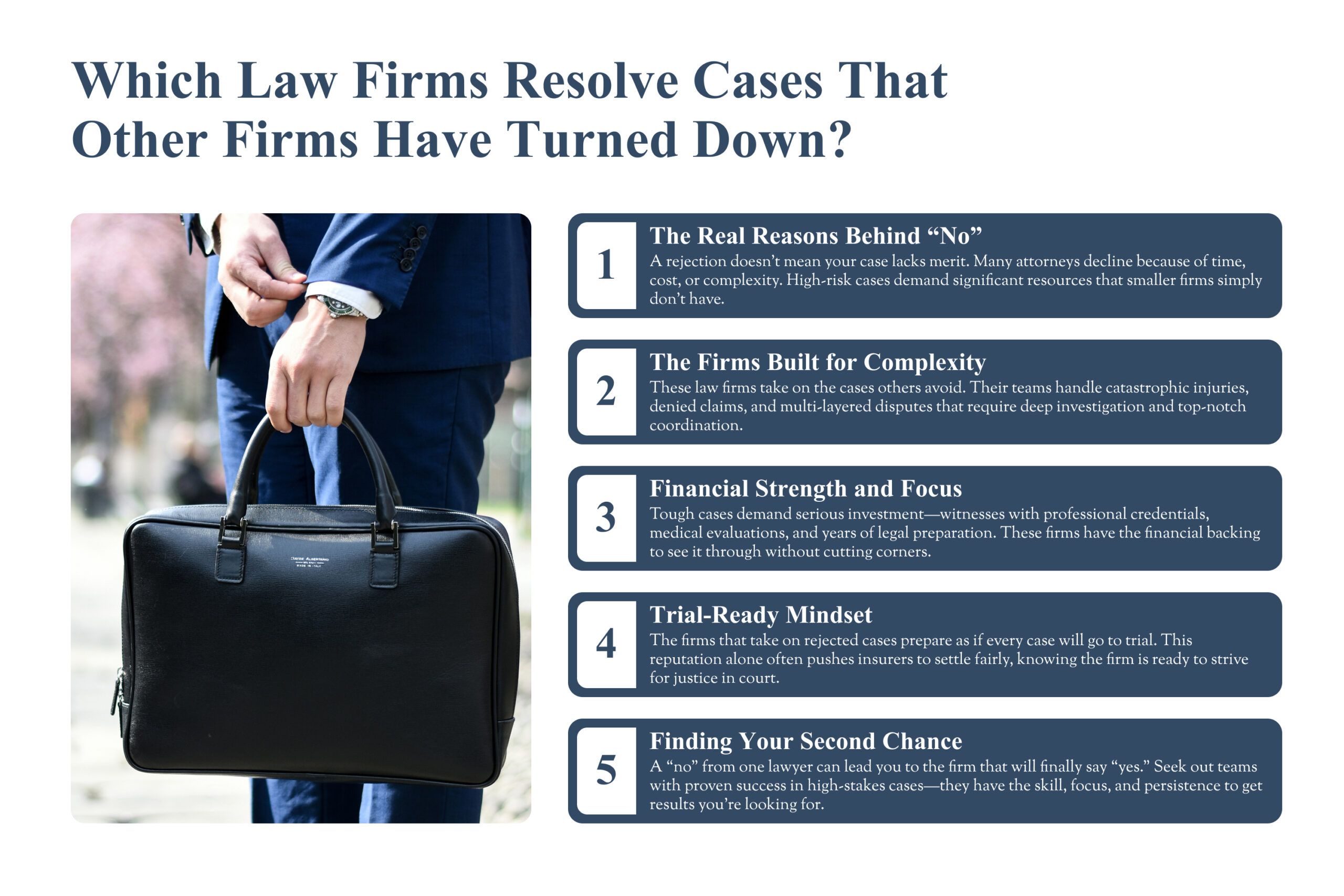
The Cost of Saying “Yes” to a Hard Case
For a standard personal injury firm that works on a contingency fee (only getting paid if you win), turning down a complicated case is often a matter of self-preservation. When a potential client hears “no,” it usually boils down to one of these three risk factors:
1. The Liability Mountain (Proving Who Was at Fault)
In personal injury law, if you can’t clearly prove the other party was negligent, you have no case. Many firms decline claims where:
- The Evidence Is Muddled: The accident scene or evidence is confusing, and establishing the exact sequence of events requires an expensive, lengthy investigation.
- Contributory Negligence: The client might share some responsibility for the accident. Laws in some states severely limit recovery if the injured person is found to be even partly at fault.
2. The Missing Money (Damages Insufficient)
A severe injury case might be worthwhile, but a minor injury case often isn’t. The projected final compensation must be large enough to cover the massive costs of litigation. If the medical bills are low, the case value is often too low to justify the hundreds of hours and thousands of dollars the firm must front.
3. The Clock Is Ticking (Statute of Limitations)
Sometimes, the client waits too long before contacting an attorney. Every state has a legal deadline (statute of limitations) for filing a lawsuit. If the deadline is very near, most firms will decline because they won’t have the necessary time to investigate and prepare the paperwork correctly.
The Operating Model of High-Stakes Personal Injury Firms
The firms that successfully take on the cases others have rejected share three key operational characteristics that set them apart: a deep focus, a heavy financial reserve, and an aggressive preparation model.
Focus Area: Complexity and Catastrophe
These legal teams rarely handle simple slip-and-falls or minor car crashes. Their entire legal practice is concentrated on matters involving catastrophic injuries (like spinal cord trauma, severe burns, or brain damage) or complex mechanisms of injury (like product liability or large-scale medical negligence). This high-value concentration allows them to spend years resolving a single case.
Unlimited Financial Commitment
The costs of high-stakes personal injury litigation are staggering. The firms known for successfully resolving difficult cases have deep reserves to fund what the initial firm could not, including:
- Securing multiple professional witnesses—sometimes from across the country—to provide testimony on everything from accident reconstruction to lifetime medical needs.
- Covering the extensive expenses of depositions (testimony taken outside of court) and forensic analysis.
- The stability to wait out the opposition, often for five years or more, without pressure to settle cheaply.
A Reputation for Full Courtroom Preparation
These law firms operate with a mindset that every case will go to a full jury trial. They are meticulous in their documentation and legal filings. This reputation is critical because the defense (usually the insurance company) knows that if they don’t offer a fair settlement, the firm will be ready, willing, and capable of seeing the case through to a verdict. This readiness often resolves the case successfully long before it ever reaches the courthouse.
Ethical Duties in Accepting Challenging Personal Injury Cases
Attorneys are ethically obligated to only take on matters they can handle. This principle, known as Competence, ensures that clients are properly represented, even in complex personal injury claims.
According to the ethical guidelines that govern lawyers across the United States, an attorney must have the “legal knowledge, skill, thoroughness, and preparation” necessary for the representation. A lawyer working in a new or unusually complex area, like a difficult personal injury claim, is allowed to accept the case only if they can either:
- Thoroughly research and prepare until they become proficient; or
- Bring in another lawyer who has the necessary proficiency to assist them.
This standard is what ensures that the dedicated legal professionals who take on rejected cases are actually equipped to handle the legal challenges involved.
Find the Legal Help You Need
If your personal injury claim was rejected, view it not as a dead end, but as a map directing you to a more specific legal professional. The fact that your case was complex enough to be rejected means that, if you find the right law firm—one concentrating on high-stakes, difficult claims—the potential for resolution and proper compensation is significant. Focus your search not just on the injury type, but on the reason your claim was initially declined, then find the firm whose core business model is built around solving that specific problem.
Looking For a Specific Practice?







No win, no fee. What does that mean for you? You only pay us when we win your case.