What Are the Most Complex Types of Press Liability Claims?
In today’s fast-paced news cycle, the act of publishing has become legally precarious. Every news organization, large publisher, and increasingly, every independent content creator, operates in a constant state of legal risk. While a simple factual error can be corrected with a retraction, certain legal actions against the press stand out for their protracted litigation, constitutional entanglement, and high financial stakes. These are the complex press liability claims, the ones that demand months or years of intense legal scrutiny.
This analysis explores the categories of claims that present the most significant legal challenges, explaining why their foundational requirements make them such a difficult and costly defense for any media entity.
The Apex of Legal Challenge: Constitutional Defamation
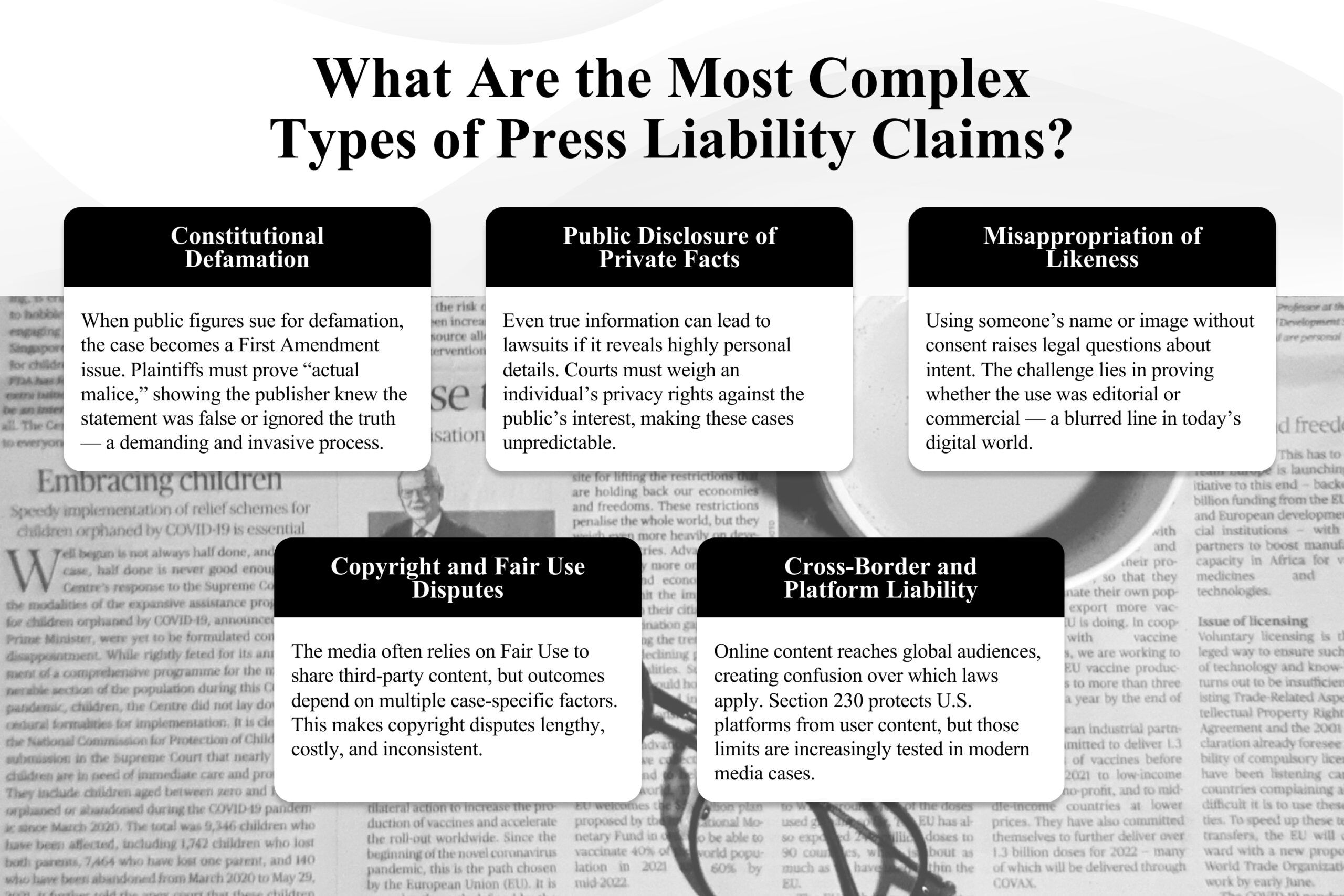
Defamation—the publication of a false statement of fact that harms a person’s reputation—is the most common area of press liability. Its complexity is rooted not just in civil law, but in the First Amendment of the U.S. Constitution, which elevates free speech and a free press above ordinary reputational interests.
When a public figure or public official sues the press for libel (written defamation), the case immediately enters the constitutional realm, dramatically increasing the burden of proof for the plaintiff and the complexity for all parties involved.
The Intrusive Inquiry of “Actual Malice”
The landmark case of New York Times Co. v. Sullivan (1964) established a critical, constitutionally-mandated standard for public officials—and subsequently, public figures—seeking to win a defamation suit. They must prove the statement was made with “actual malice.”
- Defining the Burden: Critically, “actual malice” does not mean ill will or a desire to harm. It means the defendant published the false statement either knowing it was false or with reckless disregard for the truth. This requires a plaintiff to prove a particular state of mind of the journalists or editors involved.
- The Complexity Factor: Proving a subjective mental state is the single greatest hurdle. Defense teams must turn over vast amounts of editorial material: reporter notes, internal emails, drafts, and communications. The entire litigation often devolves into a microscopic examination of the newsgathering process—whether sources were vetted adequately, whether known contradictions were ignored, and whether the journalists held a genuine doubt about the truth but forged ahead anyway. This exhaustive discovery phase makes constitutional defamation cases exceptionally expensive, time-consuming, and intrusive.
Navigating the Public vs. Private Status
Another layer of complexity is the required initial determination of the plaintiff’s status.
- Public Figures: Face the high “actual malice” standard.
- Private Figures: Generally need only prove the press acted with negligence (a failure to exercise reasonable care), a lower standard.
However, distinguishing who qualifies as a public figure—particularly a “limited-purpose public figure” who has voluntarily injected themselves into a specific public controversy—often requires a complex, multi-factor legal analysis before the court can even determine the appropriate legal standard of fault. This preliminary legal battle alone can be a major source of litigation complexity.
When Truth is the Offense: Complex Privacy Claims
Unlike defamation, which is based on falsehood, claims involving the invasion of privacy can sometimes target the publication of information that is entirely factual. This is where the media’s First Amendment right to publish truthful, newsworthy information clashes directly with an individual’s common law right to personal autonomy and solitude.
The most challenging privacy claims often involve:
1. Public Disclosure of Private Facts
This claim asserts that the media published truthful facts about the plaintiff that are not of legitimate public concern and are highly offensive to a reasonable person.
- The Collision: The primary defense available to the press is newsworthiness. The media argues that the published information is of legitimate public concern and thus protected.
- The Intrinsic Difficulty: This forces judges and juries to decide where the line of societal decency lies. They must balance the inherently subjective standard of what is “highly offensive” against the equally fluid and broad concept of “legitimate public concern” or newsworthiness. Because there are few fixed rules in this area, the outcome often depends on the specific facts and context, making these cases inherently unpredictable and therefore more difficult to settle.
2. Misappropriation of Likeness (Right of Publicity)
This claim is brought when the media uses a person’s name, image, or likeness for commercial purposes without permission. While it may seem straightforward, it becomes complex when used in an editorial context.
- Editorial vs. Commercial Use: The key legal battle is often determining whether the use was truly an editorial function (such as using a celebrity’s photo to illustrate an article about their career, which is protected) or an unauthorized commercial function (such as using the photo in an advertisement or promotional collateral, which is often not protected). This distinction can be a murky and costly legal battle, particularly in modern media where content and marketing often blend on digital platforms.
The Digital Quagmire: Intellectual Property and the Press
In an era of repurposed content, copyright and trademark infringement claims have become both prevalent and profoundly complex for the press. News organizations regularly use third-party photos, videos, and music in their reporting, often relying on the doctrine of Fair Use to protect them.
Fair Use: The Defense Without a Rule
The Fair Use doctrine permits limited use of copyrighted material without permission for purposes such as criticism, comment, news reporting, teaching, scholarship, or research. However, it is not a simple exemption. It requires a court to balance four statutory factors:
- The purpose and character of the use: Is the new work “transformative” (adding new meaning or purpose)?
- The nature of the copyrighted work: Is the original work highly creative or primarily factual?
- The amount and substantiality of the portion used: How much of the original was copied?
- The effect of the use upon the potential market for or value of the copyrighted work.
The Litigation Headache: Fair Use is not a simple rule; it is a context-dependent balancing test. Proving that a use is “transformative” and does not harm the original market often requires highly trained legal and industry professionals, leading to costly and protracted litigation where the outcome is always subject to the judge’s or jury’s interpretation of the four factors.
New Frontiers: Cross-Border and Platform Liability
The final category of complexity involves claims that leverage new technology and global reach:
- Global Jurisdiction: When a story is published on a website, it is immediately available worldwide. This raises challenging legal questions about which country’s or state’s laws apply, particularly when a plaintiff sues in a jurisdiction known for weaker press protections. Pre-trial motions over jurisdiction can become a major expense, delaying the actual defense of the story’s content for months.
- Intermediary Liability (CDA 230): In the United States, Section 230 of the Communications Decency Act generally protects platforms from liability for content posted by their users. However, media organizations that actively solicit, substantially edit, or “materially contribute” to third-party content can face complex legal arguments challenging whether they should be stripped of this protection and treated as the content creator.
The complexity of press liability is proportional to the values at stake: free speech, personal reputation, privacy, and property rights. The claims that most aggressively test these boundaries—constitutional defamation, privacy claims, and intellectual property disputes—remain the greatest legal risk for the media.
Looking For a Specific Practice?







No win, no fee. What does that mean for you? You only pay us when we win your case.