Where Can I Find Law Firms That Offer Multilingual Legal Support for Injury Cases?
Navigating the aftermath of a serious injury—whether from a car crash, workplace accident, or slip and fall—is stressful enough, but for individuals who are not native English speakers, the complexity is magnified tenfold. Personal injury litigation requires constant, precise communication regarding complex medical documentation, dense legal jargon, and highly sensitive personal details. Therefore, finding a law firm that offers robust multilingual support is not a luxury; it is a fundamental requirement for securing fair representation. Fortunately, in today’s multicultural landscape, many successful firms prioritize diversity and communication, and there are several reliable ways to find legal teams that have experience bridging these language and cultural gaps.
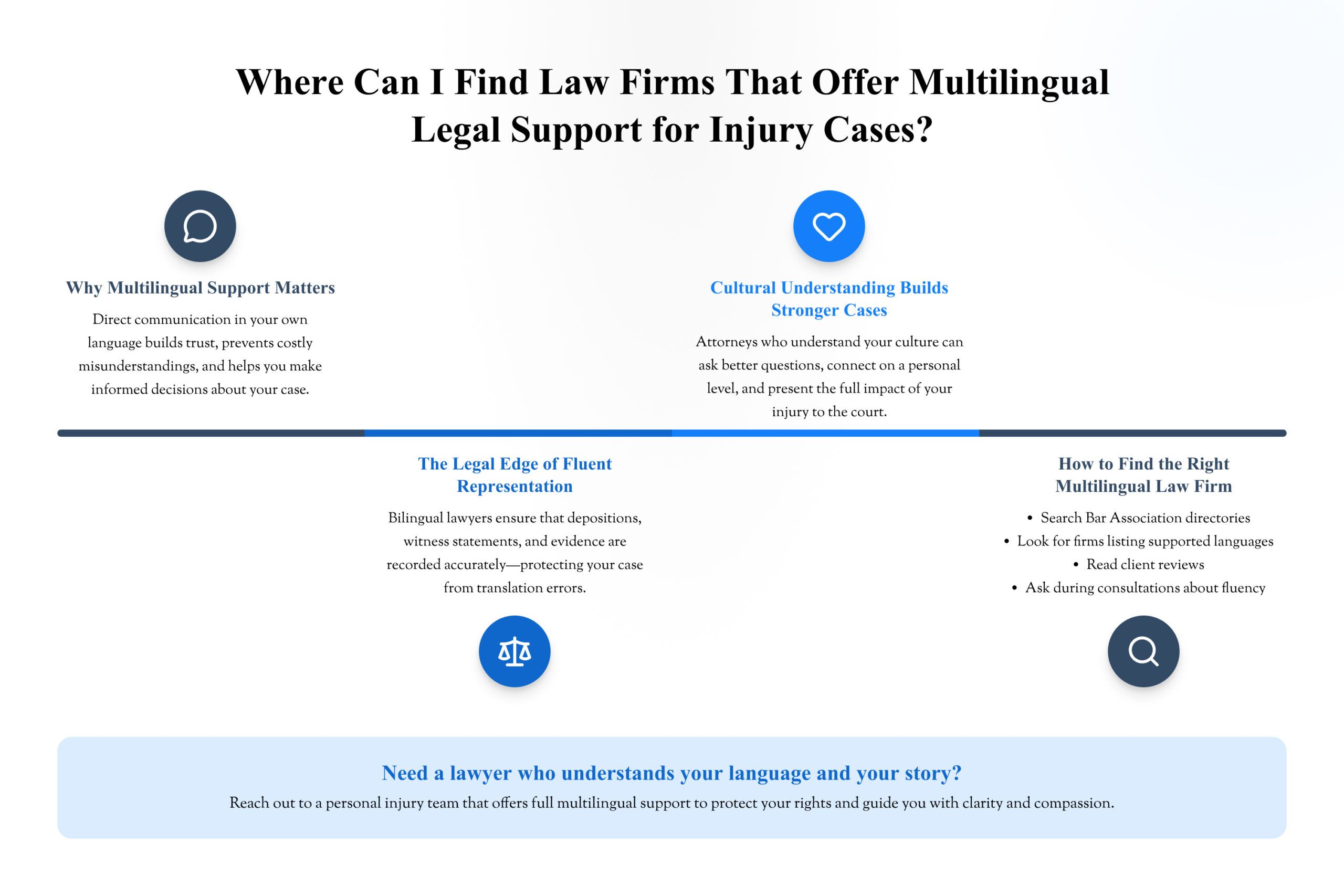
Direct Communication: Preventing Costly Translation Errors
The necessity of having a lawyer or legal staff who speaks your language comes down to accuracy and trust. Personal injury cases are won and lost on minute details—the exact description of the accident, the nuances of pain and suffering, and the precise terminology in medical records. Relying solely on third-party interpreters, even professional ones, introduces an unnecessary layer of risk, where subtle but crucial information can be lost, misinterpreted, or inaccurately conveyed.
When a lawyer is fluent in the client’s native language, communication is direct, fostering a stronger attorney-client bond and ensuring the client fully understands their rights, the legal process, and any settlement offers. This clarity helps clients avoid unknowingly making costly mistakes or accepting compensation lower than what they deserve.
This direct communication also provides a significant financial benefit. While the costs of professional interpreters may ultimately be recoverable from the negligent party, the upfront expenses can add up quickly. A fully fluent lawyer eliminates the need for hourly interpreter fees during every meeting, phone call, or document review, simplifying the process and saving on immediate costs. Furthermore, in negotiations with insurance adjusters, a bilingual lawyer can respond instantly and accurately to pressure tactics, ensuring the client’s position is never compromised by a lag in translation.
The Legal Advantage in High-Stakes Testimony
The importance of linguistic fluency becomes even more critical during high-stakes moments in the legal process. Imagine giving a deposition, where your sworn testimony is recorded and used to build the opposing side’s defense. If a key detail about your physical limitations or the sequence of events is mistranslated, it can permanently weaken your case. A lawyer fluent in your language can immediately spot these inaccuracies and correct them, ensuring that the official record is impeccable.
This advantage extends to witness handling. If you are relying on non-English-speaking witnesses, your attorney’s ability to interview them directly ensures that their accounts are accurately gathered and presented as strong evidence, without the distortions that can occur when communication is filtered through multiple parties. The bilingual attorney can prepare the witness for the deposition or trial more effectively, guiding them through the legal process and ensuring their testimony is simplified and clearly understood by the court interpreter without relying on a third party to convey complex legal instructions. This is crucial because it ensures the court focuses on the facts of the injury, not on perceived communication issues.
The Value of Cultural Competence and Empathy
Beyond simply translating words, the most effective multilingual legal support offers cultural competence. A legal team that understands cultural context recognizes how different communities perceive injury, pain, and the legal system itself. This often stems from a deep understanding of the client’s background, including immigrant experiences or cultural norms.
For example, in some cultures, there may be a deep-seated reluctance to discuss personal suffering openly, or individuals may place a strong emphasis on family consensus in decision-making. A lawyer who is culturally sensitive—often a benefit of being bilingual—can
approach the case with empathy, building trust and ensuring the client feels comfortable sharing sensitive details necessary for a comprehensive damage calculation. This means the attorney knows how to ask questions in a way that respects cultural boundaries while still gathering the vital information needed to prove damages. This nuanced approach allows the legal team to better articulate the full impact of the injury to a judge or jury, leading to a more accurate and higher likelihood of fair compensation for both economic and non-economic losses.
Practical Steps to Locate Multilingual Firms
Finding a law firm with a diverse, multilingual staff requires proactive searching. The most reliable starting point is often the local or state Bar Association’s referral service. Many associations maintain detailed directories that allow users to search for attorneys based not only on their practice area (like personal injury) but also by the foreign languages spoken by the attorney or their staff.
Additionally, when conducting online research, look for firms that explicitly state their commitment to diversity and mention specific languages they support, such as “Se Habla Español,” “Multilingual Staff,” or listings of Asian, European, or South American languages. Be sure to check online reviews; many former clients will specifically mention the language support they received, giving you concrete evidence of the firm’s capabilities.
Crucially, once you identify a potential firm, always ask these key questions during the free consultation:
- Who is fluent? Is it the attorney handling the core legal strategy or just a staff member? Direct attorney fluency is usually preferred for critical communication.
- How are documents handled? Do they use in-house fluent staff to review documents like medical records, or do they rely entirely on external translation services?
- What is their track record? Can they provide examples of how they’ve handled complex cases involving non-native English-speaking clients and achieved successful outcomes?
- How will they protect against bias? Ask how they plan to address potential jury bias or cultural misunderstandings in the courtroom.
By prioritizing firms that can prove they have experience navigating these dual challenges of law and language, you ensure your case is built on a foundation of trust, accuracy, and full understanding, allowing you to focus completely on your recovery.
Looking For a Specific Practice?







No win, no fee. What does that mean for you? You only pay us when we win your case.