How Do Lawyers Help Clients Avoid Insurance Bad Faith Practices?
When an individual pays their insurance premiums, they are purchasing more than just a policy; they are purchasing a promise. This promise, known legally as the “implied covenant of good faith and fair dealing,” ensures that the insurance company will act honestly and fairly when a claim is filed. However, insurance companies are profit-driven corporations. Sometimes, the desire to protect the bottom line leads to “bad faith” practices—tactics designed to delay, devalue, or deny legitimate claims without a reasonable basis.
Navigating the aftermath of an accident is stressful enough without having to manage a deceptive insurance provider. Lawyers serve as a critical line of defense, using their knowledge of the law to prevent these practices from taking root and holding insurers accountable when they do.
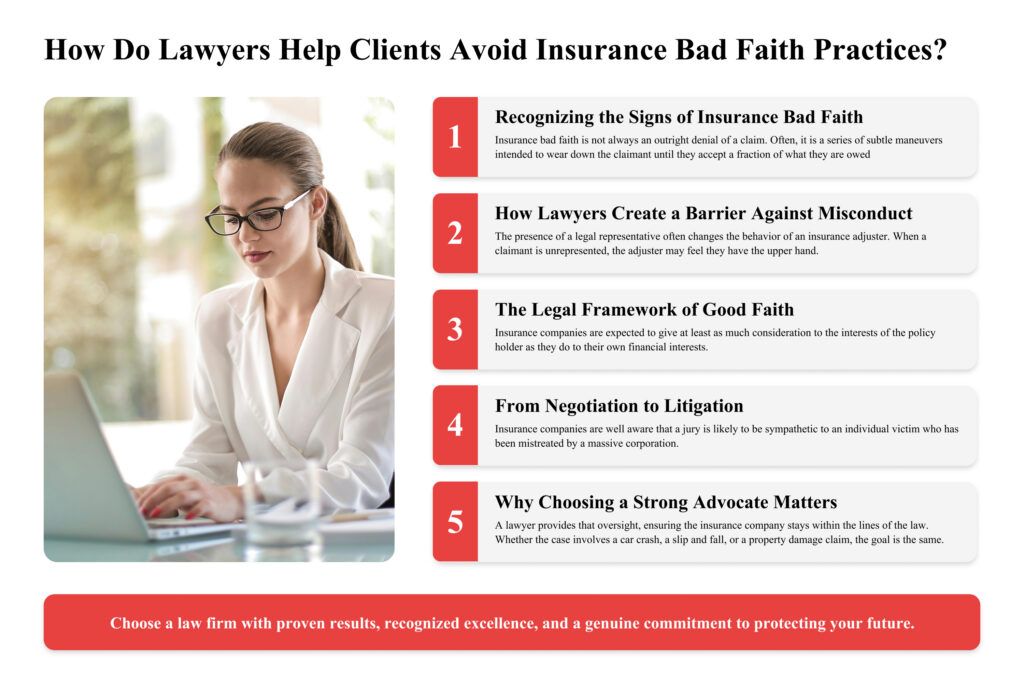
Recognizing the Signs of Insurance Bad Faith
Insurance bad faith is not always an outright denial of a claim. Often, it is a series of subtle maneuvers intended to wear down the claimant until they accept a fraction of what they are owed. Legal teams are trained to identify these red flags early in the process.
Common examples of bad faith tactics include:
- Unreasonable Delays: Taking months to investigate a straightforward accident or failing to communicate a decision within state-mandated timelines.
- Inadequate Investigation: Purposefully ignoring evidence that supports the claimant, such as witness statements or traffic camera footage, to justify a denial.
- Lowball Settlement Offers: Offering an amount that is clearly insufficient to cover medical bills and lost wages, often hoping the victim is in enough financial distress to accept it immediately.
- Misrepresenting Policy Language: Using technical jargon or “fine print” to claim that a specific injury or event is not covered when it actually is.
- Excessive Documentation Demands: Repeatedly asking for the same records or requesting irrelevant personal information to stall the claims process.
How Lawyers Create a Barrier Against Misconduct
The presence of a legal representative often changes the behavior of an insurance adjuster. When a claimant is unrepresented, the adjuster may feel they have the upper hand. Once a law firm is involved, the dynamic shifts.
1. Establishing a Formal Communication Channel
A lawyer takes over all correspondence with the insurance company. This prevents the adjuster from contacting the victim directly to solicit recorded statements that could later be used to twist the facts of the case. By centralizing communication, a lawyer ensures that every interaction is documented, creating a paper trail that is essential for proving bad faith later on.
2. Enforcing State Regulations and Deadlines
In California, insurance companies are governed by strict regulations, such as the Fair Claims Settlement Practices Regulations. These laws dictate how quickly an insurer must acknowledge a claim, begin an investigation, and provide a written explanation for a denial. Lawyers monitor these dates closely. If an insurer misses a deadline, the lawyer can issue a formal notice reminding the company of its legal obligations, which often spurs the company back into action.
3. Conducting an Independent Investigation
One of the most effective ways to prevent bad faith is to leave no room for the insurer to “doubt” the facts. While the insurance company conducts its own review, a law firm performs a parallel investigation. They secure police reports, obtain medical records, and interview bystanders. By presenting a demand package filled with undeniable evidence, the lawyer makes it much harder for the insurer to justify an inadequate offer or an arbitrary denial.
The Legal Framework of Good Faith
The duty of an insurance company to act fairly is not just a suggestion; it is a foundational principle of contract law. In California, this duty is taken very seriously by the courts. Insurance companies are expected to give at least as much consideration to the interests of the policyholder as they do to their own financial interests.
According to the California Department of Insurance, policyholders have explicit rights that companies must respect. As stated in their official regulatory guidance:
“The insurance company must acknowledge your claim within 15 calendar days of receiving it… It must accept or deny your claim within 40 calendar days after receiving proof of claim unless the investigation cannot be completed within that time.”
When a lawyer cites these specific codes in a demand letter, it signals to the insurance company that any attempt to deviate from these standards will be met with formal legal action.
Escalating the Case: From Negotiation to Litigation
If an insurance company persists in its bad faith conduct, a lawyer is prepared to escalate the matter. This typically involves filing a bad-faith lawsuit. Unlike a standard breach of contract claim, a bad faith tort allows the victim to seek damages beyond the limits of the insurance policy.
A successful bad faith lawsuit can result in the recovery of:
- Compensatory Damages: To cover the original value of the claim plus interest.
- Consequential Damages: To compensate for financial losses caused by the delay, such as damage to credit or lost opportunities.
- Emotional Distress: To account for the mental anguish and stress caused by the insurer’s misconduct.
- Punitive Damages: In cases of extreme malice or fraud, the court may award additional money to punish the insurance company and deter them from repeating the behavior.
The threat of these high-value damages is often the most powerful tool a lawyer has. Insurance companies are well aware that a jury is likely to be sympathetic to an individual victim who has been mistreated by a massive corporation.
Why Choosing a Strong Advocate Matters
Teams like Super Woman Super Lawyer understand the inner workings of the insurance industry. They know that adjusters are often trained to manage claims in a way that protects the company’s assets first. By providing a compassionate but firm approach, these lawyers ensure that their clients are not ignored or intimidated.
Handling an insurance claim without a lawyer is like walking into a courtroom without a judge. There is no one to enforce the rules. A lawyer provides that oversight, ensuring the insurance company stays within the lines of the law. Whether the case involves a car crash, a slip and fall, or a property damage claim, the goal is the same: to make sure the promise made when the policy was purchased is the promise that is kept.
Protect Your Rights Today
If you suspect your insurance provider is dragging its feet, being evasive, or offering you a settlement that doesn’t cover your basic needs, you may be facing bad faith. Do not wait for the situation to get worse. The sooner a lawyer can review your policy and the insurer’s conduct, the faster they can put a stop to unfair tactics.
Your recovery—both physical and financial—depends on a fair claims process. With the right legal team behind you, you can focus on your health while your advocates focus on ensuring the insurance company fulfills its duty to you.
Looking For a Specific Practice?







No win, no fee. What does that mean for you? You only pay us when we win your case.