How Do Law Firms Build a Case For Emotional Distress Damages?
When an individual is involved in a traumatic event, the injuries are not always visible. While broken bones and physical scars are documented with X-rays and photographs, the psychological impact—often referred to as emotional distress—can be just as debilitating. In the legal world, building a case for these “invisible” injuries requires a strategic and meticulous approach. Law firms must transform subjective feelings of anxiety, fear, and despair into objective, compensable evidence.
To secure a settlement that truly reflects a client’s suffering, legal teams focus on proving three core elements: that the distress is severe, that it was directly caused by the incident, and that it has a measurable impact on the victim’s daily existence.
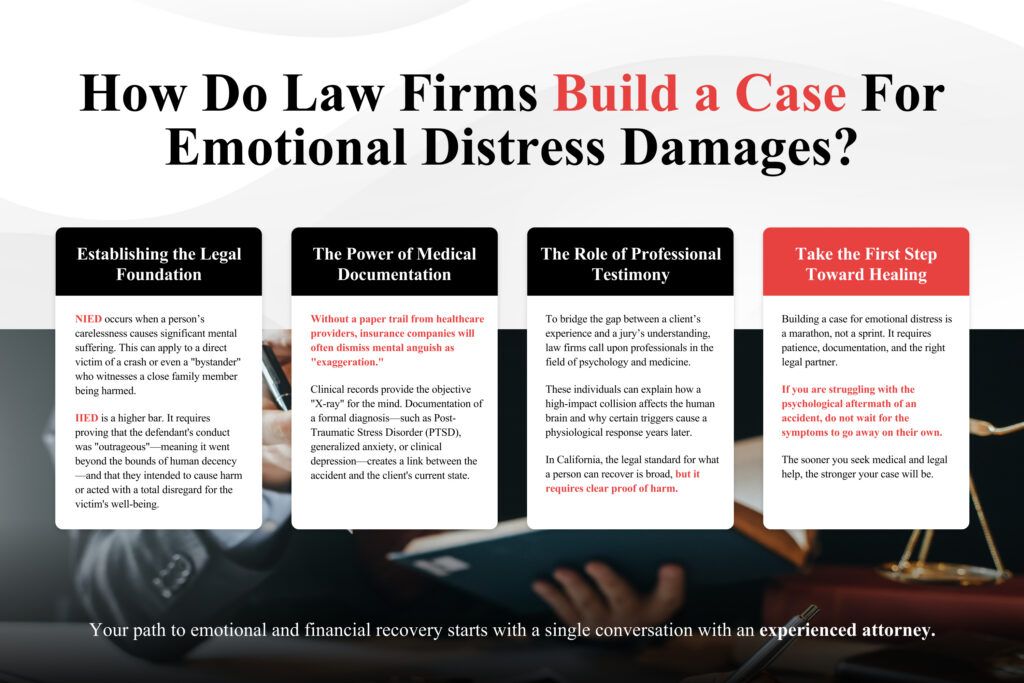
Establishing the Legal Foundation
In California, emotional distress claims typically fall under two categories: Negligent Infliction of Emotional Distress (NIED) and Intentional Infliction of Emotional Distress (IIED).
- NIED occurs when a person’s carelessness causes significant mental suffering. This can apply to a direct victim of a crash or even a “bystander” who witnesses a close family member being harmed.
- IIED is a higher bar. It requires proving that the defendant’s conduct was “outrageous”—meaning it went beyond the bounds of human decency—and that they intended to cause harm or acted with a total disregard for the victim’s well-being.
Law firms begin by determining which path fits the facts. They review the circumstances of the accident to see if the defendant’s actions were merely careless or truly egregious. This foundation dictates how the rest of the case is built.
The Power of Medical Documentation
The most critical component of any emotional distress claim is medical proof. Without a paper trail from healthcare providers, insurance companies will often dismiss mental anguish as “exaggeration.” Law firms guide their clients to seek help from mental health professionals immediately.
Clinical records provide the objective “X-ray” for the mind. Documentation of a formal diagnosis—such as Post-Traumatic Stress Disorder (PTSD), generalized anxiety, or clinical depression—creates a link between the accident and the client’s current state. These records track the frequency of panic attacks, the severity of insomnia, and the necessity of prescribed
medications. When a therapist notes that a client is unable to drive due to a fear of vehicles following a collision, it provides a concrete example of how the trauma has altered their life.
Quantifying the “Intangible”
Since there is no “receipt” for pain and suffering, law firms use specific methods to calculate the value of emotional damages. The most common is the Multiplier Method, where the total economic losses (like medical bills and lost wages) are multiplied by a number—usually between 1.5 and 5—based on the severity of the distress.
Another approach is the Per Diem Method, which assigns a daily dollar value to the suffering from the day of the accident until the victim reaches “Maximum Medical Improvement.” Legal teams collect evidence to justify why a higher multiplier or daily rate is appropriate, often pointing to the duration of the symptoms and the permanency of the psychological damage.
Gathering Corroborating Evidence
A victim’s own testimony is powerful, but it is much more effective when supported by outside voices. Law firms interview family members, friends, and coworkers to paint a “before and after” picture.
- Witness Statements: A spouse might testify that the victim no longer sleeps through the night or has withdrawn from social activities they once loved.
- Journal Entries: Clients are often encouraged to keep a daily “pain and suffering” log. This contemporaneous record captures the raw, day-to-day struggles that might be forgotten months later.
- Employment Records: If a client’s performance at work has slipped or if they have used an unusual amount of sick leave for mental health days, these records serve as proof of the distress’s real-world consequences.
The Role of Professional Testimony
To bridge the gap between a client’s experience and a jury’s understanding, law firms call upon professionals in the field of psychology and medicine. These individuals can explain how a high-impact collision affects the human brain and why certain triggers cause a physiological response years later. They provide the academic and clinical context that proves the distress is a legitimate medical condition rather than a temporary emotional reaction.
In California, the legal standard for what a person can recover is broad, but it requires clear proof of harm. According to the California Courts Self-Help Guide, the law is designed to ensure that victims are made “whole” for all losses stemming from an injury. The guide explains:
“Think about all the losses caused by the injury: Medical bills, Lost wages, Ongoing treatment, Emotional harm, Future problems from the injury. Some damages are easy to prove with bills. Others, like emotional distress, are harder to measure the value of.” This acknowledgment from the state court system reinforces that while emotional harm is harder to measure, it is a valid and essential part of a personal injury claim.
Overcoming Insurance Company Pushback
Insurance adjusters are trained to minimize non-economic damages. They may argue that the victim’s anxiety is due to “pre-existing” life stresses or that they are simply seeking a windfall. Law firms counter this by highlighting the Eggshell Plaintiff Rule. This legal doctrine states that a defendant must take the victim as they find them. If a person had a history of mild anxiety that was catastrophically worsened by an accident, the defendant is still responsible for that total outcome.
A legal team also monitors the physical manifestation of the distress. While California does not always require a physical injury to claim emotional distress, showing that the stress led to weight loss, hair loss, digestive issues, or chronic headaches makes the case significantly stronger.
The Super Woman Super Lawyer Advantage
Navigating the nuances of psychological trauma requires a team that combines legal strength with genuine empathy. Super Woman Super Lawyer and her team understand that a full recovery involves more than just fixing a car or paying a hospital bill; it involves reclaiming peace of mind.
They handle the aggressive tactics of insurance companies, ensuring that the narrative stays focused on the human impact of the crash. By gathering the right evidence and utilizing the correct legal theories, they ensure that “future you” is protected from the long-term effects of trauma. Whether the incident occurred in a car, on a motorcycle, or as a pedestrian, the goal remains the same: obtaining a settlement that recognizes every layer of the injury.
Take the First Step Toward Healing
Building a case for emotional distress is a marathon, not a sprint. It requires patience, documentation, and the right legal partner. If you are struggling with the psychological aftermath of an accident, do not wait for the symptoms to go away on their own. The sooner you seek medical and legal help, the stronger your case will be.
Super Woman Super Lawyer is ready to provide the advocacy you need to hold negligent parties accountable for the invisible wounds they have caused. Your path to emotional and financial recovery starts with a single conversation.
Looking For a Specific Practice?







No win, no fee. What does that mean for you? You only pay us when we win your case.