How Do Attorneys Support Clients Facing Insurance Company Delays?
When a person is injured in an accident, they often find themselves in a race against time. Medical bills accumulate, income stops due to missed work, and the physical path to recovery requires immediate resources. While insurance is designed to provide a safety net during these crises, the reality of the claims process can be startlingly different. Many individuals encounter a frustrating wall of silence or a series of endless requests for the same information. These are not always accidental administrative hurdles; they are often calculated strategies used to protect corporate profits.
Attorneys play a vital role in dismantling these barriers. By understanding the inner workings of the insurance industry and the legal obligations of carriers, legal counsel can provide the leverage necessary to move a claim forward. This support ranges from managing daily communications to taking formal legal action when a delay crosses the line into bad faith.
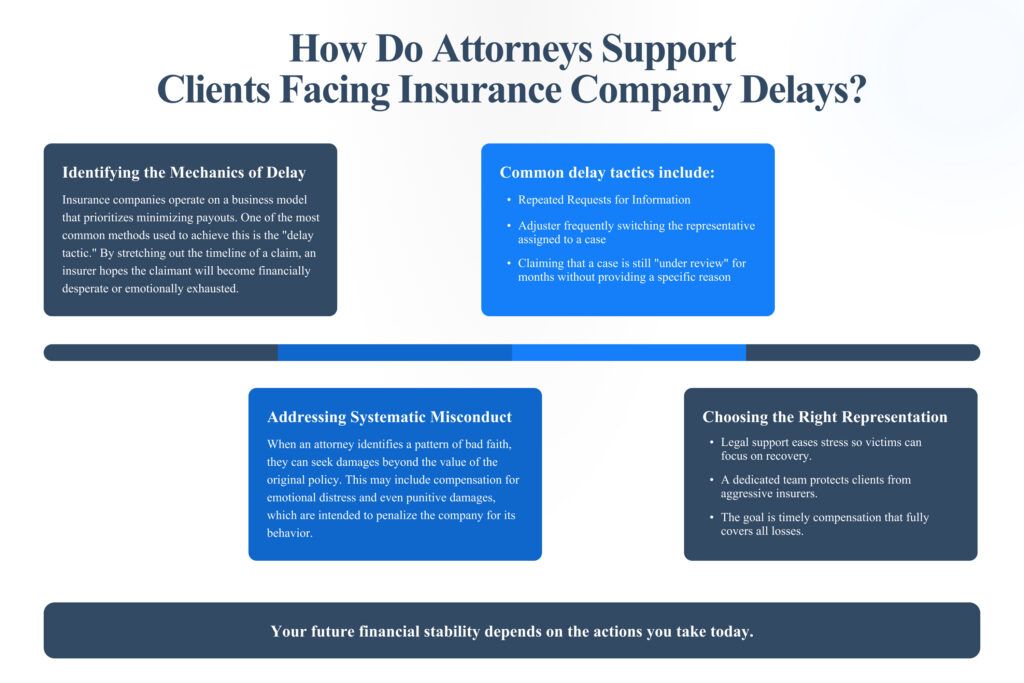
Identifying the Mechanics of Delay
Insurance companies operate on a business model that prioritizes minimizing payouts. One of the most common methods used to achieve this is the “delay tactic.” By stretching out the timeline of a claim, an insurer hopes the claimant will become financially desperate or emotionally exhausted. A person facing mounting debt is much more likely to accept a low settlement offer just to end the ordeal.
Common delay tactics include:
- Repeated Requests for Information: Asking for records already provided or requesting irrelevant documentation to stall the clock.
- Adjuster Revolving Doors: Frequently switching the representative assigned to a case, forcing the client to explain the accident and submit paperwork over and over again.
- Unjustified Investigations: Claiming that a case is still “under review” for months without providing a specific reason or update.
- Lack of Communication: Simply failing to return phone calls or emails, leaving the victim in a state of uncertainty.
Attorneys counteract these moves by establishing a strict channel of communication. Once a lawyer is involved, all correspondence must go through their office. This prevents adjusters from using high-pressure tactics directly on the victim and creates a paper trail that can be used if the case goes to court.
Leveraging Legal Deadlines and Accountability
In many states, including California, insurance companies are legally required to adhere to specific timelines for acknowledging a claim, investigating it, and providing a decision. When an insurer fails to meet these deadlines, an attorney can hold them accountable by citing the relevant insurance codes and regulations.
Legal representatives provide a level of oversight that is difficult for a private individual to maintain. They ensure that every piece of evidence—from police reports to hospital records—is submitted in a way that leaves no room for the insurer to claim the file is “incomplete.” If an insurer continues to stall without a legitimate reason, a lawyer can file a formal complaint with the state’s Department of Insurance or pursue a bad-faith lawsuit.
In California, the law is particularly clear about these timelines. According to the California Department of Insurance, policyholders have specific rights regarding how quickly their claims must be handled. As stated in their official guidance:
“The insurance company must acknowledge your claim within 15 calendar days of receiving it. They must also provide you with all necessary claim forms and instructions within that same 15-day period… Furthermore, they generally have 40 calendar days to accept or deny the claim once they have received all the information needed to make a determination.”
By quoting these specific statutes, an attorney reminds the insurance company that their internal “policies” do not override state law.
The Role of Advocacy in Valuation
A delay is often a precursor to a low offer. Insurance adjusters may wait until a victim is at their most vulnerable before presenting a “take it or leave it” settlement. Without legal guidance, many people do not realize the true value of their claim. They may account for their current hospital bill but forget to include future physical therapy, the cost of home modifications, or the long-term impact on their career.
Attorneys use a comprehensive approach to calculate damages. They review medical records to determine the full extent of the injuries and project future financial losses. By presenting a well-documented demand package that accounts for every cent, the legal team makes it much harder for the insurer to justify a delay or a lowball offer.
Shifting the Narrative
Insurance companies often try to shift blame onto the victim to delay payment. They might argue that the person was partially at fault for the accident or that their injuries are related to a pre-existing condition. Legal teams protect their clients by conducting independent investigations. This includes gathering traffic camera footage, interviewing witnesses, and working with reconstruction professionals to prove exactly what happened.
By building a mountain of undeniable evidence, an attorney changes the “story” the insurance company is trying to tell. When the facts are clear and the evidence is overwhelming, the insurer’s ability to claim “uncertainty” as a reason for delay disappears.
Addressing Systematic Misconduct
Sometimes, delays are not just about one claim but are part of a broader pattern of “bad faith.” Bad faith occurs when an insurer breaches the implied covenant of good faith and fair dealing. This is a legal obligation that requires insurers to treat policyholders fairly and not do anything to prevent the policyholder from receiving the benefits of the contract.
When an attorney identifies a pattern of bad faith, they can seek damages beyond the value of the original policy. This may include compensation for emotional distress and even punitive damages, which are intended to penalize the company for its behavior. This level of accountability is often the only thing that forces a large corporation to change its practices.
The Transition to Litigation
If negotiations fail and the insurance company refuses to act in good faith, an attorney is prepared to move the case into the courtroom. The mere threat of a lawsuit is often enough to end a delay. Litigation is expensive and time-consuming for insurance companies, and they are aware that a jury may be far less sympathetic to their delay tactics than a harried claimant might be.
A lawyer manages the entire litigation process, from filing the complaint and conducting discovery to representing the client at trial. This ensures that the client’s rights are protected at every stage and that the insurance company is forced to answer for its conduct before a judge.
Choosing the Right Representation
The support an attorney provides is more than just legal; it is also emotional. Facing a
multi-billion-dollar corporation alone is intimidating. Having a dedicated advocate allows the victim to step back from the stress of the claim and focus on their health.
Teams like those led by Super Woman Super Lawyer understand these dynamics intimately. They provide a shield against aggressive adjusters and a voice for those who feel unheard. Whether the accident involved a car, a motorcycle, or a commercial vehicle, the goal is the same: to ensure the settlement covers the full scope of the victim’s losses without unnecessary delay.
Take Charge of Your Recovery
If you are currently experiencing unreturned calls, repetitive paperwork requests, or a claim that has been “under review” for an unreasonable amount of time, it is time to seek professional
help. The legal system provides protections for consumers, but those protections are only effective if they are asserted. An attorney ensures that the insurance company respects your time and your rights. By hiring a legal team, you send a clear message that you will not be ignored or pressured into an unfair agreement. Your future financial stability depends on the actions you take today.
Looking For a Specific Practice?







No win, no fee. What does that mean for you? You only pay us when we win your case.