Bicycle accidents in Long Beach often happen during moments drivers consider routine—right turns at intersections, left turns across traffic, or quick movements through mixed-use lanes. For cyclists, these moments are anything but routine. Turning vehicles are one of the most common sources of serious bicycle injuries, especially in dense coastal traffic corridors.
When these crashes happen, fault is rarely accepted right away. Drivers may claim they “didn’t see” the cyclist or believed they had the right of way. Insurance companies frequently lean on those statements, shifting attention away from whether the driver properly yielded or checked for cyclists before turning.
At Avrek Law, we help injured cyclists in Long Beach address these fault disputes early, before assumptions become permanent. Avrek has recovered over $2 billion nationwide, and bicycle cases often hinge on how right-of-way rules are applied in the first stages of a claim.
📞 Call 866-598-5548, start a chat, or request a free case review today. You don’t pay unless we win.
Why Turning Vehicles Cause So Many Bicycle Crashes
Unlike straight-line collisions, turning crashes involve split-second judgment calls. Drivers may focus on vehicle traffic while overlooking cyclists traveling alongside them.
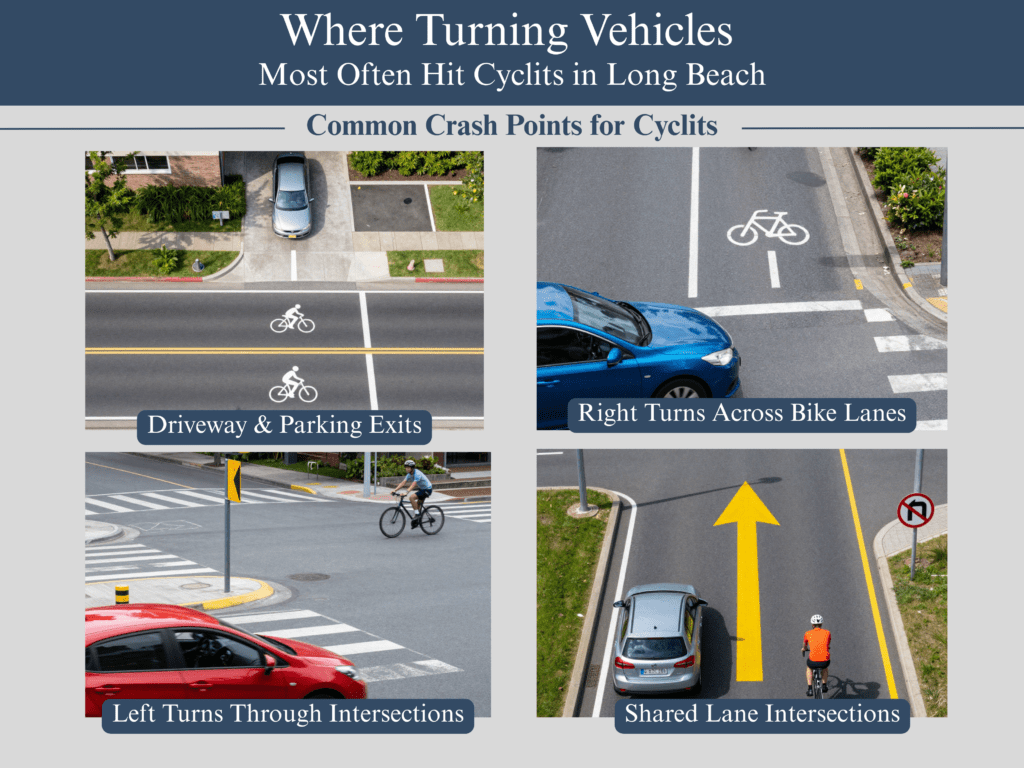
Common turning-related bicycle crash scenarios include:
- Right-hook crashes where a vehicle turns across a bike lane
- Left turns across oncoming cyclist traffic
- Vehicles entering or exiting driveways without checking bike lanes
- Sudden turns at intersections with shared road markings
In these situations, visibility and right-of-way are often misunderstood—by drivers and insurers alike.
How Right-of-Way Disputes Begin After a Bicycle Crash
After a bicycle accident, insurance adjusters often focus on where the cyclist was positioned rather than how the driver executed the turn. Questions may include:
- Was the cyclist in a bike lane or travel lane?
- Was the cyclist moving straight through the intersection?
- Did the driver signal?
- Did the driver yield before turning?
These questions matter because California law generally requires drivers to yield to cyclists traveling straight when making turns. When these rules are ignored, cyclists are exposed to significant injury risk.
Long Beach Road Design and Bicycle Safety Challenges
Long Beach includes a mix of protected bike lanes, shared lanes, and high-traffic arterial roads. While these features aim to improve safety, they can also create confusion during turning movements.
Contributing factors often include:
- Inconsistent lane markings
- Parked vehicles blocking sightlines
- High tourist and commuter traffic
- Limited reaction time in dense urban areas
Insurance companies may overlook these conditions and instead argue that the cyclist should have “anticipated” the driver’s movement.
California Bicycle Laws That Apply to Turning Collisions
California law generally gives cyclists the same rights and responsibilities as motor vehicles. Drivers must yield to cyclists when turning if the cyclist is lawfully proceeding straight.
California also follows a pure comparative negligence system. Compensation may be reduced by a cyclist’s percentage of fault, even when a driver caused the crash. Insurers often rely on this rule to argue partial responsibility in turning-vehicle cases.
California Vehicle Code — Bicycle Rights and Duties
California Courts — Civil Lawsuit Overview
Who May Be Responsible After a Long Beach Bicycle Accident
Responsibility is not always limited to the driver alone. Depending on the facts, liable parties may include:
- Negligent drivers
- Employers of drivers operating company vehicles
- Property owners with unsafe driveway access
- Government entities responsible for road design or maintenance
Identifying all responsible parties early helps preserve evidence and protect recovery options.
Why Bicycle Accident Claims Struggle Without Early Guidance
Bicycle accident claims often face challenges because:
- Fault narratives form quickly
- Right-of-way rules are misapplied
- Evidence such as video footage is lost
- Cyclist injuries are underestimated
This is why many injured cyclists work with a Long Beach bicycle accident lawyer at Avrek Law once insurers begin disputing responsibility.
What Legal Advocacy Changes in Bicycle Accident Cases
When legal representation is involved:
- Traffic laws are applied correctly
- Turning-vehicle fault is examined closely
- Medical documentation is connected to crash mechanics
- Insurers stop relying on assumptions
Early advocacy often prevents fault from being quietly shifted onto the cyclist.
Compensation That May Be Available After a Bicycle Accident
Depending on the severity of injuries, compensation may include:
- Emergency and ongoing medical care
- Rehabilitation and physical therapy
- Lost income and reduced earning capacity
- Pain and suffering
- Permanent impairment or disability
Bicycle injury claims require evaluation that accounts for both medical impact and roadway dynamics.
📞 Call 866-598-5548, start a chat, or request a free case review. You don’t pay unless we win.
Frequently Asked Questions — Long Beach Bicycle Accidents
Do cyclists have the right of way when a car turns?
In many situations, yes. Drivers must yield to cyclists proceeding straight when making turns.
What if the driver says they didn’t see me?
Failure to see a cyclist does not excuse a driver’s duty to yield and check blind spots.
Can I recover compensation if I wasn’t in a bike lane?
Yes. Cyclists may lawfully use travel lanes when appropriate.
Should I speak with the driver’s insurance company?
Not without guidance. Early statements can affect fault determinations.
When Fault Is Questioned, Timing Matters
Turning-vehicle bicycle crashes often hinge on how fault is framed early. Once insurers assign partial blame, reversing that narrative becomes more difficult.
Understanding how right-of-way laws apply—and documenting the crash correctly—can make a critical difference before decisions are locked in.
📞 Call 866-598-5548 or start a chat with Avrek Law to discuss your Long Beach bicycle accident. You don’t pay unless we win.