What Phoenix crosswalk laws mean for pedestrians and drivers is something many people only think about after an accident happens. Questions about right of way, driver responsibility, and pedestrian behavior often become central issues when a collision occurs.
At Avrek Law, we represent injury victims across Arizona. With more than $2 billion recovered nationwide, we understand how right-of-way laws are interpreted and how insurance companies evaluate pedestrian accident claims. When disputes arise, the details of how crosswalk laws apply can make a meaningful difference.
Understanding what Phoenix crosswalk laws mean for pedestrians and drivers can help both drivers and pedestrians avoid confusion and reduce the risk of accidents.
📞 Call 866-598-5548, start a chat, or request a free case review today. There are no upfront fees and you don’t pay unless we win.
When Must Drivers Yield at Phoenix Crosswalks
Marked versus unmarked crosswalks
Drivers are generally required to yield to pedestrians in both marked and unmarked crosswalks. Many intersections include crosswalks even if they are not clearly painted.
Uncontrolled intersections versus signalized crossings
At intersections without traffic signals, drivers must be especially aware of pedestrians entering the roadway. At signalized intersections, both drivers and pedestrians must follow traffic signals.
Why passing a stopped vehicle at a crosswalk is risky
If one vehicle stops for a pedestrian, another driver passing that vehicle may not see the pedestrian in time, increasing the risk of a collision.
When Must Pedestrians Yield Outside a Crosswalk
Crossing at points other than a crosswalk
Pedestrians crossing outside designated crosswalks may be required to yield to vehicles already on the road.
Pedestrian tunnels and overhead crossings
If a pedestrian chooses not to use a designated crossing structure, fault may become a point of dispute after an accident.
Crossing between adjacent signalized intersections
Crossing mid-block between intersections with traffic signals can create confusion and increase risk.
In many of these situations, the case may overlap with claims typically handled by a pedestrian accident lawyer in Phoenix, especially when right-of-way is disputed.
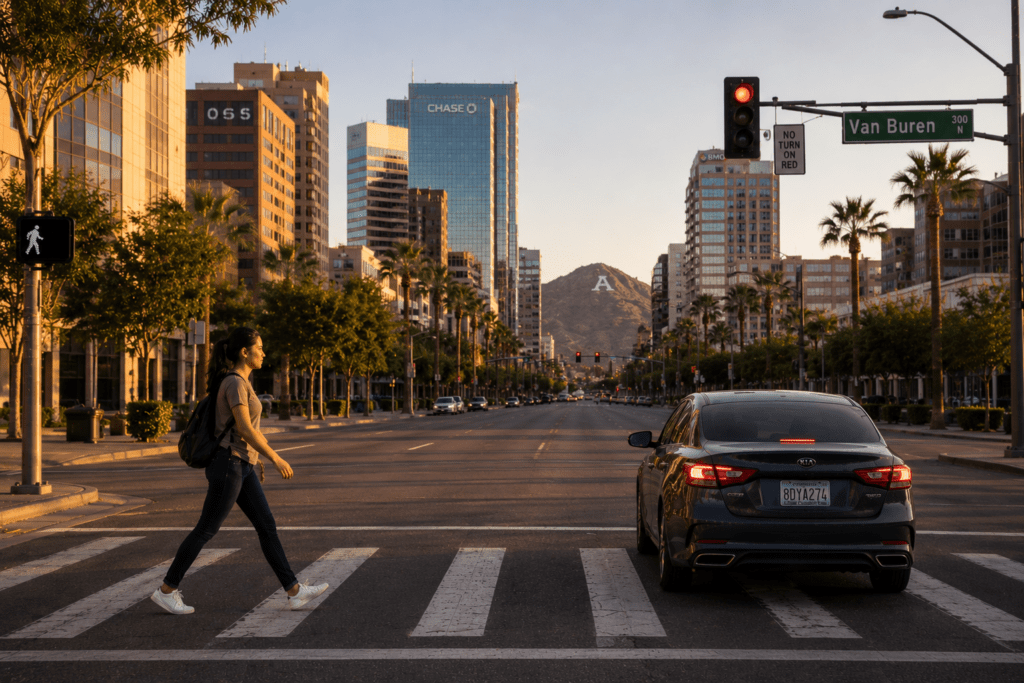
How Right-of-Way Disputes Develop After a Pedestrian Crash
Visibility, lighting, and driver speed
Conditions such as poor lighting or high vehicle speed can affect how easily a pedestrian is seen.
Pedestrian timing, movement, and distractions
Whether a pedestrian entered the roadway suddenly or was distracted may become part of the analysis.
Nearby signs, signals, and road markings
Traffic control devices often play a key role in determining who had the right of way.
Understanding what Phoenix crosswalk laws mean for pedestrians and drivers becomes especially important when both parties may share some responsibility.
What Evidence Can Clarify a Crosswalk Collision
Surveillance and dashcam footage
Video evidence can provide a clear view of how the accident occurred.
Witness statements and scene photos
Independent accounts and visual documentation help support what happened.
Police diagrams, measurements, and location data
Official reports often include diagrams that show vehicle and pedestrian positions.
These types of evidence are often reviewed in detail in cases involving a personal injury lawyer in Phoenix, particularly when liability is unclear.
Why Crosswalk Laws Matter in Accident Claims
What Phoenix crosswalk laws mean for pedestrians and drivers is not just a legal question, it directly affects how fault is assigned and how claims are evaluated. Even small details, such as where a pedestrian was crossing or how a driver approached an intersection, can influence the outcome.
According to the Arizona Department of Transportation, pedestrian safety remains a major concern in urban areas with increasing traffic density.
Knowing how these laws apply can help reduce confusion and improve how claims are handled.
Frequently Asked Questions
Do drivers always have to stop for pedestrians?
Drivers are generally required to yield to pedestrians in marked and unmarked crosswalks. However, the situation can depend on traffic signals, roadway conditions, and whether the pedestrian entered the crosswalk safely. In some cases, disputes arise when drivers claim the pedestrian entered the roadway too quickly to react.
Can a pedestrian be at fault for an accident?
Yes. Pedestrians may share responsibility if they cross outside of a crosswalk, ignore traffic signals, or step into traffic without giving drivers enough time to stop. Arizona’s comparative negligence system allows fault to be shared between both parties.
What happens if both the driver and pedestrian are at fault?
When both parties share responsibility, compensation may be reduced based on the percentage of fault assigned to each person. For example, if a pedestrian is found partially responsible, their recovery may be reduced accordingly.
Are unmarked crosswalks legally valid?
Yes. Many intersections have legally recognized crosswalks even if they are not painted. These are typically located at intersections where sidewalks meet, and drivers are still expected to yield to pedestrians in these areas.
What should a pedestrian do immediately after being hit by a vehicle?
A pedestrian should seek medical attention right away, even if injuries seem minor. If possible, they should document the scene, gather contact information from witnesses, and request a police report. These steps can help preserve important evidence.
What evidence is most important in a pedestrian accident case?
Key evidence includes surveillance footage, dashcam video, police reports, witness statements, and photos of the scene. Road markings, lighting conditions, and vehicle positioning can all help clarify what happened.
How do insurance companies evaluate pedestrian accident claims?
Insurance companies review evidence such as police reports, medical records, and witness statements to determine fault. They may also analyze whether the pedestrian was in a crosswalk, whether signals were followed, and how visible the pedestrian was at the time of the accident.
Why do pedestrian accident claims often involve disputes?
These cases often involve conflicting accounts between the driver and pedestrian. Visibility, timing, and road conditions can all affect how the accident is interpreted, which is why documentation is so important.
Do crosswalk laws apply the same way at night?
Yes, but visibility becomes a major factor. Poor lighting conditions can affect how responsibility is evaluated, especially if a driver claims they could not see the pedestrian in time.
📞 Call 866-598-5548, start a chat, or request a free case review today.