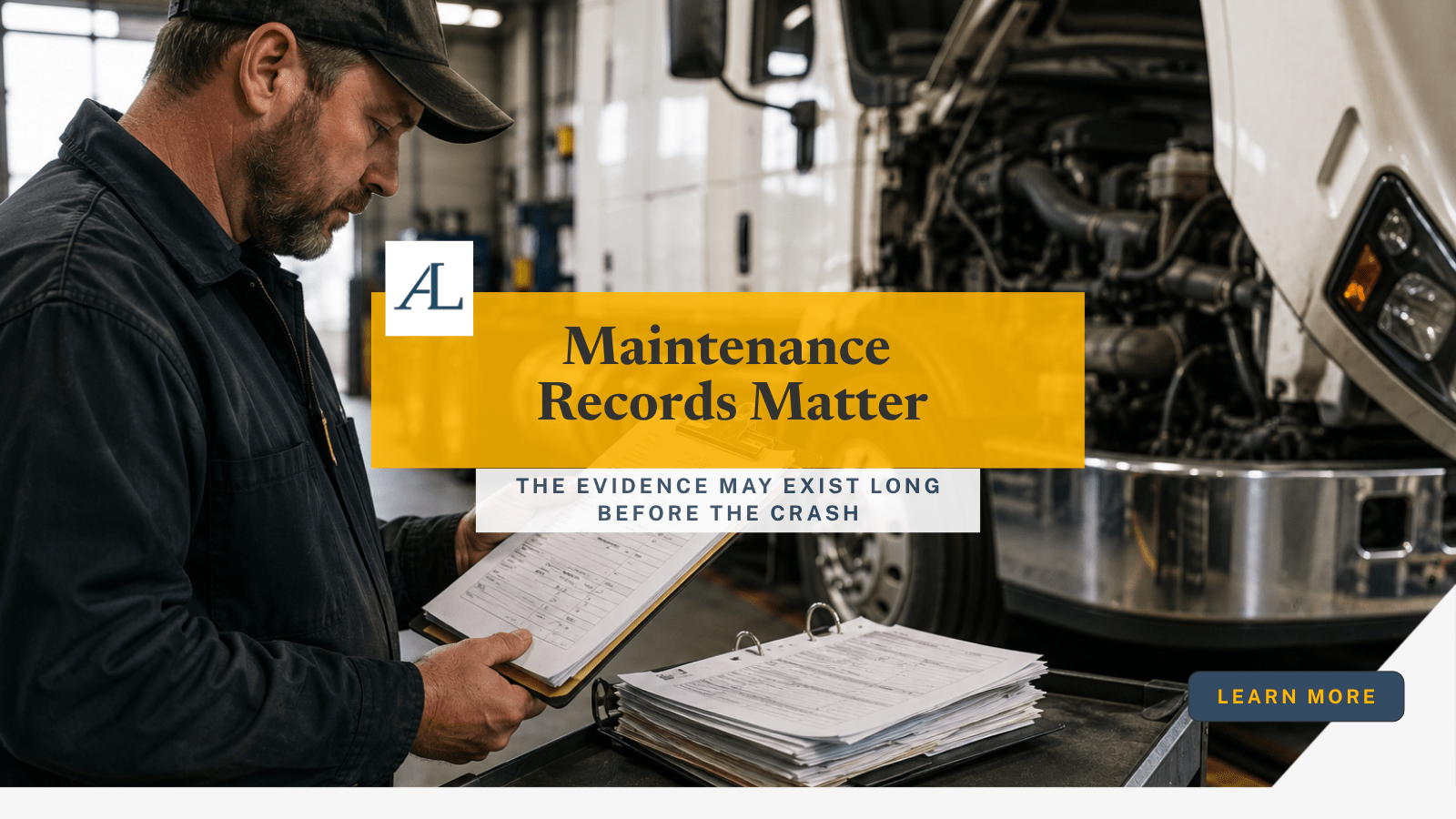
Truck maintenance records after commercial truck accident investigations often become some of the most important evidence available in a serious truck accident case. While many people naturally focus on the driver’s actions immediately before impact, investigators frequently spend just as much time examining what happened weeks, months, or even years before the collision ever occurred. Commercial trucks travel thousands of miles every month while carrying heavy loads across Southern California highways, industrial corridors, and city streets. These vehicles depend on routine inspections, preventative maintenance, and timely repairs to remain safe. When those responsibilities are neglected, the consequences can be devastating. Brake failures, tire blowouts, steering defects, and equipment malfunctions have all contributed to serious truck accidents throughout California.
For victims, the challenge is that many of these maintenance problems are invisible at the crash scene. A damaged vehicle may reveal what happened during the collision, but maintenance records often reveal why it happened. That distinction can make a significant difference when determining liability and identifying all potentially responsible parties.
Trucking companies and insurers frequently begin investigating immediately after a crash. Vehicles may be repaired, returned to service, or moved before victims fully understand the extent of their injuries. As a result, truck maintenance records after commercial truck accident investigations often become critical sources of information that cannot be replaced once evidence disappears.
📞 Call 866-598-5548, start a chat, or request a free case review today. You don’t pay unless we win.
Maintenance Issues That May Be Relevant After a Truck Crash
Commercial trucks contain thousands of components that must work together safely every time the vehicle enters the roadway. A failure involving even one critical system can create significant risks for everyone nearby.
Brake problems, tire failures, and steering issues
Few mechanical failures create more danger than defective brakes on a fully loaded commercial truck. Tractor-trailers require substantially more stopping distance than passenger vehicles, even under ideal conditions. When brakes are worn, improperly maintained, or operating below safety standards, a driver’s ability to avoid a collision may be dramatically reduced.
Brake issues often become a major focus of truck maintenance records after commercial truck accident investigations because even small deficiencies can have serious consequences. Investigators frequently review inspection histories, service records, and repair recommendations to determine whether brake concerns existed before the collision occurred.
Tire failures create another significant hazard. A blown tire can send debris across multiple lanes, trigger a loss of control event, or contribute to chain-reaction collisions involving several vehicles. In some cases, maintenance records reveal repeated warnings about tire wear, improper inflation, or delayed replacement schedules.
Steering problems may also play an important role. Defects involving steering systems can affect a driver’s ability to maintain lane position, navigate traffic safely, or respond to sudden roadway conditions. When truck maintenance records after commercial truck accident investigations show recurring steering-related repairs, those findings often become important pieces of evidence.
Lighting, mirrors, underride guards, and visibility equipment
Not every dangerous maintenance issue involves a major mechanical failure. Many collisions occur because drivers are unable to see hazards or communicate effectively with surrounding traffic. Commercial trucks rely on headlights, brake lights, marker lights, reflectors, mirrors, cameras, and other visibility equipment to operate safely. When these systems fail, both truck drivers and nearby motorists may have difficulty recognizing changing traffic conditions.
Visibility concerns become especially important during nighttime driving, poor weather conditions, and heavy traffic situations. Truck maintenance records after commercial truck accident investigations sometimes reveal prior inspection findings involving defective lighting systems, damaged mirrors, or malfunctioning safety equipment that was never properly repaired.
Underride guards deserve particular attention as well. These safety devices are designed to reduce the severity of collisions involving smaller passenger vehicles. Maintenance records may help establish whether safety equipment was inspected regularly and whether known defects were addressed appropriately.
Trailer connections, load securement equipment, and mechanical defects
Commercial trucks depend on more than just the tractor itself. Trailer connections, suspension systems, cargo securement devices, and coupling equipment all play a critical role in safe operation. When cargo shifts unexpectedly or trailer systems fail, the results can be catastrophic. Jackknife accidents, rollovers, trailer separations, and cargo spills often involve maintenance-related questions that extend far beyond the driver’s actions.
Truck maintenance records after commercial truck accident investigations frequently include information regarding trailer inspections, load securement systems, and recurring mechanical issues. In some situations, these records reveal problems that existed long before the crash occurred.
Investigators often review whether equipment defects were identified, how long they remained unresolved, and whether the vehicle should have been removed from service until repairs were completed.
Records That May Show the Truck’s Condition Before the Crash
One reason maintenance documentation is so valuable is that it often provides insight into the truck’s condition before the collision occurred.
Inspection reports and repair invoices
Inspection reports and repair invoices frequently provide one of the clearest pictures of a truck’s maintenance history. Commercial vehicles generate extensive service documentation throughout their operational life, and these records often reveal patterns that would otherwise remain hidden. Repair histories may show recurring mechanical concerns, repeated recommendations involving the same component, or repairs that were delayed despite known safety risks. In some investigations, truck maintenance records after commercial truck accident cases reveal that the same problem had been identified multiple times before the collision occurred.
These records may also help investigators determine whether repairs were completed properly or whether temporary fixes allowed the truck to continue operating despite unresolved safety concerns.
Driver vehicle inspection reports and defect notices
Commercial drivers are generally required to inspect their vehicles before and after operation. These inspections often generate Driver Vehicle Inspection Reports, commonly known as DVIRs. Driver inspection reports can become extremely important because they often document problems identified by the individuals operating the vehicle every day. Brake issues, steering concerns, lighting failures, tire defects, and trailer equipment problems frequently appear in these records.
Truck maintenance records after commercial truck accident investigations sometimes reveal repeated inspection warnings involving the same system. When defect notices continue appearing without meaningful repairs, investigators may question whether the vehicle should have remained in service.
Because drivers interact with the truck regularly, their observations often provide valuable insight into ongoing maintenance concerns.
Maintenance schedules, service logs, and fleet management records
Most commercial fleets maintain detailed maintenance schedules designed to ensure vehicles receive service at regular intervals. These records often track preventative maintenance activities, mileage-based inspections, service appointments, and repair histories. Fleet management systems may also reveal missed inspections, delayed service intervals, or overdue maintenance requirements. Truck maintenance records after commercial truck accident investigations sometimes show that recommended maintenance was postponed despite company policies requiring repairs.
These records often provide a broader picture of how a trucking company manages vehicle safety across its fleet. Patterns involving repeated delays, recurring mechanical concerns, or compliance failures may become important when evaluating liability.
Who May Have Access to Truck Maintenance Evidence
Obtaining maintenance records is not always as simple as requesting documents from a trucking company.
Trucking companies, fleet owners, and leasing companies
The trucking company itself is often the primary source of maintenance documentation. Fleet operators typically maintain inspection records, repair histories, compliance files, maintenance schedules, and service documentation. However, ownership structures can become complicated. Some vehicles are leased through separate entities that maintain portions of the maintenance history independently. In these situations, truck maintenance records after commercial truck accident investigations may be distributed across multiple organizations.
This is one reason an experienced Santa Ana truck accident lawyer often investigates more than one company when seeking maintenance evidence after a serious collision.
Repair shops, contractors, and third-party maintenance vendors
Many trucking companies outsource portions of their maintenance responsibilities to third-party repair facilities and service providers. These businesses may possess work orders, technician notes, inspection findings, repair recommendations, and service records that never appear within the trucking company’s internal documentation.
Truck maintenance records after commercial truck accident investigations often require investigators to gather information from multiple sources before a complete picture emerges. In some cases, independent repair facilities documented safety concerns that were recommended for repair but never properly addressed.
Brokers, shippers, and logistics companies when applicable
Although brokers and logistics companies typically do not perform maintenance themselves, they may maintain records involving carrier compliance, transportation arrangements, and operational oversight. These records sometimes help establish which companies participated in the transportation process and whether additional parties played a role in selecting or supervising the carrier involved in the collision.
Complex transportation arrangements frequently require investigators to review documentation from several organizations before determining who may possess relevant maintenance information.
Why Maintenance Evidence Can Be Time-Sensitive
Truck maintenance evidence does not remain available indefinitely. Delays often make critical information more difficult to obtain.
Repairs made immediately after the crash
After a collision, trucking companies often move quickly to repair damaged vehicles and return them to service. While this may be understandable from a business perspective, repairs can alter or eliminate evidence that may become important later. Worn parts may be replaced. Damaged components may be discarded. Mechanical conditions present immediately after the crash may no longer exist. Truck maintenance records after commercial truck accident investigations frequently become even more valuable when physical evidence changes shortly after the collision.
Vehicles returned to service before inspection
Commercial fleets depend on keeping vehicles operational. As a result, trucks are often returned to service quickly once repairs are completed. When that happens, opportunities for independent inspections become more limited. Investigators may lose the ability to evaluate the truck in the same condition it existed immediately after the crash.
This is one reason truck accident investigations often move much faster than ordinary passenger vehicle claims. Delays may result in lost evidence and fewer opportunities to determine whether mechanical failures contributed to the collision.
Preservation letters, inspections, and expert review topics to research
Truck accident investigations often involve efforts to preserve maintenance records, repair histories, inspection reports, electronic data, and physical evidence before changes occur. Mechanical engineers, accident reconstruction experts, and trucking safety specialists may later review these materials to determine whether maintenance failures contributed to the crash.
Truck maintenance records after commercial truck accident investigations frequently help answer one of the most important questions in any truck accident case: could this collision have been prevented? Victims can also learn more about federal commercial vehicle maintenance requirements through the Federal Motor Carrier Safety Administration (FMCSA):
https://www.fmcsa.dot.gov
Many of these investigations overlap with broader claims handled by an experienced Santa Ana personal injury lawyer, particularly when catastrophic injuries, multiple corporate defendants, or significant insurance coverage issues are involved.
The Story of the Crash Often Starts Long Before the Collision
Many truck accident investigations focus on what happened during the final seconds before impact. Maintenance records often tell a much larger story. Inspection reports, repair invoices, service logs, driver inspection reports, and maintenance schedules may reveal whether known safety concerns existed long before the collision occurred. They may show repeated repair recommendations, delayed maintenance, recurring mechanical failures, or inspection deficiencies that contributed to a preventable crash.
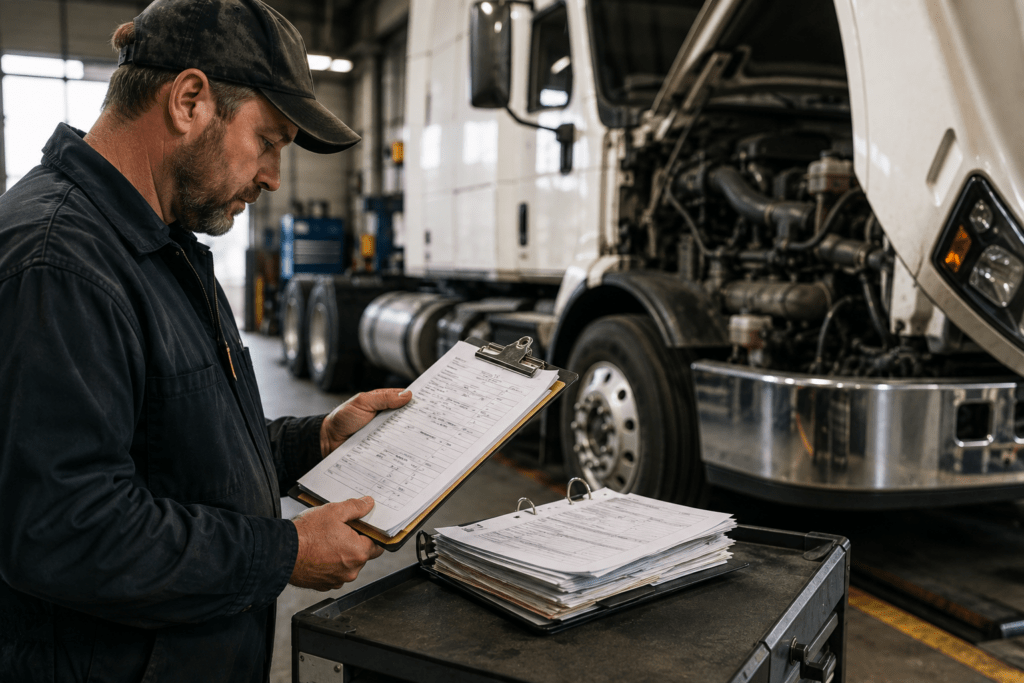
Truck maintenance records after commercial truck accident investigations often provide answers that accident scene evidence alone cannot.
Avrek Law helps victims investigate serious commercial truck accidents throughout Santa Ana and Southern California. We review maintenance evidence, identify potentially responsible parties, and help injured individuals understand what options may be available moving forward.
📞 Call 866-598-5548, start a chat, or request a free case review today.