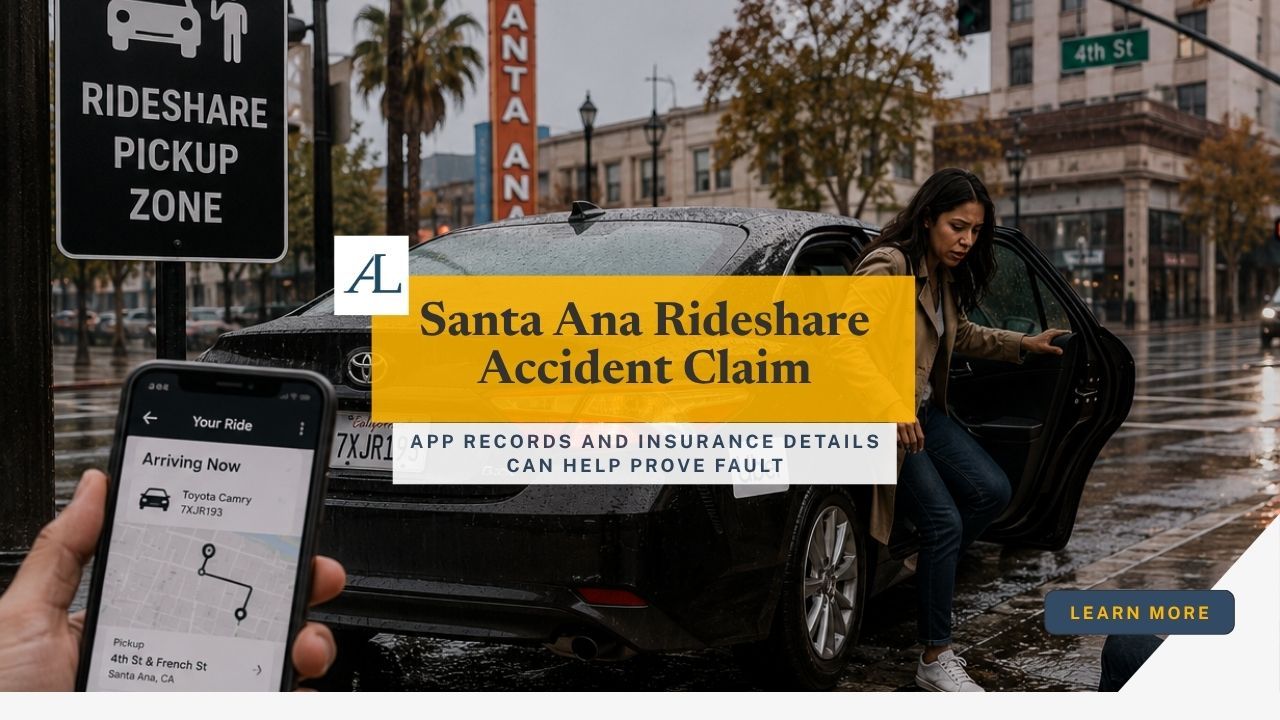
A Santa Ana rideshare accident claim can become complicated quickly because Uber and Lyft crashes are not always handled like ordinary two-car accidents. An injured passenger may have been sitting in the back seat when another driver ran a red light. A driver in another vehicle may have been hit by an Uber or Lyft driver who was logged into the app. A passenger may have been entering the vehicle, exiting near a curb, loading a bag, or waiting for the driver when the crash happened. In each situation, the injured person may have a valid claim, but the insurance questions can become confusing before medical treatment is even complete.
After a rideshare crash in Santa Ana, insurance companies may begin sorting the claim before the injured person understands who is responsible. One adjuster may say Uber or Lyft coverage applies. Another may argue that the rideshare driver’s personal insurance should respond. Another driver’s insurer may blame the Uber or Lyft driver, while the rideshare insurer asks for proof of app status, trip records, passenger location, and fault. A Santa Ana rideshare accident claim should therefore focus on evidence from the beginning: ride receipts, app screenshots, vehicle damage, police report details, medical records, and insurance communications.
When a rideshare accident leaves you injured, choosing the right legal representation matters. An experienced Santa Ana rideshare accident lawyer at Avrek Law Firm can review app status, identify the right insurance policies, preserve evidence, handle adjuster communications, and pursue compensation for the full impact of your injuries.
Call 866-598-5548, start a live chat, or request a free case review today. There are no upfront fees, and you do not pay unless we win.
Why a Santa Ana Rideshare Accident Claim Can Be Confusing
A Santa Ana rideshare accident claim can be confusing because the injured person may not know which insurance company should respond first. In a regular car accident, the injured person usually looks to the at-fault driver’s insurance. In a rideshare accident, the driver’s app status may affect which policy applies, whether coverage is primary, and whether the driver’s personal insurer tries to deny the claim because the vehicle was being used for rideshare work.
This confusion affects both injured rideshare passengers and injured drivers in other vehicles. A passenger may assume Uber or Lyft automatically handles everything because they were inside the vehicle. A driver hit by an Uber or Lyft driver may assume the rideshare driver’s personal policy will pay because that driver caused the crash. Neither assumption is always safe. A Santa Ana rideshare accident claim may require a careful review of the ride request, driver acceptance, passenger status, route data, cancellation notices, and the timing of the crash.
California’s California Public Utilities Code Section 5433 TNC Insurance Requirements state that transportation network company insurance applies from the moment a participating driver accepts a ride request until the driver completes the transaction or the ride is complete, whichever is later; during that accepted-ride period, the statute requires primary insurance of $1 million for death, personal injury, and property damage. The statute also provides uninsured and underinsured motorist coverage of $60,000 per person and $300,000 per incident from the moment a passenger enters the vehicle until the passenger exits.
That insurance structure is why a Santa Ana rideshare accident claim should not be evaluated based only on the police report or the driver’s first statement. App evidence can be just as important as vehicle damage. If the rideshare driver says the ride had not started, if the passenger says the driver had already accepted the trip, or if another driver says the Uber or Lyft vehicle was actively picking someone up, the digital timeline may help determine which policy should respond.
Injured Passengers Versus Drivers in Other Vehicles
A Santa Ana rideshare accident claim may involve an injured passenger, another injured driver, or both. An injured rideshare passenger usually had no control over either vehicle and may be caught between insurers arguing over fault. The rideshare driver may blame another motorist, the other motorist may blame the Uber or Lyft driver, and the passenger may receive calls from more than one adjuster asking for statements, medical records, or settlement discussions.
A driver in another vehicle may face a different challenge. If an Uber or Lyft driver caused the crash, the injured driver may need to prove not only that the rideshare driver was at fault, but also whether the driver was logged into the app, waiting for a ride, on the way to pick up a passenger, or already transporting a passenger. A Santa Ana rideshare accident claim involving another driver can therefore depend on records from the rideshare app, the rideshare company, police reports, witness statements, and multiple insurers.
For passengers, the priority is usually documenting the ride and the injuries. For other drivers, the priority is often proving the rideshare driver’s app status and the unsafe driving conduct that caused the crash. In both situations, screenshots, trip receipts, vehicle photos, and medical documentation can prevent insurers from controlling the story.
Why the Uber or Lyft Driver’s App Status May Still Matter
The Uber or Lyft driver’s app status may matter even when the injured person was not the rideshare passenger. If a rideshare driver hits another vehicle while logged into the app, the Santa Ana rideshare accident claim may involve different coverage questions than a crash involving a driver using the car for personal errands. If the rideshare driver had already accepted a trip, coverage may be different again. If a passenger was inside the rideshare vehicle, additional coverage issues may apply.
Passengers should save the ride receipt, trip map, driver name, driver photo, vehicle make and model, license plate, pickup and destination details, and any cancellation or support messages. Other drivers should photograph the rideshare decal if visible, write down anything the driver says about being on a ride, and ask witnesses whether they saw a passenger, app screen, or rideshare pickup activity.
App status disputes can become harder if the driver cancels the ride after the crash or if the passenger does not screenshot the trip before the app changes. These same app-record issues can also appear in related Avrek rideshare articles, including San Diego airport rideshare pickup accident claim and Long Beach rideshare passenger cruise terminal accident claim, where pickup timing, passenger movement, and trip documentation can affect the insurance review.
How Multiple Insurance Companies May Become Involved
A Santa Ana rideshare accident claim may involve several insurance companies at once. The rideshare driver’s personal auto insurer may contact the injured person. The rideshare company’s insurer or claims administrator may open a separate claim. Another driver’s insurer may request a statement. The injured person’s own insurer may become involved for medical payments, uninsured motorist, underinsured motorist, collision coverage, or related benefits. If the crash involved a delivery vehicle, employer-owned vehicle, public vehicle, or commercial driver, more coverage may need to be reviewed.
This can overwhelm injured people quickly. Each adjuster may ask questions that sound routine, but their goals may differ. One adjuster may be investigating fault. Another may be trying to determine whether coverage applies. Another may be looking for statements that reduce claim value. Without a clear strategy, an injured passenger or other driver may accidentally give inconsistent answers, sign forms too early, or accept a settlement before the rideshare evidence is reviewed.
A strong Santa Ana rideshare accident claim identifies every potential policy before serious settlement discussions begin. The first insurer to call is not always the only insurer responsible, and it is not always the insurer with the highest available coverage.
Evidence Injured Passengers and Other Drivers Should Save
A Santa Ana rideshare accident claim is strongest when evidence is preserved early. Rideshare evidence can change quickly. App screens update. Drivers continue accepting rides. Vehicles are repaired. Witnesses leave. Police reports take time to become available. Insurance companies may ask for statements before the injured person has gathered the records needed to understand the claim.
The goal is to preserve the digital timeline, crash scene, vehicle damage, injury documentation, and insurance communications. This does not mean an injured person has to investigate the entire case alone. It means the evidence available in the first few hours and days should not be lost before an attorney can request additional records.
Ride Receipts, Trip Screenshots, and Driver Information
App records are often the foundation of a Santa Ana rideshare accident claim. Passengers should save the ride receipt, trip route, pickup location, destination, driver name, driver photo, vehicle make and model, license plate, fare details, messages with the driver, cancellation notices, support chats, and any emails from Uber or Lyft. These records can show whether the ride existed, when it began, where the driver was headed, and whether the passenger was inside the vehicle or actively using the ride.
For other drivers, the evidence may look different. If you were hit by an Uber or Lyft driver in Santa Ana, take photos of the other vehicle, license plate, rideshare decals, driver’s insurance card, driver’s license, and any passengers who are willing to provide contact information. If the driver says they were on the app, waiting for a ride, picking someone up, or transporting a passenger, write that down as soon as possible.
A Santa Ana rideshare accident claim can turn on small details. A screenshot showing the driver accepted the ride, a message showing the driver changed a pickup location, or a receipt confirming the trip time may make it harder for insurers to dispute coverage.
Vehicle Photos, Scene Photos, and Passenger Statements
Photos can help prove what happened before insurers begin arguing about fault. Injured passengers and other drivers should photograph vehicle damage, license plates, traffic signals, stop signs, lane markings, skid marks, debris, crosswalks, weather conditions, rideshare decals, visible injuries, and the surrounding area. If the crash happened near Downtown Santa Ana, MainPlace Mall, Bristol Street, 17th Street, Harbor Boulevard, Grand Avenue, the Civic Center area, hotel zones, restaurants, apartment complexes, or rideshare pickup areas, nearby cameras may also be important.
Passenger statements can also help explain the crash. A rideshare passenger may have seen the driver looking at the app, making a sudden lane change, stopping abruptly, speeding, turning without enough clearance, or reacting too late. A passenger in another vehicle may have seen the Uber or Lyft driver run a red light, drift between lanes, or make an unsafe pickup move. These observations should be written down while memories are fresh.
A Santa Ana rideshare accident claim often becomes stronger when passenger statements match physical evidence. For example, if a passenger remembers the rideshare driver checking the phone moments before impact, and photos show a rear-end collision or unsafe lane movement, that detail may help explain why the crash occurred.
Police Report Details and Insurance Contact Logs
A police report can provide an official starting point for a Santa Ana rideshare accident claim. It may list drivers, passengers, witnesses, insurance information, vehicle damage, statements, citations, and the responding agency’s observations. It may not answer every rideshare coverage question, but it can help document the collision and prevent later disputes about the basic facts.
Injured people should also keep an insurance contact log. Write down the name of every adjuster who calls, the company they represent, the claim number, the date and time of the call, and what they requested. Save letters, emails, voicemail summaries, text messages, and claim forms. This is especially important in a Santa Ana rideshare accident claim because several adjusters may contact the same injured person about the same crash.
If an adjuster asks for medical authorization, recorded statements, or early settlement paperwork, keep copies of those requests. For related insurance-paperwork issues, Avrek’s Oxnard motor vehicle accident medical authorization form blog can help explain why broad medical record requests should be reviewed carefully before they are signed.
Insurance Questions After a Santa Ana Rideshare Accident Claim
Insurance questions are often the hardest part of a Santa Ana rideshare accident claim because coverage may depend on app status, driver conduct, passenger status, and fault. The injured person may know they were hurt because of the crash, but insurers may still argue over which policy applies and whether coverage is primary, secondary, disputed, or limited by the facts.
This is why injured passengers and other drivers should avoid assuming the first settlement offer reflects the true value of the claim. If app status has not been confirmed, if medical treatment is still ongoing, or if more than one insurer may be responsible, early settlement discussions may happen before the claim is fully understood.
Which Policy May Contact the Injured Person First
The first policy to contact the injured person is not always the policy that should ultimately pay. A rideshare driver’s personal insurer may open a claim, then later deny responsibility if the driver was using the vehicle for Uber or Lyft activity. A rideshare insurer may begin investigating but ask for more proof of app status. Another driver’s insurer may attempt to shift blame onto the rideshare driver. The injured person’s own insurer may request information for coverage that may be available under their own policy.
A Santa Ana rideshare accident claim should identify every possible policy before accepting a settlement. This may include rideshare company coverage, the rideshare driver’s personal coverage, another driver’s liability coverage, uninsured or underinsured motorist coverage, medical payments coverage, and collision coverage. If the crash involved a delivery driver, employer-owned vehicle, government vehicle, or commercial driver, additional coverage may need to be reviewed.
The insurance picture should be built from evidence, not from whichever adjuster calls first. App records, driver admissions, policy documents, police reports, and vehicle photos can help determine which coverage path is most important.
Recorded Statement Requests From Different Adjusters
Recorded statement requests are common after rideshare crashes. An adjuster may ask how fast the vehicles were moving, whether the injured person saw the other driver, when symptoms began, whether the rideshare driver was on the app, whether the passenger was wearing a seatbelt, whether the injured person had prior pain, or whether medical treatment has already been completed. These questions may sound routine, but answers can be used to reduce the claim.
In a Santa Ana rideshare accident claim, recorded statements can be especially risky because the injured person may not yet know which insurer is responsible. A passenger may answer questions for one insurer without realizing another insurer will later use those same answers. A driver in another vehicle may guess about whether the rideshare driver was active on the app, only to have that guess challenged later.
Before giving a recorded statement, injured people should understand who is asking, what company they represent, whether coverage has been accepted, and whether the claim evidence has been reviewed. A Santa Ana rideshare accident lawyer can help manage these communications and prevent early statements from being used unfairly.
Settlement Offers Before App Status or Fault Is Fully Reviewed
Early settlement offers can be tempting, especially when medical bills, missed work, rental car costs, and daily expenses are adding up. But a Santa Ana rideshare accident claim may be undervalued if settlement discussions happen before app status, fault, medical treatment, and available coverage are fully reviewed.
A passenger may not know whether they will need physical therapy, specialist care, imaging, injections, surgery, or extended time away from work. Another driver may not know whether the rideshare company’s policy applies, whether another motorist shares fault, or whether their own underinsured motorist coverage may become important. A release signed too early may prevent additional recovery later.
The safer approach is to document injuries, preserve app and scene evidence, identify all policies, and review the full medical picture before accepting any final settlement.
Medical and Claim Documentation After the Collision
Medical documentation is one of the most important parts of a Santa Ana rideshare accident claim. Insurance companies may dispute injuries even when the crash clearly happened. They may argue that the injuries were preexisting, that treatment was delayed, that symptoms are inconsistent, or that the impact was not serious enough to cause the complaints being reported.
A strong medical record connects the crash to the injury, explains the treatment plan, documents pain and limitations, and shows how the crash affected daily life. This is especially important in rideshare claims because insurers may focus heavily on app status and fault while minimizing the medical impact.
Emergency Care, Follow-Up Visits, and Specialist Referrals
After a Santa Ana rideshare crash, injured passengers and other drivers should seek medical attention as soon as possible. Emergency care, urgent care, and primary care records can document early symptoms and help connect the injuries to the crash. Follow-up visits can show whether pain improved, worsened, or required additional treatment.
Specialist referrals may also become important. Orthopedic doctors, neurologists, pain management providers, physical therapists, chiropractors, and imaging centers may document different parts of the injury story. A Santa Ana rideshare accident claim becomes stronger when treatment records show a consistent progression from crash to diagnosis to recovery plan.
If symptoms change, they should be reported to medical providers. Headaches, dizziness, neck pain, back pain, shoulder pain, knee pain, numbness, sleep problems, anxiety, and reduced mobility should not be ignored simply because they were not fully obvious at the scene.
Pain, Missed Work, and Daily Activity Limits
Medical bills are only part of a Santa Ana rideshare accident claim. The claim may also involve missed work, reduced hours, lost income, transportation issues, childcare problems, household limitations, sleep disruption, and emotional stress. These losses should be documented early because insurers often focus only on records they can easily quantify.
Work notes, employer letters, pay stubs, tax records, calendars, symptom journals, photos, and family observations can all help show how the crash affected daily life. If an injured person cannot lift, drive, sit for long periods, walk comfortably, sleep through the night, return to school, or complete normal household tasks, those limitations should be documented.
The claim should tell the full story of the injury, not just the cost of the first medical visit. Rideshare crashes can cause serious disruption even when the injured person was “only” a passenger or “only” another driver hit by a rideshare vehicle.
Delayed Symptoms That Should Be Discussed With a Medical Provider
Delayed symptoms are common after motor vehicle crashes. Adrenaline can mask pain, and injuries involving the neck, back, head, shoulders, knees, and soft tissues may worsen after the first day. A passenger who feels shaken at the scene may later develop headaches, stiffness, radiating pain, dizziness, or trouble sleeping. A driver in another vehicle may initially focus on vehicle damage and only later realize the crash caused physical symptoms.
A Santa Ana rideshare accident claim should document delayed symptoms instead of ignoring them. If pain begins later or changes over time, tell a medical provider when the symptoms started, how they have progressed, and how they affect daily life. Insurers may try to use delayed symptoms as a defense, but clear medical documentation can help explain the timeline.
What to Do After a Santa Ana Rideshare Accident Claim Begins
After a Santa Ana rideshare crash, medical safety comes first. Call 911 if anyone is hurt, if vehicles are blocking traffic, or if fault is disputed. Move to safety only if doing so will not worsen injuries. If you are a passenger, do not assume the rideshare company will automatically preserve everything you need. If you are another driver, do not assume the rideshare driver’s personal insurance will be enough.
Take screenshots, photograph the vehicles, collect witness names, report the crash through the appropriate channels, seek medical care, and save every insurance communication. The California DMV SR-1 Accident Reporting page states that you, your insurance agent, broker, or legal representative must send an SR-1 report to DMV within 10 days if anyone is injured or killed, or if property damage is over $1,000; DMV also states that the SR-1 is required in addition to any report made to police, CHP, or an insurance company.
A Santa Ana rideshare accident claim should also be reviewed before broad forms, recorded statements, or settlement releases are signed. The evidence may involve more than one insurer, and early mistakes can make the claim harder.
Deadlines in a Santa Ana Rideshare Accident Claim
A Santa Ana rideshare accident claim should be investigated quickly because evidence deadlines are often much shorter than legal filing deadlines. App records can become harder to access. Dashcam footage may be overwritten. Vehicles may be repaired. Witnesses may become difficult to locate. Medical symptoms may develop over time. Insurance companies may also request statements before the injured person understands the full claim.
For many California personal injury claims, California Code of Civil Procedure Section 335.1 Personal Injury Deadline provides a two-year deadline for actions involving injury to, or death of, an individual caused by another person’s wrongful act or neglect.
That deadline should not create a false sense of security. A rideshare claim can lose important evidence long before two years pass. The best time to preserve app records, driver details, photos, video, witness statements, and medical documentation is immediately after the crash.
Frequently Asked Questions About a Santa Ana Rideshare Accident Claim
Can an injured passenger file a Santa Ana rideshare accident claim after an Uber or Lyft crash?
Yes. An injured rideshare passenger may be able to file a Santa Ana rideshare accident claim after an Uber or Lyft crash, depending on who caused the collision and which insurance policies apply. The rideshare driver, another driver, or multiple parties may share responsibility.
A passenger should preserve the ride receipt, trip screenshots, driver information, vehicle photos, medical records, and all insurance communications. Passengers often have strong claims because they usually had no control over either vehicle.
Can another driver file a Santa Ana rideshare accident claim if an Uber or Lyft driver caused the crash?
Yes. A driver in another vehicle may be able to file a Santa Ana rideshare accident claim if an Uber or Lyft driver caused the crash. The key issues may include whether the rideshare driver was at fault, whether the driver was logged into the app, whether a ride had been accepted, and what coverage applies.
Another driver should document vehicle damage, crash location, rideshare decals, driver statements, witness names, and police report details.
Why does Uber or Lyft app status matter after a Santa Ana rideshare crash?
App status matters because California rideshare insurance requirements can depend on whether the driver was waiting for a ride, had accepted a trip, or was transporting a passenger. The accepted-ride period and passenger-in-vehicle period can affect which coverage may apply.
That is why screenshots, receipts, route maps, driver messages, and cancellation notices are so important in a Santa Ana rideshare accident claim.
What evidence should I save after a Santa Ana Uber or Lyft accident?
Save ride receipts, trip screenshots, driver name, vehicle make and model, license plate, pickup and destination details, app messages, cancellation notices, vehicle photos, scene photos, injury photos, witness names, police report details, medical records, and insurance letters.
A Santa Ana rideshare accident claim can become harder if app evidence disappears or vehicles are repaired before they are documented.
What if several insurance companies contact me?
Several insurance companies may contact you because rideshare crashes can involve multiple policies. The rideshare insurer, personal auto insurer, another driver’s insurer, and your own insurer may all request information. Do not assume the first adjuster who calls is responsible for the entire claim.
Before giving recorded statements or signing forms, it is wise to speak with a Santa Ana rideshare accident lawyer who can identify which policies may apply.
What if the insurer offers a quick settlement?
A quick settlement may not include future treatment, lost income, ongoing pain, therapy, specialist referrals, or coverage that has not yet been identified. A Santa Ana rideshare accident claim should be evaluated after app status, fault, medical records, and all available insurance policies are reviewed.
Once a release is signed, you may not be able to request more compensation later.
How long do I have to file a Santa Ana rideshare accident claim?
Many California personal injury claims are subject to a two-year deadline, but evidence can disappear much sooner. App records, video, witness information, vehicle damage, and medical documentation should be preserved quickly.
If a public entity or government vehicle is involved, shorter deadlines may apply. Early legal review helps protect both evidence and timing.
Do I need a lawyer for a Santa Ana rideshare accident claim?
Yes, especially if you were injured, app status is disputed, more than one insurer is involved, or an adjuster is asking for a recorded statement. A Santa Ana rideshare accident claim can involve rideshare insurance rules, multiple policies, medical documentation, and disputed fault.
A Santa Ana rideshare accident lawyer can preserve evidence, handle adjuster communications, identify coverage, and pursue compensation for medical bills, lost income, pain and suffering, future care, and long-term recovery needs.
Call or Contact Avrek Law Firm 24/7 for a Free Consultation and Pay Nothing Unless We Win
A Santa Ana rideshare accident claim can become difficult when app status is unclear, the rideshare driver and another driver blame each other, or several insurance companies begin asking for statements. These cases often depend on evidence that disappears quickly, including app screenshots, trip receipts, driver information, vehicle photos, witness statements, police reports, medical records, and insurance contact logs.
Avrek Law Firm helps injured rideshare passengers, drivers in other vehicles, pedestrians, cyclists, and families investigate Santa Ana Uber and Lyft crashes. Our team can move quickly to preserve evidence, identify every available insurance policy, communicate with adjusters, and pursue compensation for the full impact of your injuries.
If you or someone you love was injured as a passenger or another driver in a Santa Ana Uber or Lyft accident, Avrek Law Firm is ready to help.
Call 866-598-5548, start a chat, or complete our online form today for a free, no-obligation consultation. There are no upfront fees, and you do not pay unless we win.
Serving the Santa Ana Community
Avrek Law Firm represents injured rideshare passengers and accident victims throughout Santa Ana and surrounding Orange County communities. Local context matters in a Santa Ana rideshare accident claim because the location of the crash often shapes the evidence.
A rideshare crash in Downtown Santa Ana may involve restaurant traffic, nightlife, crosswalks, parking structures, and app-based pickups. A crash near MainPlace Mall, Bristol Street, Harbor Boulevard, Grand Avenue, 17th Street, the Civic Center area, South Coast Metro, or freeway access points may involve commuters, tourists, rideshare drivers, delivery vehicles, and multiple insurers. These location details can help identify witnesses, camera footage, app records, and vehicle movement before impact.
A Santa Ana rideshare accident claim should be handled with urgency, precision, and attention to the rideshare evidence insurers often minimize. Avrek Law Firm can meet with injured clients by phone, video, or in person, and our team can assist clients who are unable to travel because of their injuries.
- 📩 Submit a request through our online form
- 📞 Call 866-598-5548 now to speak with our team
- 💬 Start a live chat for immediate assistance
There are no upfront fees, and you don’t pay unless we win.