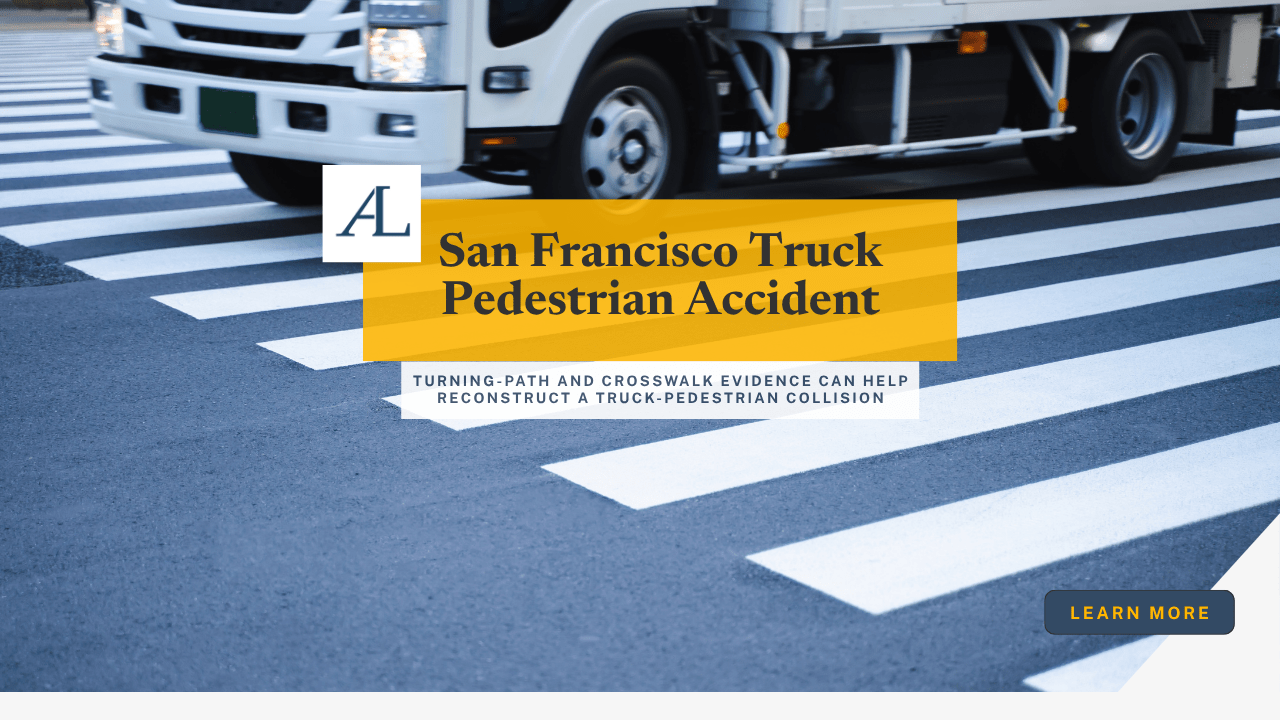
A San Francisco truck pedestrian accident can happen when a large commercial vehicle begins a right or left turn and its path enters a crosswalk occupied by a pedestrian. The collision may occur at a downtown intersection, near a delivery location, along a commercial corridor, or anywhere a truck must negotiate a relatively tight urban turn while pedestrians are crossing. Because large trucks are longer and wider than passenger vehicles, the driver’s path through an intersection and the rear wheels’ path can differ substantially, creating a larger area of potential conflict with people walking nearby.
California’s driver guidance makes pedestrian safety at crosswalks clear. The California DMV explains that pedestrians generally have the right-of-way in marked and unmarked crosswalks and instructs drivers to use caution, reduce speed, or stop as necessary to allow pedestrians to finish crossing safely. California DMV — Pedestrians and Crosswalks provides the state’s current guidance.
A San Francisco truck pedestrian accident should therefore be investigated from the moment before the truck begins its turn. The inquiry may need to determine the truck’s starting lane, the driver’s position, the trailer’s movement, the pedestrian’s location, the traffic-signal phase, the crosswalk boundaries, the truck’s speed, whether the driver stopped, and whether the pedestrian was already visible before the turn began. The final impact point matters, but it is only one part of the overall sequence.
Large trucks create additional visibility and turning challenges. California DMV guidance notes that commercial vehicles have significant blind spots and that large vehicles need more room for turns. The DMV also explains that the rear wheels of a long vehicle follow a shorter path than the front wheels during a turn, a phenomenon often called off-tracking. California DMV — Truck Drivers discusses the need for commercial drivers to manage space carefully during turns, while the commercial driver handbook describes the importance of monitoring mirrors and keeping the rear of the vehicle from striking pedestrians or objects during a wide turn.
Those physical limitations do not eliminate a driver’s responsibility to make the turn safely. They help explain why a San Francisco truck pedestrian accident may require more detailed evidence than an ordinary passenger-car collision. Cab cameras, side cameras, mirrors, telematics, route information, witness statements, traffic cameras, pedestrian position, trailer movement, and company training records may all become important in determining what the driver could see and what precautions were taken.
When a pedestrian is injured by a turning commercial vehicle, an experienced San Francisco personal injury lawyer, pedestrian accident lawyer, and truck accident lawyer at Avrek Law Firm can help preserve evidence, identify the trucking entities involved, communicate with insurers, and document the medical and financial consequences of the crash.
Call 866-598-5548, start a live chat, or request a free case review today. There are no upfront legal fees, and you do not pay unless we win.
Call 866-598-5548, start a live chat, or request a free case review today. There are no upfront fees, and you do not pay unless we win.
Reconstructing a San Francisco Truck Pedestrian Accident
A San Francisco truck pedestrian accident should be reconstructed as a moving sequence rather than from a single photograph of the truck after impact. Large commercial vehicles may begin a turn from one lane, swing through several parts of the intersection, and move the rear wheels along a different path than the cab. Investigators may need to establish the truck’s position before entering the intersection, the pedestrian’s location when the turn began, the path followed by the tractor and trailer, and the exact area where the truck crossed the pedestrian’s route.
The reconstruction should also consider the truck’s size, wheelbase, trailer configuration, turning radius, lane width, intersection geometry, curb line, crosswalk markings, traffic signals, and any obstructions that affected visibility. A San Francisco truck pedestrian accident may look straightforward in hindsight, but the actual turning path can become complicated when a long vehicle must negotiate narrow lanes or dense urban traffic.
Starting Lane, Turn Direction, Trailer Movement, and Final Position
The truck’s starting lane can affect how much of the intersection the driver needed to occupy during the turn. A large vehicle making a right turn may need to begin farther from the curb than a passenger car, while a left-turning truck may require substantial clearance to avoid striking the curb or another vehicle. California’s commercial driving guidance specifically recognizes that longer vehicles off-track more during turns and that commercial drivers must manage that path carefully.
A San Francisco truck pedestrian accident should document whether the truck remained in one lane, entered another lane during the turn, or swung wide before turning. The investigation should also identify whether a trailer was attached, because the trailer’s rear wheels can follow a different path from the tractor and may enter areas the pedestrian did not expect the vehicle to occupy.
Photographs should show the full intersection, crosswalk, lane markings, curb line, stop line, and final truck position. Close images of the point of contact are useful, but wider photographs are often more important for understanding the vehicle’s geometry.
The truck’s final resting position should be treated cautiously. A driver may stop immediately after impact, continue several feet before realizing contact occurred, or move the vehicle at the direction of police or emergency responders. A San Francisco truck pedestrian accident should therefore compare final position with video, witness accounts, debris, tire marks, vehicle damage, and police measurements.
The Pedestrian’s Location and Direction Within the Crosswalk
The pedestrian’s path should be documented independently from the truck’s path. Investigators should determine where the pedestrian entered the crosswalk, which direction the person was walking, whether the pedestrian signal permitted crossing, and approximately where the pedestrian was when the truck began to turn.
California DMV guidance states that pedestrians have the right-of-way in marked and unmarked crosswalks and that drivers should allow pedestrians enough time to cross safely. A San Francisco truck pedestrian accident should therefore determine whether the pedestrian was already within the crosswalk before the truck entered the turn.
Crosswalk position may also affect visibility. A pedestrian close to the cab may enter an area that is difficult to see through mirrors alone, while someone farther into the crosswalk may be visible through the windshield. The exact location should be established through surveillance, witnesses, pedestrian property, vehicle contact points, and police documentation whenever possible.
The pedestrian’s pace can also matter, particularly when the person is older, using a mobility device, carrying items, walking with a child, or otherwise moving more slowly. California DMV specifically reminds drivers that some pedestrians may need extra time to cross. A San Francisco truck pedestrian accident should avoid assuming that every pedestrian moves through a crosswalk at the same speed.
Signal Phase, Stop Line, and Roadway Layout
Signal information can help determine what each road user was permitted or expected to do. A San Francisco truck pedestrian accident may involve a green light for the truck and a pedestrian walk signal at the same time, creating a turning conflict that requires the driver to yield before crossing the pedestrian’s path.
The investigation should document the traffic signal, pedestrian signal, stop line, crosswalk markings, turn arrows, lane-use signs, curb configuration, and any temporary construction or traffic-control changes. Business or traffic-camera footage may show the signal phase immediately before impact.
The truck’s stop position can also matter. If the driver stopped beyond the limit line or partially inside the crosswalk, the viewing angle may have changed before the turn began. Conversely, a properly positioned truck may still have visibility limitations that require careful mirror and blind-spot checks.
A San Francisco truck pedestrian accident should preserve photographs from the driver’s approximate seating height and from the pedestrian’s approach. These different perspectives can help explain what each person could reasonably see.
Trucking and Scene Evidence to Preserve
A San Francisco truck pedestrian accident can generate evidence from multiple sources because commercial vehicles often contain more technology and business records than ordinary passenger cars. The truck itself may have cab cameras, side cameras, event data, GPS, telematics, dispatch records, route information, and electronic driver communications. The company may also possess training, employment, maintenance, and trip-assignment documents.
These records should be identified early because some data may be overwritten or retained only for a limited period. The pedestrian’s legal team should also preserve independent scene evidence, including traffic cameras, surveillance video, witness statements, roadway photographs, and the pedestrian’s damaged property.
Cab Cameras, Dashcams, Telematics, and Route Information
Commercial trucks increasingly use cameras for safety, fleet management, and insurance purposes. A San Francisco truck pedestrian accident may involve a forward-facing dashcam, inward-facing cab camera, side cameras, rear cameras, or other systems that captured the pedestrian or the turning sequence.
The complete original video should be preserved rather than only a short clip selected by the company or insurer. Several minutes before the collision may show where the truck traveled, whether the driver stopped, when the turn signal activated, whether the driver checked mirrors, and how the pedestrian entered the crosswalk.
Telematics may provide speed, GPS position, braking, acceleration, route information, or other vehicle activity depending on the system. These records can help establish when the truck approached the intersection and whether the driver slowed before turning.
A San Francisco truck pedestrian accident may also involve route instructions or delivery schedules. A driver may have been approaching a known delivery point, searching for an address, or making a scheduled turn. That context does not prove negligence, but it can help investigators understand why the truck was in the intersection and what records may exist.
Traffic Cameras, Business Video, Witnesses, and Driver Statements
San Francisco’s dense urban environment means there may be several potential cameras near a truck-pedestrian collision. Businesses, residential buildings, parking facilities, transit locations, intersections, delivery docks, or other properties may have cameras that captured the truck’s approach or turn.
A San Francisco truck pedestrian accident should identify those cameras quickly because recordings may be overwritten. Even a camera that did not capture the impact may show the truck’s lane position, signal use, speed, or pedestrian movement moments earlier.
Witnesses can provide additional perspective. A motorist waiting at the intersection may have seen the truck swing wide. Another pedestrian may have observed the injured person already in the crosswalk. A delivery worker, cyclist, transit passenger, or business employee may have seen the driver’s movements before impact.
Driver statements should also be preserved. The truck driver may say the pedestrian entered a blind spot, crossed unexpectedly, or was never seen before contact. Those statements should be compared with the physical and digital evidence rather than accepted or rejected automatically.
Truck, Trailer, Pedestrian Property, and Roadway Damage
The truck and trailer should be photographed before repairs or cleaning alter the evidence. A San Francisco truck pedestrian accident may leave marks on the bumper, side steps, wheels, tires, mirrors, body panels, trailer, undercarriage, or other components. Even relatively minor marks can help identify the point of contact.
The pedestrian’s property should also be preserved. Clothing, shoes, phone, glasses, backpack, mobility equipment, shopping bags, or other items may show contact points or where the pedestrian was struck and fell.
Roadway evidence can include scuff marks, tire tracks, debris, blood, dropped personal property, or other physical indicators of the collision path. Police photographs and measurements may preserve evidence that disappears when traffic resumes.
A San Francisco truck pedestrian accident should combine these physical records with the truck’s turning geometry, surveillance, witness accounts, and digital data.
Visibility and Company-Record Questions
Visibility is often one of the most contested issues in a San Francisco truck pedestrian accident. Large trucks have substantial blind areas, and a pedestrian close to the front or side of the vehicle may be difficult to see through ordinary mirrors. California DMV guidance recognizes these large-vehicle blind spots and refers to them as “No Zones.”
The existence of blind spots does not end the investigation. Commercial drivers are trained to use mirrors, manage space, and monitor the vehicle carefully during turns. The inquiry should determine what visibility equipment was installed, whether it was functioning, where the pedestrian was positioned, and what checks the driver made before and during the turn.
Mirrors, Camera Systems, Cab Position, and Areas Around the Truck
A San Francisco truck pedestrian accident should document the truck’s mirrors and camera systems exactly as they existed at the time of the collision. Convex mirrors, side mirrors, hood mirrors, front cameras, side cameras, proximity systems, or other technology may provide different fields of view.
California’s commercial driving guidance emphasizes regular mirror checks and specifically states that turns are situations requiring additional mirror use. The investigation should therefore determine whether the driver checked the relevant mirrors before and during the turn and whether any camera or monitoring system was operational.
Cab height also matters. A truck driver may have an excellent forward view of distant traffic while having difficulty seeing a person close to the bumper or passenger side. Photographs from the driver’s seating position can help show those sightlines.
A San Francisco truck pedestrian accident may require qualified reconstruction or human-factors analysis when visibility is heavily disputed. The injured person should not attempt to determine the exact limits of the driver’s field of view without appropriate evidence.
Driver Training, Trip Assignment, and Delivery Instructions
A commercial carrier may possess training records showing how the driver was instructed to manage pedestrian-heavy intersections, blind spots, turns, mirror checks, and urban deliveries. A San Francisco truck pedestrian accident should preserve those materials when they may be relevant.
Trip-assignment records can identify whether the driver regularly traveled the route or was unfamiliar with the location. Delivery instructions may show whether the driver was required to enter a particular street, loading area, or driveway.
Training and route familiarity should not be treated as automatic proof of liability either way. An experienced driver can still make an unsafe turn, while a new driver is not automatically negligent simply because the route was unfamiliar.
The goal is to understand what the company expected and what the driver actually did.
Carrier, Vehicle Owner, and Trailer Owner Information
The name on the side of the truck does not necessarily identify every legally relevant party. A San Francisco truck pedestrian accident may involve a motor carrier, separate vehicle owner, leasing company, trailer owner, contractor, shipper, delivery service, employer, or another business relationship.
Insurance policies may also be spread across several entities. The driver’s employer may carry commercial liability coverage, while another company owns the tractor or trailer. Contractual arrangements may determine who maintained the vehicle or controlled the trip.
The pedestrian should photograph company names, USDOT numbers where visible, license plates, vehicle numbers, trailer numbers, and other identifying information. Those details can help determine which records and insurers need to be contacted.
A San Francisco truck pedestrian accident should identify these relationships before any broad release is signed.
Injury and Insurance Documentation
A San Francisco truck pedestrian accident can produce severe injuries because the pedestrian has little physical protection against a large vehicle. The person may be knocked to the ground, pinned, struck by a wheel or trailer, or experience multiple impacts during the collision.
Medical care should be based on the actual injuries and healthcare providers’ recommendations. The legal claim should document the treatment accurately while also preserving employment, transportation, mobility, and insurance records that explain the broader effect of the crash.
Emergency Care, Imaging, Specialist Treatment, and Rehabilitation
Emergency records can establish the earliest injuries and symptoms. A San Francisco truck pedestrian accident may result in fractures, head trauma, spinal injuries, soft-tissue injuries, internal injuries, joint damage, road rash, or other conditions depending on the impact.
Preserve ambulance records, emergency-room documentation, imaging, surgical reports, medication records, specialist consultations, therapy notes, and follow-up recommendations. The injured pedestrian should also report symptoms that develop after the emergency visit rather than assuming they are unimportant because they were not immediately recognized.
Rehabilitation can become substantial after a serious pedestrian injury. Physical therapy, occupational therapy, mobility training, orthopedic care, neurological treatment, and other services may be recommended depending on the diagnosis.
A San Francisco truck pedestrian accident should also document assistive devices such as crutches, walkers, wheelchairs, braces, or other equipment when medically prescribed.
Commercial Insurance Communications and Recorded Statements
Commercial insurers may begin investigating quickly after a serious pedestrian crash. Company representatives, adjusters, investigators, attorneys, or third-party administrators may contact the injured pedestrian or family.
A San Francisco truck pedestrian accident should maintain a communication log identifying who called, which company the person represents, the claim number, what information was requested, and what documents were provided.
Use caution with recorded statements. The pedestrian should answer factual questions honestly but should not guess about truck speed, mirror position, blind spots, or exact distances when those details are unknown.
Broad medical authorizations should also be reviewed carefully. The insurer may have legitimate reasons to request records relevant to the claimed injuries, but the scope of the authorization should be understood before it is signed.
Mobility, Employment, Transportation, and Daily Activity Changes
A serious pedestrian injury can change far more than the person’s medical schedule. A San Francisco truck pedestrian accident may leave someone unable to walk normal distances, use stairs, commute, drive, work full shifts, care for children, shop independently, exercise, or perform household responsibilities.
These changes should be documented with specific examples. Work records may show missed shifts, reduced hours, modified duty, disability leave, or lost overtime. Transportation records may show increased rideshare, taxi, transit, rental, or family-assistance costs.
Mobility changes may require assistive equipment, home modifications, or temporary help from relatives. Keep receipts and provider recommendations where applicable.
A San Francisco truck pedestrian accident should document these losses contemporaneously so the claim reflects the person’s actual recovery rather than relying on estimates reconstructed later.
Comparative Fault and Crosswalk Disputes
Insurance companies may argue that the pedestrian entered the crosswalk too late, moved unexpectedly, ignored a signal, or was distracted. California law requires pedestrians to follow traffic-control rules, but motorists also have significant duties toward people crossing the roadway.
California DMV guidance states that pedestrians have the right-of-way in marked and unmarked crosswalks while also recognizing that pedestrians must follow the rules of the road. A San Francisco truck pedestrian accident should therefore investigate both the pedestrian signal and the driver’s turning movement rather than assuming fault based solely on the fact that a collision occurred in the crosswalk.
Phone records, surveillance, witnesses, signal timing, pedestrian position, and the driver’s observations may all become relevant when distraction or timing is disputed.
The evidence should also distinguish between a pedestrian entering immediately in front of an already moving truck and a pedestrian who was clearly within the crosswalk before the driver began turning. Those are materially different factual situations.
What to Do After a Turning Truck Hits a Pedestrian in San Francisco
Medical attention should come first. A pedestrian struck by a commercial truck may have serious injuries even if the person remains conscious and is initially able to speak or move.
When circumstances permit, preserve the truck’s identifying information, including company name, license plate, vehicle number, trailer number, and any visible carrier information. Photograph the crosswalk, signal, truck, pedestrian property, roadway, final positions, and surrounding cameras.
A San Francisco truck pedestrian accident should also identify witnesses immediately. Ask for names and contact information rather than relying on the assumption that police will record everyone who saw the crash.
Do not communicate extensively with the trucking company’s insurer before understanding who the representative works for and what information is being requested. Preserve every email, letter, voicemail, and claim number.
The truck itself and its electronic records may also need preservation. Commercial carriers can begin their own investigation quickly, so evidence requests should not be delayed unnecessarily.
California Deadlines for a San Francisco Truck Pedestrian Accident
California Code of Civil Procedure section 335.1 generally provides a two-year limitations period for many actions involving injury caused by another person’s wrongful act or neglect. The current California statutes can be reviewed through the California Code of Civil Procedure.
Different deadlines can apply depending on the defendants and circumstances. If a government vehicle, public entity, or dangerous public property condition is involved, separate claim procedures and significantly shorter deadlines may apply.
A San Francisco truck pedestrian accident should be investigated well before the filing deadline because crucial evidence can disappear quickly. Truck video can be overwritten, electronic records may follow retention schedules, business surveillance may disappear, vehicles can be repaired, and witnesses can become harder to locate.
The practical preservation timeline is therefore much shorter than the lawsuit deadline.
Frequently Asked Questions About a San Francisco Truck Pedestrian Accident
Who has the right-of-way when a truck turns through a crosswalk?
California DMV states that pedestrians generally have the right-of-way in marked and unmarked crosswalks, while pedestrians also must obey applicable traffic-control rules.
A San Francisco truck pedestrian accident should examine the pedestrian signal, truck signal, turning movement, and pedestrian location before determining responsibility.
Why are turning trucks especially dangerous for pedestrians?
Large trucks require more space to turn and have larger blind areas than ordinary passenger vehicles. Their rear wheels can also follow a tighter path than the front of the truck.
California DMV specifically recognizes large-vehicle blind spots and off-tracking during turns.
What evidence can show how the truck turned?
Cab cameras, dashcams, side cameras, telematics, GPS records, traffic cameras, business surveillance, witnesses, police diagrams, vehicle damage, pedestrian property, and roadway evidence can help reconstruct the turn.
A San Francisco truck pedestrian accident should preserve these records quickly when possible.
Can a truck driver’s blind spot excuse the collision?
A blind spot is relevant evidence but does not automatically resolve liability. Commercial drivers are trained to use mirrors and manage the space around their vehicles during turns.
California commercial driving guidance emphasizes mirror use during turns and awareness of blind areas.
What if the pedestrian was already in the crosswalk before the truck began turning?
That sequence can be particularly important. Video, signal timing, witnesses, and pedestrian position may help establish when the pedestrian entered the crosswalk relative to the truck’s movement.
A San Francisco truck pedestrian accident should reconstruct that timing carefully.
What if the truck was making a legal turn on a green light?
A green light does not necessarily eliminate the need to yield to pedestrians lawfully crossing the roadway. The exact signal phases and pedestrian position should be investigated.
Does the trailer matter?
Yes. A trailer’s rear wheels can follow a different path from the tractor, and the trailer may enter an area the pedestrian did not expect.
The truck and trailer configuration should be documented.
Should the trucking company’s camera footage be preserved?
Yes, when relevant. Commercial camera footage may show the driver’s view, pedestrian position, mirrors, signal use, and the truck’s movement before impact.
Preservation should occur promptly because electronic recordings can be overwritten.
What if the truck driver says the pedestrian appeared suddenly?
That statement should be compared with surveillance, witnesses, cab cameras, traffic signals, sightlines, and the pedestrian’s actual location.
A San Francisco truck pedestrian accident should be based on all available evidence rather than one person’s account.
What company records can matter?
Driver training, route assignments, dispatch records, telematics, camera footage, maintenance records, employment information, delivery instructions, and vehicle ownership records can all become relevant depending on the facts.
Can more than one company be involved?
Yes. The carrier, driver employer, tractor owner, trailer owner, delivery company, contractor, or another entity may be involved.
The business relationships should be investigated rather than assumed from the logo on the vehicle.
What if I cannot work after the pedestrian accident?
Preserve work restrictions, employer communications, pay records, schedules, disability documentation, and information showing missed work or reduced hours.
A San Francisco truck pedestrian accident may involve both current and future employment losses depending on the injuries.
How long do I have to file a California pedestrian injury claim?
California Code of Civil Procedure section 335.1 generally provides a two-year period for many injury actions based on another person’s wrongful act or neglect. Other deadlines may apply depending on the parties.
Claims involving public entities can require much faster action.
Do I need a lawyer after a commercial truck pedestrian accident?
Legal assistance can be particularly useful because commercial crashes may involve company records, electronic truck data, multiple insurers, corporate defendants, and complex turning-path evidence.
A San Francisco personal injury lawyer, pedestrian accident lawyer, and truck accident lawyer can help preserve and organize that evidence.
Call or Contact Avrek Law Firm 24/7 for a Free Consultation and Pay Nothing Unless We Win
A San Francisco truck pedestrian accident can become difficult when the truck driver says the pedestrian entered a blind spot, the company argues that the turn was normal, or insurers disagree about whether the pedestrian entered the crosswalk before the truck began moving. The strongest answers often come from objective evidence: cab cameras, traffic video, telematics, mirror configuration, signal timing, truck and trailer geometry, witness accounts, physical damage, and the pedestrian’s position.
Avrek Law Firm can help preserve that evidence before it disappears. Our team can investigate the truck, driver, carrier, vehicle owner, trailer owner, available insurance, company records, surveillance, medical treatment, employment losses, transportation costs, and long-term effects of the injuries.
A San Francisco truck pedestrian accident should be investigated promptly because commercial evidence can change quickly. Video can be overwritten, vehicles can be repaired, and corporate records may become harder to obtain as time passes.
If you or someone you love was injured when a turning commercial truck entered a crosswalk in San Francisco, call 866-598-5548, start a live chat, or complete our online consultation form today. Your consultation is free, and you do not pay unless we win.
Serving Pedestrians Throughout San Francisco
A San Francisco truck pedestrian accident may happen at a downtown intersection, near a delivery route, along a busy commercial corridor, near a construction site, or anywhere large trucks and pedestrians share limited urban space. San Francisco’s dense street network can place commercial vehicles close to pedestrians at intersections, loading zones, crosswalks, curbside delivery areas, and transit corridors.
The local environment can also provide valuable evidence. Nearby businesses may have cameras, transit facilities may have recordings, witnesses may include other pedestrians or cyclists, and police or emergency responders may document the truck’s exact position before it is moved.
A San Francisco personal injury lawyer can help preserve local evidence while Avrek’s pedestrian accident lawyers and truck accident lawyers address the commercial-vehicle, insurance, medical, and financial issues.
A San Francisco truck pedestrian accident should ultimately be reconstructed from the full turning sequence: where the truck began, where the pedestrian was walking, what the signals showed, how the cab and trailer moved, what the driver could see, and what evidence remains after the crash.
- 📩 Submit a request through our online form
- 📞 Call 866-598-5548 now to speak with our team
- 💬 Start a live chat for immediate assistance
There are no upfront fees, and you don’t pay unless we win.