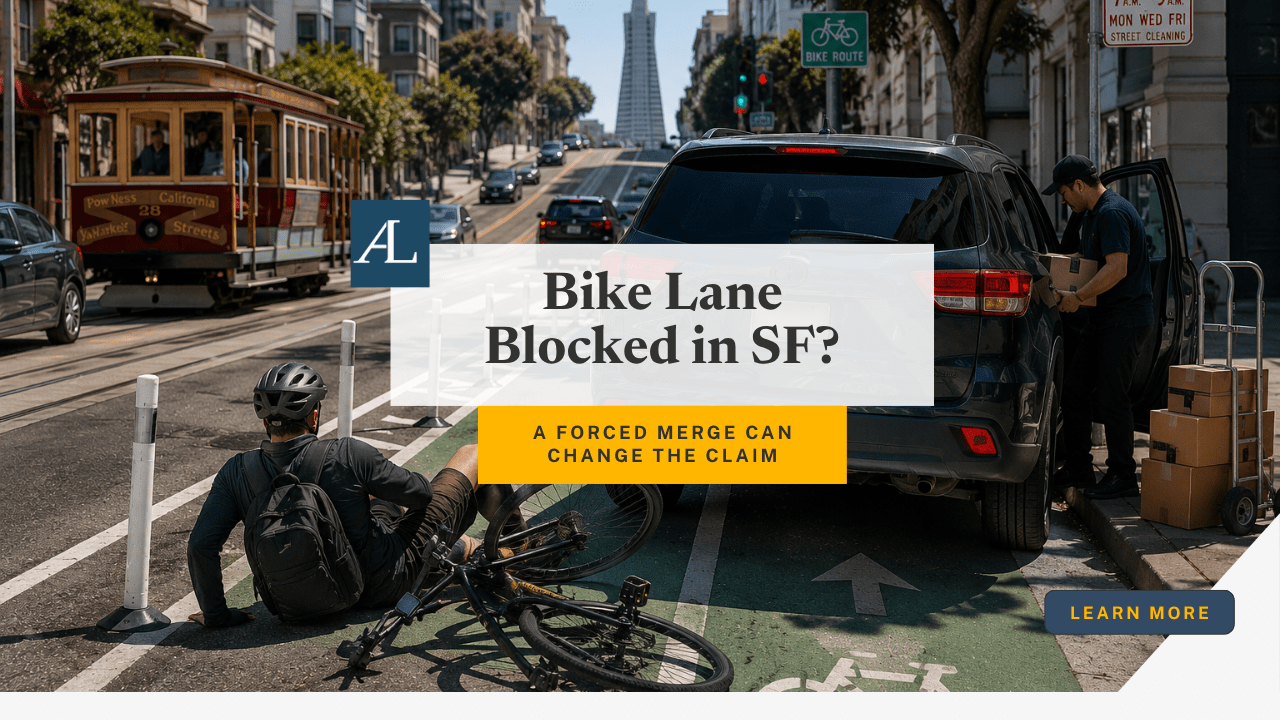
San Francisco blocked bike lane bicycle accident claim cases can become complicated because the vehicle blocking the bike lane may not be the vehicle that directly hits the cyclist. A rider may be traveling in a marked or protected bike lane when a delivery van, rideshare vehicle, parked car, moving truck, contractor vehicle, or double-parked driver blocks the path ahead. The cyclist may then have to brake suddenly, merge into traffic, ride around the obstruction, or take evasive action that leads to a crash.
These collisions are especially dangerous in San Francisco because many bike lanes run through tight urban corridors with buses, rideshare pickups, steep grades, delivery zones, parked cars, and fast-moving traffic nearby. A blocked lane can force a cyclist out of the space designed to protect them and into a vehicle lane where drivers may not expect them. If the cyclist is struck while moving around the obstruction, the insurance company may try to blame the rider for “leaving the bike lane” instead of asking why the rider was forced out of it.
A San Francisco blocked bike lane bicycle accident claim should be investigated through the full sequence of events. The key question is not only who made contact with the cyclist. The key question is what caused the rider to leave the bike lane, whether the blocked lane created a foreseeable hazard, whether nearby drivers gave enough space, and whether evidence exists to show the obstruction before it was moved.
When a bicycle crash leaves you injured, choosing the right legal representation matters. An experienced San Francisco bicycle accident lawyer at Avrek Law Firm can move quickly to preserve photos, video footage, witness statements, delivery records, rideshare records, and insurance evidence before it disappears.
Call 866-598-5548, start a chat, or request a free case review today. There are no upfront fees, and you don’t pay unless we win.
Why a San Francisco Blocked Bike Lane Bicycle Accident Claim Is Often Disputed
A San Francisco blocked bike lane bicycle accident claim is often disputed because the obstruction may be gone by the time police, insurers, or investigators review the scene. A delivery driver may pull away. A rideshare driver may complete the pickup. A parked vehicle may leave. Traffic may resume as if nothing happened. Without early documentation, the insurance company may focus only on the cyclist’s final movement and ignore the blocked lane that created the danger.
Drivers and insurers may also argue that the cyclist should have stopped, waited, or chosen a different route. That argument is often unfair. Cyclists are legal road users, and bike lanes exist to provide a safer travel path. When a vehicle blocks that path, the rider may have only seconds to decide whether to brake, merge, or avoid the obstruction.
Blocked Bike Lanes Can Force Cyclists Into Moving Traffic
A blocked bike lane can create an immediate hazard. The cyclist may be boxed in by the curb on one side and moving traffic on the other. If a delivery vehicle or parked car blocks the lane ahead, the rider may need to check traffic, signal if possible, and move left into a general travel lane. In dense San Francisco traffic, that maneuver may be risky even when the cyclist acts carefully.
A San Francisco blocked bike lane bicycle accident claim may involve a no-contact crash, a sideswipe, a dooring event, or a collision with a passing driver. The blocked vehicle may not show any damage, but that does not mean it had no role. If the obstruction forced the cyclist into traffic or caused a sudden evasive movement, the driver who blocked the bike lane may still need to be investigated.
The insurance company may try to separate the obstruction from the final collision. Avrek Law Firm looks at the entire chain of events, including what made the cyclist leave the protected lane in the first place.
Delivery Drivers and Rideshare Vehicles May Create Short-Term Hazards
Many blocked bike lane crashes involve drivers who say they stopped “just for a minute.” A food delivery driver may stop outside a restaurant. A package driver may pull into the bike lane to unload. A rideshare driver may stop where the passenger requested pickup. A contractor may park in the lane to access a worksite. Even a short stop can create a serious hazard if it forces a cyclist into traffic.
In a San Francisco blocked bike lane bicycle accident claim, the length of the stop is not the only issue. The location, visibility, traffic speed, lane width, curb space, nearby loading zones, and the cyclist’s available escape path all matter. A driver who blocks a bike lane at the wrong time can create a dangerous situation in seconds.
Insurers may argue that the stop was brief or necessary. The better question is whether the stop was lawful, safe, and reasonable under the conditions.
No-Contact Bike Crashes Still Need Serious Investigation
A cyclist may have a claim even if they never touched the vehicle blocking the bike lane. For example, a rider may swerve around a parked van and be sideswiped by another driver. Another rider may brake hard to avoid a blocked lane and go over the handlebars. A third rider may hit a pothole or curb while trying to avoid a double-parked vehicle.
A San Francisco blocked bike lane bicycle accident claim should not be dismissed simply because there was no contact with the stopped vehicle. The claim may still turn on whether the stopped or parked vehicle created a foreseeable danger and whether that danger caused the rider’s crash.
No-contact claims often require stronger evidence. Photos, video footage, witness statements, helmet camera footage, dashcam footage, GPS data, and nearby business surveillance may become critical.
California Bike Lane Rules That May Matter After the Crash
A San Francisco blocked bike lane bicycle accident claim may involve several California laws addressing motor vehicles in bike lanes, obstructions in bikeways, and safe passing around cyclists. These laws do not automatically decide every claim, but they help frame why blocked bike lanes can be dangerous and why driver conduct should be reviewed carefully.
Motor Vehicles in Bicycle Lanes
California Vehicle Code Section 21209 generally prohibits a person from driving a motor vehicle in a bicycle lane except in limited situations, including parking where permitted, entering or leaving the roadway, or preparing for a turn within 200 feet of an intersection. This law can become important when a driver enters or occupies a bike lane before a cyclist crash.
In a San Francisco blocked bike lane bicycle accident claim, the driver’s reason for entering the bike lane should be reviewed. A delivery stop, rideshare pickup, or convenience stop is different from preparing for a lawful turn or entering a permitted parking area. The exact location, signage, curb markings, and vehicle position may all affect the analysis.
A driver cannot simply use the bike lane as a temporary stopping area whenever it is convenient.
Stopping or Parking in a Bikeway
California Vehicle Code Section 21211 states that no person may stop, stand, sit, loiter, place, or park a vehicle or object on certain bikeways, bicycle paths, or trails when doing so blocks or impedes the normal and reasonable movement of bicyclists, unless the placement or parking is necessary for safe operation or otherwise lawful.
This can matter in a San Francisco blocked bike lane bicycle accident claim when a vehicle, object, loading activity, or stopped driver blocks the rider’s normal path. The driver or company may argue that the stop was temporary or necessary. The injured cyclist may need evidence showing the obstruction blocked normal bike movement and forced the rider into danger.
The statute also includes certain exceptions, so the facts should be reviewed carefully before accepting an insurer’s explanation.
Safe Passing When a Cyclist Must Leave the Bike Lane
California’s safe passing law requires drivers passing a bicycle traveling in the same direction to do so at a safe distance and, in many situations, with at least three feet of clearance. If that clearance cannot be provided, the driver must slow to a reasonable and prudent speed and pass only when doing so will not endanger the cyclist. This can become important when a cyclist is forced out of a blocked bike lane and into traffic.
In a San Francisco blocked bike lane bicycle accident claim, another driver may be responsible if they crowded, clipped, or sideswiped the cyclist while the rider was avoiding the obstruction. The blocked-lane driver and the passing driver may both need investigation.
The fact that a cyclist moved left does not automatically make the cyclist at fault. The reason they moved left matters.
Evidence That Can Prove the Bike Lane Was Blocked
A San Francisco blocked bike lane bicycle accident claim often depends on evidence collected quickly. The blocked vehicle may leave before anyone documents it. Camera footage may be overwritten. Witnesses may continue walking or driving. The cyclist may be taken for medical care before they can photograph the scene.
This is why early preservation is so important. The strongest evidence usually shows the obstruction, the bike lane layout, the cyclist’s path, and the traffic conditions before the crash.
Photos of the Vehicle, Bike Lane, and Street Layout
Photos should show the vehicle blocking the bike lane, the bicycle lane markings, curb color, signs, parked cars, traffic lanes, nearby intersections, loading zones, driveways, and the cyclist’s path. Wide photos can show how the obstruction affected the entire lane. Close photos can show license plates, company markings, hazard lights, open doors, curb placement, and vehicle position.
In a San Francisco blocked bike lane bicycle accident claim, street layout matters. Some bike lanes are protected with posts, curbs, or buffers. Others are painted lanes next to traffic. Some streets have steep grades, narrow lanes, or heavy curbside activity. These details can help explain why the cyclist had limited options.
If the vehicle leaves before photos are taken, the rider should still photograph the crash location, bike lane markings, debris, skid marks, damaged bicycle, and nearby camera locations.
Business Cameras, Dashcams, and Helmet Cameras
San Francisco streets often have nearby cameras. Restaurants, retail stores, apartment buildings, office buildings, buses, delivery vehicles, rideshare cars, dashcams, and helmet cameras may capture the blocked lane or the crash sequence. Video may show the vehicle stopping, the cyclist approaching, the cyclist checking traffic, and the final collision.
A San Francisco blocked bike lane bicycle accident claim can become much stronger when video confirms that the bike lane was blocked before the cyclist moved into traffic. Video can also show whether another driver failed to give safe clearance or whether the stopped vehicle created a sudden hazard.
Businesses and property owners may overwrite footage quickly. A preservation request should identify the exact date, time, location, and camera angle. Waiting too long may allow crucial footage to disappear.
Witnesses Who Saw the Obstruction Before the Crash
Witnesses can help confirm that the bike lane was blocked, especially when the obstructing vehicle leaves the scene. A pedestrian may have seen a delivery van stop in the lane. A nearby driver may have seen the cyclist forced left. A restaurant employee may know that delivery vehicles regularly block that stretch of bike lane. Another cyclist may have encountered the same obstruction moments before the crash.
In a San Francisco blocked bike lane bicycle accident claim, witness statements can help fill gaps when there is no video or when the video does not show the full lane. Names, phone numbers, emails, and short written summaries should be saved as soon as possible.
Witness testimony can be especially important when the insurance company tries to claim the cyclist simply swerved into traffic for no reason.
Who May Be Liable After a Blocked Bike Lane Bicycle Crash?
A San Francisco blocked bike lane bicycle accident claim may involve more than one liable party. The driver who blocked the bike lane may be responsible. The driver who hit the cyclist may be responsible. A delivery company, rideshare company, employer, contractor, property owner, or loading-zone operator may also need review depending on the facts.
Identifying every responsible party is important because bicycle crash injuries can be serious and one insurance policy may not be enough.
The Driver Who Blocked the Bike Lane
The driver who stopped or parked in the bike lane may be liable if their conduct created the hazard that caused the cyclist’s crash. This may involve a delivery driver, rideshare driver, private driver, moving truck operator, contractor, or commercial vehicle driver.
A San Francisco blocked bike lane bicycle accident claim should examine why the vehicle was stopped, whether safer parking or loading options existed, how long the vehicle was there, whether hazard lights were on, whether the driver opened a door, and whether the vehicle blocked the cyclist’s normal movement.
The driver may claim they had no other choice. That claim should be tested against the street layout, available loading zones, curb markings, and nearby parking conditions.
The Driver Who Hit or Crowded the Cyclist
A second driver may also be liable if they struck or crowded the cyclist after the rider moved around the blocked lane. Drivers must watch for cyclists, pass safely, and adjust to road conditions. A driver cannot ignore a cyclist simply because the cyclist had to leave the bike lane.
In a San Francisco blocked bike lane bicycle accident claim, the final impact should be reviewed carefully. Did the passing driver give enough space? Did they slow down? Did they see the cyclist signal or merge? Was traffic heavy? Did the driver speed, drift, or fail to react?
Both the obstruction and the passing driver’s behavior may have contributed to the crash.
A Delivery Company, Employer, or Rideshare Platform
If the blocked vehicle was being used for work, a company may need to be investigated. A package delivery company, food delivery platform, courier service, rideshare platform, contractor, moving company, or employer may have records showing why the vehicle stopped where it did.
A San Francisco blocked bike lane bicycle accident claim may involve app records, GPS logs, delivery routes, dispatch notes, pickup/drop-off timestamps, company policies, and driver instructions. These records can show whether the driver was working and whether unsafe stopping practices were part of a larger pattern.
Company involvement can also affect available insurance coverage.
A Business or Property Owner Creating Repeated Loading Hazards
Some locations repeatedly attract vehicles that block bike lanes. A restaurant may lack a safe loading area. A building may direct delivery drivers to an unsafe curb. A construction site may push vehicles into a bike lane. A property owner may allow repeated obstructions that create foreseeable cyclist hazards.
A San Francisco blocked bike lane bicycle accident claim should not assume the nearby business is automatically liable. However, if the same location repeatedly creates unsafe bike lane obstructions, business practices and property conditions may deserve review.
Prior complaints, delivery instructions, camera footage, and witness accounts can help determine whether the danger was foreseeable.
Injury Documentation After a San Francisco Bicycle Accident
A San Francisco blocked bike lane bicycle accident claim must prove both liability and damages. Even when fault is clear, insurance companies may minimize the cyclist’s injuries, argue that treatment was excessive, or claim that symptoms were unrelated to the crash.
Strong medical and daily-life documentation helps show the full impact.
Emergency Care and Follow-Up Treatment
Cyclists should seek medical attention as soon as possible after a crash. Common injuries include fractures, concussions, road rash, shoulder injuries, wrist injuries, knee trauma, hip injuries, neck pain, back pain, and nerve symptoms. Some symptoms may appear immediately. Others may worsen over hours or days.
In a San Francisco blocked bike lane bicycle accident claim, emergency records can document the first symptoms, while follow-up care can show the recovery timeline. Imaging, orthopedic evaluations, neurology visits, physical therapy, wound care, prescriptions, and work restrictions may all become important.
Delaying care may give insurers an excuse to dispute the claim, even when symptoms are real.
Bicycle, Helmet, and Gear Damage
The bicycle and gear should be preserved before repairs or replacement. A bent wheel, scraped frame, broken brake lever, cracked helmet, torn jacket, damaged gloves, broken lights, or crushed pannier can help show how the crash occurred.
A San Francisco blocked bike lane bicycle accident claim may rely on this physical evidence to prove impact direction and crash severity. Helmet damage may support head injury symptoms. Clothing and gear damage may support road rash, shoulder injuries, or fall mechanics.
Photos should be taken from multiple angles. Repair estimates and replacement receipts should be saved.
Missed Work, Transportation Costs, and Daily Limits
A bicycle crash can disrupt work, commuting, childcare, errands, and independence. A cyclist may miss work, need rideshare transportation, pay for bike repairs, attend medical appointments, or stop riding because of pain or fear.
A San Francisco blocked bike lane bicycle accident claim may include wage records, employer notes, appointment calendars, transportation receipts, bike repair estimates, pain journals, and family observations. These records help show the practical impact of the crash beyond the medical bills.
Insurance companies often focus on the crash scene. Injury victims must also document how the crash changed daily life.
Frequently Asked Questions About a San Francisco Blocked Bike Lane Bicycle Accident Claim
A San Francisco blocked bike lane bicycle accident claim often raises questions because the crash may involve one vehicle blocking the bike lane, another vehicle striking the cyclist, and several insurance companies trying to avoid responsibility.
Can I have a claim if a vehicle blocked the bike lane but did not hit me?
Yes. You may still have a claim if the blocked bike lane caused you to take evasive action that led to a crash. Direct contact with the blocking vehicle is helpful evidence, but it is not always required. Photos, video, witnesses, bike damage, and traffic conditions may help prove the obstruction caused the collision.
What if another driver hit me while I was going around the blocked bike lane?
Both drivers may need to be investigated. The vehicle blocking the bike lane may have created the danger, while the passing driver may have failed to give safe clearance. A San Francisco blocked bike lane bicycle accident claim may involve more than one responsible party and more than one insurance policy.
Does it matter if the stopped vehicle had hazard lights on?
Hazard lights do not automatically make a blocked bike lane safe or lawful. The real questions are whether the vehicle blocked normal bicycle movement, whether the stop was lawful, whether the cyclist had a safe path, and whether the obstruction caused the crash.
What evidence should I collect after a blocked bike lane crash?
Useful evidence includes photos of the vehicle blocking the bike lane, license plate, company markings, bike lane signs, street layout, damage to your bicycle, helmet and gear damage, witness names, camera locations, medical records, repair estimates, and insurance communications.
Should I talk to the insurance company right away?
Be careful. Insurance adjusters may focus on why you left the bike lane instead of why the lane was blocked. Before giving a detailed recorded statement, it may help to speak with a San Francisco bicycle accident lawyer who can preserve evidence and identify all responsible parties.
Call or Contact Avrek Law Firm 24/7 for a Free Consultation and Pay Nothing Unless We Win
A San Francisco blocked bike lane bicycle accident claim can become complicated when the obstructing vehicle leaves, video footage is overwritten, witnesses disappear, and insurers try to blame the cyclist for being forced into traffic. These cases require fast evidence preservation and a full review of the entire crash sequence.
Avrek Law Firm helps injured cyclists investigate blocked bike lane crashes, preserve delivery and rideshare records, locate camera footage, and challenge unfair insurance arguments. Our team understands how bicycle accident claims are defended and how quickly important evidence can disappear.
Speaking with a San Francisco bicycle accident lawyer may help you understand what evidence should be preserved after a blocked bike lane crash. These cases may also overlap with issues handled by a San Francisco personal injury lawyer, especially when injuries are serious, multiple insurance policies may apply, or fault is disputed.
If you or someone you love was injured after a vehicle blocked a bike lane in San Francisco, Avrek Law Firm is ready to help.
- 📩 Submit a request through our online form
- 📞 Call 866-598-5548 now to speak with our team
- 💬 Start a live chat for immediate assistance
There are no upfront fees, and you don’t pay unless we win.