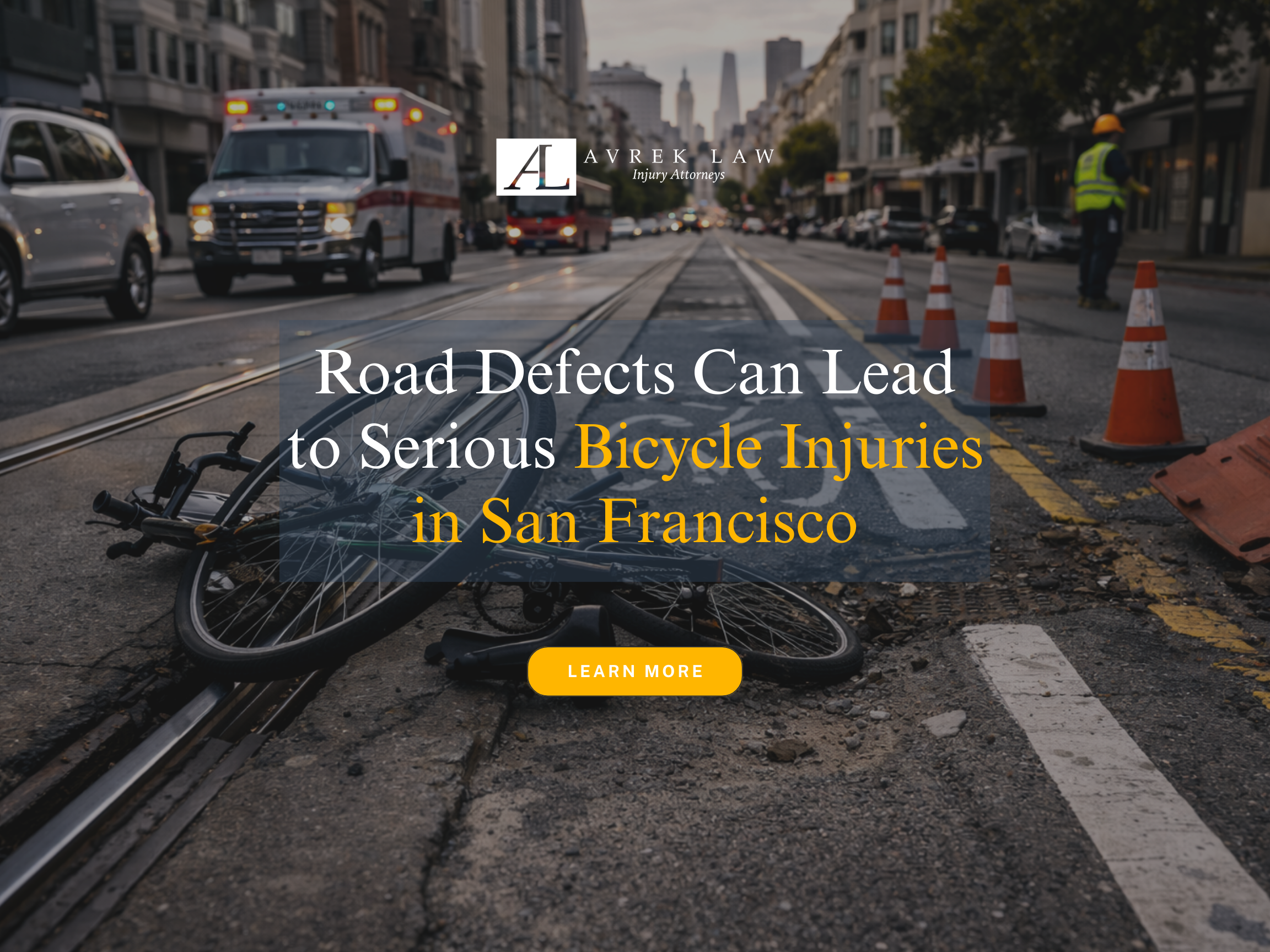
A San Francisco bicycle accident lawyer often evaluates crashes that were not caused by driver negligence alone. In dense urban cycling corridors such as Market Street, the Embarcadero, Valencia Street, and Golden Gate Park approaches, infrastructure itself can become the central liability issue.
San Francisco’s terrain and aging roadway network create unique cycling hazards. Steep grades, rail tracks, inconsistent pavement repairs, and evolving bike lane designs all introduce risk factors that can contribute to severe injuries.
At Avrek Law, we represent injured cyclists throughout San Francisco and the Bay Area. With over $2 billion nationwide recovered nationwide, we understand that infrastructure-related crashes require careful documentation and early procedural compliance.
📞 Call 866-598-5548, start a chat, or request a free case review. You only pay if we win.
When Roadway Design Contributes to the Crash
Not all bicycle accidents are caused by negligent drivers.
In San Francisco, infrastructure-related causes may include:
• Streetcar tracks that trap narrow bicycle tires
• Uneven pavement near utility cuts
• Steel construction plates with elevation differences
• Abrupt bike lane terminations
• Inconsistent protected lane barriers
• Loose gravel left after construction
In these cases, the legal analysis shifts from driver behavior to dangerous condition evaluation.
A San Francisco bicycle accident lawyer must determine whether the roadway condition created a substantial risk when used with reasonable care.
Public Entity Responsibility and Notice
When a dangerous condition of public property is involved, liability may extend to the city or another government entity.
California law requires injured parties to follow specific claim procedures before filing suit against a public entity.
For procedural guidance, see California Courts Civil Overview.
To establish liability, the injured cyclist typically must show:
• The condition was dangerous
• The public entity had notice
• The entity failed to repair or warn
• The defect was a substantial factor in causing injury
Notice may be proven through prior complaints, maintenance logs, inspection reports, or evidence that the defect existed for a sufficient period.
Construction Zones and Temporary Hazards
San Francisco’s constant construction environment creates additional cycling risks.
Temporary hazards may include:
• Poorly secured steel plates
• Loose debris in bike lanes
• Sudden elevation transitions
• Inadequate signage
• Improper detours
When private contractors create hazardous conditions, liability may extend beyond the city to the construction company.
These cases often involve layered responsibility.
Why Documentation Is Critical
Infrastructure defects can disappear quickly.
Potholes are patched.
Plates are removed.
Construction zones shift.
Lane markings change.
Early photographs and witness statements often determine whether a defect can be clearly proven.
Without documentation, insurers may argue that the roadway was safe.
Comparative Fault in Bicycle Infrastructure Cases
Even when infrastructure is the primary issue, insurers may attempt to assign partial fault to the cyclist.
Arguments may include:
• Excessive downhill speed
• Failure to avoid visible hazards
• Improper tire selection
• Riding outside designated lane areas
California’s comparative negligence framework allows recovery even if fault is shared, but compensation may be reduced proportionally.
That makes liability framing critical.
Frequently Asked Questions About Infrastructure-Related Bicycle Accidents in San Francisco
Can the City of San Francisco be held liable for a dangerous bike lane?
Yes, if the condition qualifies as a dangerous condition of public property and the city had notice of it. Notice can be actual or constructive. Constructive notice means the defect existed long enough that it should have been discovered through reasonable inspection.
What qualifies as a dangerous condition?
Not every crack or bump qualifies. The condition must create a substantial risk when the roadway is used with reasonable care. Courts evaluate the size, location, foreseeability of harm, and prior complaint history.
What if the defect was repaired shortly after my crash?
Repairs do not automatically eliminate liability. However, they make documentation crucial. Photographs taken immediately after the incident can preserve evidence of the condition as it existed at the time of injury.
Can contractors be responsible instead of the city?
Yes. If a construction company created the hazard or failed to properly secure a work zone, liability may extend to that contractor.
Does comparative fault apply to cyclists?
Yes. If the cyclist’s conduct contributed to the incident, compensation may be reduced proportionally under California law.
How long do I have to file a claim involving a public entity?
Claims involving government entities often require early formal notice before a lawsuit may proceed. Deadlines can be shorter than standard personal injury cases.
Before Infrastructure Issues Are Overlooked
In San Francisco bicycle crashes, the focus often defaults to driver behavior. But infrastructure defects can be just as significant.
If you were injured in a cycling accident involving a road hazard or construction condition, consulting a San Francisco bicycle accident lawyer early can help ensure all potential sources of liability are examined.
Call 866-598-5548 today for a confidential consultation.