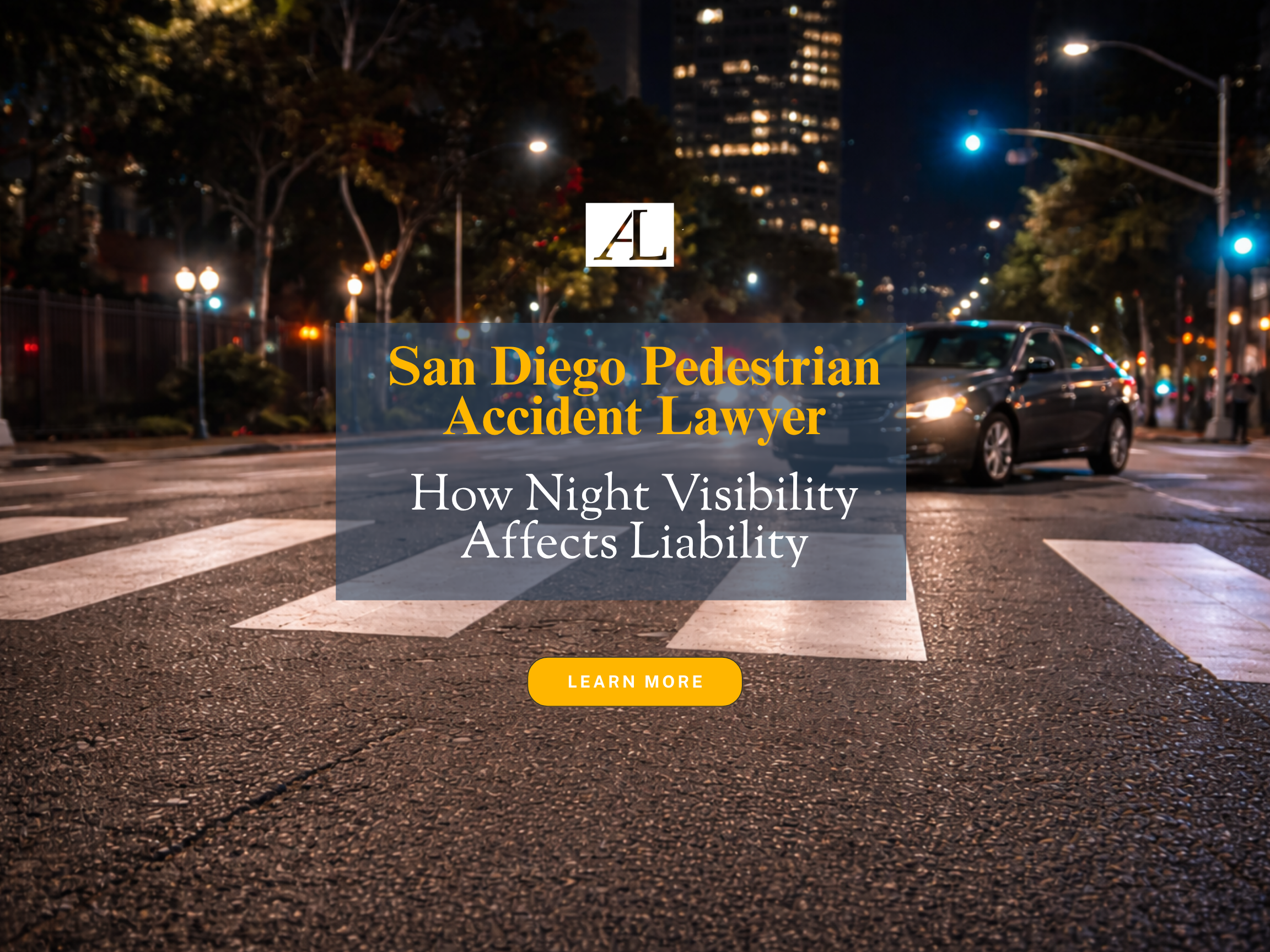
A San Diego pedestrian accident lawyer often handles cases where the central issue is not whether a collision occurred—but how visibility is interpreted after it happens.
Pedestrian accidents at night are among the most disputed claims. Drivers frequently say they never saw the pedestrian, while injured individuals are left trying to understand why visibility has become the focus of the case instead of the driver’s behavior.
For many people, this is where the confusion begins.
At Avrek Law, we regularly work with injured pedestrians throughout San Diego. What we often see is that these cases are not decided by whether it was dark—but by how both visibility and driver responsibility are evaluated together.
📞 Call 866-598-5548, start a chat, or request a free case review today. You don’t pay unless we win.
Why Night Pedestrian Accidents Are Evaluated Differently
Nighttime conditions change how accidents are interpreted.
Reduced lighting, headlight range, and reaction time all become factors. But what matters most is not just visibility itself—it is whether the driver acted reasonably under those conditions.
Drivers are expected to adjust their behavior at night. That includes speed, awareness, and attention to surroundings.
The issue is not simply whether a pedestrian was visible—it is whether the driver should have seen them.
How a San Diego Pedestrian Accident Lawyer Analyzes Visibility Claims
A San Diego pedestrian accident lawyer evaluates these cases by looking at the full context—not just the moment of impact.
This includes:
- Lighting conditions in the area
- Traffic flow and speed
- Whether the pedestrian was in a crosswalk
- Whether the driver was paying attention
- The driver’s ability to react
We often see that visibility arguments focus on a single factor, while the broader circumstances tell a different story.
What Most People Don’t Realize About Night Visibility
Many people assume that if it was dark, the driver is not responsible.
But that assumption is often incorrect.
We regularly see cases where:
- Drivers claim they “never saw” the pedestrian
- Visibility is used as a defense
- Responsibility is shifted onto the injured person
What matters is not just whether the pedestrian was visible—but whether the driver was driving in a way that accounted for reduced visibility.
How Insurance Companies Use Visibility to Reduce Claims
In many cases, insurance companies focus heavily on visibility because it allows them to assign partial fault.
We often see insurers argue that:
- The pedestrian was difficult to see
- Clothing or positioning reduced visibility
- The pedestrian entered the roadway unexpectedly
These arguments are used to reduce compensation—even when the driver had the ability to avoid the crash.
The Role of Evidence in Night Pedestrian Cases
Because these cases depend on interpretation, evidence becomes critical.
Photographs of the scene, lighting conditions, surveillance footage, and witness accounts all help establish what actually happened.
In some cases, accident reconstruction or lighting analysis may be necessary to determine whether the driver’s actions were reasonable.
Without strong evidence, these cases can quickly become disputes based on competing narratives.
How Fault Is Evaluated in California
California follows a pure comparative negligence system. This means fault can be shared, and compensation is reduced based on the percentage of responsibility assigned.
For general civil case guidance, see California Courts:
https://selfhelp.courts.ca.gov/civil-lawsuit
This is why visibility arguments matter—because they are often used to assign partial fault.
What Changes When a Lawyer Gets Involved Early
When a San Diego pedestrian accident lawyer becomes involved early, the focus shifts from assumptions to analysis.
Instead of accepting initial interpretations, the case is built around:
- What the driver should have seen
- Whether reasonable care was exercised
- How the conditions actually affected visibility
We often see that early involvement helps prevent the claim from being shaped solely by the driver’s account.
Frequently Asked Questions About Night Pedestrian Accident Claims
If it was dark, does that mean the driver is not at fault?
No. Drivers are expected to adjust to nighttime conditions. Darkness does not remove responsibility—it changes how that responsibility is evaluated.
Why do drivers often say they didn’t see the pedestrian?
Because it is one of the most common defenses. However, the key question is whether they should have seen the pedestrian under reasonable conditions.
Can I still recover compensation if I wasn’t in a crosswalk?
Yes. While crosswalk location matters, it does not automatically determine fault. The full circumstances are evaluated.
Why do insurance companies focus so much on visibility?
Because it allows them to assign partial fault and reduce payouts.
What evidence is most important in these cases?
Lighting conditions, video footage, and witness statements are often critical.
What is the biggest mistake people make after these accidents?
Assuming the case is straightforward and not documenting the scene or conditions early.
Before Visibility Defines Your Case
Night pedestrian accidents are often framed around visibility—but they are decided based on responsibility.
If visibility is interpreted incorrectly, it can affect how your claim is evaluated.
If you were injured in a pedestrian accident, speaking with a San Diego pedestrian accident lawyer early can help ensure your case reflects what actually happened.
📞 Call 866-598-5548, start a chat, or request a free case review today.