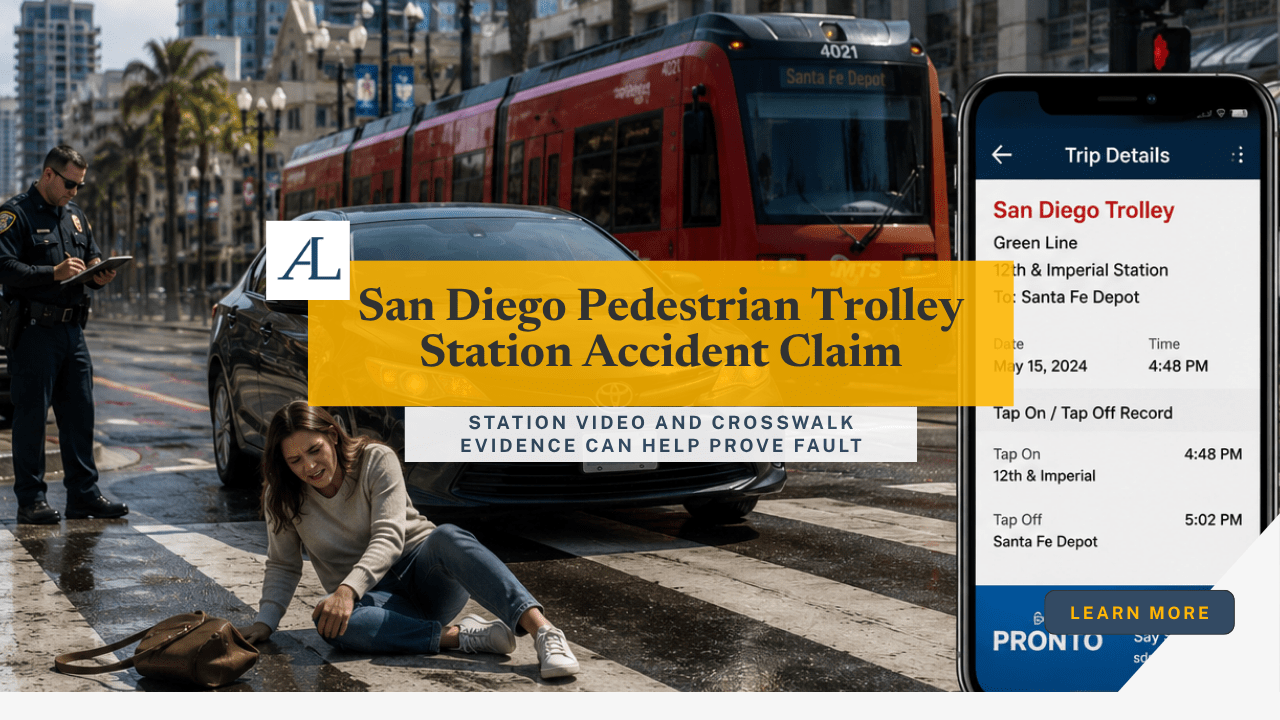
A San Diego pedestrian trolley station accident claim can become complicated because trolley stations and transit stops are busy places where pedestrians, buses, rideshare vehicles, delivery drivers, cyclists, scooters, commuters, tourists, and traffic all converge in a small area. A person may be walking from a platform to a crosswalk, crossing near a bus stop, heading toward a trolley station, stepping around a parked vehicle, or leaving a transit center when a driver fails to yield, turns too quickly, blocks visibility, or moves through the station area without enough caution.
These claims are rarely as simple as “a pedestrian was hit.” A San Diego pedestrian trolley station accident claim may involve crosswalk law, station layout, signal timing, transit video, MTS incident records, bus or trolley operator reports, rideshare pickup behavior, lighting, curb ramps, construction zones, and insurance disputes. The driver may claim the pedestrian crossed against a signal, stepped out suddenly, or was distracted by a phone. The pedestrian may know the real issue was that the driver rushed a turn, blocked the crosswalk, ignored the station environment, or failed to adjust for the number of people moving through the transit stop.
San Diego’s transit system creates many pedestrian-heavy locations. MTS says its trolley service connects downtown San Diego with East County, UC San Diego, South Bay, and the Mexico border, and its broader transit system includes 62 trolley stations and almost 100 fixed bus routes. That means pedestrian injury claims near transit stops may arise in downtown San Diego, Old Town, Little Italy, City College, 12th & Imperial, Santa Fe Depot, Barrio Logan, SDSU, Fashion Valley, UTC, San Ysidro, El Cajon, La Mesa, and other station areas where people are expected to walk before and after using transit.
When a pedestrian crash near a trolley station or transit stop leaves you injured, choosing the right legal representation matters. An experienced San Diego pedestrian accident lawyer at Avrek Law Firm can act quickly to preserve station video, identify the driver, request transit records, investigate crosswalk and curb evidence, determine whether a public entity or private driver may be responsible, and pursue compensation for the full impact of your injuries.
Call 866-598-5548, start a live chat, or request a free case review today. There are no upfront fees, and you do not pay unless we win.
Why a San Diego Pedestrian Trolley Station Accident Claim Is Often Disputed
A San Diego pedestrian trolley station accident claim is often disputed because transit environments create many opportunities for blame-shifting. A driver may say they could not see the pedestrian because of a bus, trolley column, parked car, shuttle, or rideshare vehicle. An insurer may claim the pedestrian crossed outside a designated area, moved too slowly, ignored a signal, wore dark clothing, or looked at a phone. If a transit vehicle, public roadway, or station condition may be involved, additional parties may argue about who controlled the area and who had the duty to prevent the hazard.
That is why these cases require careful investigation from the beginning. A San Diego pedestrian trolley station accident claim should examine the exact location of the impact, whether the pedestrian was in a marked or unmarked crosswalk, whether the driver was turning, whether a vehicle blocked visibility, whether station video exists, whether transit staff created an incident report, whether traffic signals were working, and whether the area had lighting, signage, curb ramps, or construction barriers that affected pedestrian movement.
San Diego Metropolitan Transit System Trolley — https://www.sdmts.com/transit-services/trolley
MTS safety guidance also reinforces that transit stations involve special pedestrian risks. Its Think FAST guidance tells riders to look both ways before crossing tracks or streets, use designated crosswalks at transit centers, use designated crossing areas on trolley tracks, stay behind the line while waiting, and stay off tracks except when crossing in designated crosswalks. Those safety reminders can become relevant in a San Diego pedestrian trolley station accident claim because they show that crossings, platforms, tracks, and transit center walking routes must be taken seriously by both pedestrians and drivers.
Drivers Must Expect Pedestrians Near Transit Stops
A driver approaching a trolley station or bus stop should expect pedestrians. People do not appear randomly in these areas; they are there because the transit system invites and requires walking. Commuters may cross from a parking lot to a platform. Students may walk between bus bays. Tourists may leave a trolley station while looking for hotels, restaurants, Petco Park, the Convention Center, or waterfront attractions. A San Diego pedestrian trolley station accident claim should therefore evaluate whether the driver adjusted their speed, attention, and turning behavior to match the predictable pedestrian activity around the stop.
California Vehicle Code Section 21950 requires drivers to yield the right-of-way to pedestrians in marked crosswalks and unmarked crosswalks at intersections. The same statute also states that drivers approaching pedestrians in a crosswalk must exercise due care and reduce speed or take other action as necessary to safeguard pedestrian safety, while also recognizing that pedestrians must use due care. In a San Diego pedestrian trolley station accident claim, insurers may focus heavily on the pedestrian’s conduct, but California law still places a clear duty on drivers to use care around pedestrians in crosswalks.
Transit Stop Layout Can Shape Liability
The layout of a transit stop or trolley station can strongly affect liability. A pedestrian may be required to cross a street to reach the platform, pass through a parking lot, walk near bus bays, move around a curb, cross tracks at a designated crossing, or navigate traffic near a transit center entrance. If the pedestrian followed station signs and designated walking routes, that evidence can help counter an insurer’s claim that the pedestrian was careless.
A San Diego pedestrian trolley station accident claim should document the full path of travel. That includes where the pedestrian started, where they were headed, which crosswalk or sidewalk they used, where the vehicle came from, whether the driver was turning or entering the station area, whether a bus or parked vehicle blocked visibility, and whether signs or barriers directed pedestrians into a particular route. These details can make the difference between an insurer calling the crash “unavoidable” and evidence showing that a driver or other party created a foreseeable hazard.
Public Entity Issues Can Create Shorter Deadlines
Some pedestrian claims near trolley stations and transit stops may involve public property, transit facilities, public sidewalks, street design, signal timing, curb ramps, construction zones, or public vehicles. When a public entity may be responsible, California claim deadlines can be much shorter than ordinary personal injury deadlines. California Government Code Section 911.2 generally requires claims relating to death, personal injury, or personal property injury against a public entity to be presented within six months after the cause of action accrues.
This does not mean every San Diego pedestrian trolley station accident claim is automatically a public entity claim. Many cases are caused entirely by private drivers, rideshare drivers, delivery vehicles, or commercial vehicles. However, if the injury involved a defective crossing, unclear signs, broken signals, inadequate lighting, dangerous public walkway design, or a public transit vehicle, early legal review is important so the correct deadlines are protected.
Common Accident Scenarios Near San Diego Trolley Stations and Transit Stops
A San Diego pedestrian trolley station accident claim may arise from several different crash patterns. Some happen in marked crosswalks near station entrances. Others happen at bus bays, parking lots, rideshare pickup areas, hotel shuttle zones, drop-off lanes, station driveways, or intersections where transit users are walking to and from platforms. These cases require more than a basic police report because the physical environment often explains why the crash happened.
Pedestrian crashes near trolley stations and transit stops are especially serious because a person has little protection against a moving vehicle. Even a low-speed impact can cause fractures, traumatic brain injuries, spinal injuries, hip injuries, shoulder injuries, knee trauma, internal injuries, or long-term pain. A San Diego pedestrian trolley station accident claim should therefore investigate not only who caused the crash, but also how the station environment contributed to the pedestrian’s exposure.
Crosswalk Crashes Near Trolley Platforms
Crosswalk crashes are among the most common scenarios in a San Diego pedestrian trolley station accident claim. A pedestrian may be crossing near a station entrance when a driver turns right, turns left, rolls through a stop, accelerates through a yellow light, or fails to notice pedestrians leaving a trolley. At busy stops, drivers may focus on traffic signals, buses, or navigation while failing to scan for people walking through a marked or unmarked crosswalk.
California Vehicle Code Section 21950 is important in these claims because it requires drivers to yield to pedestrians in crosswalks while also requiring pedestrians to use due care. That balance is exactly why insurers often dispute fault. They may argue the pedestrian entered too suddenly, but the investigation may show that the driver approached too quickly, turned without checking the full crosswalk, or ignored the predictable flow of transit users near the station.
Drivers Crossing Sidewalks Near Station Entrances
A San Diego pedestrian trolley station accident claim may also involve a driver crossing over a sidewalk near a station entrance, parking lot, driveway, garage, hotel shuttle area, bus bay, or drop-off zone. These crashes can happen when a rideshare driver, private driver, delivery vehicle, shuttle, or service vehicle pulls across a sidewalk without yielding to pedestrians walking toward or away from a transit stop.
California Vehicle Code Section 21952 states that before driving over or upon any sidewalk, the driver of a motor vehicle must yield the right-of-way to any pedestrian approaching there. This rule can be important when a driver exits a parking lot near a trolley station, enters a transit center driveway, or crosses a sidewalk to reach a curbside pickup area. A pedestrian should not be blamed simply because a driver failed to yield before crossing a walkway.
Vehicles Blocking Crosswalks, Sidewalks, or Station Paths
Visibility obstruction is another common issue in a San Diego pedestrian trolley station accident claim. A car, rideshare vehicle, delivery van, shuttle, or bus may stop in a way that blocks a crosswalk or sidewalk, forcing pedestrians to move around it or preventing other drivers from seeing them. The driver who hits the pedestrian may claim the pedestrian “came out of nowhere,” but the vehicle that blocked visibility may also be part of the liability analysis.
California Vehicle Code Section 21970 states that a person may not stop a vehicle unnecessarily in a manner that causes the vehicle to block a marked or unmarked crosswalk or sidewalk. That statute can matter near stations where vehicles stop to pick up passengers, wait for rideshare requests, unload luggage, or make deliveries. A San Diego pedestrian trolley station accident claim should investigate whether a stopped vehicle created the sight-line problem that led to the crash.
Unsafe Turns and Lane Movements Near Transit Centers
Transit centers often require vehicles to turn across pedestrian paths, change lanes near bus stops, enter station driveways, or move around stopped buses and shuttles. A driver may make an unsafe lane movement while looking for a passenger, trying to reach a curb, or avoiding a bus. If a pedestrian is hit during one of these movements, the insurer may attempt to blame the pedestrian for being in a crowded station area, even though the driver had the duty to move safely.
California Vehicle Code Section 22107 states that no person may turn from a direct course or move right or left on a roadway until the movement can be made with reasonable safety and only after giving an appropriate signal if another vehicle may be affected. In a San Diego pedestrian trolley station accident claim, this rule may help show that the driver should not have turned, merged, or pulled away from a curb unless the movement was safe for pedestrians and surrounding traffic.
Speeding or Driving Too Fast for Station Conditions
A driver does not need to exceed the posted speed limit to be negligent near a trolley station or transit stop. California Vehicle Code Section 22350 prohibits driving faster than is reasonable or prudent given weather, visibility, traffic, roadway surface and width, and conditions that affect safety. Around transit stops, reasonable speed may be much lower than the posted limit because pedestrians may be crossing, buses may be stopping, and vehicles may be entering or leaving pickup zones.
In a San Diego pedestrian trolley station accident claim, speed evidence may include skid marks, vehicle damage, surveillance video, traffic signal timing, witness statements, event data, and police observations. A driver who says the pedestrian appeared suddenly may have been moving too fast for the station environment. A careful driver should anticipate pedestrian movement near transit stops rather than treating every crossing as a surprise.
Evidence That Can Strengthen a San Diego Pedestrian Trolley Station Accident Claim
A San Diego pedestrian trolley station accident claim depends heavily on evidence because transit environments change quickly. The trolley leaves. Buses rotate through the stop. Rideshare drivers move on. Station crowds clear. Surveillance footage may be overwritten. Witnesses may continue their commute or leave the area entirely. The injured pedestrian may be transported for medical care before they can take photos or gather information.
The strongest claims preserve evidence from several sources. A police report is important, but it may not capture the full station layout, video availability, driver behavior, crosswalk timing, transit records, or sight-line obstruction. A San Diego pedestrian trolley station accident claim should be built around the entire accident environment, not just the driver’s version of events.
Station Video, Transit Records, and Incident Reports
Video can be critical in a San Diego pedestrian trolley station accident claim. Potential sources may include MTS station cameras, bus cameras, trolley platform cameras, nearby business cameras, parking garage cameras, hotel cameras, dashcams, rideshare cameras, and traffic cameras. Video may show whether the pedestrian was in a crosswalk, whether the driver turned too quickly, whether another vehicle blocked visibility, whether signals were functioning, and whether the driver stopped or continued after impact.
MTS also publishes safety guidance for riders at stops and stations, including instructions to use designated crosswalks, cross trolley tracks only at designated crossing areas, and stay behind platform lines. If a pedestrian injury occurred near a station, incident reports or transit communications may help determine whether MTS personnel responded, whether a transit vehicle was involved, and whether there were prior safety concerns at the location.
Photos of the Crosswalk, Signal, Platform, and Vehicle Position
Photos should document the station environment as soon as possible. Important images may include the crosswalk, curb ramp, platform entrance, pedestrian signal, traffic signal, bus stop sign, trolley crossing sign, warning lights, gates, lane markings, sidewalk, bike lane, curb color, nearby parked vehicles, lighting, obstructions, and final vehicle position. These photos can become powerful evidence when an insurer claims the pedestrian was not visible or was walking in an unsafe place.
A San Diego pedestrian trolley station accident claim may turn on details that seem small at first. A delivery van blocking the curb, a rideshare vehicle parked near a crosswalk, a construction barrier narrowing the sidewalk, or a bus stopped near an intersection can change what drivers and pedestrians could see. Photos taken immediately after the crash can preserve the conditions before the scene returns to normal.
Witness Statements From Riders, Drivers, and Transit Staff
Witness statements are especially important near transit stops because many people may see different parts of the event. A bus passenger may see the pedestrian enter the crosswalk. A trolley rider may see a turning vehicle fail to yield. A rideshare passenger may see a driver block the station path. A transit employee may see whether a warning signal or gate was working. A nearby business employee may know that the same location has had repeated close calls.
A San Diego pedestrian trolley station accident claim should collect names, phone numbers, and short descriptions of what each witness observed. Witnesses may leave quickly, especially if they are commuting, traveling, or headed to work or school. Early legal involvement can help locate witnesses before memories fade and before contact information is lost.
Medical Records and Delayed Symptoms
Pedestrian crashes near trolley stations and transit stops can cause serious injuries. Common injuries include fractures, traumatic brain injuries, spinal injuries, hip injuries, knee injuries, shoulder injuries, internal injuries, nerve damage, facial injuries, dental injuries, lacerations, bruising, and emotional trauma. Some symptoms appear immediately, while others worsen over several days.
Medical records are critical because they connect the injury to the crash. A San Diego pedestrian trolley station accident claim should include emergency care, ambulance records, urgent care records, imaging, orthopedic treatment, neurological evaluations, physical therapy, work restrictions, and follow-up treatment. If the pedestrian delays care, insurers may argue that the injuries were minor or unrelated. Prompt medical attention protects both health and the strength of the claim.
Transit Fare, Phone, and Location Records
In some cases, digital records can help prove where the pedestrian was and when the accident happened. A PRONTO fare record, trolley schedule, rideshare receipt, phone location history, text message, photo timestamp, or transit app route may help establish that the pedestrian was traveling to or from a station. These records can be useful when an insurer disputes the pedestrian’s route, timing, or reason for being near the transit stop.
A San Diego pedestrian trolley station accident claim may also involve phone data from the driver. If the driver was distracted, using navigation, looking for a rideshare passenger, texting, or checking a delivery app, phone records may become relevant. Preserving these records often requires legal action before the data is deleted or becomes difficult to obtain.
Who May Be Liable After a Pedestrian Accident Near a San Diego Trolley Station or Transit Stop?
A San Diego pedestrian trolley station accident claim may involve more than one responsible party. The driver who hit the pedestrian may be the most obvious defendant, but other parties may also contribute to the dangerous conditions. Liability may depend on who controlled the vehicle, who controlled the property, whether a public entity had responsibility for the sidewalk or station area, whether a transit vehicle was involved, and whether another parked or stopped vehicle blocked visibility.
The key is to identify every source of fault and insurance coverage. Serious pedestrian injuries can lead to major medical expenses, long-term treatment, lost income, and life-changing limitations. If the investigation stops with one driver when several parties contributed to the crash, the injured pedestrian may lose access to compensation that should have been pursued.
A Negligent Driver
The most common liable party in a San Diego pedestrian trolley station accident claim is the driver who struck the pedestrian. Driver negligence may include failure to yield in a crosswalk, unsafe turning, speeding, distracted driving, failing to check for pedestrians, blocking a sidewalk, driving over a sidewalk without yielding, or moving from a stopped position without reasonable safety.
These cases often overlap with claims handled by a San Diego car accident lawyer, especially when the crash involves a private passenger vehicle. If the crash involved a rideshare pickup or drop-off near a trolley station, the claim may also require guidance from a San Diego rideshare accident lawyer because app status, pickup location, and rideshare insurance can affect coverage. If the crash involved a delivery truck, shuttle, or commercial vehicle, a San Diego truck accident lawyer may need to review company records, driver logs, routing instructions, and maintenance evidence.
A Rideshare, Shuttle, Taxi, or Delivery Driver
Transit stops often attract rideshare pickups, hotel shuttles, taxis, food delivery vehicles, package vans, and private drop-offs. These vehicles may stop near station entrances, crosswalks, curb ramps, or bus bays. A driver may rush to pick up a passenger, stop in a crosswalk, block a sidewalk, or pull away without checking for pedestrians.
A San Diego pedestrian trolley station accident claim involving a commercial or app-based driver should investigate the driver’s employment status, app activity, dispatch records, vehicle positioning, insurance coverage, and whether the driver stopped in a lawful and safe place. A company may try to deny control or blame the pedestrian, but records can show whether the driver was working, what instructions they received, and whether the pickup or delivery created the hazard.
A Public Entity or Transit Operator
Some pedestrian injuries near trolley stations and transit stops may involve public property, transit facilities, or public vehicles. A public entity or transit operator may need to be investigated if the accident involved a dangerous station crossing, malfunctioning pedestrian signal, inadequate lighting, broken curb ramp, unsafe platform access, confusing signs, poor traffic control, or a public vehicle. These claims are fact-specific and require careful review of who owned, maintained, controlled, or operated the location.
Because California Government Code Section 911.2 generally requires many personal injury claims against public entities to be presented within six months, a San Diego pedestrian trolley station accident claim involving public property should be reviewed quickly. Waiting too long can risk missing a deadline before the injured person even understands who may be responsible.
A Property Owner, Contractor, or Maintenance Company
A nearby property owner, construction contractor, maintenance company, or event operator may also contribute to a pedestrian accident near a transit stop. A construction barrier may force pedestrians into traffic. A private parking lot may direct pedestrians through an unsafe driveway. A hotel or venue may encourage pickups near a dangerous curb. A maintenance company may fail to repair lighting, pavement, or walking surfaces that lead to a fall or vehicle conflict.
A San Diego pedestrian trolley station accident claim should examine whether private property conditions played a role. This is especially important near mixed-use station areas with hotels, apartments, offices, restaurants, event venues, parking lots, and retail centers. A driver may have caused the impact, but a dangerous property condition may have contributed to the pedestrian’s vulnerability.
Insurance Defenses and Comparative Fault in San Diego Transit Stop Pedestrian Claims
A San Diego pedestrian trolley station accident claim is often defended by blaming the pedestrian. Insurers may argue the pedestrian crossed outside a designated area, ignored a signal, walked while distracted, wore dark clothing, stepped from behind a bus, failed to use a crosswalk, or entered the roadway too quickly. These arguments can reduce claim value if they are not challenged with evidence.
California follows pure comparative negligence. In Li v. Yellow Cab Co., the California Supreme Court adopted comparative negligence and held that responsibility and damages should be allocated in proportion to fault rather than barred entirely by contributory negligence. That means an insurer may try to assign a percentage of fault to the pedestrian, but it also means fault can be divided among the driver, another vehicle, property owner, public entity, or other responsible parties.
Comparative fault makes evidence essential. A San Diego pedestrian trolley station accident claim should not accept a driver’s statement that the pedestrian “came out of nowhere” without reviewing video, signal timing, station layout, vehicle speed, sight lines, and whether the driver was turning or distracted. Transit stops are pedestrian-heavy by design, and drivers should expect people to be walking near platforms, crosswalks, bus bays, and station entrances.
Pedestrian Distraction Does Not Automatically Decide Fault
A pedestrian may have been using a phone, checking a transit app, reviewing a route, or looking for an arriving trolley or bus. Insurers may use that fact to argue the pedestrian caused the crash. However, pedestrian distraction does not automatically excuse a driver who failed to yield, drove too fast, blocked a crosswalk, or made an unsafe turn near a transit stop.
A San Diego pedestrian trolley station accident claim should evaluate distraction in context. Was the pedestrian in a crosswalk? Did the driver have time to stop? Was the driver also distracted by navigation, a rideshare app, or traffic? Did the driver fail to reduce speed near a known transit stop? The answers matter more than a generalized claim that the pedestrian looked at a phone.
“I Did Not See Them” Is Not a Complete Defense
Drivers often say they did not see the pedestrian. Near a trolley station or transit stop, that statement may reveal negligence rather than excuse it. A driver approaching a station area should anticipate pedestrians, especially around crosswalks, platforms, bus stops, transit center entrances, and parking lot paths.
A San Diego pedestrian trolley station accident claim should investigate why the driver did not see the pedestrian. Was the driver looking at a phone? Was a vehicle blocking the crosswalk? Was the driver turning too quickly? Was the station poorly lit? Were pedestrians directed into a route that created a blind spot? These questions help determine whether the crash was avoidable.
Public Transit Areas Require More Care, Not Less
Some insurers try to frame transit stop crashes as chaotic accidents that no one could prevent. That framing should be challenged. Transit stops are known areas of pedestrian movement, which means drivers should use extra caution, not less. Buses stopping, trolley riders crossing, pedestrians carrying bags, students commuting, and visitors navigating unfamiliar streets are predictable parts of the environment.
A San Diego pedestrian trolley station accident claim should focus on reasonable conduct under the circumstances. If a driver approached a station without slowing, turned through a crosswalk, blocked a pedestrian path, or failed to yield, the crowded transit environment may strengthen the claim rather than weaken it.
What to Do After a Pedestrian Accident Near a San Diego Trolley Station or Transit Stop
After a pedestrian accident, medical safety comes first. Call 911 or ask someone nearby to call. If you are in the roadway, near tracks, or in an active bus or vehicle lane, move to safety only if you can do so without worsening your injuries. Pedestrian crashes can cause serious internal, head, spine, and orthopedic injuries, so it is important to get medical care even if you are unsure how badly you are hurt.
If possible, preserve evidence before the station environment changes. Take photos of the vehicle, license plate, driver, crosswalk, signal, platform, bus stop, trolley crossing, curb ramp, sidewalk, lighting, signs, vehicle position, and visible injuries. Identify witnesses, including transit riders, drivers, MTS personnel, security staff, nearby business employees, rideshare passengers, and bystanders. Ask whether an incident report was created and save any report number you receive.
California DMV states that an SR-1 report must be sent to DMV within 10 days if someone is injured or killed, or if property damage is over $1,000, and that this report is required in addition to any police, CHP, or insurance report. A pedestrian may not be the driver responsible for filing an SR-1, but the injured person should still preserve police report information, driver insurance details, and any official documentation connected to the crash.
OUTBOUND LINK TO USE: California DMV SR-1 Accident Reporting — https://www.dmv.ca.gov/portal/dmv-virtual-office/accident-reporting/
A San Diego pedestrian trolley station accident claim should also be reported carefully to insurers. Do not give a recorded statement that guesses about speed, fault, signal timing, injuries, or whether you “could have avoided” the crash. Insurance adjusters may sound helpful, but early statements can be used later to shift blame or reduce compensation. Speaking with a San Diego pedestrian accident lawyer before detailed insurer interviews can help protect the claim.
Deadlines in a San Diego Pedestrian Trolley Station Accident Claim
A San Diego pedestrian trolley station accident claim must be handled before legal deadlines expire. California Code of Civil Procedure Section 335.1 generally provides two years for an action involving injury to, or death of, an individual caused by the wrongful act or neglect of another. That deadline may apply to many claims against private drivers, rideshare drivers, delivery drivers, or other non-public defendants.
However, evidence deadlines are often much shorter. Station video may be overwritten. Bus and trolley records may be archived. Businesses may delete surveillance footage. Witnesses may leave San Diego. Vehicles may be repaired. Traffic signal data may become harder to obtain. A San Diego pedestrian trolley station accident claim should be investigated quickly even when the lawsuit deadline seems far away.
If a public entity may be involved, the timeline may be much shorter. California Government Code Section 911.2 generally requires many personal injury claims against public entities to be presented within six months after accrual. This can matter if the claim involves MTS, a public roadway, city infrastructure, public transit property, a public employee, a public vehicle, or a dangerous condition on public property. Early legal review helps determine which deadlines apply.
Frequently Asked Questions About a San Diego Pedestrian Trolley Station Accident Claim
Can a pedestrian file a claim after being hit near a trolley station or transit stop?
Yes. A pedestrian may be able to file a San Diego pedestrian trolley station accident claim if they were injured because a driver, transit vehicle operator, rideshare driver, delivery driver, property owner, public entity, or another party failed to use reasonable care. The key question is not simply where the accident happened, but who created the danger and what evidence proves fault.
A pedestrian crash near a transit stop may involve crosswalk duties, turning rules, blocked visibility, station layout, signal timing, public property issues, or unsafe curbside activity. Because several parties may be involved, these claims should be investigated quickly before video, witness statements, and transit records disappear.
What evidence matters most after a pedestrian accident near a San Diego trolley station?
Important evidence may include station video, traffic camera footage, bus or trolley records, police reports, MTS incident reports, witness statements, photos of the crosswalk, signal timing, vehicle position, driver information, license plate photos, medical records, and photos of lighting, signs, curb ramps, and platform access points. If a vehicle blocked visibility, photos of that vehicle’s position can be especially important.
A San Diego pedestrian trolley station accident claim may also use digital evidence such as phone location data, transit app records, fare records, rideshare receipts, or timestamps from photos and messages. These records can help prove where the pedestrian was and what happened before the crash.
What if the driver says I crossed outside the crosswalk?
A driver’s claim does not automatically decide fault. The investigation should determine whether there was a marked or unmarked crosswalk, whether the pedestrian signal was active, whether the driver was turning, whether the driver was speeding or distracted, whether visibility was blocked, and whether the pedestrian had a safe route available. California pedestrian cases often require a careful comparison of both driver and pedestrian conduct.
Even when a pedestrian is accused of partial fault, California comparative negligence rules may still allow recovery based on each party’s percentage of responsibility. A San Diego pedestrian accident lawyer can help push back when insurers exaggerate pedestrian blame.
What if a bus, trolley, shuttle, or rideshare vehicle blocked the driver’s view?
Blocked visibility can be a major issue in a San Diego pedestrian trolley station accident claim. If a vehicle stopped in or near a crosswalk, blocked a sidewalk, created a blind spot, or forced the pedestrian into traffic, that vehicle’s driver or company may need to be investigated. California law restricts unnecessary blocking of crosswalks and sidewalks, and station-area vehicles should not create foreseeable pedestrian hazards.
The claim should examine whether the blocked view was caused by a private driver, rideshare vehicle, delivery truck, shuttle, bus, or other vehicle. Fault may be shared among multiple parties if more than one person or entity contributed to the crash.
MTS or a public entity be responsible for a pedestrian accident?
Possibly, depending on the facts. A public entity or transit-related party may need to be investigated if the accident involved a dangerous station condition, defective crossing, broken signal, poor lighting, unsafe sidewalk, inadequate signs, public vehicle, or transit facility issue. These claims are highly fact-specific and require careful review of ownership, control, maintenance, and notice.
Because claims against public entities may require action within six months, any San Diego pedestrian trolley station accident claim involving public property or transit operations should be reviewed as soon as possible.
What if I was hit while walking from a trolley platform to a bus stop?
You may still have a claim if the injury was caused by a negligent driver, unsafe crossing, dangerous station condition, blocked visibility, or poor traffic control. Pedestrians often need to transfer between trolley platforms, bus stops, parking areas, sidewalks, and rideshare zones. Drivers and property operators should anticipate that movement.
A San Diego pedestrian trolley station accident claim should document the transfer path, platform exit, crosswalk, traffic signal, signs, and any vehicles that affected your route. The fact that you were transferring between transit services does not eliminate the duty others owed to use reasonable care.
What injuries are common after pedestrian crashes near transit stops?
Common injuries include broken bones, traumatic brain injuries, concussions, spinal injuries, hip injuries, knee injuries, shoulder injuries, internal injuries, nerve damage, facial injuries, dental injuries, lacerations, bruising, and emotional trauma. Some injuries may not be fully apparent right away, especially when adrenaline masks pain.
Prompt medical care is important. Medical documentation can connect the injuries to the crash, show the seriousness of the harm, and help support compensation for treatment, lost income, pain, future care, and long-term limitations.
How long do I have to file a San Diego pedestrian accident claim?
Many California personal injury claims must be filed within two years, but claims involving public entities may require a government claim within six months. Evidence may disappear much sooner than either deadline, especially station video, transit records, witness information, and vehicle data.
The safest step is to speak with a San Diego personal injury lawyer quickly so the right deadlines can be identified and evidence can be preserved before it is lost.
Do I need a lawyer for a San Diego pedestrian trolley station accident claim?
Yes, especially if you were seriously injured, the driver blames you, a public entity may be involved, transit records are needed, or the crash happened near a trolley platform, bus stop, transit center, or station crossing. These claims can involve multiple insurance policies, public claim deadlines, surveillance footage, crosswalk law, comparative fault, and medical damages.
A San Diego pedestrian accident lawyer can preserve evidence, request video, communicate with insurers, identify every responsible party, and pursue compensation for medical bills, lost income, pain and suffering, future care, and long-term recovery needs.
Call or Contact Avrek Law Firm 24/7 for a Free Consultation and Pay Nothing Unless We Win
A San Diego pedestrian trolley station accident claim can become difficult when the driver blames the pedestrian, station video is at risk of being overwritten, a public entity deadline may apply, or multiple parties argue about who controlled the area. These cases often depend on evidence that disappears quickly, including MTS records, surveillance footage, traffic signal data, crosswalk photos, witness statements, vehicle damage, medical records, and incident reports.
Avrek Law Firm helps injured pedestrians, transit riders, commuters, students, tourists, workers, and families investigate serious pedestrian crashes near trolley stations, transit centers, bus stops, rideshare pickup areas, and public sidewalks. Our team can move quickly to preserve critical evidence, identify every available insurance policy, determine whether a driver, rideshare operator, commercial vehicle, property owner, public entity, or transit-related party may be responsible, and pursue compensation for the full impact of your injuries.
Speaking with a San Diego pedestrian accident lawyer may help you understand whether your case also involves a San Diego personal injury lawyer, San Diego car accident lawyer, San Diego rideshare accident lawyer, or San Diego truck accident lawyer, depending on who caused the crash and where it happened.
If you or someone you love was injured near a San Diego trolley station, bus stop, transit center, crosswalk, or station entrance, Avrek Law Firm is ready to help.
Call 866-598-5548, start a chat, or complete our online form today for a free, no-obligation consultation. There are no upfront fees, and you do not pay unless we win.
Serving the San Diego Community
Avrek Law Firm represents injured pedestrians throughout San Diego and surrounding communities. Local context matters in a San Diego pedestrian trolley station accident claim because the location often shapes the evidence, the defendants, and the insurance issues.
A pedestrian crash near 12th & Imperial may involve transfer traffic, downtown congestion, trolley platform movement, and bus connections. A crash near Santa Fe Depot, America Plaza, County Center/Little Italy, or Old Town Transit Center may involve tourists, commuters, rideshare pickups, shuttle traffic, and confusing station crossings. A crash near SDSU, UTC, Fashion Valley, Barrio Logan, City College, San Ysidro, or El Cajon Transit Center may involve students, workers, shoppers, cross-border travelers, buses, parking lots, and heavy foot traffic.
A San Diego pedestrian trolley station accident claim should be handled with urgency, precision, and attention to the station-specific details that insurers often minimize. Avrek Law Firm can meet with injured clients by phone, video, or in person, and our team can assist clients who are unable to travel because of their injuries.
- 📩 Submit a request through our online form
- 📞 Call 866-598-5548 now to speak with our team
- 💬 Start a live chat for immediate assistance
There are no upfront fees, and you don’t pay unless we win.