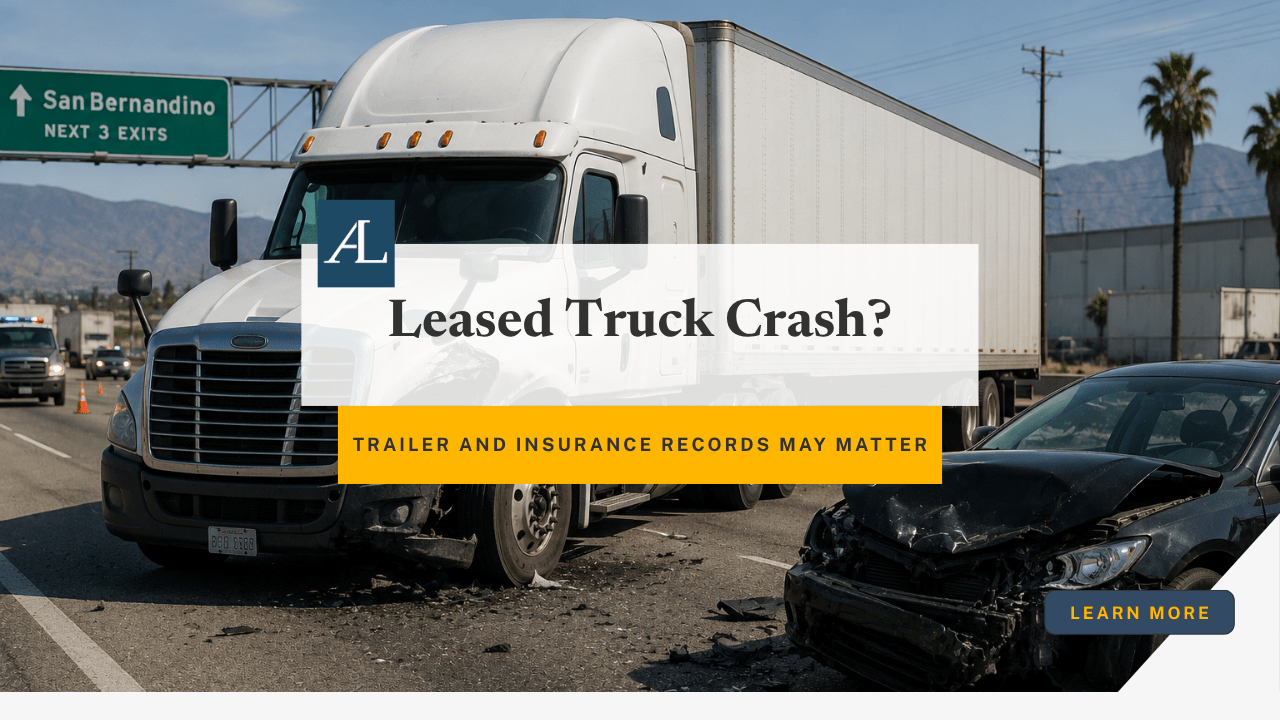
San Bernardino truck accident leased trailer insurance claim cases can become complicated because the truck, trailer, driver, freight, and insurance coverage may not all belong to the same company. After a serious commercial truck crash, an injured driver may assume the name on the side of the truck identifies the responsible company. In reality, the tractor may be leased, the trailer may be owned by a separate equipment company, the driver may work for a carrier or contractor, and the freight may have been assigned through a broker, shipper, or logistics provider.
This matters because serious truck accidents are rarely evaluated like ordinary car accident claims. When a commercial tractor-trailer causes a crash in San Bernardino, the insurance investigation may involve lease agreements, registration records, carrier identification, bills of lading, dispatch logs, maintenance records, and multiple insurance policies. A San Bernardino truck accident leased trailer insurance claim may require identifying who controlled the equipment, who maintained it, who dispatched the load, who loaded the cargo, and which policy applies to the crash.
San Bernardino and the surrounding Inland Empire are heavily connected to freight movement, warehouse traffic, commercial trucking routes, and freeway corridors. When a crash involves a leased truck or trailer, evidence can move quickly through several hands. The vehicle may be towed, the trailer may be returned to a yard, freight may be transferred, and insurers may begin communicating before the injured person knows which companies are involved.
When a commercial truck accident leaves you injured, choosing the right legal representation matters. Avrek Law Firm helps injured drivers and passengers investigate leased truck and trailer cases, preserve evidence, and pursue compensation from every responsible party.
Call 866-598-5548, start a chat, or request a free case review today. There are no upfront fees, and you pay nothing unless we win.
Why a San Bernardino Truck Accident Leased Trailer Insurance Claim Can Involve Multiple Companies
A San Bernardino truck accident leased trailer insurance claim can involve several companies because commercial trucking often separates ownership, operation, dispatch, maintenance, and cargo responsibility. One company may own the tractor. Another may own the trailer. Another may employ or contract with the driver. Another may control the shipment. Another may maintain the equipment. Each layer can affect liability and insurance coverage.
Federal leasing rules under 49 CFR Part 376 apply to equipment leasing and interchange arrangements involving motor carriers. The eCFR explains that Part 376 covers leasing equipment to perform regulated transportation, leasing equipment to motor private carriers or shippers, and equipment interchange between for-hire carriers. It also defines “equipment” to include motor vehicles, straight trucks, tractors, semitrailers, full trailers, and other equipment used in property transportation.
Differences Between Driver, Carrier, Tractor Owner, and Trailer Owner Records
A commercial crash may involve several records that point to different responsible parties. The driver record may identify the person operating the truck. The motor carrier record may identify the company operating under federal authority. The tractor registration may identify one owner. The trailer registration may identify another. The lease agreement may explain who had possession and control of the equipment at the time of the trip.
In a San Bernardino truck accident leased trailer insurance claim, these distinctions are important because the company that owns the trailer may not be the same company that hired the driver or dispatched the shipment. A trailer owner may still have relevant maintenance, inspection, or equipment history. A motor carrier may have dispatch records and driver qualification records. A freight or logistics company may have delivery instructions, load details, or communications that explain why the truck was where it was when the crash happened.
This is why a truck crash investigation should not stop with the driver’s insurance card or the name on the door. The deeper question is who controlled the vehicle, who benefited from the trip, who maintained the equipment, and who had the legal or contractual responsibility to operate the truck safely.
Why Equipment Leasing Can Create Additional Insurance Questions
Equipment leasing can create insurance questions because the policy covering the carrier may not be the only policy involved. A tractor owner, trailer owner, motor carrier, equipment lessor, cargo contractor, or excess insurer may each have coverage that needs to be reviewed. Some policies may apply only during certain operations. Others may dispute responsibility based on whether the tractor or trailer was leased, loaded, unloaded, parked, returning to a yard, or actively performing a shipment.
A San Bernardino truck accident leased trailer insurance claim may become disputed when insurers point fingers at each other. One insurer may say the carrier’s policy applies. Another may say the equipment owner’s policy is responsible. Another may argue that a separate maintenance company or loading contractor caused the problem. These disputes can delay the claim and create confusion for injured victims who need medical care, wage-loss support, and answers.
Insurance coverage disputes should not be allowed to distract from the injury claim. When multiple policies may apply, the key is to identify each possible source of coverage early and preserve communications from every insurer that contacts the injured person.
How Freight, Dispatch, and Ownership Documents May Need Review
Freight and dispatch documents can help explain what the truck was doing at the time of the crash. A bill of lading may identify the cargo, shipper, destination, and carrier. Dispatch logs may show delivery timelines, route instructions, pickup details, and communications between the driver and company. Ownership documents may show who had legal control over the tractor and trailer.
In a San Bernardino truck accident leased trailer insurance claim, these records can become critical if there is a dispute over whether the driver was working, whether the trailer was part of an active shipment, whether the vehicle was under carrier control, or whether the trailer was improperly maintained or loaded.
Federal leasing rules also address written leases, equipment identification, receipts, and records related to leased equipment. Under 49 CFR Part 376, authorized carriers using leased equipment must use written leases under certain conditions, identify leased equipment being operated in service, and keep trip documents with details such as equipment ownership, origin, departure date and time, final destination, and lading responsibility.
Records That May Identify the Responsible Companies
A San Bernardino truck accident leased trailer insurance claim may depend on documents that are not available at the crash scene. Injured motorists may receive a police report and insurance information, but the most important trucking records may be held by carriers, equipment owners, brokers, warehouses, repair vendors, and insurers.
These records may show whether the trailer was leased, whether the tractor and trailer were connected under the same carrier’s authority, whether the load was being transported under a specific dispatch, and whether any company failed to inspect, maintain, load, or operate the equipment safely.
Lease Agreements, Registration Materials, and Carrier Identification
Lease agreements can help identify which company had control over the tractor or trailer. Registration materials may show the owner of the equipment. Carrier identification may show the operating authority used for the trip. Together, these records can clarify whether the equipment was being used by the listed carrier, a subcontracted driver, a different company, or another party.
A San Bernardino truck accident leased trailer insurance claim may also require reviewing whether the trailer had proper markings, whether documents were carried with the equipment, and whether the carrier kept records required for leased equipment. If the truck or trailer was leased through a master lease or short-term arrangement, additional records may be needed to determine who had possession at the time of the collision.
The lease provisions may also matter. Federal leasing regulations state that certain written leases must identify the parties, specify duration, and address possession, control, use, and responsibility for operation during the lease period.
Bills of Lading, Dispatch Logs, and Delivery Instructions
Bills of lading, dispatch logs, delivery instructions, and load records can help show the purpose of the trip. These documents may identify the shipper, receiver, carrier, freight broker, route, cargo type, and delivery schedule. They may also show whether the driver was under pressure to meet a deadline or whether the cargo required special handling.
In a San Bernardino truck accident leased trailer insurance claim, these records can help answer practical questions. Was the trailer loaded? Was the driver headed to a warehouse, port, rail yard, distribution center, or delivery point? Was the trailer being moved empty? Was the tractor pulling equipment owned by someone else? Did dispatch communications show route changes or timing pressure before the crash?
These questions may become important if an insurer claims the trailer owner had no role, the carrier was not responsible, or the driver was operating outside the scope of a shipment.
Inspection, Repair, and Maintenance Records for the Tractor and Trailer
Inspection, repair, and maintenance records can help determine whether the tractor or trailer had safety issues before the crash. Brake problems, tire defects, lighting failures, steering issues, coupling problems, worn components, or trailer defects may contribute to a serious collision. When leased equipment is involved, maintenance responsibility may be split between the carrier, lessor, owner, repair vendor, or fleet manager.
A San Bernardino truck accident leased trailer insurance claim may require separate maintenance records for the tractor and trailer. The tractor may have one maintenance history, while the trailer may have another. If the trailer had defective lights, brakes, tires, underride guards, landing gear, or coupling equipment, the trailer owner or maintenance provider may become part of the investigation.
These records should be preserved quickly. Once the trailer is repaired, moved, released, or returned to service, evidence of pre-crash defects may become harder to document.
Insurance Layers in a Leased Commercial Truck Accident
Insurance is often one of the most complicated parts of a San Bernardino truck accident leased trailer insurance claim. A serious truck crash may involve primary commercial liability coverage, trailer owner coverage, non-trucking liability coverage, excess policies, umbrella coverage, broker-related coverage, or other insurance layers depending on the facts.
The Federal Motor Carrier Safety Administration explains that entities applying for operating authority must have minimum financial responsibility on file, and that insurance requirements can vary based on entity type, operating authority, cargo type, and vehicle type. FMCSA also notes that entities must maintain proof of insurance on file to avoid revocation proceedings.
Carrier Coverage, Equipment Owner Coverage, and Possible Excess Policies
Carrier coverage is often the first policy examined after a commercial truck accident. However, leased equipment can introduce additional policies. If the trailer was owned by another company, the trailer owner may have separate coverage. If the tractor was leased from an owner-operator, the owner may have policies that need review. If the carrier had excess coverage, that policy may become important in serious injury cases.
A San Bernardino truck accident leased trailer insurance claim may involve high damages because commercial truck crashes can cause catastrophic injuries, permanent disability, surgery, extended rehabilitation, or wrongful death. When damages exceed basic coverage, identifying excess or umbrella policies becomes critical.
FMCSA’s insurance chart lists different financial responsibility requirements depending on the carrier type and operation. For example, the FMCSA chart identifies a $750,000 bodily injury and property damage requirement for certain for-hire non-hazardous property carriers with a gross vehicle weight rating of at least 10,001 pounds. Other cargo or passenger operations may involve different requirements.
Disputes Over Which Policy Applies to the Crash
Insurance companies may dispute which policy applies when a leased tractor or trailer is involved. One insurer may argue that another company controlled the equipment. Another may claim the crash happened outside the insured trip. Another may say the driver was operating under someone else’s authority or that the trailer defect was not covered under its policy.
In a San Bernardino truck accident leased trailer insurance claim, these disputes can delay payment and create unnecessary stress for injured victims. Insurance companies may request statements, documents, or medical authorizations while they are still arguing internally about coverage. Injured people should be careful not to let insurer confusion define the claim too narrowly.
The existence of multiple policies does not mean the claim is weak. It often means the case needs a detailed investigation to identify all available coverage and responsible parties.
Why Early Communications From Trucking Insurers Should Be Preserved
Every communication from a trucking insurer should be preserved. Letters, emails, claim numbers, adjuster names, policy references, recorded statement requests, document requests, and settlement communications may help show which insurers were involved and when they became aware of the claim.
A San Bernardino truck accident leased trailer insurance claim may involve several adjusters contacting the injured person or family. One adjuster may represent the motor carrier. Another may represent the trailer owner. Another may represent a third-party maintenance company. These communications can become important if an insurer later denies involvement or claims it was not notified promptly.
Preserving communications also helps prevent confusion. When several companies are involved, keeping a clear timeline of calls, emails, claim numbers, and requests can help protect the injured person from repeated statements or inconsistent explanations.
Evidence That Can Support an Injury Claim After a Truck Crash
A San Bernardino truck accident leased trailer insurance claim should not focus only on business records. The injured person’s claim also depends on crash evidence, medical records, work records, and daily-life documentation. Commercial trucking evidence may help prove liability, but injury documentation helps show the full human impact of the crash.
The strongest claims usually combine both sides of the evidence. The trucking records explain who may be responsible. The crash evidence explains how the collision occurred. The medical and personal records explain what the crash did to the injured person’s life.
Vehicle Damage, Scene Photos, and Skid or Debris Patterns
Vehicle damage, scene photos, skid marks, debris fields, final resting positions, and impact points can help reconstruct how the crash occurred. In leased truck and trailer cases, damage to the trailer may be especially important. The trailer may show impact points, underride damage, lighting issues, coupling problems, tire failure, or cargo-related movement.
A San Bernardino truck accident leased trailer insurance claim may become disputed if an insurer argues that the injured driver caused the crash or that the truck driver had no chance to avoid impact. Physical evidence may support or contradict those arguments.
Photos should capture the tractor, trailer, passenger vehicles, road surface, lane markings, traffic signs, damage patterns, debris, and any visible company markings or DOT numbers. If the crash involved a trailer, photos of the trailer number, license plate, company markings, and rear underride area may become especially useful.
Medical Records, Specialist Referrals, and Treatment Plans
Truck accidents often cause serious injuries because of the size and weight of commercial vehicles. Medical records may document emergency treatment, fractures, spinal injuries, traumatic brain injuries, internal injuries, soft tissue injuries, surgery, pain management, physical therapy, orthopedic referrals, neurological symptoms, and long-term rehabilitation needs.
A San Bernardino truck accident leased trailer insurance claim may involve an aggressive defense if insurers believe the injuries are expensive. They may question whether the crash caused the injuries, whether treatment was necessary, whether symptoms are related to a prior condition, or whether future care is reasonable.
Consistent medical documentation helps respond to those arguments. Emergency records, imaging, specialist notes, physical therapy records, prescriptions, work restrictions, and follow-up recommendations all help create a clear medical timeline.
Work Restrictions, Travel Burdens, and Long-Term Recovery Needs
The impact of a truck crash may extend far beyond medical bills. Injured victims may miss work, lose income, need transportation to medical appointments, require household help, or struggle with long-term limitations. Family members may also miss work to provide care or attend appointments.
A San Bernardino truck accident leased trailer insurance claim should document these burdens. Work restriction notes, employer letters, pay records, mileage logs, appointment calendars, caregiver schedules, and daily symptom notes can help show how the crash affected the injured person’s life.
Truck insurers may focus heavily on liability and policy questions, but the injury claim must also show damages. The more complete the medical and daily-life records are, the harder it becomes for an insurer to minimize the real cost of the crash.
Frequently Asked Questions About a San Bernardino Truck Accident Leased Trailer Insurance Claim
A San Bernardino truck accident leased trailer insurance claim often raises questions because injured victims may not know which company owned the trailer, who employed the driver, or which insurer is responsible. These answers are written to help readers understand the practical issues that often come up after a leased commercial truck or trailer crash.
What is a San Bernardino truck accident leased trailer insurance claim?
A San Bernardino truck accident leased trailer insurance claim is a commercial truck accident claim involving a tractor, trailer, or other trucking equipment that may be leased rather than owned by the company operating it. These cases can require review of lease agreements, carrier records, trailer ownership documents, dispatch records, maintenance records, and insurance policies to determine who controlled the equipment and which coverage applies.
Why does it matter if the truck or trailer was leased?
It matters because leasing can separate ownership from operation. The company operating the truck may not own the tractor or trailer. The trailer owner may have maintenance records. The carrier may have dispatch records. A separate insurance policy may cover the equipment. In a serious crash, these distinctions can affect liability, insurance coverage, and the amount of compensation available.
Who may be responsible after a leased trailer truck accident?
Responsibility may involve the truck driver, motor carrier, tractor owner, trailer owner, maintenance provider, freight broker, cargo loader, or another company connected to the trip. The exact answer depends on who controlled the equipment, who maintained it, who dispatched the load, and whether any company’s negligence contributed to the crash.
What records should be preserved after a leased truck or trailer crash?
Important records may include lease agreements, registration materials, carrier identification, bills of lading, dispatch logs, driver qualification files, inspection reports, repair records, maintenance history, insurance correspondence, towing records, photographs, and medical documentation. These records can help identify responsible companies and support the injury claim.
Should I speak with the trucking company’s insurer right away?
You should be careful. Trucking insurers may request recorded statements, authorizations, or early settlement discussions before all companies and policies are identified. In a San Bernardino truck accident leased trailer insurance claim, speaking with a lawyer before giving a detailed statement may help protect the claim from being limited by incomplete information.
Call or Contact Avrek Law Firm 24/7 for a Free Consultation and Pay Nothing Unless You Win
A San Bernardino truck accident leased trailer insurance claim can involve multiple companies, multiple insurance policies, and records that may disappear quickly if they are not preserved. The driver, carrier, tractor owner, trailer owner, maintenance provider, cargo loader, broker, and excess insurer may all need review depending on the facts.
Avrek Law Firm helps injured victims investigate commercial truck crashes, preserve lease and insurance records, and challenge trucking companies when they attempt to shift responsibility. These cases often require fast action because vehicles are repaired, trailers are returned to service, electronic records are overwritten, and insurers begin building defenses immediately.
Speaking with a San Bernardino truck accident lawyer may help you understand what records should be preserved after a leased truck or trailer crash. These cases may also overlap with issues handled by a San Bernardino personal injury lawyer, especially when the crash causes serious injuries, lost income, or long-term recovery needs.
If you or someone you love was injured in a San Bernardino commercial truck accident involving a leased truck or trailer, Avrek Law Firm is ready to help.
- 📩 Submit a request through our online form
- 📞 Call 866-598-5548 now to speak with our team
- 💬 Start a live chat for immediate assistance
There are no upfront fees, and you don’t pay unless we win.