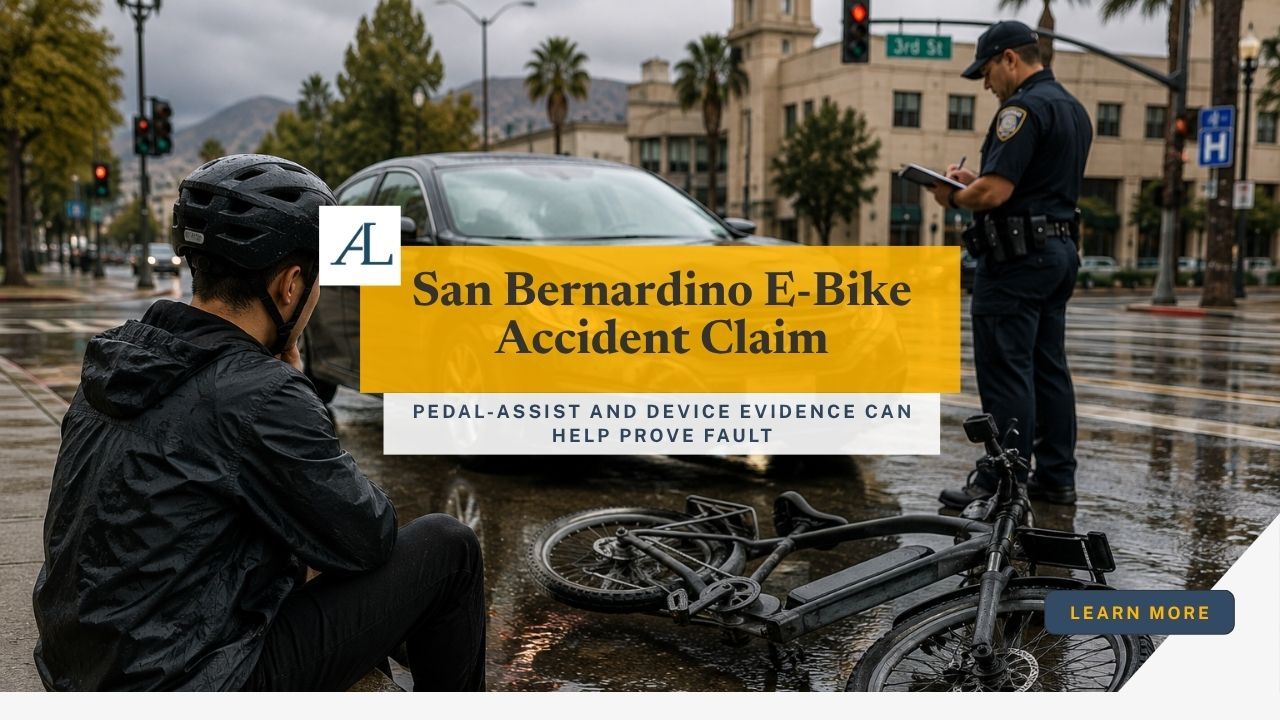
A San Bernardino e-bike accident claim can become complicated quickly because electric bicycles introduce questions that do not always appear in traditional bicycle crash cases. After a collision, an insurance company may focus on the rider’s speed, pedal-assist setting, throttle use, reaction time, helmet use, lane position, or the type of e-bike involved. Instead of looking first at the driver who turned, merged, opened a door, blocked a bike lane, or failed to yield, the insurer may try to make the rider’s technology the center of the dispute.
That pressure can be overwhelming for an injured rider. A crash that happened in seconds can lead to months of arguments over device data, motor-assist limits, app records, GPS history, repair reports, and medical documentation. A San Bernardino e-bike accident claim may involve a rider traveling through a bike lane, crossing near an intersection, passing a driveway, riding near a school or shopping center, or moving through traffic when a driver claims the e-bike was “going too fast” or “came out of nowhere.” Those phrases can sound powerful, but they are not proof. The claim should be built around evidence, not assumptions.
When an e-bike crash leaves you injured, choosing the right legal representation matters. An experienced San Bernardino bicycle accident lawyer at Avrek Law Firm can act quickly to preserve device records, document the bike’s condition, investigate the driver’s conduct, and pursue compensation for the full impact of your injuries.
Call 866-598-5548, start a live chat, or request a free case review today. There are no upfront fees, and you do not pay unless we win.
Why a San Bernardino E-Bike Accident Claim Often Becomes a Speed Dispute
A San Bernardino e-bike accident claim often becomes a speed dispute because insurers know that e-bikes can be misunderstood. Many people assume that every electric bicycle is unusually fast, motorized like a motorcycle, or difficult to control. After a crash, those assumptions can be used against the rider even when the evidence shows the driver caused the collision. A driver may say the rider appeared suddenly, crossed too quickly, or could not stop in time, while the insurer may argue that pedal-assist speed or throttle use contributed to the impact.
California law separates electric bicycles into classes, and that classification can become important in a disputed claim. Under California Vehicle Code Section 312.5 Electric Bicycle Classes, an electric bicycle is generally defined as a bicycle with fully operable pedals and an electric motor not exceeding 750 watts, with Class 1 and Class 2 assistance ceasing at 20 miles per hour and Class 3 pedal-assist assistance ceasing at 28 miles per hour with a required speedometer.
Those categories matter because a San Bernardino e-bike accident claim should not be decided by vague claims about “high speed.” The investigation should identify what class of e-bike was involved, whether the manufacturer label was present, whether the bike was modified, whether the display or app recorded speed, and whether the rider’s actual movement matched the driver’s accusation. A pedal-assist speed dispute is strongest for the defense when the rider has no preserved evidence. It becomes much weaker when the bike, device data, scene photos, and witness statements are documented early.
Driver Claims About Rider Speed or Reaction Time
A common defense in a San Bernardino e-bike accident claim is that the rider was traveling too fast to be seen or avoided. A driver may say they checked traffic, began turning, and then the e-bike appeared suddenly. That statement may reflect the driver’s perception, but perception is not the same as fault. The real question is whether the driver looked carefully, yielded when required, scanned for cyclists, checked the bike lane, and avoided moving into the rider’s path.
Reaction time is often used against e-bike riders. The insurer may argue that the rider should have braked sooner, swerved differently, or avoided the crash entirely. However, those arguments must be tested against the actual timing of the collision. If a driver turned across the rider’s path, opened a door, entered from a driveway, or merged into the bike lane without warning, the rider may have had little or no safe opportunity to avoid impact. A San Bernardino e-bike accident claim should evaluate the driver’s conduct and the rider’s real options, not hindsight assumptions made after the crash.
This is why physical evidence matters. Impact damage, skid marks, final resting positions, bike damage, helmet damage, device data, GPS history, and witness statements may all help show whether the rider had enough time to react. If the insurer claims excessive speed, it should be required to support that claim with evidence.
How Pedal-Assist Settings May Be Questioned
Pedal-assist settings can become a central issue in a San Bernardino e-bike accident claim because insurers may try to connect the rider’s assist level to fault. They may ask whether the rider was using eco mode, sport mode, turbo mode, throttle assist, or a higher assist setting. They may also ask whether the bike was modified, whether the speed limiter worked, or whether the rider had changed factory settings before the collision.
These questions are not automatically unfair. In some cases, the bike’s condition and settings may be relevant. The problem is when an insurer uses general suspicion about e-bikes to avoid analyzing the driver’s negligence. If the rider was traveling lawfully and the driver failed to yield, the mere existence of pedal assist does not make the rider responsible. A San Bernardino e-bike accident claim should separate technical questions from blame-shifting.
The rider should preserve the e-bike, battery, controller, display, motor, app records, repair reports, and photos of the assist setting if possible. If the bike has a companion app, it may contain trip history, speed estimates, route information, or ride time data. If the display was damaged, photos should still be taken before repairs are made. Preserving this evidence can help prevent the insurer from speculating about speed without proof.
Why E-Bike Accidents Can Be Treated Differently Than Traditional Bicycle Crashes
A San Bernardino e-bike accident claim may be treated differently from a traditional bicycle crash because e-bikes can raise technical questions about classification, motor assistance, rider behavior, braking distance, and road position. A traditional bicycle accident may focus mostly on right of way, driver conduct, bike lane use, lighting, helmet use, and vehicle movement. An e-bike claim may involve all of those issues plus device records, battery condition, pedal-assist modes, motor function, and whether the vehicle legally qualified as an electric bicycle.
California law also makes clear that a person riding an electric bicycle is generally subject to the bicycle rules contained in the Vehicle Code article governing bicycle operation. California Vehicle Code Section 21200 Bicycle Rights and Duties states that a person riding a bicycle upon a highway has the rights and is subject to the provisions applicable to drivers of vehicles, except provisions that by their nature cannot apply.
That means a San Bernardino e-bike accident claim should not be dismissed as less valid because the rider used electric assistance. E-bike riders still have rights, and drivers still have duties. When an insurer treats the e-bike itself as proof of fault, the claim should be redirected to the evidence: who had the right of way, who moved unsafely, who failed to look, and what the technical records actually show.
Device and Bike Evidence Riders Should Preserve
A San Bernardino e-bike accident claim can depend heavily on technical evidence that may disappear or change after the bike is repaired. Unlike many traditional bicycles, e-bikes may contain displays, controllers, batteries, motor systems, ride apps, GPS integrations, and diagnostic data. Even when the bike does not store detailed crash information, the device ecosystem may still help show route, timing, assist mode, battery condition, or whether the bike was operating normally before the impact.
Riders should avoid repairing, selling, discarding, or modifying the e-bike until the evidence has been documented. The bike itself may help answer questions about speed, braking, impact angle, component failure, lighting, and whether the insurer’s accusations are supported. A San Bernardino e-bike accident claim becomes harder when the rider fixes the bike before photos, repair estimates, and component conditions are preserved.
E-Bike Display Data, App Records, and GPS History
Display data, app records, and GPS history can be valuable in a San Bernardino e-bike accident claim. Many e-bikes have displays showing speed, assist level, battery status, trip distance, or ride mode. Some connect to apps that may store ride history, route maps, timestamps, average speed, maximum speed, or battery performance. Fitness apps, phone location history, navigation apps, and smartwatches may also help show where the rider was and how the trip progressed before the crash.
This evidence can respond directly to a pedal-assist speed dispute. If the insurer claims the rider was traveling too fast, app records may show a more moderate speed. If the driver claims the rider came from the wrong direction, GPS history may show the actual route. If the driver says the rider appeared suddenly, route and timing data may show that the rider was visible and established in the lane or crossing.
A San Bernardino e-bike accident claim should preserve screenshots immediately. Apps may update, devices may sync, ride logs may be deleted, and damaged displays may stop working. Screenshots should include the date, time, route, speed information if available, assist setting if visible, and any trip summary connected to the ride.
Battery, Brake, Tire, and Motor-Assist Condition
The physical condition of the e-bike can also matter. The battery may show whether the bike had power at the time of the crash. The brakes may show whether the rider could stop properly. The tires may show wear, traction, or damage caused by impact. The motor and controller may show whether the assist system was functioning normally. A San Bernardino e-bike accident claim should preserve all of these components before any repair shop begins replacing parts.
Insurers may argue that the rider lost control because of the e-bike rather than because of the driver’s actions. They may suggest the brakes failed, the motor surged, the battery malfunctioned, or the rider was using excessive assist. These claims require evidence. Repair estimates, diagnostic reports, photos, and mechanic statements can help show whether the bike was functioning properly or whether the crash caused the damage.
If a component failure may have contributed to the accident, the claim may require a broader investigation. A defective battery, brake issue, tire failure, or motor-assist malfunction could raise questions involving a manufacturer, repair provider, rental company, or maintenance issue. Those possibilities should be reviewed before the bike is repaired or destroyed.
Repair Estimates, Damage Photos, and Gear Documentation
Repair estimates and damage photos can help explain how the crash occurred. A bent wheel, broken fork, damaged handlebar, cracked frame, crushed pedal, torn seat, broken display, or damaged battery casing may help show impact direction and severity. The rider’s helmet, clothing, gloves, shoes, backpack, lights, reflectors, and protective gear should also be photographed and preserved.
A San Bernardino e-bike accident claim may involve serious injuries even when the vehicle impact appears modest. E-bike riders can be thrown onto pavement, into traffic, against a curb, or into a parked vehicle. Helmet damage, torn clothing, and damaged gear may support the medical record and show why the injuries were consistent with the crash.
These documentation issues connect closely with Avrek’s earlier Oxnard motor vehicle accident medical authorization form blog, where medical and claim records can affect how insurers interpret injuries. In an e-bike claim, the same principle applies: the medical file, damage file, and insurance communications should tell a consistent story before the insurer starts selecting facts out of context.
Scene Evidence That Can Help Explain the Collision
A San Bernardino e-bike accident claim is not only about the bike. The scene often explains why the crash happened. The rider’s lane position, the driver’s movement, the visibility at the intersection, the condition of the road, and the presence of driveways, parked cars, crosswalks, or bike lanes may matter just as much as device data. If the insurer focuses only on pedal-assist speed, it may be ignoring the roadway conditions that show the driver created the danger.
Scene evidence should be documented as soon as possible because it can change quickly. Vehicles are moved, debris is cleared, traffic resumes, road work continues, and witnesses leave. If the crash happened near a shopping center, school, apartment complex, transit stop, industrial area, or busy arterial road in San Bernardino, nearby cameras may preserve the clearest evidence of the driver’s conduct.
Lane Position, Crosswalks, Driveways, and Traffic Flow
Lane position can be central in a San Bernardino e-bike accident claim. The rider may have been in a bike lane, near the right side of the road, moving through an intersection, crossing near a driveway, or leaving a crosswalk area when the driver caused the collision. Insurers may argue the rider was outside a safe position, but the scene may show that the rider was using a lawful or reasonable route based on traffic flow, parked vehicles, debris, or roadway design.
Driveway crashes are common because drivers entering or leaving parking lots may focus on cars and miss e-bike riders. A driver may pull out from a gas station, restaurant, apartment driveway, or shopping center without looking carefully in both directions. The rider may have only a moment to react. If the insurer later blames speed, photos of the driveway angle, sight lines, bike lane, curb, and traffic flow can help show that the driver entered the rider’s path.
Crosswalks and intersections also matter. A rider may be accused of crossing too quickly or appearing unexpectedly, but traffic signal timing, vehicle position, crosswalk markings, and witness statements may tell a different story. A San Bernardino e-bike accident claim should document the rider’s actual path and the driver’s movement before any conclusion is reached.
Sightlines, Obstructions, Lighting, and Road Surface Conditions
Sightlines can explain why an e-bike crash happened. Parked vehicles, delivery trucks, landscaping, utility poles, construction barriers, signs, traffic queues, or building corners may block visibility. Poor lighting, glare, nighttime conditions, shadows, or sun angle may also affect what the driver and rider could see. A San Bernardino e-bike accident claim should document these conditions before they change.
Road surface conditions may also be relevant. Potholes, gravel, sand, uneven pavement, metal plates, puddles, broken glass, debris, or faded lane markings can affect e-bike control and braking. If the rider swerved or braked to avoid a road hazard, the insurer may claim the rider lost control because of speed. Photos of the hazard may show the rider was responding to a dangerous condition.
Lighting and visibility evidence can also help counter claims that the rider was difficult to see. Photos of the rider’s headlight, rear light, reflectors, clothing, time of day, traffic lighting, and weather conditions may all matter. The goal is to show what was actually visible, not what a driver claims they noticed after the crash.
Nearby Cameras, Witnesses, and Dashcam Footage
Video can be one of the strongest forms of evidence in a San Bernardino e-bike accident claim. Potential sources include business cameras, apartment cameras, school cameras, dashcams, bus cameras, delivery vehicle cameras, home security cameras, and traffic-facing cameras. Even if video does not capture the impact, it may show the rider’s route, the driver’s turn, vehicle speed, traffic flow, or the rider’s position moments before the collision.
Witnesses may include pedestrians, drivers, passengers, store employees, security guards, delivery workers, students, residents, or other cyclists. Their statements can help confirm whether the driver failed to yield, whether the rider was visible, whether the e-bike was traveling normally, or whether the driver made a sudden movement. Witness information should be collected quickly because people may leave before police finish the scene.
A San Bernardino e-bike accident claim should treat video and witnesses as urgent evidence. Businesses may overwrite video within days. Dashcam footage may loop automatically. Witnesses may become difficult to locate. Early legal action can help preserve this evidence before the insurer claims there is not enough proof.
Insurance Issues in San Bernardino E-Bike Injury Claims
A San Bernardino e-bike accident claim often becomes an insurance dispute because the insurer may try to use the e-bike’s technology to shift blame. The adjuster may ask whether the rider was using pedal assist, how fast the bike can go, whether the rider wore a helmet, whether the rider was in the bike lane, whether the rider had lights, or whether the rider had prior experience using the e-bike. Some of those questions may be relevant, but they can also be used to distract from the driver’s unsafe conduct.
Insurance companies may also pressure riders before technical evidence is reviewed. They may request recorded statements, broad medical authorizations, repair records, or quick settlement discussions while the rider is still in treatment. A San Bernardino e-bike accident claim should be handled carefully so that app data, bike evidence, scene evidence, and medical documentation are reviewed together.
Attempts to Shift Fault Based on Speed Assumptions
Speed assumptions are one of the most common insurance tactics in a San Bernardino e-bike accident claim. The insurer may say the rider was traveling too fast because the bike had electric assistance, because the rider suffered serious injuries, or because the driver did not see the rider in time. None of those points prove actual speed. A serious injury can happen at moderate speeds, especially when a rider is struck by a vehicle, thrown onto pavement, or forced into traffic.
A strong claim should challenge unsupported speed allegations. Device records, app data, witness statements, damage patterns, location evidence, and roadway conditions can all help show the rider’s actual movement. If the insurer claims speed was a factor, it should identify the evidence supporting that claim.
This issue is similar to the evidence preservation concerns in Avrek’s Santa Ana rideshare accident claim blog, where app records and trip timing can shape insurance coverage and fault. In e-bike cases, digital records may also become a key part of proving what happened.
Questions About Helmet Use, Visibility, or Road Position
Helmet use, visibility, and road position may also become disputed. The insurer may argue the rider was not wearing a helmet, wore dark clothing, lacked lights, or rode outside the bike lane. These arguments should not be accepted without reviewing the facts. Helmet use may affect injury arguments, but it does not automatically decide who caused the crash. A driver still has a duty to look, yield, and avoid unsafe movements.
Visibility should be evaluated carefully. Was the rider using lights? Was the crash at night or during daylight? Were there streetlights? Was the driver turning into the rider’s path? Were parked cars or signs blocking the view? Did the driver make a proper scan for cyclists? A San Bernardino e-bike accident claim should examine all of those details before assigning blame.
Road position should also be evaluated in context. A rider may leave a bike lane to avoid debris, pass a hazard, prepare for a turn, or avoid a parked vehicle. The insurer may label that movement unsafe, but the rider’s position may have been reasonable under the conditions. Scene photos and witness statements can help explain the choice.
Early Settlement Offers Before Technical Evidence Is Reviewed
Early settlement offers can be risky in a San Bernardino e-bike accident claim because the full evidence may not be available yet. The rider may not know whether device data supports the claim, whether video exists, whether the driver admitted fault, or whether a repair inspection shows how the crash happened. The rider may also still be receiving medical care, and the long-term effect of injuries may not be clear.
An insurer may make a quick offer before the rider understands future treatment needs, lost income, pain, mobility limits, or permanent effects. Once a release is signed, the rider may not be able to reopen the claim later. This is why technical evidence, medical records, and insurance coverage should be reviewed before settlement.
A San Bernardino e-bike accident claim should not be rushed because the insurer wants closure. The evidence should be preserved first, the injuries should be documented, and the claim should be valued based on the full impact of the crash.
What to Do After a San Bernardino E-Bike Accident Claim Begins
After an e-bike crash, medical care should come first. Call 911 if anyone is hurt, if a vehicle was involved, if the rider was knocked down, or if the driver leaves the scene. Move out of traffic only if it can be done safely. E-bike riders can suffer head injuries, fractures, spinal injuries, internal injuries, road rash, shoulder injuries, knee injuries, wrist injuries, and nerve symptoms, even when the crash appears low speed.
If possible, document the e-bike before it is moved or repaired. Take photos of the bike, display, assist setting, battery, motor, pedals, brakes, tires, lights, helmet, clothing, damaged gear, vehicle damage, road conditions, traffic signs, lane markings, debris, and visible injuries. Save app data, ride history, GPS records, and any messages or photos from before the crash. Get the driver’s information, witness names, police report details, and insurance contact information.
Do not give a recorded statement before the facts are clear. Adjusters may ask questions about speed, pedal assist, lane position, helmet use, and prior injuries in ways that can later be used against the rider. A San Bernardino bicycle accident lawyer can help manage insurer communications while preserving the evidence needed to support the claim.
Deadlines in a San Bernardino E-Bike Accident Claim
A San Bernardino e-bike accident claim should be investigated quickly because evidence can disappear long before the legal deadline expires. The bike may be repaired. App data may be deleted. Nearby video may be overwritten. Witnesses may become difficult to locate. The driver’s vehicle may be repaired. Road hazards may be cleaned up or changed. Medical symptoms may develop over time.
For many California personal injury claims, California Code of Civil Procedure Section 335.1 Personal Injury Deadline provides a two-year deadline for actions involving injury to, or death of, an individual caused by another person’s wrongful act or neglect.
That deadline is important, but riders should not wait. A San Bernardino e-bike accident claim may depend on evidence that is available only in the first days or weeks after the crash. If a public entity, dangerous roadway condition, public property issue, or government vehicle is involved, shorter claim requirements may also apply. Early legal review helps protect both evidence and timing.
Frequently Asked Questions About a San Bernardino E-Bike Accident Claim
Can pedal-assist speed affect fault in a San Bernardino e-bike accident claim?
Yes. Pedal-assist speed can affect a San Bernardino e-bike accident claim if there is evidence that the rider’s speed contributed to the collision. However, the insurer should not be allowed to assume fault simply because the rider was using an e-bike. The actual evidence matters, including app data, display information, GPS records, witness statements, road layout, driver conduct, and impact damage.
If a driver failed to yield, turned across the rider’s path, opened a door, blocked a bike lane, or entered from a driveway without looking, the driver may still be responsible even if speed is disputed. Pedal assist should be reviewed as one part of the claim, not used as an automatic defense.
What evidence should I save after a San Bernardino e-bike crash?
Save the e-bike, battery, display, controller, app records, GPS history, repair estimates, helmet, clothing, lights, photos, videos, medical records, witness names, police report details, and insurance communications. If the e-bike has a companion app, screenshot ride history, route information, speed data, battery information, and assist settings before anything is deleted.
A San Bernardino e-bike accident claim can become harder if the bike is repaired or app records are lost before they are documented. Preserve the evidence first, then review repairs and settlement discussions.
What if the driver says I came out of nowhere?
A driver saying the rider “came out of nowhere” does not automatically prove the rider was at fault. That statement may mean the driver failed to look carefully, failed to check a bike lane, misjudged the rider’s speed, or moved before the path was clear. The claim should investigate what the driver could see and what the rider was actually doing before the crash.
Scene photos, video, witness statements, lane markings, lighting, and device records can help answer that question. A San Bernardino e-bike accident claim should not be decided by the driver’s perception alone.
Can an insurer blame me for using a high assist setting?
An insurer may try to blame the rider for using a higher pedal-assist setting, but that does not automatically mean the rider caused the crash. The question is whether the rider was operating reasonably under the conditions and whether the driver’s conduct caused the collision. If the assist setting is relevant, it should be evaluated with route data, speed evidence, traffic conditions, and the driver’s movement.
A San Bernardino e-bike accident claim should preserve the display and app data so the insurer cannot speculate about assist use without proof.
What if the e-bike was damaged before data could be downloaded?
Even if the e-bike display or controller was damaged, other evidence may still help. App records, phone GPS history, fitness data, repair inspections, photos, witness statements, vehicle damage, and scene evidence can all support the claim. A damaged display should still be photographed and preserved before repairs are made.
A San Bernardino e-bike accident claim does not depend on one type of evidence alone. The strongest cases combine technical evidence, physical evidence, medical records, and witness accounts.
Can I still recover compensation if I was partly at fault?
Possibly. California comparative fault rules may allow recovery even when fault is divided, but the insurer may try to reduce compensation by assigning blame to the rider. That is why evidence is critical. Speed assumptions, helmet arguments, lane-position claims, and visibility disputes should be tested against the facts.
A San Bernardino e-bike accident claim should push back against unsupported blame and focus on what the driver did, what the rider could reasonably do, and what the evidence shows.
How long do I have to file a San Bernardino e-bike accident claim?
Many California personal injury claims are subject to a two-year deadline, but evidence can disappear much sooner. Riders should preserve app records, e-bike components, video, witness statements, medical records, and repair documentation quickly. If public property or a government entity may be involved, shorter deadlines may apply.
The safest step is to speak with an attorney early so evidence and deadlines are protected.
Do I need a lawyer for a San Bernardino e-bike accident claim?
Yes, especially if the insurer is disputing speed, pedal-assist use, helmet use, road position, or fault. A San Bernardino e-bike accident claim can involve technical records, device evidence, bicycle law, medical documentation, comparative fault arguments, and multiple insurance policies.
A San Bernardino bicycle accident lawyer can preserve the e-bike, request video, organize medical records, deal with insurers, and pursue compensation for medical bills, lost income, pain and suffering, future care, damaged property, and long-term recovery needs.
Call or Contact Avrek Law Firm 24/7 for a Free Consultation and Pay Nothing Unless We Win
A San Bernardino e-bike accident claim can become difficult when an insurer focuses on pedal-assist speed, questions the rider’s reaction time, or tries to shift blame away from the driver who caused the crash. These cases often depend on evidence that disappears quickly, including e-bike display data, app records, GPS history, bike damage, helmet damage, repair estimates, scene photos, witness statements, and medical records.
Avrek Law Firm helps injured riders and families investigate serious e-bike and bicycle crashes throughout San Bernardino. Our team can move quickly to preserve technical evidence, identify available insurance coverage, communicate with adjusters, and pursue compensation for the full impact of your injuries.
If you or someone you love was injured in an e-bike crash in San Bernardino, Avrek Law Firm is ready to help.
Call 866-598-5548, start a chat, or complete our online form today for a free, no-obligation consultation. There are no upfront fees, and you do not pay unless we win.
Serving the San Bernardino Community
Avrek Law Firm represents injured e-bike riders, cyclists, pedestrians, drivers, passengers, students, workers, and families throughout San Bernardino and surrounding communities. Local context matters in a San Bernardino e-bike accident claim because the crash location often shapes the evidence.
An e-bike crash near Downtown San Bernardino, the University District, Highland Avenue, Waterman Avenue, Baseline Street, Hospitality Lane, Inland Center, school zones, shopping centers, apartment complexes, or freeway-adjacent corridors may involve different visibility issues, driveway conflicts, traffic patterns, camera sources, and witness opportunities. A crash near a bike lane, crosswalk, transit stop, parking lot, or commercial driveway may require fast evidence preservation before the scene changes.
A San Bernardino e-bike accident claim should be handled with urgency, precision, and attention to the pedal-assist evidence insurers often minimize. Avrek Law Firm can meet with injured clients by phone, video, or in person, and our team can assist clients who are unable to travel because of their injuries.
- 📩 Submit a request through our online form
- 📞 Call 866-598-5548 now to speak with our team
- 💬 Start a live chat for immediate assistance
There are no upfront fees, and you don’t pay unless we win.