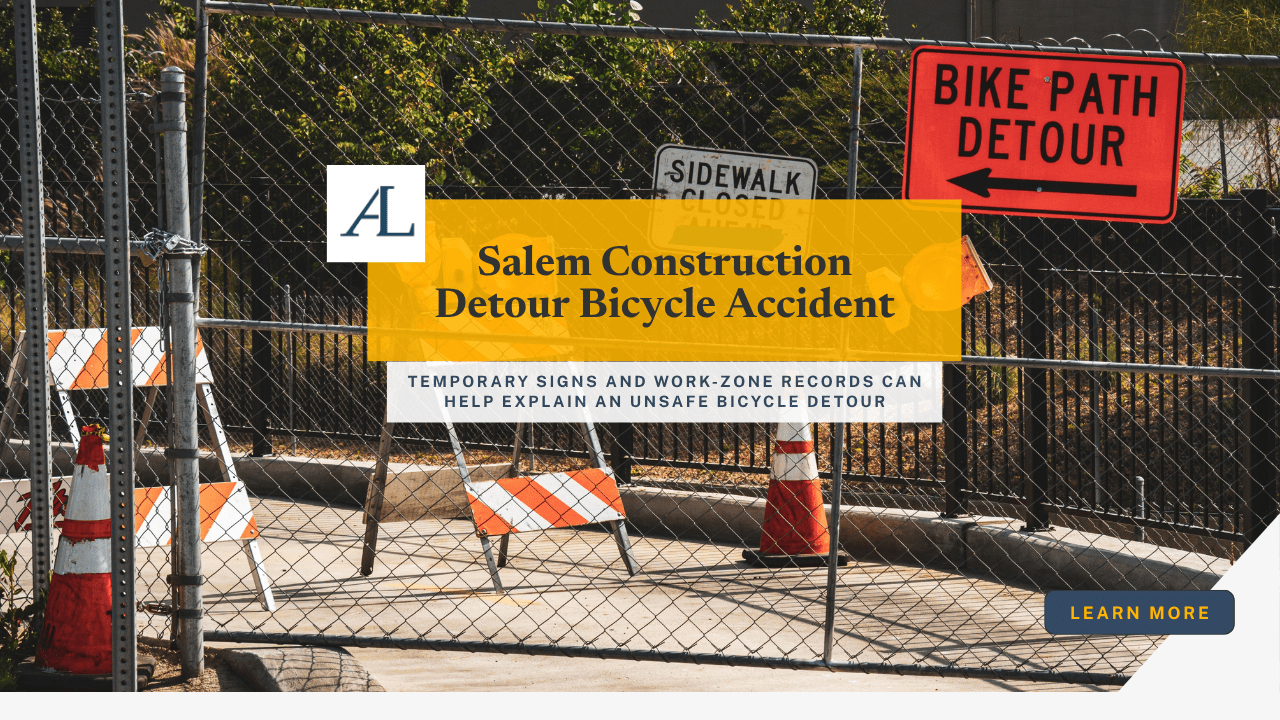
A Salem construction detour bicycle accident can happen when a familiar bicycle lane or roadway suddenly changes because of construction. A cyclist who normally travels along a marked bike lane may encounter cones blocking the lane, a temporary sign directing traffic elsewhere, an abrupt merge into vehicle traffic, gravel covering the riding surface, a steel plate across the roadway, or a detour that becomes unclear at the next intersection. When the temporary route is poorly marked, the rider may have only seconds to decide where to go while motor vehicles continue moving around the work zone.
Construction does not eliminate the need to account for bicycle traffic. The Oregon Department of Transportation explains that a traffic control plan is required for temporary activity disrupting the normal flow of highway traffic and that the plan’s primary purpose includes providing safe and effective movement for vehicles, bicycles, and pedestrians through or around the work zone. ODOT’s current Work Zone Traffic Control materials provide the state’s framework for temporary traffic-control planning.
That makes the temporary traffic-control setup an important source of evidence after a Salem construction detour bicycle accident. The investigation may need to determine what the approved plan required, what signs were actually installed, whether a bicycle lane was supposed to remain open, whether cyclists were supposed to merge with vehicles, and whether an alternate route was properly identified.
ODOT’s current bicycle guidance specifically tells riders to obey construction signs, look for bicycle-specific warning and detour signs, follow bicycle-route detours where applicable, and follow motor-vehicle detours when sharing the roadway. It also warns riders about rough surfaces, gravel, steel plates, barricades, and active work areas. Those recommendations appear in ODOT Riding Through Construction Zones.
The cyclist’s responsibilities, however, do not answer whether the construction detour itself was reasonably designed, installed, and maintained. A rider cannot follow a bicycle detour sign that is missing, obscured, turned away from traffic, or placed too late to allow a safe maneuver. A Salem construction detour bicycle accident should therefore examine both the rider’s conduct and the work-zone conditions.
ODOT’s 2026 temporary traffic-control standards provide particularly useful context. When a dedicated bicycle lane is closed, the handbook calls for signs addressing bicycles and vehicles merging or an alternate route. When neither roadway width nor an alternate route is available, a shared-roadway arrangement may be used under specified conditions, with bicycle-warning signs installed in advance of the work area.
Those standards do not automatically establish negligence in every Salem construction detour bicycle accident. The particular roadway, project, traffic-control plan, contractor responsibilities, work duration, and conditions on the crash date must be investigated. They do show why photographs of the actual work zone and copies of the approved plans can become critical evidence.
When a cyclist is injured because a construction zone creates a confusing or unsafe temporary route, an experienced Salem personal injury lawyer and bicycle accident lawyer at Avrek Law Firm can investigate the motorist, construction company, traffic-control contractor, public agency, roadway evidence, and insurance coverage involved.
Call 866-598-5548, start a live chat, or request a free case review today. There are no upfront legal fees, and you do not pay unless we win.
Documenting a Salem Construction Detour Bicycle Accident
A Salem construction detour bicycle accident should be documented before the work zone changes. Construction sites are temporary by definition. Cones may move within hours. Signs can be added after a collision. A lane that was closed in the morning may reopen that evening. Gravel can be swept away, a steel plate can be repositioned, and a flagger may be assigned to a location that had no worker present when the cyclist crashed.
That makes early scene documentation especially important. Photographs and video should capture not merely the bicycle and injury, but the cyclist’s entire approach to the work zone.
Missing, Obscured, Confusing, or Late Detour Signs
Temporary signs can determine whether a cyclist has enough time to understand a change in the roadway. A sign announcing a bicycle-lane closure several hundred feet before the work area gives the rider a different opportunity to respond than a barricade placed directly at the end of the bike lane.
A Salem construction detour bicycle accident should document every temporary sign along the cyclist’s approach. Photograph the signs in sequence and from the rider’s actual direction of travel.
A sign may exist but still be difficult to use. Tree branches, parked construction equipment, another temporary sign, a truck, fencing, darkness, or a sharp roadway angle can block the cyclist’s view. A sign may have fallen, rotated, or been placed so close to the conflict point that the rider has little time to react.
Photographs should show those conditions from bicycle-rider eye level rather than only from across the street. Wide images can establish spacing, while closer images can show wording, arrows, condition, orientation, and obstruction.
The 2026 Oregon Temporary Traffic Control Handbook became effective January 1, 2026 and serves as Oregon’s current reference for temporary traffic-control standards and practices for qualifying short-duration work zones.
A Salem construction detour bicycle accident should compare the actual signs with the plan and applicable standards rather than assume that the presence of orange cones means the work zone was properly marked.
Closed Bike Lanes and Sudden Merges Into Vehicle Traffic
One of the most dangerous moments for a cyclist can occur when a protected or dedicated bicycle lane ends unexpectedly and the rider must enter a general traffic lane.
The cyclist may encounter a barricade extending across the bike lane while cars continue alongside. The rider may need to slow suddenly, look over a shoulder, merge, or stop. A driver behind the cyclist may not expect that movement.
A Salem construction detour bicycle accident should identify exactly where the bike lane became unavailable and where the temporary route expected the cyclist to go.
ODOT’s 2026 handbook states that when a dedicated bicycle lane is closed, signs should address bicycles and vehicles merging or provide an alternate route. It also addresses bicycle-warning signage when cyclists must use a shared roadway.
ODOT’s broader Traffic Control Plan Design Manual likewise explains that temporary traffic-control plans are designed to accommodate all traffic types, including bicycles and pedestrians.
The investigation should document lane width, posted speed, traffic volume, sight distance, barriers, parked equipment, and whether motorists received any warning that cyclists would merge into their lane.
If the cyclist was struck by a vehicle during the merge, preserve the driver’s statement and vehicle evidence separately. The motorist’s conduct and the construction detour can both be relevant to the same Salem construction detour bicycle accident.
Gravel, Steel Plates, Uneven Pavement, and Temporary Surfaces
Not every construction-zone bicycle crash involves a motor vehicle. A cyclist may lose control because the temporary route contains loose gravel, a pavement edge, mud, a steel plate, a trench, broken asphalt, a hose, a temporary ramp, or another surface condition.
ODOT specifically warns cyclists traveling through work zones to watch for rough, uneven, or gravel surfaces and steel plates, which can be slippery.
A Salem construction detour bicycle accident involving a surface hazard should be photographed immediately. Use a reference object or measurement when safe to show the size of a pavement gap, height difference, trench, plate edge, or debris field.
The surface should also be photographed from the direction the cyclist approached. A raised edge that is obvious while standing beside it may have been difficult to see while traveling through a poorly lit or visually complex work zone.
Weather can affect the condition. Rain may make a steel plate more slippery or turn dirt into mud. Construction vehicles can track gravel onto the bicycle route. Temporary markings may become difficult to see on wet pavement.
ODOT’s traffic-control design guidance emphasizes providing bicycle accommodations through or around work zones and recognizes the need for traversable temporary routes.
The cyclist should preserve the bicycle and tires when the road surface is disputed. Scrapes, wheel damage, tire condition, and debris may help explain the loss of control.
Traffic-Control Records in a Salem Construction Detour Bicycle Accident
A Salem construction detour bicycle accident should not be investigated only from photographs. The records behind the work zone may reveal what was supposed to be present.
Depending on the project, those materials can include a temporary traffic-control plan, construction drawings, detour diagrams, contractor logs, daily inspection reports, sign inventories, change orders, emails, complaints, work schedules, and photographs created by inspectors.
The actual project records should be obtained rather than assuming that every Salem construction project uses the same arrangement.
Approved Traffic-Control Plans and Bicycle Detour Diagrams
ODOT states that a traffic-control plan is required for temporary activities that disrupt normal highway traffic and that its purpose includes moving bicycles safely through or around the work zone.
A Salem construction detour bicycle accident should therefore determine whether a formal traffic-control plan existed and which version was in effect on the crash date.
Projects can change. An original plan may show one detour while field conditions require a revised arrangement. The contractor may move a work area, change the lane closure, or modify the schedule.
Request every relevant version rather than only the final plan.
The bicycle portion deserves specific attention. Did the plan show a temporary bicycle path? Was the existing bike lane supposed to remain open? Were cyclists directed onto another street? Were they expected to merge into a shared traffic lane?
ODOT’s design manual explains that temporary bicycle accommodations should provide safe travel through or around a work zone and discusses alternate routes and shared-roadway strategies when existing bicycle facilities are closed.
A Salem construction detour bicycle accident may become easier to understand when the approved drawing is placed beside photographs showing what was actually installed.
Contractor Daily Logs, Inspections, and Sign Changes
Construction conditions can change every day. Contractor daily reports may identify what work occurred, which lanes were closed, what traffic-control devices were installed, weather conditions, subcontractors present, and whether an inspector raised concerns.
A Salem construction detour bicycle accident should preserve the daily log for the crash date and the days immediately before and after it.
Inspection records may show that a sign was missing before the crash or that a barricade repeatedly moved. Conversely, they may document that the traffic-control setup was inspected and considered compliant earlier that day. Both types of evidence matter.
Sign changes can become especially important. If a new bicycle detour sign appeared immediately after the collision, photographs or logs may explain whether it was part of a planned phase change or a response to a newly recognized problem.
Workers may also maintain photographs of the traffic-control setup. These images can provide an independent record of cone placement, lane closures, signs, barriers, and pavement conditions.
The investigation should identify which contractor controlled traffic management and whether a specialized traffic-control subcontractor was responsible for signs or flaggers.
A Salem construction detour bicycle accident should not assume that the general contractor personally installed every device. Contracts and work assignments can identify who controlled each part of the temporary route.
Complaints, Prior Incidents, and Work-Zone Changes
Other cyclists, residents, businesses, or drivers may have complained about the detour before the collision. Complaints can be submitted through phone calls, emails, project hotlines, public-works systems, inspectors, or social media.
A Salem construction detour bicycle accident should investigate whether anyone previously reported confusing bicycle signs, dangerous merges, gravel, missing lighting, blocked sightlines, or other hazards.
A prior complaint does not automatically establish liability. It can, however, help show whether the responsible entity had notice of a condition and what response followed.
Project meeting minutes may contain similar information. A contractor may have discussed bicycle access during a weekly meeting or changed traffic control because of an earlier near miss.
The ODOT Work Zone Traffic Control program also conducts work-zone reviews to evaluate traffic-control plan design and implementation practices.
The cyclist’s legal team should determine whether project-specific inspection or review records exist rather than relying solely on general standards.
Who May Be Involved in a Salem Construction Detour Bicycle Accident?
A Salem construction detour bicycle accident can involve more parties than a typical bicycle-versus-car collision. Depending on the evidence, the investigation may include a negligent driver, construction contractor, traffic-control subcontractor, engineering company, utility company, property owner, City of Salem, ODOT, or another public entity.
The presence of multiple entities does not mean all are legally responsible. The investigation should identify what each party actually controlled.
The Driver Who Struck the Cyclist
A construction detour does not eliminate a motorist’s responsibility to drive carefully. Drivers approaching work zones may encounter narrower lanes, changing traffic patterns, cyclists entering shared lanes, workers, equipment, and temporary signs.
ODOT’s current Work Zone Safety guidance tells drivers to slow down, stay alert, plan for delays, and follow construction traffic controls.
If a motorist strikes a cyclist who was following a temporary detour, a Salem construction detour bicycle accident should examine the driver’s speed, attention, lane position, braking, following distance, and opportunity to see the cyclist.
Dashcam footage, vehicle damage, phone records when legally available, witnesses, and event data may help reconstruct the driver’s conduct.
The insurer may argue that the cyclist entered the vehicle lane unexpectedly. That claim should be compared with the temporary traffic-control design. If construction forced cyclists into the lane, drivers may have been expected to encounter bicycle traffic.
Avrek’s related article on when cyclists have the right of way after a Salem bike crash discusses how roadway design and lane positioning can become central when insurers attempt to shift blame to the rider.
Construction and Traffic-Control Contractors
A construction company may control the work area while a separate subcontractor installs and maintains signs, cones, barricades, channelizing devices, or flagging operations.
A Salem construction detour bicycle accident should identify those companies by photographing contractor vehicles, signs, equipment, project boards, and work permits.
Contracts can then establish which company had responsibility for maintaining temporary traffic control.
Daily records may show whether workers inspected the route at the beginning of the shift or after conditions changed.
A traffic-control contractor may have followed the approved plan exactly. If the plan itself failed to account adequately for cyclists, the investigation may extend to the entity responsible for designing or approving it.
Alternatively, the plan may have required appropriate bicycle signs that were missing in the field. In that situation, implementation becomes especially important.
The cyclist should avoid assuming that every worker at the site worked for the same employer. A Salem construction detour bicycle accident can involve several contractors operating simultaneously.
City, State, or Other Public Agencies
Some Salem projects are controlled by the City of Salem, while others involve ODOT, utilities, or another public body.
The distinction matters because the project owner may possess plans, inspection records, contracts, permits, complaints, and change orders.
It can also affect legal deadlines. Oregon’s Tort Claims Act contains notice requirements for claims against public bodies. Oregon Revised Statutes Chapter 30 contains those provisions.
Under ORS 30.275, notice for many non-wrongful-death claims against a public body generally must be given within 180 days after the alleged loss or injury, subject to statutory requirements and exceptions. Because those deadlines are substantially shorter than the ordinary limitations period, identifying a public entity early can be critical.
A Salem construction detour bicycle accident should therefore determine who owned the roadway and who controlled the construction before assuming that the case involves only private companies.
Current Salem Construction Shows Why Bicycle Detours Matter
Salem currently has real projects requiring temporary bicycle accommodations. For example, the City’s Commercial Street SE pavement rehabilitation project is scheduled through 2026 and states that traffic-control signs, detour routes, and flaggers will direct traffic while a bicycle detour route will be available. City of Salem Commercial Street SE Construction Project provides the project’s current public information.
That does not mean this article concerns a crash at that project or that the project is unsafe. It provides a current local example of how Salem construction can temporarily change bicycle travel.
A Salem construction detour bicycle accident at any location should be investigated based on the particular project and conditions present on the crash date.
Other ODOT projects around Salem may involve shoulder or lane closures and flagger-controlled work zones. Current project conditions can change frequently, which is another reason scene photographs and project-specific records are important.
Physical and Digital Evidence to Preserve
A Salem construction detour bicycle accident can produce several categories of evidence that disappear at different speeds. The temporary traffic-control setup may change within hours, surveillance may be overwritten within days, and the bicycle may be repaired within weeks.
Preservation should therefore begin immediately.
Bicycle, Helmet, Clothing, and Personal Property
Preserve the bicycle in its post-crash condition whenever possible. Photograph the frame, fork, wheels, tires, brakes, handlebars, drivetrain, lights, reflectors, and accessories.
A Salem construction detour bicycle accident involving gravel or a pavement edge may leave different damage than a collision with a vehicle or barrier.
Do not repair the bicycle before inspection needs are considered. A shop may straighten a wheel, replace a tire, clean construction debris, or discard a broken component.
Preserve the helmet as well. Scrapes and impact marks can help show how the rider contacted the roadway.
Clothing, shoes, backpack, phone, glasses, lights, and other damaged property should also be saved.
If the cyclist used an e-bike, preserve the battery, display, controller, motor information, and app records. Do not charge or operate visibly damaged electrical equipment until it has been evaluated safely.
GPS, Cycling Apps, and Camera Footage
Cycling applications may document the rider’s route, direction, timing, speed, and stopping points.
A Salem construction detour bicycle accident may benefit from data showing that the cyclist followed a familiar route until construction forced a change.
Preserve the original app record rather than only a screenshot. Export available trip data where the service permits it.
Helmet cameras, handlebar cameras, and vehicle dashcams can provide even stronger evidence. A camera may show exactly when the cyclist first saw the closure sign or whether no bicycle detour sign was visible.
Nearby businesses, homes, construction vehicles, transit facilities, and public buildings may also have surveillance.
Ask that footage be preserved promptly. The cyclist does not need to prove exactly what the camera recorded before requesting preservation.
Work-Zone Photographs at the Same Time of Day
Lighting can dramatically affect temporary traffic control. A sign visible at noon may be difficult to see at dusk. Headlights, rain, shadows, work lights, and reflective materials can change the appearance of the route.
A Salem construction detour bicycle accident should therefore be documented at or near the same time of day when feasible and safe.
Those later photographs should not replace images from the actual crash scene. They provide context for visibility.
The investigator should also note whether signs or barriers have changed. A photograph taken two days later should not be presented as though it shows the exact crash-date configuration.
Weather records may also help establish rain, visibility, and surface conditions.
Medical and Financial Documentation
A Salem construction detour bicycle accident may cause fractures, head injuries, concussion symptoms, shoulder injuries, wrist injuries, road rash, knee trauma, spinal injuries, dental injuries, or other conditions.
The actual diagnosis must come from qualified healthcare providers.
The cyclist should tell providers how the crash happened. If the rider struck gravel, a steel plate, a barricade, or a vehicle after entering a temporary lane, that mechanism should be described accurately.
Emergency and Follow-Up Medical Records
Emergency records can establish the earliest symptoms and injuries. Follow-up records may document conditions that become clearer after swelling, pain, or neurological symptoms develop.
A Salem construction detour bicycle accident should maintain a continuous medical timeline from emergency care through specialists, therapy, imaging, surgery, and recovery.
Treatment gaps should be documented when they result from scheduling, insurance authorization, transportation, or other legitimate reasons.
The cyclist should follow provider instructions rather than attempting to create evidence through unnecessary treatment.
Lost Income and Daily-Life Limitations
Preserve pay statements, work schedules, employer communications, disability notes, and documentation of missed shifts.
Self-employed cyclists may need invoices, contracts, calendars, tax records, or client communications.
A Salem construction detour bicycle accident may also affect transportation. A person who regularly commuted by bicycle may need rideshare services, public transit, a rental vehicle, or help from family.
Keep those expenses.
Daily-life documentation can describe difficulty sleeping, driving, walking, exercising, caring for children, or returning to cycling.
Specific examples are more useful than broad statements.
Insurance Disputes After a Salem Construction Detour Bicycle Accident
Insurance companies may attempt to simplify a construction-zone crash into cyclist error. An adjuster may argue that the rider should have slowed down, dismounted, taken another street, or recognized the construction sooner.
Those questions should be evaluated against the actual signs and conditions.
Claims That the Cyclist Should Have Avoided the Work Zone
ODOT advises cyclists that pre-trip planning may help identify alternate routes and provides safety recommendations for traveling through construction zones. It does not state that cyclists must categorically avoid every work zone. Its guidance specifically addresses how cyclists should travel through work zones and follow applicable detours.
A Salem construction detour bicycle accident should therefore determine whether a usable alternate route was actually identified.
If a cyclist approached a familiar bike lane and encountered an unmarked closure, hindsight should not replace evidence about what the rider could reasonably see and understand at the time.
Arguments About Bicycle Speed or Position
An insurer may argue that the cyclist was traveling too quickly to react or was riding outside the correct portion of the roadway.
GPS data, video, witnesses, road markings, and the traffic-control plan may help address those allegations.
A Salem construction detour bicycle accident should distinguish between a cyclist choosing an unusual lane position and construction forcing the rider into that position.
The temporary route may have eliminated the shoulder or bicycle lane altogether.
Multiple Insurers and Responsible Entities
The driver’s auto insurer may handle one part of the claim while a contractor’s commercial insurer handles another.
A public agency may have its own claims process. A traffic-control subcontractor may have separate liability coverage.
A Salem construction detour bicycle accident should identify those entities before any broad release is signed.
One insurer’s settlement offer may contain language releasing parties that were not obvious from the initial claim.
What to Do After a Construction Detour Bicycle Crash in Salem
Seek medical attention first. Do not remain in an active work zone or traffic lane to collect evidence when doing so creates another danger.
When safe, photograph the entire approach to the work zone, not just the crash location. Capture every sign, cone, barrier, bike-lane closure, detour arrow, temporary marking, road surface, construction vehicle, and potential obstruction.
A Salem construction detour bicycle accident should also document the project name and contractor information when visible.
Collect witness names and contact information. Ask whether anyone saw the cyclist approach the closure or noticed missing or confusing signs.
Preserve the bicycle, helmet, clothing, GPS data, camera footage, medical records, and insurer communications.
Report the collision appropriately. Oregon DMV requires qualifying crashes to be reported within 72 hours when an injury or death occurs and in certain property-damage situations. Current requirements are available through Oregon DMV Collision Reporting.
Do not sign a release until the responsible parties, injuries, project records, and insurance coverage have been investigated.
Deadlines for a Salem Construction Detour Bicycle Accident
Oregon’s general civil limitations provisions are contained in Oregon Revised Statutes Chapter 12. Many injury actions are subject to a two-year period under ORS 12.110, but the precise deadline depends on the claim and circumstances.
A Salem construction detour bicycle accident involving a government entity requires particular attention because Oregon’s public-body notice requirements can be substantially shorter.
Oregon Revised Statutes Chapter 30 contains the Oregon Tort Claims Act provisions. ORS 30.275 generally requires notice of many non-wrongful-death public-body claims within 180 days, subject to the statute’s requirements and exceptions.
The family should not attempt to calculate the deadline from this article alone.
More importantly, evidence disappears much sooner. A work zone can change the same day as the crash.
Frequently Asked Questions About a Salem Construction Detour Bicycle Accident
What evidence should I photograph after a Salem construction detour bicycle accident?
Photograph the entire work-zone approach, bicycle lane, closure, detour signs, cones, barriers, lane markings, surface conditions, gravel, steel plates, construction vehicles, lighting, bicycle, helmet, vehicle damage, and final positions.
Take photographs from the cyclist’s direction of travel when safe.
Does Oregon require construction projects to consider cyclists?
ODOT states that temporary traffic-control plans are intended to provide safe and effective movement of public traffic, including bicycles and pedestrians, through or around highway work zones.
The specific requirements depend on the project, roadway, work duration, and applicable traffic-control standards.
What happens when construction closes a bicycle lane?
ODOT’s 2026 temporary traffic-control handbook addresses bicycle-lane closures and calls for bicycle/vehicle merging signs or an alternate route in applicable circumstances.
A Salem construction detour bicycle accident should determine what the project’s approved plan required and what was actually installed.
Can a cyclist be directed into a vehicle lane?
Temporary shared-roadway conditions can be used in certain circumstances under Oregon’s work-zone guidance, but signage and other traffic-control considerations apply.
The investigation should determine whether the temporary arrangement complied with the applicable plan and standards.
What if the cyclist crashed on loose gravel?
Photograph the gravel before it is swept away and preserve the bicycle and tires.
ODOT specifically warns cyclists that construction zones can contain rough, uneven, and gravel surfaces.
The claim should determine why the gravel was in the bicycle path and whether reasonable traffic control or cleanup measures were used.
What if there was a detour sign but I could not see it?
The sign’s existence is only part of the investigation. Its location, orientation, visibility, advance distance, lighting, obstructions, and relationship to other traffic-control devices may all matter.
A Salem construction detour bicycle accident should document the sign from the rider’s actual approach.
Can both a driver and construction company be responsible?
Potentially. A negligent motorist may contribute to the collision while an unsafe temporary route also contributes.
The evidence should establish what each party controlled and how each action affected the crash.
Can the City of Salem or ODOT be involved?
Potentially, depending on which entity owned or controlled the roadway, project, or traffic-control plan.
Claims against public bodies can involve Oregon Tort Claims Act notice requirements, so identifying the responsible agency promptly is important.
How quickly can construction evidence disappear?
Very quickly. Signs, cones, barriers, lane closures, equipment, and surface conditions can change within hours.
That makes immediate documentation particularly important after a Salem construction detour bicycle accident.
Should I give the contractor’s insurer a recorded statement?
Use caution. Identify who the representative works for and what claim the company is investigating.
Describe what you personally observed without guessing about construction standards, engineering, or which company was legally responsible.
How long do I have to file a claim?
Many Oregon injury actions have a two-year limitations period, but claims involving public bodies can carry much shorter notice requirements.
The precise deadline depends on the parties and facts, so a Salem construction detour bicycle accident should be reviewed promptly.
Do I need a lawyer after a construction-zone bicycle accident?
These cases can involve a motorist, contractor, traffic-control company, engineering firm, utility, City of Salem, ODOT, or another entity.
A bicycle accident lawyer can help determine which records and parties matter, while a Salem personal injury lawyer can help preserve local evidence and manage the insurance claim.
Call or Contact Avrek Law Firm 24/7 for a Free Consultation and Pay Nothing Unless We Win
A Salem construction detour bicycle accident can become difficult when the temporary route changes before anyone documents it. The contractor may say the signs were present, the driver may say the cyclist entered traffic unexpectedly, and the cyclist may know that the bicycle lane simply ended without enough warning.
The answer often lies in evidence that is highly temporary: construction photographs, traffic-control plans, sign placement, daily inspection records, project logs, video, GPS data, witnesses, road-surface conditions, and the damaged bicycle.
Avrek Law Firm helps injured cyclists investigate crashes involving motorists, roadway conditions, and disputed bicycle access. Avrek’s bicycle accident practice handles bicycle injury claims, while the firm’s Salem personal injury lawyers serve injured people throughout Salem and surrounding Oregon communities.
An experienced legal team can investigate a Salem construction detour bicycle accident before the work zone moves into another construction phase or important project records become harder to locate.
If you or someone you love was injured while navigating a poorly marked construction detour in Salem, Avrek Law Firm is ready to help.
Call 866-598-5548, start a live chat, or complete our online consultation form today. Your consultation is free, and you pay nothing unless we win.
Serving Cyclists Throughout Salem
A Salem construction detour bicycle accident can happen anywhere construction temporarily changes the path cyclists normally use. Salem riders travel through downtown streets, neighborhood routes, commercial corridors, school areas, and roads connecting to surrounding Marion and Polk County communities.
Construction activity can affect routes such as Commercial Street, Liberty Road, State Street, Mission Street, Lancaster Drive, Center Street, and other Salem corridors.
The City of Salem’s current Commercial Street SE rehabilitation project provides a useful example of how active construction can require traffic-control signs, flaggers, and a bicycle detour route. The project is scheduled through 2026.
That example does not imply that the project has caused a bicycle accident or that its traffic control is deficient. It demonstrates why temporary bicycle access is a real and current part of Salem roadway construction.
A Salem construction detour bicycle accident should be investigated based on the actual project, signs, roadway conditions, and traffic-control setup present when the cyclist was injured.
A Salem personal injury lawyer can help preserve that local evidence while Avrek’s bicycle accident lawyers address the driver, construction, insurance, and injury issues.
- 📩 Submit a request through our online form
- 📞 Call 866-598-5548 now to speak with our team
- 💬 Start a live chat for immediate assistance
There are no upfront fees, and you don’t pay unless we win.