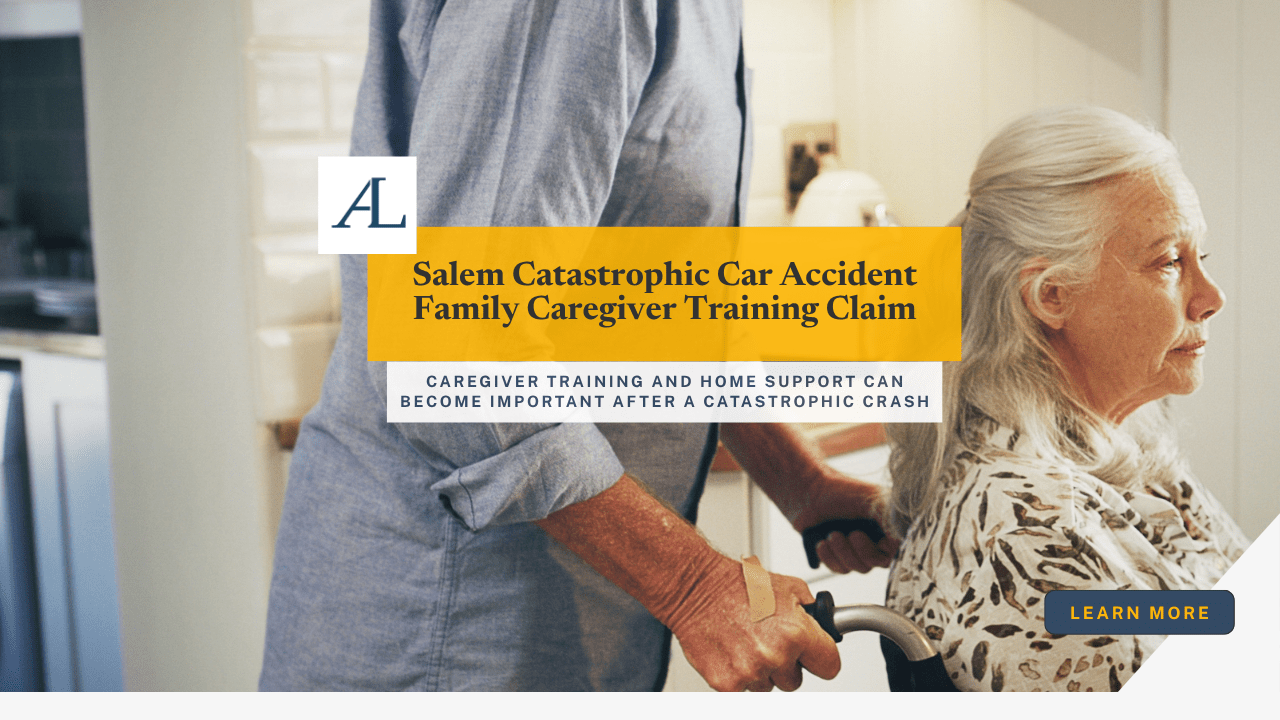
A Salem catastrophic car accident family caregiver training claim can involve much more than hospital bills and a description of the original collision. When a serious crash leaves a person unable to walk independently, transfer safely, manage medications, communicate normally, use medical equipment, or perform ordinary personal-care tasks, family members may suddenly become part of the patient’s daily care team.
That transition can happen quickly. A patient may be discharged from a hospital or rehabilitation facility with instructions that a spouse, parent, adult child, or another family member must understand before returning home. The family may need to learn how to assist with transfers, operate equipment, recognize warning signs, organize medications, help with bathing or dressing, manage appointments, or follow restrictions designed to prevent another injury.
A Salem catastrophic car accident family caregiver training claim should document that transition carefully because the family’s time and responsibilities may become a significant part of the post-crash losses. A family member who spends hours each day providing care may be unable to maintain the same work schedule, arrange childcare differently, or hire additional help.
The Centers for Medicare & Medicaid Services has emphasized the importance of an effective discharge-planning process that includes patients and their caregivers as active partners and provides information needed for safe post-discharge care. CMS specifically identifies communication with caregivers about the patient’s needs at home and the training or preparation needed to manage those needs. CMS Hospital Discharge Planning Requirements provides the federal guidance. (cms.gov)
Oregon’s own home-health rules also recognize caregiver education and training as part of discharge planning in applicable home-health settings. The state’s rules identify discharge plans that include patient and caregiver education and training to facilitate timely discharge. Oregon Health Authority Home Health Rules provides the relevant state framework. (oregon.gov)
Those medical and discharge-planning principles do not automatically establish the value of a legal claim. They do, however, help explain why caregiver training can create records that are relevant to a Salem catastrophic car accident family caregiver training claim. Training sessions, written instructions, therapy notes, equipment manuals, home-health records, care plans, and provider communications can show what the family was expected to do after the crash.
When catastrophic injuries change a family’s daily life, choosing the right representation matters. An experienced Salem personal injury lawyer at Avrek Law Firm can help organize the medical timeline, identify long-term care needs, preserve caregiver documentation, handle insurance communications, and develop the evidence needed to explain how the injury affected the household.
Call 866-598-5548, start a live chat, or request a free case review today. There are no upfront fees, and you do not pay unless we win.
Why Family Members May Need Formal Training Before Discharge
A Salem catastrophic car accident family caregiver training claim often begins with the discharge process. A patient may be medically stable enough to leave an acute-care hospital without being medically independent. The next stage may involve rehabilitation, skilled nursing, home health, outpatient therapy, or substantial family assistance.
The family may be given instructions in a short meeting before discharge. Those instructions can cover several different areas at once, and relatives may need to demonstrate that they understand the techniques before the patient goes home.
Mobility Assistance, Transfers, Positioning, and Personal Care
Mobility assistance can involve far more than helping someone walk. A family caregiver may need to understand how to move a patient from a bed to a wheelchair, assist with standing, position the person safely, use a gait belt when instructed, manage a transfer board, operate a wheelchair, or follow weight-bearing restrictions.
A Salem catastrophic car accident family caregiver training claim should preserve records showing exactly what the family was taught and why. A therapy note may state that a spouse was trained in transfers before discharge. A physical therapist may document how much assistance the patient required and whether a caregiver successfully demonstrated the technique.
Positioning can also become important for patients with spinal injuries, paralysis, significant weakness, or limited sensation. The family may be instructed to change the patient’s position, protect pressure points, monitor skin condition, or follow equipment-specific positioning instructions.
Personal care may include bathing, dressing, toileting, grooming, feeding, or assistance with mobility inside the home. The family should document which tasks require hands-on assistance and which can be performed independently.
Those details can make a Salem catastrophic car accident family caregiver training claim more concrete. Saying that a family member “needs help” does not explain the time and skill involved. Documenting that a spouse assists with a transfer twice each morning, helps with bathing several days a week, and remains present during medication administration creates a much clearer picture of the daily burden.
Medication, Medical Equipment, and Appointment Management
Catastrophic injuries can create complicated medication schedules. A family member may need to organize multiple prescriptions, track dosages, monitor timing, obtain refills, identify possible problems, and communicate with physicians when something changes.
The family should follow the healthcare provider’s instructions rather than creating its own medication system without guidance. Records showing medication training, written instructions, medication lists, and follow-up communications may become relevant to a Salem catastrophic car accident family caregiver training claim.
Medical equipment can create another layer of responsibility. Depending on the patient’s condition, the family may need to learn to operate a wheelchair, walker, hospital bed, transfer device, oxygen equipment, communication system, feeding equipment, or other medically prescribed device.
Equipment training may be provided by a therapist, nurse, durable-medical-equipment supplier, home-health provider, or another qualified professional. The family should preserve written instructions, demonstration records, equipment manuals, and contact information for the person who provided training.
Appointment management can become a job of its own. A caregiver may coordinate multiple specialists, transportation, therapy sessions, imaging, lab work, medication reviews, and follow-up appointments.
A Salem catastrophic car accident family caregiver training claim should document those obligations rather than focusing only on the number of medical appointments. The family may spend significant time coordinating care between appointments even when the patient is not physically in a medical facility.
Safety Plans and Provider Instructions for the Home
A catastrophic injury can make the home environment part of the recovery process. The family may need instructions on fall prevention, wheelchair positioning, transfer safety, emergency procedures, wound care, infection precautions, or restrictions on stairs or driving.
CMS guidance specifically recognizes that caregivers and post-acute providers need adequate information about a patient’s needs at home and how the home environment may affect safety after discharge. (cms.gov)
That information can be valuable in a Salem catastrophic car accident family caregiver training claim because it helps connect the medical injury to the practical changes required in the home.
The family should preserve any home-safety checklist, discharge instructions, therapy recommendations, equipment orders, photographs, and communications about modifications.
A patient may require grab bars, ramps, a shower chair, bed rails, a wheelchair-accessible entrance, different sleeping arrangements, or other changes. Not every recommendation will be medically necessary in every case, so the claim should rely on actual provider recommendations rather than assumptions.
The family should also keep a record of safety incidents or near-misses. If the patient nearly falls during a transfer, cannot access the bathroom independently, or requires a caregiver during stairs, those experiences may be relevant to future care planning.
Records That Can Document Caregiver Training
A Salem catastrophic car accident family caregiver training claim should be supported by contemporaneous records whenever possible. A family member’s later description of what happened can be helpful, but the medical record may provide much more precise information about the training, assistance level, and expected care responsibilities.
Training evidence can appear in several different places. It may be located in hospital records, rehabilitation notes, therapy documentation, home-health records, equipment orders, discharge summaries, patient portals, emails, or handwritten instructions given to the family.
Attendance Logs, Written Instructions, Demonstrations, and Assessments
Some facilities document caregiver attendance during therapy or education sessions. The record may identify who attended, what was taught, and whether the caregiver successfully demonstrated the technique.
A Salem catastrophic car accident family caregiver training claim should preserve attendance sheets, caregiver-training notes, competency assessments, checklists, and written instructions.
If the therapist asked the caregiver to demonstrate a transfer, that demonstration may be noted in the therapy record. If the caregiver needed additional instruction, that may also be documented.
Written instructions should be preserved in their original form. Families sometimes receive several versions as the patient’s condition changes. A new wheelchair setup, transfer restriction, or medication schedule may replace an earlier instruction.
The date matters. An instruction given before surgery may no longer apply after surgery. A patient may improve from requiring two-person assistance to needing one-person assistance. Those changes can affect the amount of family care required.
Oregon’s current homecare workforce materials also recognize formal training and testing for certain paid home-care roles. The Oregon Home Care Commission Training and Education page describes required training and assessment for certain homecare workers. (oregon.gov)
That does not mean an unpaid family caregiver has the same legal certification requirements. Rather, it illustrates why training and demonstrated competency are treated as meaningful parts of safe care in Oregon’s broader home-care system.
Hospital, Rehabilitation, Therapy, and Home-Health Notes
A Salem catastrophic car accident family caregiver training claim should gather records from every facility involved in the patient’s recovery.
Hospital notes may document discharge instructions and caregiver involvement. Rehabilitation records may contain detailed information about transfers, mobility, cognitive limitations, and activities of daily living. Therapy notes may identify what the caregiver was taught and how much assistance the patient required.
Home-health records may show whether a nurse, therapist, or aide continued educating the family after discharge. The home-health plan may change as the patient’s needs evolve.
Oregon’s home-health framework specifically recognizes discharge plans that include patient and caregiver education and training. (oregon.gov)
Families should preserve records from each stage rather than assuming the final discharge summary contains everything. A rehabilitation therapist may document a hands-on training session that does not appear in a shorter physician note.
Medical portals can also contain instructions and messages between the family and care team. Save those communications rather than relying on memory.
Equipment Manuals and Provider Communications
Equipment manuals can establish how a device is supposed to operate and what safety precautions apply. Provider communications can establish what the family was specifically told about the patient’s equipment.
A Salem catastrophic car accident family caregiver training claim may involve a wheelchair, lift, transfer equipment, hospital bed, shower equipment, communication device, or another piece of prescribed equipment.
The family should retain the model number, manufacturer, purchase or rental record, delivery paperwork, installation documents, and training materials.
If an equipment supplier conducted an in-home demonstration, preserve the appointment date and names of the people who participated. If the supplier later modified or replaced the equipment, keep those records as well.
A family member should not be expected to independently determine whether equipment is safe or whether a different model is required. Those questions should be addressed by the appropriate healthcare provider or equipment professional.
Provider communications can also show that the family requested additional training. If the caregiver said, “I do not feel comfortable performing this transfer alone,” and the provider arranged another session, that communication can help explain why additional support was needed.
Showing the Time and Work Required From Family Caregivers
A Salem catastrophic car accident family caregiver training claim should document not only what the family learned, but how often those skills are used. Caregiving can become a substantial daily workload even when each individual task appears short.
The family should avoid exaggerating the hours. A contemporaneous care calendar can be more credible than a large estimate created after a settlement dispute begins.
Care Schedules, Transportation Logs, and Daily Task Records
Create a daily or weekly care schedule identifying recurring tasks. The schedule may include morning transfers, bathing, dressing, medication management, meals, therapy exercises, appointments, transportation, repositioning, evening routines, and overnight monitoring when medically required.
A Salem catastrophic car accident family caregiver training claim may benefit from a record showing who performs each task and approximately how long it takes.
Transportation records should include medical appointments, therapy visits, pharmacy trips, equipment appointments, and other care-related travel. Keep mileage, parking, tolls, fuel, rideshare receipts, and other transportation expenses.
Daily task records should reflect actual care. If a patient can dress independently on some days but needs assistance on others, document that variation instead of using one fixed estimate.
The family can also record significant changes in the patient’s condition. Increased weakness, new equipment, surgery, or a medication change may temporarily increase caregiving time.
These records can help medical providers, attorneys, and other professionals understand what the family is actually doing at home.
Missed Work, Reduced Hours, and Childcare Changes
Caregiving frequently affects employment. A spouse may reduce shifts, use paid leave, take unpaid time off, change schedules, work from home, or stop working altogether.
A Salem catastrophic car accident family caregiver training claim should preserve employer communications, schedules, timesheets, leave records, pay statements, and documentation of reduced hours.
The family should connect work changes to the care schedule. For example, a caregiver may leave work two hours early three days a week to transport the patient to therapy.
Childcare can change too. A parent caring for an injured spouse may need to pay for after-school care, arrange transportation, or ask another relative to supervise children during medical appointments.
Keep receipts and calendars showing those changes. A family member’s time is not simply a medical expense, but the economic consequences of that caregiving can become relevant to the overall claim depending on the applicable law and evidence.
A Salem catastrophic car accident family caregiver training claim should distinguish between ordinary family responsibilities and new responsibilities created by the catastrophic injury.
Additional Paid Help or Respite-Care Needs
Family members may provide care initially but eventually need additional assistance. That may include home-health services, personal-care attendants, transportation assistance, respite care, meal services, or specialized nursing.
The family should preserve written recommendations from healthcare providers concerning additional care. If the family voluntarily hires help without medical guidance, the expense may still be relevant, but the claim should not automatically characterize every household expense as medically necessary.
Paid-care records should include invoices, schedules, contracts, receipts, and descriptions of the services provided.
A Salem catastrophic car accident family caregiver training claim may involve periods when a spouse can no longer safely provide certain care without another trained person present. That change should be documented when it occurs.
Respite care can also affect the caregiver’s ability to remain employed and avoid burnout. A family should follow the treating team’s recommendations about appropriate levels of support.
Insurance Questions About Caregiver Support
A Salem catastrophic car accident family caregiver training claim may encounter significant insurance questions because adjusters often want to distinguish medical expenses from family assistance and short-term help from long-term care.
The family should expect requests for detailed medical records and documentation supporting the amount and type of care being provided.
Disputes Over Whether Training or Assistance Is Medically Necessary
An insurer may argue that a family member can provide assistance without formal training or that the caregiver’s time is simply an ordinary family responsibility.
Those arguments should be compared against the medical record. If a rehabilitation therapist documented caregiver training, a physician prescribed home health, or a provider ordered specialized equipment, those records provide context.
CMS’s discharge-planning guidance specifically recognizes caregivers as active partners in post-discharge care and emphasizes the importance of communicating the patient’s care needs and safety requirements. (cms.gov)
A Salem catastrophic car accident family caregiver training claim should therefore identify who recommended the care, what the family was trained to do, how often the tasks are performed, and whether the patient’s condition requires continued assistance.
The insurer may also request an independent medical evaluation. The family should preserve the current treatment plan and communicate honestly with providers about what assistance is actually required.
Requests for More Records or Independent Evaluations
A catastrophic injury can generate thousands of pages of records. Insurance companies may request records from hospitals, therapists, home-health agencies, specialists, pharmacies, employers, and prior providers.
The family should understand the scope of each request before signing a broad authorization. Records unrelated to the injury may not be necessary to establish current caregiving needs.
A Salem catastrophic car accident family caregiver training claim should organize records chronologically so the insurer can see the progression from crash to hospital care, rehabilitation, discharge, and home-based assistance.
Independent evaluations may be requested to determine future care needs. That evaluation may address mobility, cognitive function, activities of daily living, equipment, supervision, and the expected duration of assistance.
The family should cooperate with legitimate evaluations while preserving its own records and understanding what the evaluation is intended to address.
Settlement Timing Before Long-Term Care Needs Are Established
Settlement timing is particularly important in catastrophic-injury claims. A patient may continue to improve for months after discharge, while another patient may develop permanent limitations that become clearer only after rehabilitation.
A Salem catastrophic car accident family caregiver training claim should not be based solely on the first discharge plan if medical professionals later change the patient’s prognosis or care needs.
An early settlement offer may account for current medical bills but fail to address future equipment, ongoing therapy, caregiver assistance, home modifications, transportation, or reduced household capacity.
The family should preserve every settlement offer, insurer letter, recorded-statement request, medical authorization, and release.
Avrek’s handles claims where injuries may produce long-term changes in independence, medical treatment, and daily life. The value and structure of an individual case depend on its specific facts and evidence.
What Families Should Do After a Catastrophic Crash
The family’s first priority is medical care and safe discharge. Do not take on a new caregiving task without appropriate instructions when the task could endanger the patient or caregiver.
Before discharge, ask the care team to explain what assistance will be required at home, what equipment is needed, what symptoms require urgent attention, and who should be contacted when questions arise.
A Salem catastrophic car accident family caregiver training claim should preserve the written discharge packet and any updated version issued later.
Ask providers to document caregiver instruction when training is provided. If the family member cannot safely perform a task, say so. Request additional instruction or professional assistance when appropriate.
Create a care calendar as soon as the patient returns home. Document transfers, bathing, dressing, medication administration, therapy exercises, appointments, transportation, supervision, and overnight assistance.
Keep a separate record of work changes, childcare changes, paid assistance, equipment costs, transportation, and household modifications.
Save every medical record and communication. Do not rely on one hospital’s records when the patient has been transferred between several facilities.
Reporting and Deadlines for a Salem Catastrophic Car Accident Family Caregiver Training Claim
Oregon DMV requires drivers involved in a reportable collision to submit an Oregon Traffic Collision and Insurance Report within 72 hours when an injury or death occurs and in specified property-damage situations. The current requirements are available through Oregon DMV Collision Reporting. (oregon.gov)
The family may not be the person responsible for filing the driver’s report, but obtaining and preserving the collision documentation can still be important to the Salem catastrophic car accident family caregiver training claim.
Oregon generally provides a two-year limitations period for many personal-injury actions under ORS 12.110, with other provisions affecting certain claims and circumstances. Oregon Revised Statutes Chapter 12 contains the current statutory framework. (oregonlegislature.gov)
Claims involving a public body can be subject to separate notice requirements under Oregon law. Oregon Revised Statutes Chapter 30 contains the applicable public-body provisions. (oregonlegislature.gov)
Families should not wait until a filing deadline approaches. Medical equipment may be replaced, home-health providers may change, records may become harder to obtain, and early caregiving conditions may no longer be available to document.
Frequently Asked Questions About a Salem Catastrophic Car Accident Family Caregiver Training Claim
What is a Salem catastrophic car accident family caregiver training claim?
A Salem catastrophic car accident family caregiver training claim concerns the evidence and losses associated with the family education, assistance, and support required after a serious crash leaves someone with substantial ongoing care needs.
The claim may involve discharge training, home care, equipment, transportation, lost work, and long-term support.
Why would a hospital train family members before discharge?
When a patient requires significant assistance at home, the caregiver may need to understand how to safely perform transfers, use equipment, manage medications, follow restrictions, or recognize symptoms that require medical attention.
CMS’s discharge-planning guidance identifies caregivers as active participants in post-discharge care planning. (cms.gov)
What records should a family preserve?
Preserve discharge instructions, therapy notes, caregiver-training records, competency assessments, equipment manuals, home-health notes, provider messages, appointment schedules, care calendars, employment records, receipts, and communications with insurers.
A Salem catastrophic car accident family caregiver training claim is easier to document when the family maintains records as care occurs.
Can family members be compensated for caregiving time?
The answer depends on Oregon law, the nature of the losses, the medical evidence, and the structure of the claim.
Family members should document the actual care they provide and any financial or employment consequences rather than assume that every hour has a particular legal value.
What if the caregiver has to quit work?
Preserve employment records showing the change. Pay statements, schedules, leave records, employer communications, and reduced hours can help explain the economic impact.
The medical records should also document why the patient’s condition required that level of assistance.
What if the patient needs more care than the family can provide?
Tell the medical and rehabilitation providers. A Salem catastrophic car accident family caregiver training claim should document recommendations for home health, personal care, respite, equipment, therapy, or other support.
The family should not attempt unsafe care solely to avoid an expense.
Can an insurer dispute caregiver training?
Yes. An insurer may question whether training was necessary, whether the family member needed to perform the task, or whether professional services were appropriate.
Medical documentation, discharge records, therapy notes, and home-health records can help explain why the care was required.
Should caregiver hours be tracked?
Yes. A simple daily or weekly record can identify tasks, approximate time, transportation, appointments, medications, equipment use, and changes in the patient’s condition.
A contemporaneous care log is generally more useful than trying to recreate months of care from memory.
What if the patient’s care needs are still changing?
That is one reason settlement timing matters. A catastrophic injury may have a long recovery period, and the amount of future care may not be clear immediately after discharge.
The family should preserve updated medical opinions and care plans as the patient’s condition changes.
Does Oregon have a deadline for filing a catastrophic injury claim?
Many personal injury claims are subject to a two-year limitations period, but the exact deadline depends on the claim and the parties. Public-body claims can involve separate notice requirements.
The family should obtain case-specific legal advice rather than relying on a general deadline stated in an article. (oregonlegislature.gov)
Does the family need a lawyer?
A lawyer can help when the injury requires long-term care, several insurers are involved, caregiver time affects employment, equipment and home modifications are needed, or the insurer disputes whether the family assistance is medically necessary.
Avrek’s Salem personal injury lawyers can help organize those issues while the family focuses on the patient’s recovery.
Call or Contact Avrek Law Firm 24/7 for a Free Consultation and Pay Nothing Unless You Win
A Salem catastrophic car accident family caregiver training claim can become difficult when an insurer sees only the injured person’s hospital bills and does not account for what happens after discharge. The patient may require assistance with transfers, medication, equipment, transportation, personal care, therapy, and everyday safety while a family member gives up work hours or takes on additional responsibilities.
Those changes should be documented while they are happening.
Avrek Law Firm helps people and families dealing with catastrophic injuries after serious motor vehicle collisions. Our team can help organize the medical timeline, preserve caregiver-training records, document equipment and home-care needs, communicate with insurers, and address the long-term financial effects of a devastating injury.
An experienced legal team can evaluate a Salem catastrophic car accident family caregiver training claim before an early settlement closes the claim before the patient’s long-term care needs are fully understood.
If you or someone you love suffered a catastrophic injury in a Salem motor vehicle accident and now requires family assistance at home, Avrek Law Firm is ready to help.
Call 866-598-5548, start a live chat, or complete our online consultation form today for a free, no-obligation case review. There are no upfront fees, and you do not pay unless we win.
Serving the Salem Community
Avrek Law Firm represents injured people and families throughout Salem and nearby Marion County communities. A Salem catastrophic car accident family caregiver training claim may involve treatment at a Salem-area hospital, rehabilitation facility, outpatient therapy provider, home-health agency, or specialist located elsewhere in Oregon.
A Salem personal injury lawyer can help preserve local evidence and coordinate the collision claim, while a catastrophic injury lawyer can help address the longer-term medical, caregiving, employment, and household consequences.
Local circumstances can affect transportation time, appointment schedules, home-health availability, and the amount of travel required for specialized treatment.
A Salem catastrophic car accident family caregiver training claim should be handled promptly because caregiver needs may evolve and early records can become difficult to reconstruct later.
- 📩 Submit a request through our online form
- 📞 Call 866-598-5548 now to speak with our team
- 💬 Start a live chat for immediate assistance
There are no upfront fees, and you don’t pay unless we win.