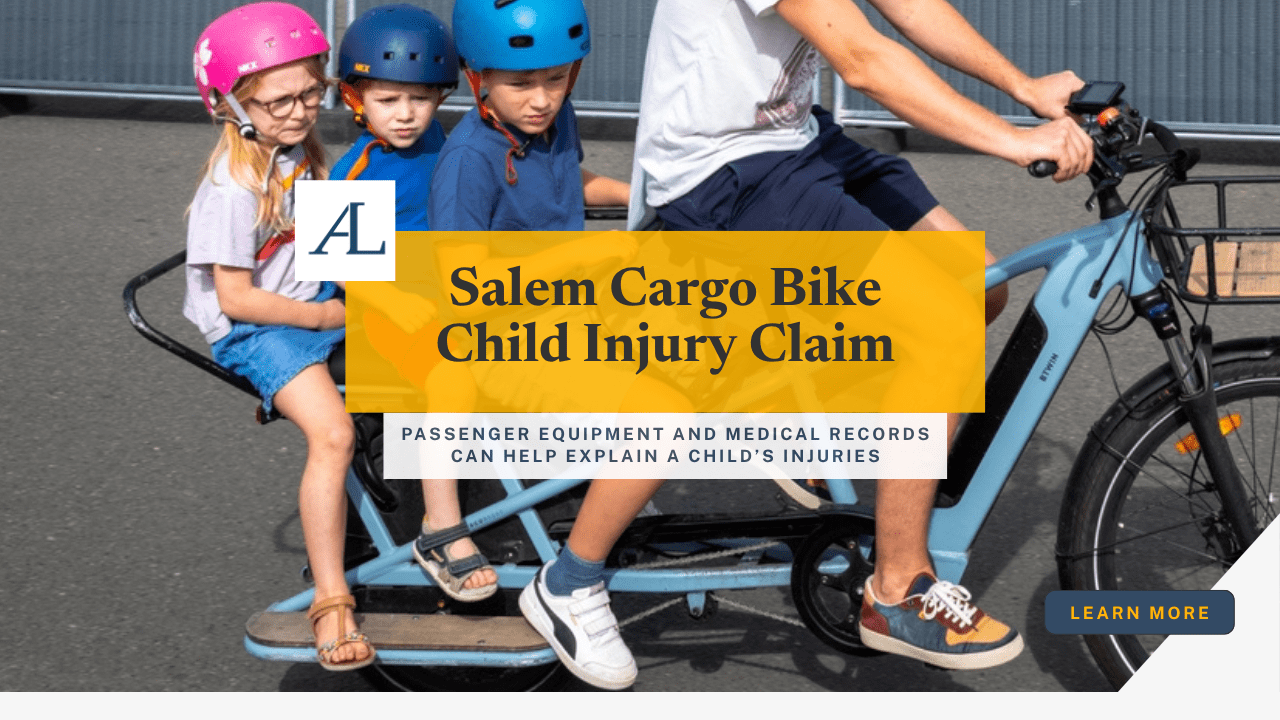
A Salem cargo bike child injury claim can become complicated quickly because the injured child may have been riding in a front cargo box, rear child seat, longtail passenger area, trailer, or another configuration that changes how the collision occurred. The parent or adult rider may remember the motor vehicle entering the bicycle’s path, but the child’s seating position, harness, footrests, helmet, cargo enclosure, and point of contact may determine which injuries were possible and what evidence must be preserved.
Cargo bicycles are designed to carry more weight and, in many cases, passengers, but the specific passenger setup matters. Oregon law prohibits carrying more people on a bicycle than the number for which the bicycle is designed or safely equipped. Oregon also generally requires bicycle operators and passengers under sixteen to wear approved protective headgear while riding on a highway or premises open to the public. Those requirements appear in Oregon Revised Statutes Chapter 814.
A Salem cargo bike child injury claim should document those issues accurately without allowing an insurer to use generalized assumptions about family bicycling as a substitute for investigating the motor vehicle driver. The central question remains how the collision occurred, what each party did, and how the child was injured.
The Oregon Department of Transportation explains that carrying cargo affects a bicycle’s balance and its ability to start, stop, and steer. ODOT also recognizes that specialized cargo bicycles and cargo e-bicycles may be used to transport multiple children or heavier loads. The state’s ODOT Bicycling With Cargo guidance emphasizes using appropriate, balanced, and secured equipment.
That guidance does not mean the adult rider caused the crash simply because a child was being transported. It means the bicycle’s design, weight distribution, motor-assist system, brakes, passenger equipment, and travel path may become relevant evidence in a Salem cargo bike child injury claim.
A child passenger may suffer substantial injuries even when the adult rider remains upright or experiences less direct contact. The vehicle may strike the cargo box, trailer, rear wheel, child seat, or side of the bicycle where the child is positioned. The child may be thrown within the passenger area, restrained by a harness, struck by bicycle components, or injured when the entire bicycle falls to the pavement.
The child’s injuries should be investigated separately from the adult rider’s injuries. A motor vehicle may contact the passenger area without striking the rider’s torso directly. A Salem cargo bike child injury claim should therefore reconstruct the child’s movement rather than assume the rider’s medical records describe everything that happened.
Avrek’s related article on what causes bicycle accidents discusses driver distraction, speeding, failure to yield, roadway conditions, and other factors that commonly contribute to bicycle collisions. A child-passenger cargo-bike case adds the separate need to preserve the passenger configuration and child-specific medical evidence.
When a vehicle collision injures a child riding on a cargo bicycle, choosing the right legal representation matters. A Salem personal injury lawyer and bicycle accident lawyer at Avrek Law Firm can help preserve the bicycle, passenger equipment, vehicle evidence, camera footage, medical records, school information, and caregiving documentation before critical evidence disappears. Avrek’s Salem practice handles personal injury matters throughout Salem and surrounding Oregon communities.
Call 866-598-5548, start a live chat, or request a free case review today. There are no upfront legal fees, and you do not pay unless we win.
Documenting the Passenger Setup in a Salem Cargo Bike Child Injury Claim
A Salem cargo bike child injury claim should begin with a complete record of how the child was being transported. Cargo bicycles vary widely. Some place children in a box in front of the adult rider. Others use an extended rear rack with one or more child seats, cushions, rails, footboards, or wheel guards. A separate trailer may be attached behind the bicycle. The bike may be traditional or electrically assisted.
The passenger configuration can affect balance, visibility, stopping distance, and the child’s exposure during impact. It can also help identify whether the vehicle struck the bicycle itself, the passenger area, the trailer connection, or an accessory added after purchase. Photographs should show the entire system before the bicycle, seat, trailer, or harness is repaired or removed.
Cargo Box, Child Seat, Trailer, Harness, and Footrest Position
The first step in a Salem cargo bike child injury claim is identifying exactly where the child sat. A front-box passenger may be positioned low and ahead of the rider. A rear child seat may place the child above the rear wheel. A longtail setup may use a padded bench, safety rail, footboards, and wheel guards instead of a conventional child seat. A trailer may place the child behind the bicycle and closer to the ground.
Photographs should show the seat, cargo box, trailer, harness, buckle, padding, side panels, safety rails, footrests, wheel skirts, canopy, and any protective frame. The equipment should be photographed from above, below, both sides, front, and rear. If the vehicle struck one side, that area should receive close-up photographs before the equipment is moved.
The child’s actual seating position should be documented separately from the manufacturer’s intended setup. A Salem cargo bike child injury claim may involve a child seated on the left or right side of a box, in the front or rear position of a trailer, or behind another child. The rider should explain where the child’s legs, arms, torso, and head were located before impact without guessing about movement they did not see.
Harness evidence can be important, but it must be handled carefully. A harness may reduce ejection while still allowing movement within the seat. The buckle can be damaged during impact. A strap may stretch, twist, release, or leave a mark. The parent should not alter or tighten the harness after the crash in an attempt to demonstrate how it was used. Instead, photograph its existing condition and preserve it for inspection.
Footrests and wheel guards can help show whether the child’s legs were supported and protected from moving parts. Damage to a footboard, spoke guard, wheel skirt, or child-seat leg support may correspond with a particular injury. A Salem cargo bike child injury claim should preserve those components rather than allowing a repair shop to discard them as ordinary broken accessories.
Oregon Revised Statutes Chapter 814 states that a bicycle operator may not carry more persons than the bicycle is designed or safely equipped to carry. That rule makes the bicycle’s passenger capacity, manufacturer specifications, and installed equipment relevant, but it does not automatically resolve fault for a collision caused by a negligent driver.
Bicycle Size, Load, Lighting, and Motor-Assist Features
The bicycle’s dimensions and load should also be documented. A cargo bike may be longer, wider, or heavier than a standard bicycle. The passenger box or trailer may extend beyond the rider’s body, and a longtail setup may carry weight behind the rear axle. Those differences can affect the bicycle’s path and how a turning or passing vehicle should have approached it.
A Salem cargo bike child injury claim should record the bicycle’s make, model, frame size, wheel size, serial number, listed carrying capacity, cargo dimensions, and estimated load at the time of the collision. The adult rider should identify the number of passengers, bags, groceries, school supplies, or other items being carried. The goal is not to create an after-the-fact calculation but to preserve the setup the rider actually used.
ODOT advises that cargo affects balance and the ability to start, stop, and steer. The bicycle’s brakes, tires, wheel condition, and weight distribution should therefore be preserved. Oregon equipment law requires a bicycle brake capable of stopping the bicycle within fifteen feet from ten miles per hour on dry, level, clean pavement. That statutory standard may become part of an insurer’s investigation, but the actual condition and operation of the bicycle should be evaluated through evidence rather than assumption.
Lighting and visibility equipment can also matter. Oregon law requires a white front light visible from at least five hundred feet and a rear red reflector or lighting device visible under specified conditions during limited visibility. A Salem cargo bike child injury claim should document front and rear lights, reflective material, flags, spoke reflectors, helmet lights, trailer lights, and the time and weather conditions.
Avrek’s guide to bicycle safety and visibility provides additional background on lights, reflective gear, roadway hazards, and inattentive drivers. Those general safety principles can support the investigation, but the claim must still focus on the actual equipment and collision evidence.
If the cargo bicycle uses electric assist, preserve the display, battery, motor, controller, app data, assist setting, mileage, error messages, and charging records. Motor assistance may affect acceleration and available trip data, but one display screen does not necessarily prove the bicycle’s speed at the moment of impact. GPS or cycling-app records may provide additional context.
The insurer may argue that the bicycle was unusually large or difficult to control. The correct response is evidence. A Salem cargo bike child injury claim should compare the rider’s route, bicycle condition, traffic movement, and collision point rather than treating cargo-bike size as proof that the rider caused the crash.
Pre-Crash Equipment Condition and Installation Records
A Salem cargo bike child injury claim should also establish the condition of the bicycle and passenger equipment before the collision. Earlier photographs, purchase records, assembly documents, service invoices, safety checks, and app records can help show that the cargo bike, child seat, trailer, brakes, lights, and motor system were functioning normally.
Manufacturer instructions can identify approved passenger arrangements, weight limits, compatible seats, required mounting hardware, and recommended inspections. The parent should preserve manuals, product pages, installation receipts, warranty information, and communications with the bicycle shop. If the equipment was installed by a dealer, the work order and technician notes may be useful.
Modifications should be documented honestly. The rider may have added a seat, cushion, footboard, trailer hitch, canopy, handrail, wheel guard, or aftermarket light. A modification does not automatically defeat a Salem cargo bike child injury claim, but the insurer may investigate whether it contributed to the event. Photographs and installation records can show what was changed and how it was secured.
The bicycle should not be repaired before the need for inspection is considered. A shop may straighten the frame, replace a wheel, remove a damaged child seat, clear an electronic error, or discard the trailer hitch. Those routine repairs can change evidence about the impact direction and force.
If the equipment creates a safety concern, it should be stored responsibly. A damaged e-bike battery, sharp frame component, or unstable trailer may require professional handling. Preserving evidence never requires a parent to create an additional danger for the child or household.
Reconstructing the Collision in a Salem Cargo Bike Child Injury Claim
A Salem cargo bike child injury claim should reconstruct both the adult rider’s path and the child passenger’s movement. The driver may claim the bicycle appeared suddenly, was outside the bike lane, or was difficult to judge because of its size. The rider may remember traveling straight when the vehicle turned, passed too closely, opened a door, entered from a driveway, or failed to yield.
The complete sequence should be built from scene photographs, vehicle and bicycle damage, video, witness statements, traffic controls, GPS data, police records, and final resting positions. The child’s injuries should then be compared with the physical evidence without forcing the parent to make technical conclusions.
Rider Path, Vehicle Movement, and Point of Contact
The rider’s route should be documented from several viewpoints. A Salem cargo bike child injury claim may arise in a bicycle lane, shared travel lane, neighborhood street, intersection, driveway, parking lot, school area, or multi-use connection. The roadway width, bike-lane markings, parked cars, traffic signals, signs, curb extensions, and sightlines can affect how the collision occurred.
The motor vehicle’s movement should be identified separately. The driver may have turned across the bicycle’s path, passed and moved back too soon, entered from a side street, backed from a driveway, or opened a door into the rider’s line of travel. A vehicle can also strike a trailer or rear passenger area after the bicycle’s front has already cleared.
The point of contact can help establish which movement occurred. Paint transfer, scrapes, dents, broken lights, tire marks, and damage height should be photographed on both the vehicle and bicycle. If the cargo box or child seat has a direct impact mark, that evidence may be especially important to the Salem cargo bike child injury claim.
The rider should describe what they saw and felt without guessing about speed or distance. A statement such as “the vehicle turned across the bike lane and struck the left side of the box” is often more reliable than an unsupported estimate of miles per hour or feet.
Oregon defines people operating or riding on bicycles as vulnerable users of a public way. The legal duties in a specific crash depend on the exact roadway and maneuver, but a child passenger does not lose protection simply because the family chose a cargo bicycle for transportation.
Avrek’s related article on when cyclists have the right of way after a Salem bike crash provides additional context for turning vehicles, bike lanes, intersections, and insurer attempts to blame the cyclist.
Bicycle Damage, Passenger Area Damage, and Final Positions
Damage should be documented before anyone separates the child seat, cargo box, trailer, or bicycle. A Salem cargo bike child injury claim may involve damage to the frame, fork, wheels, brakes, motor, battery, rack, steering linkage, trailer arm, hitch, harness, safety rail, footboard, wheel guard, or canopy.
The passenger area deserves its own damage inventory. A cracked box panel, bent rail, torn harness, broken buckle, compressed padding, scraped trailer shell, or displaced child seat may help explain how the child moved. The absence of obvious damage does not prove the child was uninjured, but any visible damage should be preserved.
Final resting positions can also help reconstruct the crash. Photograph where the bicycle, vehicle, child seat, trailer, helmet, shoes, backpack, and personal items came to rest. The child may have remained restrained while the bicycle fell, or the child may have been removed by a parent or responder before photographs were taken. Record who moved what and why.
The cargo bicycle may be declared a total loss even when some components appear repairable. The frame and passenger equipment may need specialized inspection because ordinary bicycle-shop estimates may not address structural integrity, motor electronics, or child-restraint components.
A Salem cargo bike child injury claim should preserve the damaged helmet, clothing, shoes, school bag, glasses, and other property. These items may contain scrape patterns or impact marks that correspond with the child’s medical records.
Repair estimates should include photographs and written findings. If a shop says a frame, seat, trailer, or harness cannot be safely reused, ask for that conclusion in writing and request that the part be preserved rather than discarded.
Cameras, Cycling App Data, Witnesses, and Scene Photos
Video can resolve disputes that are difficult to answer from damage alone. A Salem cargo bike child injury claim may involve helmet-camera footage, handlebar video, vehicle dashcams, doorbell cameras, business surveillance, traffic cameras, school cameras, or witness phones.
The complete original recording should be preserved, including the minutes before and after the collision. A short clip may omit the rider’s approach, the driver’s earlier position, or statements made immediately afterward. Original files may also contain timestamps, audio, GPS, or metadata that a texted copy does not preserve.
Cycling apps and phone-location history can show route, direction, speed, stops, elevation, and time. E-bike apps may add assist level, battery status, or trip distance. A Salem cargo bike child injury claim should use this information carefully. GPS can have gaps or delays, and one recorded speed point should not be treated as a complete reconstruction without context.
Witnesses may include drivers, passengers, pedestrians, other cyclists, crossing guards, school staff, nearby employees, residents, or transit users. Each person should provide an independent account. Useful questions include where the cargo bicycle was traveling, how the vehicle moved, whether the driver used a signal, and what happened to the child passenger.
Scene photographs should show the full roadway, lane markings, bike lane, intersection, driveway, lighting, weather, surface condition, debris, sightlines, and camera locations. The parent should not focus only on the damaged bicycle. A Salem cargo bike child injury claim may depend on showing the driver had a clear view or crossed a predictable bicycle route.
Salem Police allows written public-record requests for releasable police reports, photographs, video, and 911 audio. Those records may not be available immediately while an investigation remains open, but the report number and request process should be preserved.
Medical Records in a Salem Cargo Bike Child Injury Claim
A Salem cargo bike child injury claim requires child-specific medical documentation. Children may not describe pain, dizziness, fear, or functional changes in the same way adults do. A young child may become quiet, irritable, unusually tired, reluctant to use an arm or leg, afraid to ride, or unable to explain where something hurts.
Parents should seek medical evaluation based on the child’s condition and provider guidance, not on the insurer’s opinion about the apparent speed or bicycle damage. The medical record should identify that the child was a passenger on a cargo bicycle, where the child was seated, whether a helmet and harness were used, which part of the bicycle or vehicle was struck, and how the child moved.
Emergency Care, Follow-Up Treatment, and Specialist Referrals
Emergency records can establish the first symptoms, visible injuries, neurological status, pain, bruising, swelling, and treatment recommendations. A Salem cargo bike child injury claim may involve fractures, head injury, concussion symptoms, facial trauma, dental injury, road rash, shoulder or wrist injuries, knee or ankle trauma, back or neck pain, or emotional distress.
The parent should tell providers whether the child remained restrained, struck a side panel or rail, fell with the bicycle, or was thrown from the passenger area. If the parent did not see the exact movement, the record should say that rather than present a guess as fact.
Follow-up care may include pediatrics, orthopedics, neurology, physical therapy, occupational therapy, dental care, counseling, or another specialist. Preserve referral orders, scheduling messages, authorization delays, test results, treatment plans, home instructions, and progress notes.
Children can improve quickly in some areas while continuing to struggle in others. A child may return to school but still have headaches, sleep problems, limited mobility, or fear of traffic. A Salem cargo bike child injury claim should not equate school attendance with complete recovery.
Oregon law requires bicycle riders and passengers under sixteen to wear approved protective headgear on highways and premises open to the public. Oregon law also states that evidence of failure to wear required headgear cannot be used to reduce damages or as a defense in an action brought for an injured bicyclist or passenger when another person’s fault contributed to the injury. That distinction is important: helmet use should be documented accurately, but a driver’s insurer should not use the issue in a manner Oregon law prohibits.
ODOT likewise advises that all bicycle riders wear helmets and states that children under sixteen are legally required to wear approved headgear on public roads or paths. It also advises inspecting and replacing a helmet after a crash when damage is present.
School, Sleep, Mobility, and Activity Changes
Medical bills do not capture every effect on a child. A Salem cargo bike child injury claim should document changes in school attendance, concentration, homework, physical education, sports, playground activity, sleep, mood, mobility, and daily routines.
School records may include absence notes, nurse visits, accommodation plans, reduced assignments, delayed testing, tutoring, transportation changes, or restrictions from physical activity. Parents should preserve emails with teachers, administrators, coaches, and school nurses.
Sleep changes can be important. A child may have nightmares, wake frequently, resist bedtime, become afraid of traffic sounds, or need a parent nearby. These observations should be shared with the child’s provider rather than recorded only for the insurance claim.
Mobility changes may include difficulty walking, climbing stairs, carrying a backpack, sitting through class, using a dominant hand, or participating in ordinary play. A Salem cargo bike child injury claim should use specific examples and provider restrictions instead of general statements that the child “cannot do anything.”
Emotional changes can also matter. A child may fear bicycles, cars, intersections, or separation from a parent. The family should not pressure the child to resume riding before the child and providers are ready. Counseling or behavioral-health recommendations should be preserved when they are made.
Photographs and short videos can document casts, braces, mobility aids, bruising, or activity limitations, but they should be created respectfully. The child’s privacy should remain a priority.
Parent Transportation, Missed Work, and Caregiving Records
A child’s recovery often creates substantial demands for the parent or guardian. A Salem cargo bike child injury claim may involve transportation to emergency care, specialists, therapy, school meetings, imaging, counseling, or follow-up appointments.
Keep mileage records, parking receipts, rideshare costs, public-transit costs, hotel expenses when applicable, and calendars showing appointments. If the cargo bicycle was the family’s primary transportation, preserve the cost of replacement transportation and equipment.
Parents may miss work, reduce hours, use leave, decline shifts, or work remotely to care for the child. Preserve pay stubs, schedules, employer communications, leave records, and notes explaining which absences were connected to appointments or caregiving.
Caregiving records can show help with bathing, dressing, medication, mobility, schoolwork, sleep, transportation, and emotional support. A Salem cargo bike child injury claim should document actual tasks and time without exaggeration.
Siblings and household routines may also be affected. A parent may arrange additional childcare, meal support, school transportation, or help from relatives. Receipts and calendars can show those changes.
How parent-incurred medical expenses, wage loss, and caregiving costs are presented can depend on Oregon law and the family’s circumstances. Legal review is especially important because the child’s claim and the parent’s related financial losses may not always be handled in exactly the same way.
Insurance and Property Issues in a Salem Cargo Bike Child Injury Claim
A Salem cargo bike child injury claim may involve the driver’s auto insurer, the vehicle owner’s policy, the family’s health insurance, the parent’s auto policy, bicycle or e-bike coverage, homeowner or renter coverage, and other policies. Coverage should be identified from actual documents rather than assumptions.
Oregon requires motor-vehicle owners to carry bodily-injury and property-damage liability coverage, personal injury protection, and uninsured-motorist coverage at specified minimum levels. ODOT’s bicycling guidance also advises injured cyclists to document injuries and property damage, save medical receipts and repair estimates, and contact applicable auto or bicycle insurers.
Driver, Vehicle Owner, and Bicycle Coverage Information
The driver may not own the vehicle. A Salem cargo bike child injury claim should identify the driver, registered owner, employer, rental company, rideshare company, delivery business, or other entity connected to the vehicle.
Collect the driver’s license, registration, license plate, insurer, policy number, employer information when applicable, and police report number. If a commercial or government vehicle is involved, additional policies and shorter notice deadlines may apply.
The family should also review its own coverage. An auto policy may contain personal injury protection or uninsured/underinsured motorist provisions that could become relevant to a bicyclist or child passenger, depending on the policy and facts. Health insurance may pay medical bills while liability is investigated. A specific bicycle or e-bike policy may address property damage, theft, or replacement.
A Salem cargo bike child injury claim should track which insurer paid each expense and whether reimbursement or lien issues may arise. Parents should not sign broad authorizations or releases merely because one carrier offers to pay an early bill.
Oregon follows modified comparative negligence. Under ORS 31.600, a claimant may recover when the claimant’s fault is not greater than the combined fault of the parties described by the statute, with damages reduced by the claimant’s percentage of fault. Insurers may therefore investigate the adult rider’s route, lighting, passenger setup, and attention. Those issues should be answered with evidence rather than assumptions about cargo bikes.
Cargo Bike, Child Seat, Trailer, Helmet, and Personal Property Losses
Property damage can be extensive. A Salem cargo bike child injury claim may include the bicycle frame, motor, battery, controller, display, wheels, brakes, steering linkage, cargo box, child seat, trailer, hitch, harness, footboards, lights, helmet, clothing, backpack, phone, glasses, and other items.
The original purchase price is only one part of the property claim. Preserve model information, serial numbers, receipts, photographs, upgrades, accessories, service history, and comparable replacement prices. Specialized cargo bicycles and compatible child equipment may be expensive or difficult to replace.
The helmet should be evaluated and replaced in accordance with manufacturer and safety guidance after an impact. Preserve the damaged helmet and purchase information until it is photographed and the claim’s inspection needs are considered.
A repair shop should provide a written estimate and photographs. If the frame, box, seat, or trailer cannot be safely repaired, ask the shop to explain why. A Salem cargo bike child injury claim should not rely solely on an insurer’s photo estimate when hidden structural or electrical damage may exist.
Storage and transportation costs can also matter. The family may need a larger vehicle, specialty shop, battery-safe storage, or disassembly to move the cargo bicycle. Keep receipts and document who controlled the equipment.
Do not allow the insurer, driver, shop, or manufacturer to take permanent possession of the bicycle or passenger equipment without a written agreement. Inspection may be appropriate, but the family should know what testing is permitted, whether parts may be removed, and when the property will be returned.
Recorded Statements and Settlement Communications Involving the Parent
Insurance adjusters may contact the parent quickly and ask detailed questions about the child, bicycle, harness, helmet, route, speed, and medical condition. A Salem cargo bike child injury claim can be harmed when a parent guesses about details they did not see or accepts the adjuster’s wording.
The parent should separate personal observations from conclusions learned later. They can describe where the child sat, what the driver did, what damage they saw, and how the child behaved. They should not diagnose an injury, estimate impact force, or state that equipment failed without evidence.
The insurer may request a recorded statement from the adult rider and a separate interview involving the child. Parents should obtain legal guidance before allowing an insurance representative to question a minor. The child should not be placed in a stressful interview simply because the carrier wants an early account.
Early settlement offers require caution. The child may still be undergoing evaluation, therapy, or specialist care. School and emotional effects may not yet be clear. A release signed too early may close the Salem cargo bike child injury claim before future needs are known.
Settlement involving a minor may require additional legal procedures depending on the amount, structure, and circumstances. The family should not rely on the insurer to explain every consequence of a release or payment arrangement.
What to Do After a Cargo Bike Collision Injures a Child
Medical safety comes first. Call 911 when a child may be injured, has struck the head, appears confused, has significant pain, cannot move normally, or faces another emergency concern. Follow responder instructions and do not move the child unnecessarily unless there is an immediate danger.
When safe, photograph the child passenger area, bicycle, trailer, vehicle, license plate, driver, roadway, bike lane, intersection, debris, final positions, lights, helmet, clothing, and visible injuries. Do not delay emergency care to gather evidence.
A Salem cargo bike child injury claim should preserve the bicycle and equipment before repair. Save the harness, child seat, trailer, helmet, battery, display, and any broken components. Obtain the tow or storage location and send written preservation requests when appropriate.
Collect witness information and identify nearby cameras. Save app data, route history, texts, calls, purchase records, maintenance records, school communications, medical papers, and every insurer message.
For a collision with injuries inside Salem, the Salem Police Department directs people to call its non-emergency line rather than use the online report system; emergencies require 911. The family should record the agency, officer, case number, and how to request reports, photos, video, and 911 audio.
Reporting and Deadlines for a Salem Cargo Bike Child Injury Claim
Oregon DMV requires drivers involved in a reportable motor-vehicle collision to submit an Oregon Traffic Collision and Insurance Report within seventy-two hours. A report is required when injury or death occurs and in specified property-damage situations, even if law enforcement also creates a report. The family should confirm which driver or owner is responsible for filing and preserve a copy of any report connected to the Salem cargo bike child injury claim.
Oregon generally provides a two-year limitations period for personal injury actions under ORS 12.110. ORS 12.160 contains tolling rules for minors that may extend the period, but the statute places limits on that extension. Claims involving a public body may also require notice within 180 days under ORS 30.275, subject to the statute’s terms and exceptions.
These rules are fact-specific. A Salem cargo bike child injury claim should be reviewed promptly rather than relying on the child’s age as a reason to wait. Video can be overwritten, equipment can be repaired, witnesses can move, and digital records can disappear long before any filing deadline.
Frequently Asked Questions About a Salem Cargo Bike Child Injury Claim
What evidence should be preserved after a child is injured on a cargo bike?
A Salem cargo bike child injury claim may require the bicycle, cargo box, child seat, trailer, harness, footrests, wheel guards, helmet, lights, motor-assist data, GPS route, vehicle photographs, camera footage, witness statements, police records, medical records, school records, and caregiving documentation.
The equipment should be preserved before repair or disposal when it can be stored safely.
Is it legal to carry a child on a cargo bicycle in Oregon?
Oregon law prohibits carrying more people on a bicycle than the number for which the bicycle is designed or safely equipped. Whether a particular cargo box, rear seat, longtail system, or trailer is appropriate depends on the bicycle, equipment, passenger capacity, manufacturer instructions, and actual setup.
A Salem cargo bike child injury claim should document the design and installation instead of assuming all cargo bicycles are configured the same way.
Does a child have to wear a bicycle helmet in Oregon?
Oregon requires bicycle riders and passengers under sixteen to wear approved protective headgear on highways and premises open to the public, subject to the statutory religious-practice exemption.
Oregon law also limits the use of helmet nonuse evidence in an injury claim caused in whole or part by another person’s fault.
What if the driver says the cargo bike was too large or difficult to see?
Cargo-bike size does not automatically establish fault. The investigation should examine the rider’s lane position, lights, visibility, vehicle movement, point of contact, traffic controls, and available reaction time.
A Salem cargo bike child injury claim should rely on scene and digital evidence rather than stereotypes about family bikes.
Can a child be injured even if the harness stayed buckled?
Yes. A harness may reduce ejection without preventing every type of movement or injury. The child may contact the box, rail, seat, or harness, or the entire bicycle may fall.
Medical providers should evaluate the injuries, while photographs and equipment inspection can help explain the movement.
Should the damaged helmet, child seat, or trailer be thrown away?
No, not before they are documented and the need for inspection is considered. Photograph the equipment and store it securely.
If an item creates an immediate safety risk, follow professional guidance while preserving photographs, serial numbers, and records whenever possible.
What if the bicycle was electrically assisted?
Preserve the battery, display, motor, controller, app information, assist setting, mileage, and error messages. These records may help establish the bicycle’s condition and route.
A Salem cargo bike child injury claim should not assume motor assist proves excessive speed or improper operation.
Can the parent recover missed work and caregiving costs?
Parent wage loss, transportation, medical expenses, and caregiving records may be relevant, but the way those losses are presented depends on Oregon law and the case structure.
Preserve the records and obtain legal review before accepting a settlement.
Should the child speak with the driver’s insurance adjuster?
Parents should obtain legal guidance before allowing an insurer to interview a minor. The child may not understand the purpose of the questions and should not be pressured to provide a recorded account.
The parent should also avoid guessing on the child’s behalf.
How long do we have to bring the claim?
Oregon generally provides a two-year period for personal injury actions, and Oregon law contains special tolling rules for minors. Public-body claims may involve a 180-day notice requirement.
A Salem cargo bike child injury claim should be evaluated promptly because the precise deadline depends on the facts and evidence can disappear much sooner.
Do we need a lawyer for a child-passenger bicycle claim?
Legal assistance can be especially important when the child’s seating configuration, medical prognosis, school effects, equipment condition, insurance coverage, or comparative-fault arguments are disputed.
A Salem personal injury lawyer can organize the local, medical, school, and family evidence, while a bicycle accident lawyer can investigate the driver, road, bicycle, and passenger equipment.
Call or Contact Avrek Law Firm 24/7 for a Free Consultation and Pay Nothing Unless We Win
A Salem cargo bike child injury claim can become difficult when the driver blames the adult rider, the insurer questions the passenger setup, or the cargo bike and child equipment are repaired before an inspection. These cases may depend on the cargo box, seat, trailer, harness, footrests, lights, motor-assist data, frame damage, camera footage, witnesses, medical records, school documentation, caregiving records, and multiple insurance policies.
Avrek Law Firm helps families investigate bicycle and motor-vehicle collisions throughout Salem and Marion County. Our team can move quickly to preserve the bicycle and passenger equipment, identify the driver and vehicle owner, obtain camera and app records, organize the child’s medical and school timeline, and document the family’s financial losses.
An experienced legal team can evaluate a Salem cargo bike child injury claim before equipment is discarded, surveillance is overwritten, or an insurer presents a broad release. Prompt action can also protect the child from unnecessary insurer questioning while the medical recovery remains uncertain.
If your child was injured while riding as a passenger on a cargo bicycle in Salem, Avrek Law Firm is ready to help.
Call 866-598-5548, start a live chat, or complete our online consultation form today for a free, no-obligation case review. There are no upfront legal fees, and you do not pay unless we win.
Serving the Salem Community
Avrek Law Firm represents injured cyclists, child passengers, and families throughout Salem and nearby Marion County communities. A Salem cargo bike child injury claim may arise on Commercial Street, Liberty Street, State Street, Mission Street, Lancaster Drive, neighborhood routes, school corridors, downtown streets, park connections, or another location where bicycles and motor vehicles interact.
Local context matters because the crash location can determine which Salem Police records, business cameras, school cameras, traffic controls, or witnesses are available. Wet pavement, seasonal darkness, parked vehicles, and turning traffic can also affect the investigation, but each factor should be documented rather than assumed.
A Salem personal injury lawyer can help preserve local evidence and coordinate the family’s claim. Avrek’s bicycle accident lawyers can address the bicycle configuration, motor-vehicle movement, child injuries, and insurance disputes.
A Salem cargo bike child injury claim should be handled with urgency and care. The child’s recovery comes first, while the legal team preserves the equipment, records, and testimony needed to show what happened.
- 📩 Submit a request through our online form
- 📞 Call 866-598-5548 now to speak with our team
- 💬 Start a live chat for immediate assistance
There are no upfront fees, and you don’t pay unless we win.