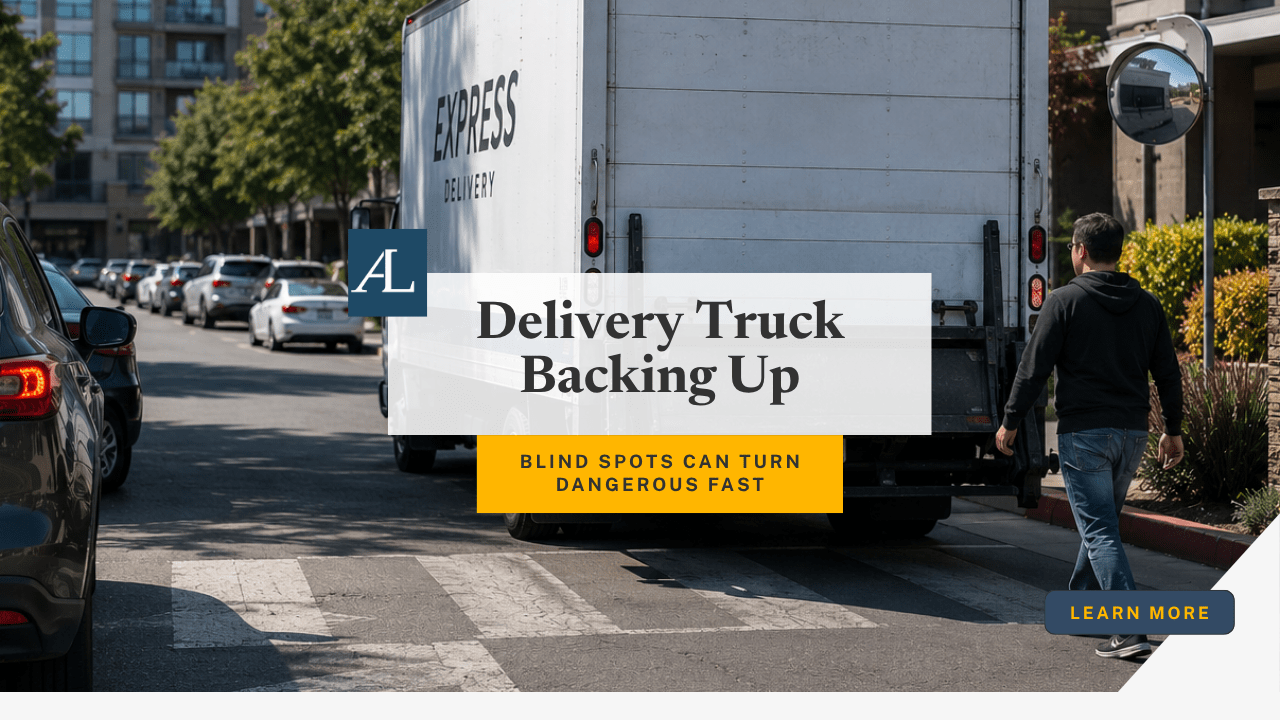
Sacramento delivery truck backing accident claim cases can become serious very quickly because backing collisions often happen in tight areas where pedestrians, residents, workers, cyclists, and passenger vehicles are difficult for a delivery driver to see. A truck may back out of an apartment complex driveway, reverse through a business parking lot, move near a loading dock, or back into a narrow alley while the driver is trying to complete a delivery on a schedule. In seconds, a pedestrian, parked vehicle, cyclist, or another driver can be struck.
These crashes are especially dangerous because a delivery truck’s blind spots can make people and smaller vehicles hard to detect. The injured person may have been walking through an apartment parking lot, carrying groceries, loading a child into a car, riding through a driveway, leaving work, or passing behind the vehicle when the truck began moving backward. The delivery driver may say they did not see anyone. The company may say the driver followed procedure. The insurer may try to argue the injured person should not have been behind the truck.
A Sacramento delivery truck backing accident claim should not be evaluated through the driver’s version alone. Backup camera footage, dashcam video, delivery logs, GPS records, apartment security cameras, business surveillance, witness statements, vehicle damage, warning beepers, maintenance records, and driver training documents may all help prove what happened.
When a delivery truck backing accident leaves you injured, choosing the right legal representation matters. An experienced Sacramento truck accident lawyer at Avrek Law Firm can act quickly to preserve evidence, identify every responsible party, and pursue compensation that reflects the full impact of the injury.
Call 866-598-5548, start a chat, or request a free case review today. There are no upfront fees, and you pay nothing unless we win.
Why a Sacramento Delivery Truck Backing Accident Claim Is Often Disputed
A Sacramento delivery truck backing accident claim is often disputed because backing collisions usually happen in places where visibility is limited and the scene changes fast. The truck may be moved. The driver may continue the route. Apartment management may clean the area. A business may overwrite video. Witnesses may leave before their information is collected.
Delivery companies and insurers may also try to frame the crash as a simple parking lot accident. That can minimize the seriousness of the claim. In reality, backing accidents involving delivery trucks can involve complex company records, commercial insurance, driver training, blind-spot hazards, and evidence that injured victims cannot access on their own.
Backing Trucks Create Blind-Spot Risks in Tight Spaces
Delivery trucks, box trucks, vans, and step vans often have large blind spots behind and beside the vehicle. In apartment complexes and business lots, those blind spots become more dangerous because people and vehicles may move close to the truck in several directions at once.
The FMCSA advises truck and bus drivers to check mirrors every 8 to 10 seconds and scan ahead for traffic issues, work zones, and other dangers. The same official safety guidance emphasizes that large trucks and buses face unique challenges, including blind spots and the need for careful movement.
In a Sacramento delivery truck backing accident claim, the question is not only whether the driver personally saw the injured person. The question is whether the driver used reasonable care before backing, checked mirrors and cameras, used a spotter when needed, moved slowly, and confirmed the path was clear.
Apartment Complexes and Business Lots Have Mixed Traffic
Apartment complexes and business lots are not controlled like open highways. A driver may be dealing with parked cars, children, delivery carts, dumpsters, loading zones, tenants, customers, employees, cyclists, scooters, and pedestrians moving between buildings.
A Sacramento delivery truck backing accident claim may involve a truck backing near mailrooms, leasing offices, loading bays, commercial storefronts, restaurant entrances, medical offices, apartment garages, or narrow drive aisles. These are places where pedestrians are expected, not rare.
When a delivery company sends drivers into these spaces, it should anticipate the risk that someone may walk or drive behind the truck. That means driver training, route planning, camera use, warning devices, and safe backing procedures may all become relevant.
“I Did Not See Them” Does Not Automatically Excuse the Crash
Drivers often say they did not see the injured person before impact. That statement may describe what the driver remembers, but it does not automatically excuse the crash. A driver who backs a delivery truck has a duty to make sure the movement can be made safely.
California Vehicle Code Section 22106 states that a person must not start a vehicle that is stopped, standing, or parked on a highway, and must not back a vehicle on a highway, until the movement can be made with reasonable safety.
For private parking lots or apartment complexes, the legal analysis may also involve general negligence principles, property rules, and company safety procedures. Either way, a Sacramento delivery truck backing accident claim should examine whether the driver backed only after confirming the area was safe.
Evidence That Can Prove How the Backing Accident Happened
A Sacramento delivery truck backing accident claim can depend on evidence that disappears quickly. The truck may leave the scene. A company may control the dashcam. A backup camera may not save footage unless requested. Security footage may be overwritten. Property managers may repair damage or change the layout.
The sooner evidence is preserved, the stronger the claim may be.
Backup Camera, Dashcam, and Vehicle Technology Records
Many delivery trucks have backup cameras, sensors, dashcams, GPS systems, or telematics. These records may show whether the truck was backing, how fast it moved, whether it stopped before impact, whether alerts sounded, and whether the driver had enough time to avoid the collision.
In a Sacramento delivery truck backing accident claim, backup camera footage can be critical. If the video shows the pedestrian, cyclist, or vehicle behind the truck before impact, it may challenge the driver’s claim that the person appeared suddenly. If the video does not exist, the claim may need to ask why it was not saved, whether the system was working, and whether the company had a retention policy.
Delivery companies often control this evidence. Injured victims should not assume the company will preserve it voluntarily.
Apartment, Business, and Parking Lot Surveillance Footage
Apartment complexes and businesses often have cameras near gates, garages, entrances, loading docks, mail areas, leasing offices, parking lots, and storefronts. These cameras may show the truck’s approach, backing movement, impact, and whether warning sounds or lights were visible.
A Sacramento delivery truck backing accident claim should identify nearby cameras quickly. Property managers, retail stores, warehouses, office buildings, restaurants, and apartment communities may delete or overwrite footage within days or weeks.
A written preservation request should identify the date, time, location, and camera angles needed. Even partial footage may help if it shows where the injured person was walking, how long the truck was stopped, or whether the driver backed without checking the path.
Delivery Logs, GPS Records, and Route Pressure
Delivery records may show why the truck was at the location and whether the driver was working under time pressure. Package scans, app timestamps, dispatch messages, route assignments, GPS records, delivery photos, and driver communications may all matter.
In a Sacramento delivery truck backing accident claim, these records can help identify the responsible company, confirm that the driver was on duty, and show whether the company’s delivery system contributed to unsafe backing decisions.
If a company expects drivers to complete too many deliveries in too little time, those pressures may affect how safely drivers maneuver in parking lots and apartment complexes. Route data can help reveal whether the driver was rushing, behind schedule, or making repeated high-pressure stops.
Who May Be Liable After a Sacramento Delivery Truck Backing Accident?
A Sacramento delivery truck backing accident claim may involve several possible responsible parties. The driver may be liable, but the company, vehicle owner, maintenance provider, property owner, or another driver may also need review.
Identifying every liable party is important because serious injuries may exceed one insurance policy.
The Delivery Driver
The delivery driver may be responsible if they backed without checking mirrors, failed to use the backup camera, moved too fast, ignored warning sounds, failed to use a spotter, backed into a pedestrian path, or failed to stop when someone was visible.
A Sacramento delivery truck backing accident claim should compare the driver’s statement with physical evidence. Vehicle damage, video footage, witness accounts, camera angles, and GPS records may show whether the driver moved carelessly.
The driver may say the injured person was in a blind spot. That does not end the analysis. Blind spots are exactly why commercial drivers must use extra caution before backing.
The Delivery Company or Employer
The delivery company may be responsible if the driver was working at the time of the crash, operating a company vehicle, following route instructions, or acting within the scope of employment. Company liability may also arise from poor training, unsafe schedules, inadequate supervision, failure to maintain safety equipment, or policies that encourage rushed deliveries.
In a Sacramento delivery truck backing accident claim, company records may be central. Training materials, safety policies, delivery quotas, vehicle inspection records, prior complaints, route data, and driver history may all help show whether the crash was preventable.
Companies may try to blame the driver alone. A complete investigation asks whether the company’s practices helped create the risk.
The Vehicle Owner or Maintenance Provider
Some delivery trucks are leased, rented, or maintained by third parties. If the backup camera failed, warning alarm did not work, mirrors were damaged, brake lights malfunctioned, or the truck had maintenance problems that contributed to the crash, the vehicle owner or maintenance provider may need review.
A Sacramento delivery truck backing accident claim may require inspection records, repair invoices, pre-trip inspection forms, mechanic notes, and equipment maintenance logs. If the company knew the backup alarm or camera was not working and still allowed the vehicle to operate, that evidence may become important.
The Apartment Complex, Business, or Property Owner
A property owner is not automatically responsible for every delivery truck crash on its property. However, property conditions may matter when the layout creates foreseeable danger.
A Sacramento delivery truck backing accident claim may involve poor lighting, blind corners, missing mirrors, blocked sight lines, confusing loading areas, narrow drive aisles, unsafe delivery instructions, or a loading dock that forces trucks to back through pedestrian areas.
If the property owner or manager knew delivery vehicles frequently backed through a dangerous pedestrian path and failed to address it, property liability may need investigation.
What Injured Victims Should Do After a Delivery Truck Backing Crash
A Sacramento delivery truck backing accident claim can be affected by the steps taken immediately after the crash. Safety comes first, but evidence preservation should begin as soon as possible.
Report the Crash and Get Medical Help
Call 911 if anyone is injured. If the crash happens in an apartment complex, business lot, warehouse, or private property, report it to property management as well. Request the incident report number and save the names of everyone who responds.
Medical care should not be delayed. Backing truck crashes can cause fractures, head injuries, back and neck injuries, hip trauma, knee injuries, internal injuries, crush injuries, and psychological trauma. Some symptoms may worsen after the initial shock wears off.
Prompt medical documentation helps connect the injury to the crash.
Photograph the Scene Before It Changes
Photos should show the truck, vehicle position, impact area, parking lot layout, delivery location, driveway, loading dock, signs, lighting, cones, debris, skid marks, warning devices, and visible injuries. If safe, photograph the truck’s license plate, company markings, vehicle number, open doors, mirrors, backup camera, and any visible damage.
In a Sacramento delivery truck backing accident claim, scene photos can prove where the injured person was and how the truck moved. They may also show whether the driver had a clear view, whether warning signs existed, and whether the property layout contributed to the crash.
Save Witness Information and Delivery Details
Witnesses may include residents, employees, customers, security guards, delivery workers, property managers, passengers, or nearby drivers. Save names, phone numbers, emails, and a short summary of what each person saw.
Delivery details matter too. If the driver was delivering to a specific apartment, business, loading dock, or customer, write that down. Package labels, delivery photos, company uniforms, and app screens may help identify the company responsible.
Avoid Recorded Statements Before Evidence Is Reviewed
Insurance adjusters may ask for a recorded statement soon after the crash. They may ask whether you were behind the truck, whether you heard a backup alarm, whether you saw the vehicle moving, or whether you could have moved away sooner.
In a Sacramento delivery truck backing accident claim, these questions can be used to shift blame. Avoid guessing about distances, timing, speed, or visibility before video and other evidence are reviewed.
Reporting and DMV Requirements After a California Delivery Truck Accident
A Sacramento delivery truck backing accident claim may also involve DMV reporting when injuries or property damage meet California reporting thresholds.
The California DMV states that a driver, insurance agent, broker, or legal representative must complete an SR-1 report and send it to the DMV within 10 days if someone is injured, killed, or property damage is over $1,000. The DMV also explains that the SR-1 is required in addition to any report made to police, CHP, or an insurance company.
This can matter even when the crash happens in a parking lot, apartment complex, or business property. Injured victims should speak with counsel about which reports may apply and how to preserve records without making statements that harm the claim.
Frequently Asked Questions About a Sacramento Delivery Truck Backing Accident Claim
Who may be responsible if a delivery truck backs into someone?
The delivery driver may be responsible, but the delivery company, employer, vehicle owner, maintenance provider, property owner, or another party may also share liability. A Sacramento delivery truck backing accident claim should review the full sequence, not just the driver’s statement.
What evidence helps prove a backing accident claim?
Important evidence may include backup camera footage, dashcam footage, apartment or business surveillance, witness statements, delivery logs, GPS records, route data, vehicle damage, scene photos, medical records, and company safety policies.
Does it matter if the driver says they did not see me?
Yes, but that statement does not automatically excuse the crash. Delivery drivers must use reasonable care before backing. If a camera, mirror, warning device, or spotter should have prevented the collision, the driver and company may still be responsible.
Can a delivery company be liable for a driver’s backing crash?
Yes. A delivery company may be liable if the driver was working, using a company vehicle, following company instructions, or operating under unsafe delivery pressure. Company training, route data, and safety policies may all matter.
Should I speak with a lawyer before talking to the insurer?
Yes. Delivery truck backing claims often involve company-controlled evidence and multiple insurance policies. A Sacramento truck accident lawyer can help preserve video, request delivery records, and prevent insurers from shifting blame unfairly.
Call or Contact Avrek Law Firm 24/7 for a Free Consultation and Pay Nothing Unless We Win
A Sacramento delivery truck backing accident claim can become complicated when delivery companies, insurers, property owners, and drivers each try to limit responsibility. These cases often depend on evidence that can disappear quickly, including backup camera footage, surveillance video, delivery logs, GPS records, witness statements, and vehicle technology records.
Avrek Law Firm helps injured victims investigate delivery truck backing accidents, identify all liable parties, and pursue compensation for medical bills, lost income, pain, and long-term recovery needs. Our team understands how commercial insurers defend these claims and how important fast evidence preservation can be.
Speaking with a Sacramento truck accident lawyer may help you understand what records should be preserved after a backing crash involving a delivery truck. These cases may also overlap with issues handled by a Sacramento pedestrian accident lawyer or Sacramento personal injury lawyer, especially when a pedestrian, cyclist, tenant, customer, or worker is injured in a parking lot or apartment complex.
If you or someone you love was injured in a Sacramento delivery truck backing accident, Avrek Law Firm is ready to help.
- 📩 Submit a request through our online form
- 📞 Call 866-598-5548 now to speak with our team
- 💬 Start a live chat for immediate assistance
There are no upfront fees, and you don’t pay unless we win.