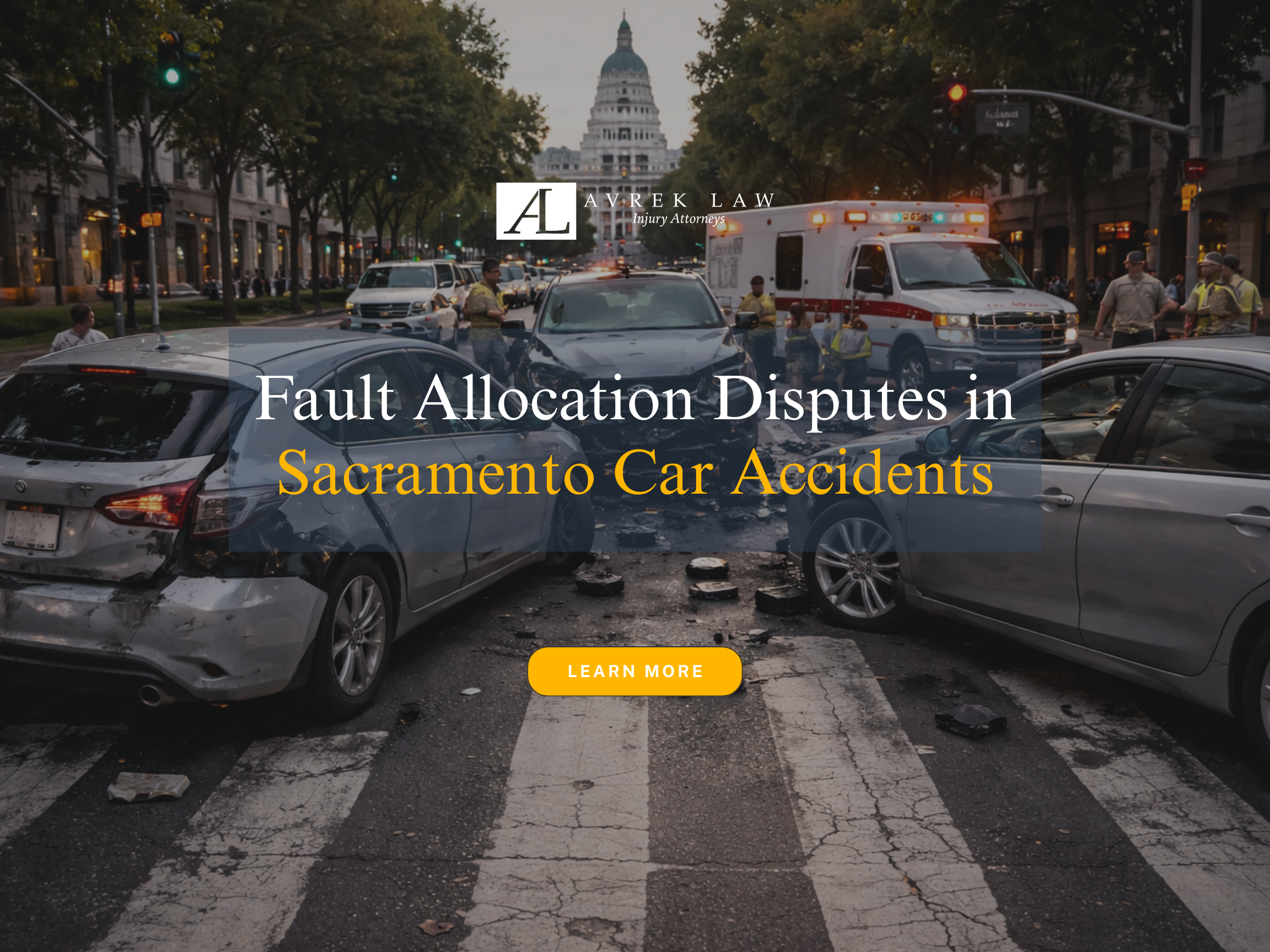
A Sacramento car accident lawyer frequently encounters cases where no one denies that a collision occurred — yet everyone disputes who caused it.
In busy corridors near Interstate 5, Highway 50, and Capitol-area intersections, multi-vehicle crashes are common. Stop-and-go congestion, abrupt lane changes, and compressed following distances create the perfect conditions for chain-reaction collisions.
When more than two vehicles are involved, fault allocation often becomes complicated.
At Avrek Law, we represent injured drivers throughout Sacramento and surrounding communities. Avrek has recovered over $2 billion nationwide, and in multi-vehicle crash cases, early legal evaluation often determines whether liability is structured accurately or oversimplified by insurers.
Call 866-598-5548 today for a free case review. You only pay if we win.
Why Multi-Vehicle Collisions Create Disputes
In a simple rear-end crash, responsibility may appear straightforward.
In a chain reaction collision, the sequence matters.
Consider a typical scenario:
Vehicle A brakes suddenly.
Vehicle B strikes Vehicle A.
Vehicle C then strikes Vehicle B.
Vehicle D sideswipes during evasive movement.
Now the questions begin.
Which impact caused which injury?
Who initiated the sequence?
Was the first brake reasonable?
Did someone fail to maintain adequate following distance?
Was there a lane merge contributing to the crash?
Each driver may genuinely believe they reacted appropriately.
That is where disputes begin.
Primary Impact Versus Secondary Impact
In multi-car collisions, there is often a distinction between the primary impact and subsequent impacts.
The primary impact is the first contact that begins the chain.
Secondary impacts may:
• Exacerbate injuries
• Create new injuries
• Shift vehicle positions
• Cause additional property damage
A Sacramento car accident lawyer must examine physical evidence carefully to determine how impact sequencing relates to injury causation.
This often involves:
• Reviewing vehicle crush patterns
• Evaluating skid marks
• Analyzing braking data
• Examining airbag deployment timing
Impact sequence is not guesswork. It is reconstruction.
Why Insurers Simplify Fault Allocation
Insurance companies prefer simplicity.
In a multi-vehicle crash, they may attempt to assign a single percentage to each driver early in the process. But early allocations are often based on incomplete information.
Fault may be disputed because:
• Police reports rely on limited witness statements
• Some drivers leave the scene before full statements are taken
• Dashcam footage is unavailable initially
• Impact angles are misinterpreted
• Drivers provide conflicting accounts
When insurers simplify complex collisions, injured parties may be assigned more responsibility than the evidence supports.
Government and Fleet Vehicle Considerations
Because Sacramento is a government-heavy city, some multi-vehicle crashes involve state or municipal vehicles.
That introduces additional procedural considerations and documentation requirements.
For general civil procedure context, see California Courts Civil Overview.
When government vehicles are involved, investigation often requires early clarity.
How Fault Allocation Affects Settlement
Fault allocation directly affects settlement evaluation.
If one driver is assigned forty percent responsibility and another sixty percent, available insurance coverage, indemnity agreements, and settlement posture all shift.
In serious injury cases involving surgery, spinal trauma, or permanent impairment, small shifts in fault allocation can significantly change recovery potential.
This is why early reconstruction and structured liability framing matter.
Frequently Asked Questions About Fault Allocation in Sacramento Multi-Vehicle Crashes
Why is fault allocation often disputed in chain-reaction collisions?
Because multiple drivers contribute actions within seconds. Each participant may have reacted reasonably under the circumstances. Determining which action was the substantial cause of injury requires careful sequencing analysis.
Does the first driver who makes contact automatically bear full responsibility?
Not necessarily. If the initial stop was abrupt and unreasonable, or if another driver created a hazardous condition that triggered the sequence, liability may be shared.
Can more than one driver be legally responsible?
Yes. Multi-vehicle crashes often involve layered responsibility. Each driver’s conduct is evaluated separately, and fault may be divided accordingly.
How is impact sequence determined?
Investigators may analyze vehicle damage patterns, event data recorder information, braking marks, and witness statements. In serious cases, accident reconstruction experts may be retained.
What if insurers assign fault before all evidence is reviewed?
Early fault allocations are not final. Structured investigation and documentation can clarify responsibility and correct inaccurate assumptions.
Why do these cases sometimes take longer to resolve?
Because multiple insurers, defense attorneys, and drivers are involved. Coordinating liability positions and evaluating evidence requires additional time.
Before Fault Is Oversimplified
In Sacramento multi-vehicle crashes, fault allocation is often more complex than it first appears.
If you were injured in a chain-reaction collision, consulting a Sacramento car accident lawyer early can help ensure liability is evaluated accurately and all responsible parties are considered.
Call 866-598-5548 today for a confidential consultation.