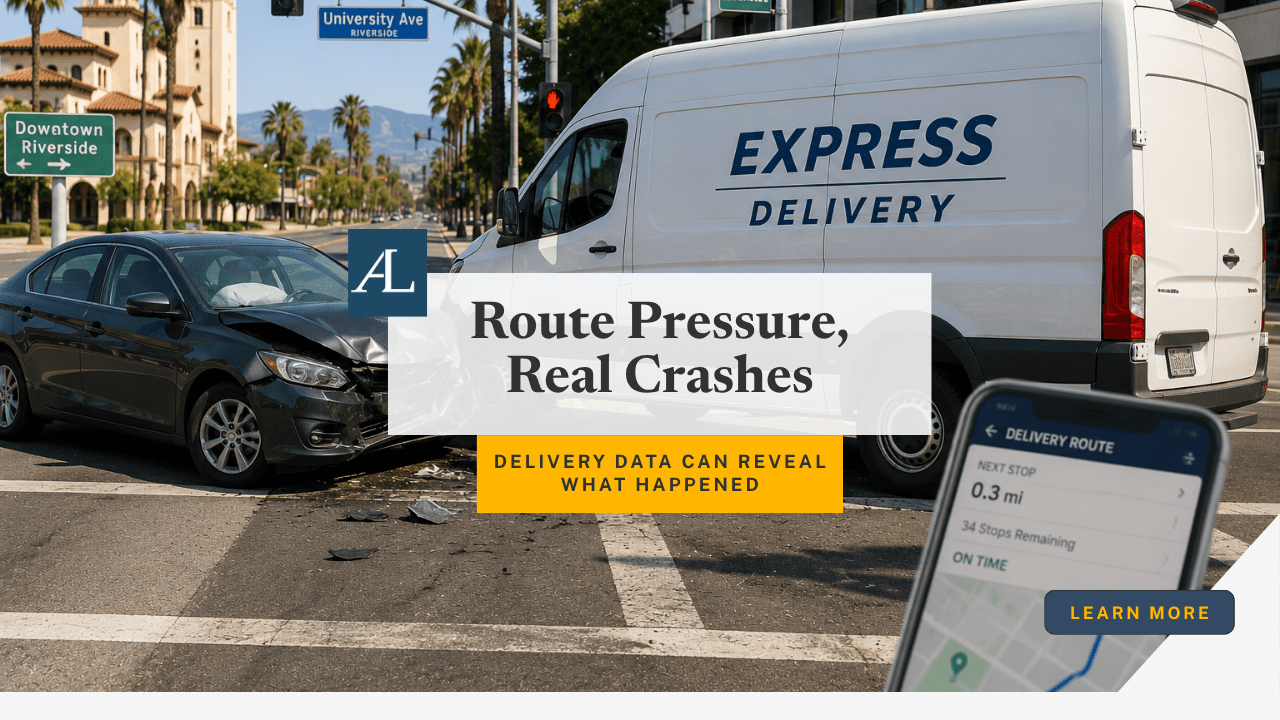
Riverside last mile delivery truck accident claim cases can become complicated because delivery crashes are rarely just about one driver making one mistake. Last-mile delivery vehicles move through residential neighborhoods, apartment complexes, business parks, shopping centers, warehouse corridors, and freeway-adjacent streets throughout Riverside. Drivers may be working under route pressure, delivery time windows, GPS instructions, package scan requirements, customer messages, or company productivity expectations that can affect how safely they drive.
When a delivery van, box truck, step van, or commercial vehicle causes a crash, injured victims are often left dealing with medical bills, missed work, vehicle repairs, pain, and confusing insurance questions. The delivery driver may say they were following the route. The company may say the driver was an independent contractor. The insurer may try to treat the crash like a simple car accident instead of a commercial vehicle claim involving company records and electronic data.
A Riverside last mile delivery truck accident claim should look beyond the crash scene alone. Route logs, GPS data, package scan times, dispatch messages, delivery app records, driver schedules, vehicle maintenance records, dashcam footage, and company policies may all help show whether the crash was connected to unsafe delivery pressure or preventable company practices.
When a delivery truck crash leaves you injured, choosing the right legal representation matters. An experienced Riverside truck accident lawyer at Avrek Law Firm can act quickly to preserve delivery records, identify every responsible party, and pursue compensation that reflects the full impact of the accident.
Call 866-598-5548, start a chat, or request a free case review today. There are no upfront fees, and you don’t pay unless we win.
Why a Riverside Last Mile Delivery Truck Accident Claim Is Often More Complex Than a Regular Crash
A Riverside last mile delivery truck accident claim is often more complex than a standard car accident because the driver may have been working for a company, contractor, logistics provider, delivery platform, retailer, or third-party fleet operator. That means the claim may involve multiple insurance policies, employer records, commercial vehicle data, and legal arguments about who controlled the driver at the time of the crash.
Delivery companies often move quickly after accidents. They may collect driver statements, inspect the vehicle, retrieve app data, contact insurers, and preserve only the records that help their position. Injured victims may not know what evidence exists or how quickly it can disappear.
Route Pressure Can Affect Driver Decisions
Last-mile delivery is built around speed and volume. Drivers may be expected to complete dozens or even hundreds of stops in a shift. That pressure can lead to risky choices, including speeding through residential streets, stopping in unsafe locations, making sudden U-turns, blocking lanes, backing without enough caution, cutting across traffic, or rushing through apartment complexes and business lots.
In a Riverside last mile delivery truck accident claim, route pressure may matter if the driver appeared rushed, distracted by the delivery app, behind schedule, or focused on finding the next stop instead of watching traffic. The crash may have been caused by the driver’s conduct, but the company’s delivery expectations may explain why that conduct happened.
This is why delivery records are important. Package scan times, route assignments, GPS history, and driver communications may reveal whether the driver was under pressure before the crash.
Commercial Vehicle Claims May Involve Company-Controlled Evidence
A regular two-car crash usually depends on police reports, witness statements, vehicle photos, medical records, and insurance information. A delivery truck crash may require far more.
A Riverside last mile delivery truck accident claim may involve electronic records controlled by the company or delivery platform. These can include driver app data, GPS routes, delivery timestamps, dispatch instructions, dashcam video, telematics, vehicle inspection records, and company safety policies.
If those records are not preserved quickly, they may become harder to obtain. Some data may be overwritten, deleted, or limited by company retention policies. An attorney can send preservation letters and request the records needed to show the full picture.
The Driver’s Employment Status May Be Disputed
Delivery companies may argue that the driver was an independent contractor, not an employee. This issue can affect liability and insurance coverage. However, the label a company uses does not always answer the legal question. The claim may need to examine who controlled the route, schedule, vehicle, app, uniform, delivery process, training, and customer interaction.
In a Riverside last mile delivery truck accident claim, the driver’s relationship to the company should be investigated carefully. If the company controlled how the delivery work was performed, used the driver as part of its delivery system, or benefited from the route that led to the crash, those facts may matter.
The goal is to identify every responsible party, not simply accept the company’s first explanation.
Delivery Data That Can Help Prove What Happened
A Riverside last mile delivery truck accident claim may depend on delivery data that injured victims cannot access without legal help. This data can show where the driver was going, how fast they were moving, whether they were behind schedule, whether the vehicle stopped before impact, and whether company practices contributed to the crash.
GPS Records, Route Logs, and Delivery Timestamps
GPS data can show the delivery vehicle’s route before the crash. It may reveal whether the driver made sudden turns, repeated stops, rapid acceleration, unusual detours, or rushed movements between deliveries. Route logs may show the assigned stops and whether the driver was running behind schedule.
Delivery timestamps can also matter. If the driver scanned a package moments before the crash or was racing to the next stop, that information may help explain why the crash happened.
In a Riverside last mile delivery truck accident claim, GPS records and route data may be especially important when the driver claims they were driving carefully or when the company denies that delivery pressure played any role.
Dashcam, Telematics, and Vehicle Data
Some delivery vehicles have dashcams, driver-facing cameras, backup cameras, telematics systems, or electronic tracking devices. These systems may record speed, braking, hard turns, impact events, seatbelt use, driver distraction, or route behavior.
This evidence may show whether the driver was looking at the road, checking the app, braking late, speeding, drifting, or backing into a pedestrian or vehicle. It may also show whether another driver contributed to the collision.
A Riverside last mile delivery truck accident claim should include fast requests for this evidence. If the company controls the footage, the injured victim should not assume it will be saved unless preservation is demanded.
Package Scans, Driver Messages, and App Instructions
Delivery apps and company systems may create records every time a package is scanned, marked delivered, delayed, or reassigned. Driver messages may show route instructions, customer notes, delivery pressure, parking issues, or dispatch communications.
These records can help answer important questions. Was the driver rushing? Was the company tracking delivery speed? Did dispatch direct the driver to a difficult location? Was the driver trying to meet a deadline? Did the driver report a vehicle or safety issue before the crash?
In a Riverside last mile delivery truck accident claim, app and communication records may help connect the crash to company systems rather than treating it as an isolated driver mistake.
Federal and State Safety Rules That May Matter
A Riverside last mile delivery truck accident claim may involve federal commercial vehicle rules, California reporting requirements, and company safety policies. Not every delivery van or local route falls under every federal rule. Vehicle size, interstate commerce, cargo, company structure, and driver duties can all affect which rules apply. Still, these standards can help identify what records should be reviewed.
Hours of Service and Driver Fatigue Issues
The Federal Motor Carrier Safety Administration explains that property-carrying drivers subject to hours-of-service rules may drive a maximum of 11 hours after 10 consecutive hours off duty, may not drive beyond the 14th consecutive hour after coming on duty, and must take a 30-minute break after 8 cumulative hours of driving without a qualifying interruption.
In a Riverside last mile delivery truck accident claim, these rules may become relevant if the delivery vehicle and driver are covered by federal motor carrier regulations. Even when a smaller local delivery operation is not fully covered by FMCSA hours-of-service rules, driver fatigue, long shifts, route pressure, and unrealistic delivery schedules can still matter as evidence of negligence.
A tired driver may make poor decisions, miss pedestrians, fail to check blind spots, or react too late to traffic.
Inspection, Repair, and Maintenance Records
Federal inspection, repair, and maintenance rules require motor carriers and intermodal equipment providers to systematically inspect, repair, and maintain vehicles under their control, and the rules also require records showing vehicle identification, inspection and maintenance operations, repair dates, and related documentation. The same regulations require parts and accessories to be in safe and proper operating condition at all times.
A Riverside last mile delivery truck accident claim may involve maintenance issues if the vehicle had bad brakes, worn tires, broken lights, defective mirrors, malfunctioning backup cameras, steering problems, or unsafe cargo loading. Delivery companies should not place unsafe vehicles on the road.
Maintenance records may reveal whether the vehicle had known problems before the crash or whether inspection procedures were ignored.
California DMV Accident Reporting
The California DMV states that a driver, insurance agent, broker, or legal representative must complete an SR-1 report and send it to DMV within 10 days if someone is injured or killed, or if property damage is over $1,000. The DMV also states that the SR-1 report is required in addition to any report made to police, CHP, or an insurance company.
This can matter after a Riverside last mile delivery truck accident claim because injured victims may assume that a police report or insurance claim is enough. The DMV requirement is separate, and accident reporting should be handled carefully when a commercial delivery vehicle is involved.
Who May Be Liable After a Riverside Delivery Truck Accident?
A Riverside last mile delivery truck accident claim may involve several responsible parties. The delivery driver may be liable, but the investigation should not stop there. Companies, contractors, vehicle owners, maintenance providers, cargo handlers, and other drivers may all need review.
The Delivery Driver
The delivery driver may be liable if they were speeding, distracted, fatigued, backing unsafely, making an illegal turn, blocking traffic, failing to yield, following too closely, or driving too fast for the conditions.
In a Riverside last mile delivery truck accident claim, the driver’s statement should be compared with objective records. GPS data, route logs, dashcam footage, witness accounts, and vehicle damage may show whether the driver’s version matches the evidence.
A driver who says they were “just doing deliveries” may still be responsible for unsafe driving.
The Delivery Company, Retailer, or Logistics Provider
The delivery company may be responsible if the driver was working within a delivery route, operating a company vehicle, following company instructions, or working under company-controlled route pressure. Retailers and logistics providers may also need review if they controlled delivery schedules, route expectations, or subcontracted delivery operations.
A Riverside last mile delivery truck accident claim may involve company liability when unsafe policies contributed to the crash. Examples include unrealistic delivery quotas, poor driver training, failure to monitor unsafe driving, inadequate vehicle maintenance, or repeated pressure to complete deliveries quickly.
Company records may be the difference between a claim against one driver and a claim that fully addresses corporate responsibility.
A Contractor or Third-Party Fleet Operator
Many last-mile deliveries are handled by contractors or third-party fleet companies. A large retailer may not directly employ the driver, but it may rely on contractors to complete local deliveries. A fleet operator may own the vehicles, supervise drivers, maintain vans, or control schedules.
In a Riverside last mile delivery truck accident claim, every layer of the delivery chain should be reviewed. The company name on the package may not match the company that employed the driver, owned the vehicle, or carried the insurance.
Identifying the correct companies is critical, especially when injuries are serious and multiple insurance policies may apply.
Maintenance Providers or Vehicle Owners
If the crash involved mechanical failure, defective equipment, poor maintenance, or unsafe tires, the vehicle owner or maintenance provider may need investigation. A delivery vehicle with bad brakes, broken warning lights, damaged mirrors, or a malfunctioning backup camera may create preventable danger.
A Riverside last mile delivery truck accident claim may require repair records, inspection logs, mechanic invoices, vehicle ownership records, and maintenance schedules. If a company knew the vehicle was unsafe and continued using it, that evidence may strengthen the claim.
What Injured Victims Should Do After a Delivery Truck Crash in Riverside
A Riverside last mile delivery truck accident claim can be affected by what happens immediately after the crash. Delivery vehicles may leave, records may be controlled by companies, and insurers may try to shape the story early.
Call Law Enforcement and Get Medical Care
If anyone is injured, call 911. A police report or CHP report may help document the crash location, driver information, vehicle ownership, insurance details, witness names, and early statements.
Medical care should not be delayed. Delivery truck crashes can cause fractures, concussions, spinal injuries, soft tissue injuries, internal injuries, nerve damage, and psychological trauma. Some symptoms may not appear until hours or days later.
Prompt care protects your health and creates records connecting the injuries to the crash.
Photograph the Vehicle, Company Markings, and Scene
Photos should show the delivery vehicle, license plate, company markings, vehicle number, package labels, driver uniform, crash damage, road conditions, traffic signs, skid marks, debris, and final vehicle positions. If the driver was using a handheld device or delivery app, that detail should be documented if safely visible.
In a Riverside last mile delivery truck accident claim, company markings and vehicle numbers may help identify who controlled the driver and vehicle. This can matter if insurers later dispute responsibility.
Preserve Witnesses, Video Sources, and Delivery Details
Witnesses may include residents, store employees, delivery customers, pedestrians, cyclists, other drivers, security guards, or apartment staff. Their contact information should be saved quickly.
Video sources may include dashcams, doorbell cameras, business surveillance, apartment cameras, warehouse cameras, delivery vehicle cameras, and traffic cameras. A preservation request should be sent quickly because footage may be overwritten.
Delivery details also matter. If the crash happened near a package drop-off, business delivery, apartment complex, loading zone, or warehouse route, those facts may help identify the delivery records connected to the driver.
Avoid Recorded Statements Before Evidence Is Reviewed
Insurance adjusters may ask questions designed to limit the claim. They may ask whether you saw the delivery truck, whether you could have avoided it, whether the driver seemed rushed, whether you were distracted, or whether another vehicle caused the crash.
In a Riverside last mile delivery truck accident claim, avoid guessing about speed, distance, timing, or fault before the evidence is reviewed. Delivery records and company data may reveal facts that are not obvious at the scene.
Frequently Asked Questions About a Riverside Last Mile Delivery Truck Accident Claim
What is a Riverside last mile delivery truck accident claim?
A Riverside last mile delivery truck accident claim is an injury claim involving a delivery vehicle that was transporting packages, food, goods, retail orders, or commercial items near the end of the delivery chain. These claims may involve delivery vans, box trucks, step vans, courier vehicles, or commercial fleet vehicles.
Can route pressure help prove a delivery truck accident claim?
Yes. Route pressure may matter if the driver was rushing, behind schedule, distracted by app instructions, or pressured by company delivery expectations. GPS data, delivery timestamps, dispatch messages, and app records may help show whether the delivery system contributed to unsafe driving.
Can the delivery company be responsible for the crash?
Yes. A delivery company may be responsible if the driver was working, following company instructions, using a company vehicle, operating under company-controlled route pressure, or driving as part of the company’s delivery system. Contractors, retailers, and fleet operators may also need review.
What evidence should be preserved after a delivery truck crash?
Important evidence may include police reports, medical records, vehicle photos, company markings, license plate photos, witness names, dashcam footage, delivery app records, GPS data, route logs, package scan times, maintenance records, and insurance communications.
Should I speak with a lawyer before talking to the delivery company’s insurer?
Yes. Delivery truck claims often involve company-controlled records, commercial insurance, contractor disputes, and aggressive defense tactics. A Riverside truck accident lawyer can help preserve evidence and prevent insurers from narrowing the claim too early.
Call or Contact Avrek Law Firm 24/7 for a Free Consultation and Pay Nothing Unless We Win
A Riverside last mile delivery truck accident claim can become complicated when delivery companies, contractors, fleet operators, drivers, and insurers each try to limit responsibility. These cases often depend on records the injured person cannot access alone, including GPS data, route logs, package scans, dispatch messages, maintenance records, dashcam footage, and company safety policies.
Avrek Law Firm helps injured victims investigate delivery truck crashes, identify all responsible parties, and pursue compensation for medical bills, lost income, pain, future care, and long-term recovery needs. Our team understands how commercial insurers defend these claims and how quickly important evidence can disappear.
Speaking with a Riverside truck accident lawyer may help you understand what records should be preserved after a last-mile delivery crash. These cases may also overlap with issues handled by a Riverside personal injury lawyer or Riverside car accident lawyer, especially when delivery pressure, company liability, or multiple insurance policies are involved.
If you or someone you love was injured in a Riverside delivery truck accident, Avrek Law Firm is ready to help.
- 📩 Submit a request through our online form
- 📞 Call 866-598-5548 now to speak with our team
- 💬 Start a live chat for immediate assistance
There are no upfront fees, and you don’t pay unless we win.