A Riverside car accident lawyer often handles cases where the most important question is not who was involved—but how the crash actually started.
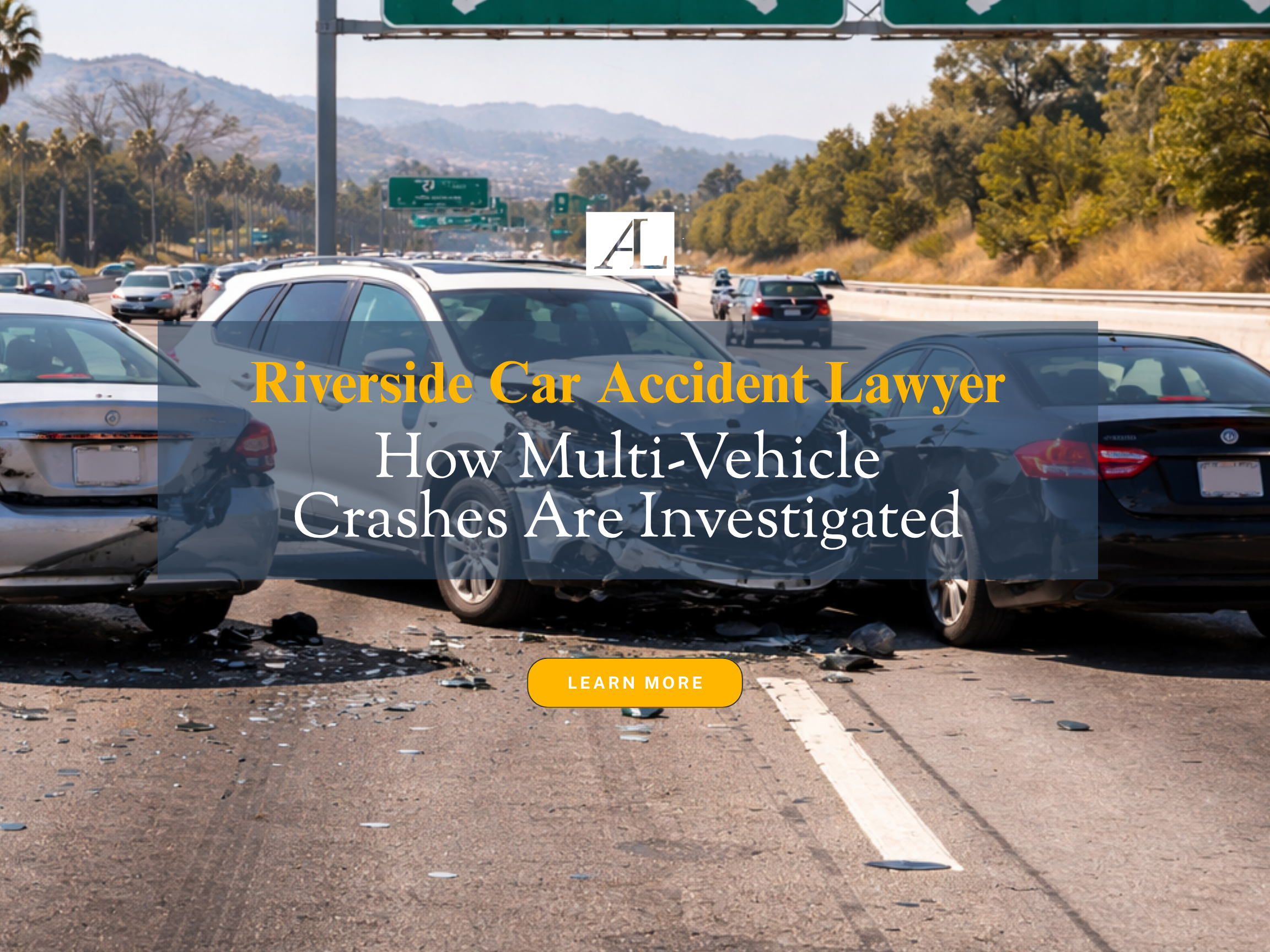
Multi-vehicle freeway accidents are among the most complex claims we see. On busy Inland Empire routes like I-215, I-10, and SR-60, a single moment—one sudden brake, one lane change, one missed reaction—can trigger a chain reaction involving multiple vehicles within seconds. By the time everything comes to a stop, several drivers may be involved, and each one may have a different version of what happened.
For the people involved, the situation quickly becomes overwhelming. You may be dealing with injuries, damage to your vehicle, and conflicting explanations from other drivers—all while insurance companies begin evaluating the case immediately.
At Avrek Law, we regularly work with individuals in Riverside who are trying to make sense of these situations. What we often see is that the complexity of the crash is not just in the number of vehicles—it’s in how the sequence of events is interpreted afterward.
📞 Call 866-598-5548, start a chat, or request a free case review today. You don’t pay unless we win.
Why Multi-Vehicle Crashes Are More Complex Than They Appear
Unlike a typical two-car accident, a multi-vehicle crash is not a single event—it’s a chain of events.
Each driver is reacting to something different. One driver may brake suddenly. Another may not have enough time to stop. A third may swerve and collide with another vehicle entirely. By the end of it, what looks like one accident is actually a sequence of impacts, each with its own cause.
We often speak with people who say, “I was just hit, so I assumed I wasn’t at fault.” But in these cases, liability is not always that simple. Insurance companies don’t just look at who was hit—they look at how each driver behaved in the seconds leading up to the crash.
How a Riverside Car Accident Lawyer Investigates Multi-Vehicle Freeway Crashes
A Riverside car accident lawyer approaches these cases by focusing on sequence, not just impact. This means identifying how the crash started, how each vehicle reacted, and how each phase of the collision contributed to injuries. In many cases, what appears to be a single accident is actually multiple events, each with its own liability considerations. Understanding that sequence is critical to building a claim that reflects what actually happened.
Understanding Primary and Secondary Impacts
One of the most important parts of investigating these crashes is identifying what caused the chain reaction in the first place.
The initial event—often referred to as the primary impact—is what sets everything in motion. But the collisions that follow, known as secondary impacts, can involve different drivers and different levels of responsibility.
In many cases, injuries are not caused by the first impact, but by what happens after. This is where things become more complicated, because responsibility may be divided across multiple drivers depending on how each part of the crash unfolded.
Why Fault Is Often Disputed in Freeway Crashes
In multi-vehicle accidents, it’s very common for drivers to have completely different perspectives on what happened.
One person may believe they were following safely. Another may feel they were cut off. Someone else may not even realize what caused the initial impact.
We often see insurance companies take advantage of this uncertainty. Instead of identifying one responsible party, they may divide fault across multiple drivers. This allows them to reduce the amount they pay, even in cases where one driver clearly caused the initial crash.
How Insurance Companies Actually Analyze These Cases
What many people don’t realize is that insurance companies are not simply trying to determine what happened—they are trying to determine how to divide responsibility.
In many cases, we see insurers break the crash down into separate moments. They evaluate how each driver reacted, whether there was enough time to avoid the collision, and whether any action—or lack of action—contributed to what followed.
For example, even if one driver caused the initial crash, another driver may still be assigned partial fault if they were following too closely or failed to react in time.
This is one of the most important—and most misunderstood—parts of these cases. It’s not just about who caused the crash. It’s about how each driver’s behavior is interpreted after the fact.
What Most People Don’t Realize About Chain-Reaction Crashes
Many people assume that if they were hit, they are automatically not at fault.
But in multi-vehicle accidents, that assumption can lead to problems.
We often see situations where:
- A driver is rear-ended but still assigned partial fault
- Multiple drivers are blamed for different phases of the crash
- The sequence of events is interpreted in a way that reduces overall payouts
This doesn’t happen because the situation is unclear—it happens because there is room for interpretation, and insurance companies use that to their advantage.
The Role of Evidence in Reconstructing the Crash
Because these cases are so dependent on sequence and timing, evidence becomes critical.
Photographs, vehicle positioning, and witness accounts can help clarify what happened. In some cases, traffic camera footage or accident reconstruction may be necessary to understand how the crash unfolded.
Without strong evidence, these cases often turn into competing narratives. And when that happens, fault is more likely to be shared—even when it shouldn’t be.
How Fault Impacts Compensation in California
California follows a pure comparative negligence system. That means fault can be divided between multiple parties, and compensation is adjusted accordingly.
In practical terms, this means that even a small percentage of assigned fault can reduce the amount you recover.
For general civil case guidance, see California Courts: https://selfhelp.courts.ca.gov/civil-lawsuit
What Changes When a Lawyer Gets Involved Early
In multi-vehicle cases, early involvement can make a significant difference.
Instead of allowing the situation to be shaped by initial assumptions, a structured investigation can focus on how the crash actually unfolded. Evidence can be preserved, liability can be analyzed more clearly, and insurance arguments can be challenged before they become fixed positions.
We often see that when cases are addressed early, the outcome reflects the full picture—not just the first version of events.
Frequently Asked Questions about Multi-Vehicle Accident Claims
Why do these cases feel more complicated than a normal accident?
Because they involve multiple timelines, multiple drivers, and multiple interpretations. It’s not just one event—it’s a sequence that has to be understood correctly.
Can I still be blamed even if I didn’t cause the crash?
Yes. In many cases, insurers assign partial fault based on how each driver reacted, not just who caused the initial impact.
How do insurance companies decide who is responsible?
They evaluate timing, positioning, and behavior leading up to each impact. Their goal is often to distribute liability, not just identify a single cause.
What if I was rear-ended in the middle of a chain reaction?
Rear-end collisions suggest fault, but in multi-vehicle crashes, insurers may still argue that earlier actions contributed to the outcome.
Why do these claims take longer to resolve?
Because multiple parties, insurance policies, and liability arguments must be evaluated at the same time.
What is the biggest mistake people make after these crashes?
Assuming the situation is straightforward and not documenting what happened. These cases rely heavily on early evidence.
Before the Sequence Is Misinterpreted
Multi-vehicle freeway crashes are not just about impact—they are about sequence.
If that sequence is misunderstood or misrepresented, it can affect how your claim is evaluated and what compensation you receive.
If you were injured in a Riverside freeway accident, speaking with a Riverside car accident lawyer early can help ensure your case reflects what actually happened—not just the first interpretation of events.
📞 Call 866-598-5548, start a chat, or request a free case review today.