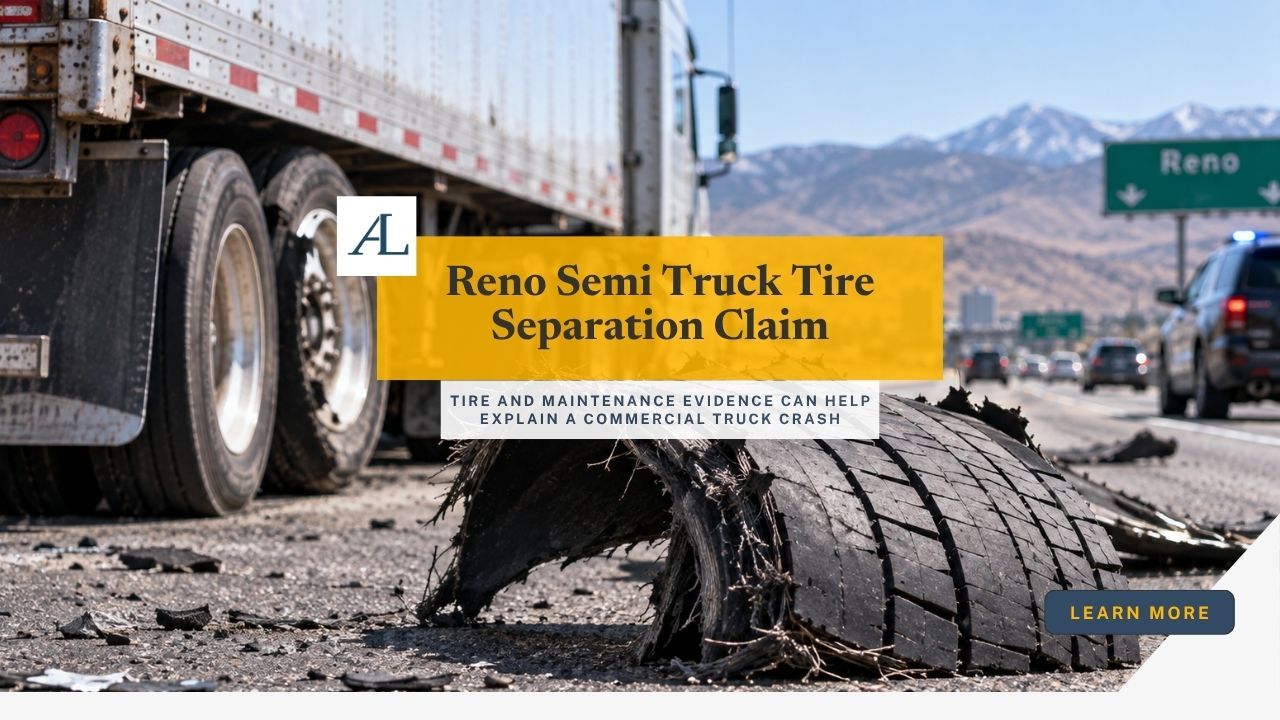
A Reno semi truck tire separation claim can become complicated quickly because the tire involved in the crash may have passed through several companies before the failure occurred. A motor carrier may operate the truck, another business may own the tractor or trailer, a tire dealer may have supplied the tire, a retreading facility may have rebuilt it, and a maintenance contractor may have inspected or serviced it before the collision. When a section of tread separates at highway speed, determining why it happened can require far more than photographing the debris left on the roadway.
The physical tire can become one of the most important pieces of evidence. The detached tread, remaining tire carcass, wheel, rim, valve components, and surrounding pieces may help qualified professionals evaluate what occurred. If those materials are discarded, returned as a tire core, destroyed during cleanup, or altered during repair, important evidence may disappear before the injured person understands its significance.
Federal commercial-vehicle regulations make tire condition an important safety issue. 49 CFR § 393.75 — Tires establishes requirements for tires used on commercial motor vehicles, including restrictions concerning exposed body-ply or belt material, tread or sidewall separation, audible leaks, load restrictions, and minimum tread depth. The regulation also specifically prohibits regrooved, recapped, or retreaded tires on the front wheels of a bus. The actual vehicle, axle, tire, condition, and applicable regulations must be evaluated rather than assuming that the mere presence of a retread proves a violation.
A Reno semi truck tire separation claim should therefore distinguish between the fact that a tire was retreaded and the reason it separated. A retread may have a manufacturing or bonding issue, but separation may also be associated with inflation, heat, road hazards, excessive wear, loading, prior damage, maintenance, or other factors. Qualified inspection and the maintenance history can help determine which explanation is supported by the evidence.
Commercial carriers also have ongoing maintenance responsibilities. 49 CFR § 396.3 — Inspection, Repair, and Maintenance requires motor carriers to systematically inspect, repair, and maintain vehicles under their control and keep parts and accessories in safe and proper operating condition. Maintenance records may therefore become central when a truck tire fails before a serious collision.
Avrek has discussed mechanical failures, including tire blowouts and maintenance problems, as important issues in commercial truck investigations. Its related article on common causes of truck accidents and trucking-company accountability also emphasizes the importance of preserving maintenance records and electronic evidence after commercial crashes.
When a tire separation causes a serious truck crash, choosing the right legal representation matters. Avrek Law Firm’s Reno personal injury lawyers handle trucking accident claims and can help identify the truck, trailer, carrier, tire companies, maintenance providers, insurers, and physical evidence that should be preserved.
Call 866-598-5548, start a live chat, or request a free case review today. There are no upfront legal fees, and you do not pay unless we win.
Preserving Tire Evidence in a Reno Semi Truck Tire Separation Claim
A Reno semi truck tire separation claim should begin with the physical tire and roadway evidence. The investigation should identify which tire failed, where the separation began, where the detached material landed, and what happened to the truck immediately afterward.
The tire should not be discarded simply because the trucking company needs to repair the vehicle. A tire dealer may ordinarily dispose of the failed casing or send it elsewhere. A towing or maintenance company may remove damaged components. Road crews may clear pieces from travel lanes. Each routine step can change or eliminate evidence.
Written preservation requests should therefore be considered as early as possible.
Detached Tread, Tire Carcass, Wheel, Rim, and Related Components
The detached tread should be preserved whenever it can be safely identified and recovered. Photographs should document it in its original location before movement when roadway conditions permit. Wide photographs can show where the tread landed relative to the truck, other vehicles, lanes, shoulders, and impact area.
The remaining tire carcass can be equally important. A Reno semi truck tire separation claim should preserve the entire tire rather than only the visibly separated section. Qualified professionals may need to evaluate the tread, casing, belts, sidewalls, bead area, repair history, wear, and other physical characteristics.
The wheel and rim should also be preserved if there is any question about their role. Damage may have occurred before, during, or after the separation. Removing the tire from the rim before an appropriate inspection can change the evidence.
The investigation should document the tire’s manufacturer, model, size, DOT identification information, retread markings, serial or casing information where available, axle position, and whether it was mounted on the tractor or trailer.
Photographs should be taken before cleaning. Dirt, rubber residue, marks, foreign objects, and damage can be important. The tire should not be cut apart or subjected to destructive testing until all interested parties have had an appropriate opportunity to address inspection protocols.
Debris Locations, Tire Marks, Vehicle Damage, and Final Positions
Roadway debris can help reconstruct when the separation occurred. A large section of tread may remain near the point where the tire began failing, while smaller fragments can extend farther down the road. The truck may continue traveling for a significant distance after the initial separation.
A Reno semi truck tire separation claim should photograph and map the debris whenever possible. Investigators may compare the debris path with tire marks, gouges, skid marks, fluid, damaged roadway features, and final vehicle positions.
Damage to the tractor or trailer may also help explain the event. A separated tread can strike the mud flap, fender, trailer, air lines, lighting, or nearby components. It may also strike another vehicle directly.
The passenger vehicle involved in the crash should be documented before repair. Damage may show whether it was struck by the truck, by detached tire material, or during an evasive maneuver after the separation.
Final resting positions can help establish how the drivers reacted. A truck may move toward the shoulder after the tire failure, cross lanes, jackknife, or remain partially in traffic. Other drivers may brake or swerve before colliding with one another.
The scene should be documented from multiple perspectives. Wide photographs help preserve the roadway geometry, while detailed images show tire fragments and physical marks.
Photos and Video Before the Scene Is Cleared
A commercial truck crash scene can change rapidly. Law enforcement and road crews may need to clear lanes, move the truck, remove debris, and restore traffic. Safety comes first, but those necessary actions can make early photographs and video especially valuable.
A Reno semi truck tire separation claim may benefit from photographs taken by drivers, passengers, witnesses, police, tow operators, maintenance personnel, and road crews. Each source may capture the scene at a different stage.
Dashcam footage can show the moment the tread separates or begins striking the truck. A following vehicle may capture rubber debris leaving the tire. A forward-facing truck camera may show the driver’s reaction and roadway conditions.
Nearby traffic or business cameras may also capture the truck before or after the failure. Footage showing the truck traveling immediately before the separation may help identify visible tire problems, smoke, vibration, debris, or vehicle movement.
The original video files should be preserved rather than relying only on clips posted online or sent through text messages. Original recordings may contain better image quality, timestamps, audio, and additional footage before and after the selected clip.
Maintenance and Tire History Records to Request
The physical tire explains only part of a Reno semi truck tire separation claim. Records can help establish where the tire came from, when it was installed, how many times the casing was retreaded, what inspections occurred, and whether anyone previously identified a concern.
Federal maintenance rules require carriers to maintain certain records identifying controlled vehicles and documenting inspections, repairs, and maintenance. 49 CFR § 396.3 provides the federal framework.
The investigation should obtain records before routine retention practices or business transitions make them harder to locate.
Purchase, Installation, Retreading, and Replacement Information
Purchase records may identify the tire manufacturer, dealer, date, model, size, and original purchaser. Installation records may identify the truck or trailer, axle position, mileage, date, and technician.
For a retread tire, additional records may identify the casing and retreading facility. The retreader may maintain information concerning inspection, preparation, repair, tread application, curing, and final processing depending on its procedures and available records.
A Reno semi truck tire separation claim should determine whether the tire remained on the same vehicle throughout its service life. Commercial fleets may rotate tires between axles, tractors, and trailers. A tire may therefore have a maintenance history extending beyond the truck involved in the crash.
Replacement history can provide context. If several tires on the same vehicle were replaced recently but the failed tire remained in service, investigators may ask why. If another tire on the same axle previously had a problem, that history may also warrant review.
Invoices, work orders, fleet-management records, tire inventories, and vendor communications should be preserved together. One record may identify the tire while another explains why it was serviced.
Pre-Trip Inspections, Driver Reports, and Maintenance Logs
Commercial drivers and carriers use inspection and maintenance processes to identify vehicle defects. Tire condition may be checked visually and through other fleet procedures before or during operation.
A Reno semi truck tire separation claim should identify the driver who inspected the vehicle before the trip and what was documented. Records may include pre-trip inspection materials, driver vehicle inspection reports where applicable, maintenance forms, digital fleet inspections, photographs, or communications with dispatch.
The driver may have reported vibration, pressure concerns, visible tire damage, unusual wear, or another issue before the crash. Conversely, the records may show no reported problem. Both possibilities matter.
Maintenance logs can show when tires were inspected, rotated, inflated, repaired, or replaced. The records may also identify who performed the work and whether the carrier used its own maintenance department or an outside vendor.
FMCSA’s Vehicle Maintenance BASIC materials identify tires among the vehicle components relevant to commercial-vehicle maintenance and roadside safety. The FMCSA Vehicle Maintenance BASIC resource provides additional federal background on vehicle-maintenance safety issues.
Electronic records should be preserved in their original form where possible. A printed summary may not contain the same information as the fleet-management system that created it.
Prior Complaints, Repairs, and Out-of-Service Decisions
Prior complaints can become especially important when a tire fails catastrophically. A driver may have reported vibration, low pressure, abnormal wear, damage, or repeated inflation issues before the crash.
A Reno semi truck tire separation claim should investigate what happened after each complaint. Did maintenance personnel inspect the tire? Was it repaired? Was it replaced? Did the truck return to service without addressing the concern?
Repair records may identify puncture repairs, casing repairs, wheel work, alignment issues, suspension problems, or other conditions that could affect tire performance. The relevance of each repair requires technical evaluation.
Out-of-service records can also matter. If a vehicle or tire previously failed an inspection, investigators should determine what repair was performed before it returned to operation.
The absence of a formal complaint does not necessarily prove that the tire showed no earlier signs of trouble. Driver texts, dispatch messages, maintenance emails, vendor communications, photographs, and telematics-related service alerts may contain information outside the standard maintenance file.
The records should be preserved before employees leave, accounts change, or the company’s ordinary data-retention practices remove them.
Identifying the Companies Connected to the Tire
A Reno semi truck tire separation claim may involve more companies than appear on the police report. The driver may work for one carrier while the tractor belongs to another business. The trailer may be leased. The tire may have been purchased by a fleet-management company and serviced by an outside vendor.
The investigation should map these relationships before deciding which party controlled the tire’s inspection, maintenance, and replacement.
Motor Carrier, Tractor Owner, Trailer Owner, and Leasing Company
The motor carrier generally controls the commercial operation, but ownership should still be confirmed. Registration, lease agreements, USDOT information, insurance records, and company documents can help identify the businesses connected to the tractor and trailer.
A Reno semi truck tire separation claim should determine whether the failed tire was mounted on the tractor or trailer. That distinction may affect which company maintained it.
A tractor owner may lease the vehicle to the operating carrier. A trailer may belong to a freight company, leasing business, shipper, or another carrier. Maintenance responsibilities may be allocated through contracts, although contractual allocation does not automatically decide every legal responsibility to an injured person.
Fleet-management companies may also participate in maintenance scheduling, tire purchasing, vendor selection, and recordkeeping. Their role should be investigated when supported by the documents.
Insurance records should identify each entity separately. One commercial policy may cover the carrier while another policy applies to a vehicle owner, trailer owner, or contractor.
Tire Vendor, Retreading Facility, and Maintenance Provider
The tire vendor may have sold or installed the tire without manufacturing or retreading it. The retreading facility may have processed the casing earlier. A separate maintenance shop may later have inspected, repaired, or rotated the tire.
A Reno semi truck tire separation claim should identify each company rather than using the generic term “tire company.” Their roles may be very different.
Purchase invoices and tire markings may identify the retreader. Service records may identify the installer. Fleet records may identify who selected the tire and approved its continued use.
Communications with these businesses should be preserved. A maintenance provider may have recommended replacement but been told to continue using the tire. Alternatively, the shop may have inspected the tire shortly before the crash and documented no visible problem.
The physical tire should be made available for appropriate inspection before anyone assumes which company caused the failure. A separation does not establish negligence by a retreader, dealer, carrier, or maintenance company by itself.
Avrek’s article on whether an accident injury lawyer is needed after a complex crash notes that tire failures can raise complicated responsibility questions involving maintenance, defects, or road hazards.
Cargo Owner or Other Business Connected to the Trip
Cargo can affect the investigation even when the tire itself is the primary focus. Truck and trailer loading may influence vehicle weight and tire load. The actual weights and axle distribution should be established from records rather than assumed.
A Reno semi truck tire separation claim may therefore require bills of lading, cargo records, scale tickets, dispatch records, pickup and delivery documents, and loading information.
The cargo owner does not automatically become responsible simply because its freight was on the truck. The investigation should determine what role, if any, the shipper, loader, broker, or other business had in the vehicle’s loading or operation.
Route information may also matter. The truck may have traveled long distances before reaching Reno, crossed areas with high temperatures, stopped at inspection facilities, or changed trailers or drivers during the trip. Dispatch and telematics records can help reconstruct that history.
If the trailer was picked up already loaded, the driver and carrier may have had different opportunities to inspect or control the cargo than if they loaded it themselves. Those facts should be documented accurately.
Reconstructing the Crash in a Reno Semi Truck Tire Separation Claim
A Reno semi truck tire separation claim should establish not only why the tire failed but how the failure led to the collision. Tire separation does not always cause the driver to lose complete control. The truck may remain in its lane, move toward the shoulder, strike another vehicle, or create debris that causes a separate driver to crash.
The sequence should be reconstructed from video, vehicle data, physical evidence, witness accounts, and driver communications.
Truck Movement Before and After the Tire Separation
The truck’s movement immediately before the separation may help identify whether a tire problem was already developing. Witnesses may report wobbling, smoke, vibration, rubber fragments, or unusual movement.
After separation, the driver may brake, steer toward the shoulder, or attempt to maintain the lane. A Reno semi truck tire separation claim should document those actions without assuming that the driver’s response was negligent merely because a tire failed.
The relevant questions may include when the driver first recognized the problem, how the truck responded physically, what traffic surrounded it, and whether the driver had a safe opportunity to stop.
Damage to the truck can help show how the separated tread moved. Marks on the trailer, mud flap, fender, lighting, or other components may correspond with debris recovered from the roadway.
Other vehicles’ movements must also be reconstructed. A driver may brake suddenly to avoid tread debris, change lanes, strike another car, or collide with the truck after it moves unexpectedly.
In a chain-reaction collision, the tire failure may be only the first event. Each later impact should be documented separately.
Dashcams, Telematics, Witnesses, and Driver Communications
Dashcams may show the roadway before the separation and the driver’s reaction afterward. A rear-facing camera from another vehicle may capture the tire or debris more clearly than the truck’s own camera.
Telematics may provide information about vehicle speed, location, braking, and other operational data depending on the system. A Reno semi truck tire separation claim should identify the truck’s electronic systems promptly because commercial data may be subject to retention schedules.
Driver communications can establish when the problem was first reported. A driver may call dispatch immediately after hearing or feeling the tire fail. An electronic message may describe the tire position or ask for roadside assistance.
Witnesses may include other truck drivers who recognize a tire problem, motorists struck by debris, passengers, road workers, tow operators, or people who stopped after the crash.
Their accounts should be collected separately and compared with the physical evidence. A witness may call the event a “blowout” even though a technical inspection later identifies tread separation. The witness’s description of what they saw remains valuable even if their terminology is not technically precise.
Commercial Policies and Early Contact From Carrier Representatives
Trucking companies and commercial insurers may begin investigating immediately. A carrier may send a safety manager, investigator, towing contractor, maintenance representative, or insurance adjuster to the scene or storage yard.
That early response makes independent preservation especially important in a Reno semi truck tire separation claim. The carrier may gain control of the truck, tire, electronic data, maintenance records, and driver before the injured person has representation.
An insurance representative may request a recorded statement from the injured driver or passenger. The person should identify who the representative works for before answering detailed questions.
Questions about the tire’s cause should be answered carefully. An injured motorist who saw rubber fly from a truck can describe that observation but should not be expected to determine whether the cause was a retread defect, underinflation, maintenance issue, or road hazard.
Commercial policies may apply to the motor carrier, tractor, trailer, maintenance company, or another entity. The existence and applicability of coverage should be established from actual policy documents rather than assumptions based on the truck’s logo.
Avrek’s broader trucking materials emphasize that commercial truck claims can involve multiple responsible companies, maintenance records, federal regulations, and insurer investigations.
Injury and Property Documentation After Tire Separation
A Reno semi truck tire separation claim should document the injured person’s medical and property losses separately from the mechanical investigation. Determining why the tire failed does not establish the extent of the injuries.
Medical records should identify the collision mechanism as accurately as possible. A driver may have been struck directly by the truck, hit by detached tread, forced into another vehicle, or injured while swerving to avoid debris.
Emergency records, imaging, specialist treatment, therapy, surgery, medications, work restrictions, and follow-up care should be preserved. Symptoms that develop later should be reported accurately to medical providers.
Property documentation may include vehicle damage, towing, storage, rental expenses, replacement transportation, damaged personal property, and repair supplements.
The claimant should also document missed work, reduced duties, transportation problems, and limitations affecting household or family responsibilities.
A Reno personal injury lawyer can help coordinate those losses with the trucking and tire evidence. Avrek’s Reno practice specifically includes trucking accidents among its listed services.
What to Do After a Reno Semi-Truck Tire Separation Accident
Safety and medical needs come first. Call 911 after a serious truck collision and remain away from active lanes and tire debris whenever possible. Pieces of commercial tire can remain in traffic and create additional hazards.
Photograph the truck, tractor, trailer, license plates, USDOT information, tire positions, detached tread, debris, roadway marks, vehicle damage, and final positions when it is safe. Do not enter traffic to retrieve tire debris.
Obtain witness information, including names and contact details for drivers who saw the tire separate before the collision. Ask law enforcement to document the debris when appropriate.
Identify where the truck and trailer will be towed. A Reno semi truck tire separation claim may depend on preventing the tire, wheel, and related components from being discarded during repair.
Preserve your own dashcam footage immediately. Identify nearby vehicles and businesses that may have additional recordings.
Seek medical evaluation and follow provider recommendations. Keep every medical record, bill, work restriction, repair document, towing receipt, rental expense, and insurance communication.
Avoid signing a broad release before the tire evidence, responsible companies, available insurance, and medical recovery are understood.
Deadlines for a Reno Semi Truck Tire Separation Claim
A Reno semi truck tire separation claim should be investigated immediately even though Nevada provides filing periods for civil actions. Tire and electronic evidence can disappear far sooner than the court deadline.
Nevada Revised Statutes Section 11.190 contains Nevada’s limitation periods for various civil actions. For many actions seeking damages for injury to a person caused by another person’s wrongful act or neglect, the statute provides a two-year period, subject to exceptions and other applicable provisions.
The correct deadline depends on the particular claim and parties. An injured person should not assume that every possible claim against a carrier, tire company, maintenance provider, or other party follows exactly the same analysis.
More importantly, waiting can result in the destruction of evidence. The tire may be discarded. The truck may be repaired. Electronic records may be overwritten. Witnesses may become difficult to locate.
Preservation should begin as soon as possible.
Frequently Asked Questions About a Reno Semi Truck Tire Separation Claim
What Evidence Should Be Preserved After a Semi-Truck Tire Separation?
A Reno semi truck tire separation claim may require preservation of the detached tread, tire carcass, wheel, rim, truck and trailer, debris photographs, dashcam footage, telematics, driver reports, maintenance records, tire invoices, retread records, inspection materials, and witness statements.
The physical tire should not be discarded or destructively examined before appropriate preservation and inspection issues are addressed.
Does Tread Separation Mean the Retread Company Was Negligent?
No. Tread separation alone does not establish why the tire failed or who was responsible.
A qualified inspection may need to consider the casing, retread process, inflation, load, maintenance, prior damage, road hazards, heat, wear, and other factors before determining the likely cause.
Are Retread Tires Illegal on Semi-Trucks?
Retread tires are not categorically prohibited on commercial trucks. Federal tire rules contain specific restrictions and safety requirements. For example, 49 CFR § 393.75 prohibits regrooved, recapped, or retreaded tires on the front wheels of a bus and establishes other commercial tire-condition requirements.
The specific vehicle, axle position, tire, and regulation should be reviewed before drawing conclusions.
What Maintenance Records Matter Most?
Relevant records may include tire purchases, installation dates, retreading information, mileage, pressure checks, rotations, inspections, repairs, driver reports, maintenance work orders, prior complaints, replacement decisions, and out-of-service records.
A Reno semi truck tire separation claim may also require electronic fleet-management and dispatch records.
What if the Tire Debris Was Removed From the Road?
Photographs, police records, road-cleanup records, dashcam footage, witness statements, and recovered pieces may still help reconstruct the event.
The remaining tire on the truck can also provide important evidence. The investigation should identify what happened to every known component.
Can the Tire Vendor or Maintenance Shop Be Part of the Investigation?
Potentially. A tire dealer, retreader, maintenance provider, fleet manager, carrier, tractor owner, or trailer owner may possess relevant evidence or have had a role in the tire’s service history.
Their involvement does not automatically establish liability. The records and physical evidence must show what each company actually did.
What if the Trucking Company Repairs the Truck Immediately?
Repairs can alter important evidence. The injured person’s legal team may need to send preservation requests addressing the tire, wheel, truck, trailer, electronic data, photographs, maintenance records, and removed parts.
A Reno semi truck tire separation claim is easier to investigate before the original condition changes.
Can a Tire Separation Cause a Crash Without the Truck Hitting My Vehicle?
Yes. Detached tread or the truck’s movement may cause another driver to brake, swerve, lose control, or collide with a different vehicle.
The complete sequence must be reconstructed to determine which events and parties contributed.
Should I Give the Trucking Company’s Insurer a Recorded Statement?
Use caution. State what you genuinely observed and avoid technical conclusions about why the tire failed unless you have a qualified basis.
A carrier representative may ask questions before you have seen the tire, maintenance records, video, or other evidence.
How Long Do I Have to File a Reno Truck Accident Claim?
Nevada Revised Statutes Section 11.190 provides a two-year limitations period for many personal injury actions, subject to exceptions and other rules. The official statute is available at Nevada Revised Statutes Section 11.190.
Evidence should be preserved immediately regardless of the filing deadline.
Do I Need a Lawyer for a Retread Tire Separation Accident?
These claims can involve federal regulations, commercial insurance, physical tire evidence, trucking records, maintenance companies, tire vendors, retreaders, and multiple corporate entities.
Avrek’s Reno personal injury lawyers handle trucking accident matters and can help preserve the evidence and identify the companies connected to the truck and tire.
Call or Contact Avrek Law Firm 24/7 for a Free Consultation and Pay Nothing Unless We Win
A Reno semi truck tire separation claim can become difficult when the tire disappears after the crash, the carrier says its inspections found no problems, or several companies handled the tire before it failed. These cases may depend on the detached tread, tire carcass, wheel, maintenance records, retread history, driver inspections, telematics, dashcams, witness accounts, company contracts, and commercial insurance policies.
Avrek Law Firm represents people injured in trucking and other motor vehicle accidents in Reno and surrounding Nevada communities. The firm’s Reno practice expressly includes trucking accidents among its personal injury services.
Our team can move quickly to identify the motor carrier, tractor owner, trailer owner, tire vendor, retreading facility, maintenance provider, insurers, and other entities that may possess important evidence.
If you or someone you love was injured after a semi-truck tire or retread separated on a Reno roadway, Avrek Law Firm is ready to help.
Call 866-598-5548, start a live chat, or complete our online consultation form today for a free, no-obligation case review. There are no upfront legal fees, and you do not pay unless we win.
Serving the Reno Community
Avrek Law Firm represents people injured in commercial truck crashes throughout Reno and nearby Nevada communities. Its Reno practice identifies trucking accidents as one of the types of personal injury cases the firm handles and serves Reno and surrounding communities including Carson City, Sun Valley, Cold Springs, and Spanish Springs.
Local context matters in a Reno semi truck tire separation claim because commercial trucks move through the region on routes including I-80, US-395/I-580, industrial corridors, distribution routes, and roads connecting Reno with Sparks and surrounding communities.
A tire separation at freeway speed can leave debris spread across multiple lanes and trigger several driver reactions before traffic stops. That makes immediate scene photographs, video, witness identification, and truck preservation especially important.
A Reno personal injury lawyer can help coordinate the mechanical, trucking, medical, and insurance evidence while the injured person focuses on treatment.
A Reno semi truck tire separation claim should be handled quickly because the most important evidence may literally be removed from the roadway within minutes and discarded shortly afterward.
- 📩 Submit a request through our online form
- 📞 Call 866-598-5548 now to speak with our team
- 💬 Start a live chat for immediate assistance
There are no upfront fees, and you don’t pay unless we win.