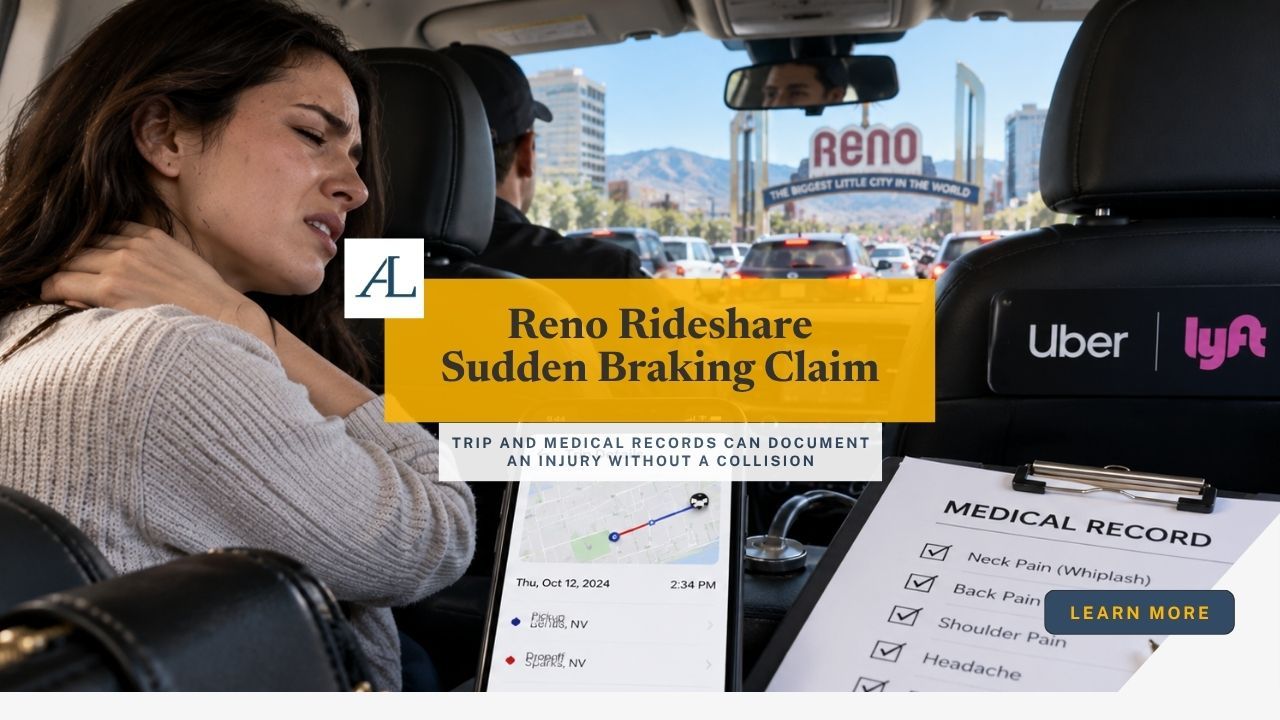
A Reno rideshare sudden braking claim can become complicated quickly because an Uber or Lyft passenger may be injured even though the rideshare vehicle never strikes another car, person, or object. A driver may brake abruptly to avoid stopped traffic, a turning vehicle, a pedestrian, road debris, or a car entering the lane. The passenger may be thrown forward, sideways, or against the seatbelt, door, dashboard, seatback, center console, or another interior surface. When there is no visible vehicle damage, the insurance company may question whether the event was forceful enough to cause the symptoms the passenger reports.
The absence of a collision does not eliminate the need for evidence. It changes the type of evidence that becomes important. A Reno rideshare sudden braking claim may depend on the trip route, traffic conditions, app receipt, passenger seat position, driver’s explanation, witness accounts, dashcam footage, phone-location information, vehicle data, medical records, work restrictions, and written communications with Uber, Lyft, or insurance representatives.
Medical symptoms may not be fully apparent during the ride. A passenger may initially feel shaken or sore, then develop neck stiffness, headaches, shoulder pain, back discomfort, wrist pain, or dizziness later. The MedlinePlus Whiplash Overview explains that whiplash-related pain may take hours or longer to appear and may include dizziness, headache, and pain or stiffness affecting the neck, jaw, shoulders, or arms. A qualified medical provider must determine what caused a particular passenger’s symptoms and what treatment is appropriate.
The rideshare app can help establish that the passenger was inside an active trip when the sudden braking occurred. Nevada’s transportation network company statutes require the company to provide the passenger with identifying information about the driver and vehicle before transportation begins and provide an electronic receipt after the ride. Those records may become especially important when no police report or damaged vehicle independently documents the incident. The relevant provisions appear in the Nevada Transportation Network Company Laws.
This article focuses specifically on abrupt braking without vehicle contact. Avrek’s related article on San Diego rideshare passenger app records after a crash explains more broadly how receipts, route maps, driver profiles, messages, and support reports can preserve the digital history of a rideshare trip. Those same records can support a Reno passenger when the injury resulted from sudden movement rather than a conventional crash.
When an Uber or Lyft ride leaves you injured, choosing the right representation matters. An experienced rideshare accident lawyer and Reno car accident lawyer at Avrek Law Firm can help preserve trip records, investigate why the driver braked, document the medical timeline, and respond when an insurer argues that no collision means no valid injury claim. Avrek’s Reno practice includes car, rideshare, and other personal injury matters throughout Reno and surrounding communities.
Call 866-598-5548, start a live chat, or request a free case review today. There are no upfront legal fees, and you do not pay unless we win.
Documenting a Reno Rideshare Sudden Braking Claim
A Reno rideshare sudden braking claim should begin with a detailed account of the event while the passenger’s memory is still fresh. The passenger should record where the ride began, where it was going, what roadway the vehicle was traveling on, where the passenger was seated, what the passenger was doing immediately before the stop, and what movement occurred inside the car. The account should distinguish between facts the passenger personally remembers and explanations learned later from the driver, another passenger, or the rideshare company.
The passenger does not need to estimate exact speed, distance, or braking force without a reliable basis. Statements such as “the driver braked hard enough that I was thrown into the seatbelt” or “my knee struck the seat in front of me” may be more accurate than guessing how fast the vehicle was traveling. The goal is to preserve the passenger’s honest experience rather than create a technical reconstruction without the necessary records.
Trip Route, Traffic Conditions, and the Driver’s Explanation
The trip route can help explain why sudden braking occurred. A Reno rideshare sudden braking claim may arise in stop-and-go traffic on I-80, US-395, South Virginia Street, McCarran Boulevard, Plumb Lane, or another busy Reno corridor. The vehicle may have been leaving the airport, approaching a hotel or casino entrance, traveling through downtown, entering a freeway, or navigating a crowded pickup or drop-off area.
The trip receipt and route map may identify the roadway and approximate time. Phone-location history may provide additional context. If the driver changed routes, exited unexpectedly, or made an unscheduled stop, those details should be preserved. Traffic-camera footage, nearby business video, or another passenger’s phone may show congestion, a pedestrian, a cut-in vehicle, or another hazard that prompted the braking.
The driver’s explanation should be documented without treating it as the final answer. A driver may say another vehicle cut into the lane, traffic stopped suddenly, a pedestrian stepped toward the road, or navigation caused a missed turn. That explanation may be accurate, incomplete, or influenced by concern about the driver’s rideshare account and insurance. A Reno rideshare sudden braking claim should compare the explanation with the route, app messages, dashcam footage, witnesses, and vehicle data when available.
Messages sent immediately after the event can be especially useful. The passenger may text the person waiting at the destination that the driver “slammed on the brakes,” or the driver may apologize and explain what happened. Those contemporaneous communications should be saved in full rather than reduced to a later summary.
If another vehicle caused the emergency but left without contact, identifying that vehicle may be difficult. The passenger should preserve any description, plate information, dashcam footage, or witness account without assuming that an unidentified driver will automatically be covered by a particular policy. No-contact insurance questions can depend on Nevada law and the specific policy language.
Whether the Passenger Was Seated, Entering, Exiting, or Reaching for an Item
Passenger position is central to a Reno rideshare sudden braking claim because the same vehicle movement can affect occupants differently. A passenger sitting upright in the back seat with a fastened seatbelt may experience a different movement than someone turning to speak, reaching for luggage, checking a phone, fastening a seatbelt, or leaning toward the door.
The passenger may also have been entering or exiting when the driver moved or braked suddenly. A vehicle that starts before the passenger is fully seated can cause a fall or twisting injury. A sudden stop during drop-off can throw a passenger who has already unfastened the seatbelt or begun reaching for the door. The app’s trip status, door position, curb location, and passenger’s own account may help establish that sequence.
The claim should document which seat the passenger occupied and whether anyone sat beside or in front of them. Photos of the vehicle interior can show the distance to the seatback, door, console, dashboard, and other contact surfaces. If the passenger’s knee, wrist, shoulder, or head struck something inside the car, that surface should be photographed when possible.
Seatbelt position should also be described. The shoulder belt may restrain the upper body while the lower body moves forward. A passenger may feel pressure across the chest or shoulder even though the belt prevented a more serious movement. Whether that pressure caused a particular injury is a medical question, but the physical details belong in the Reno rideshare sudden braking claim.
Loose objects can also matter. A suitcase, backpack, shopping bag, mobility device, or other item may shift during the stop and strike the passenger. The passenger should photograph damaged or displaced property and preserve receipts or replacement records when relevant.
Other Passengers, Witnesses, and Nearby Vehicle Information
Other passengers may confirm the sudden nature of the stop and describe how people or objects moved inside the vehicle. A second passenger might remember hearing the driver react, seeing another vehicle enter the lane, or watching the injured passenger strike the seatback. Each person should describe their own observations separately rather than agreeing on one shared account.
A Reno rideshare sudden braking claim may also be supported by outside witnesses. A nearby driver, cyclist, pedestrian, hotel employee, valet worker, security officer, or business employee may have seen the rideshare vehicle brake abruptly or swerve. Even if no one witnessed the passenger’s movement inside the car, an outside witness may confirm the traffic event that caused it.
Nearby vehicle information should be preserved when possible. If another car cut across the rideshare vehicle and caused the emergency braking, its color, make, model, plate, direction, and driver description may become relevant. A rideshare driver or passenger may have captured the vehicle on dashcam or phone video.
Witness contact information should include the person’s name, phone number, email address, location, and a short description of what they observed. A person who cannot stay at the scene may still provide valuable information later. The passenger should not assume the rideshare company or insurer will locate witnesses independently.
The absence of an outside witness does not automatically defeat a Reno rideshare sudden braking claim. App records, medical records, interior photographs, driver communications, and consistent passenger reporting may still create a detailed evidentiary record.
App and Vehicle Records in a Reno Rideshare Sudden Braking Claim
A Reno rideshare sudden braking claim often depends heavily on digital records because there may be no damaged bumper, debris field, or police diagram. The app can establish the passenger’s connection to the driver and vehicle, while route and vehicle records can help confirm when and where the abrupt movement occurred.
The passenger should save information outside the app rather than assume it will remain displayed indefinitely. Screenshots, emailed receipts, downloaded records, exported messages, and secure backups can help preserve information even if the app interface changes or the trip becomes harder to locate.
Trip Receipts, Route History, Messages, and In-App Reports
Nevada law requires transportation network companies to provide passengers with the driver’s photograph and the vehicle’s license plate information before transportation and an electronic receipt after the service. Those legal requirements make the receipt and driver profile logical starting points in a Reno rideshare sudden braking claim.
The passenger should preserve the driver’s name, photograph, vehicle make and model, license plate, pickup point, destination, trip start, trip end, route map, fare, ride identification number, and any added stops. If the trip was ordered by another person or business, the booker’s receipt and the passenger’s own text notifications may need to be collected together.
Messages can show whether the driver discussed traffic, apologized for the stop, reported another vehicle, or asked the passenger not to report the incident. A Reno rideshare sudden braking claim should preserve the complete conversation, including timestamps and messages sent after the passenger left the vehicle.
An in-app safety report can create an early written record. The passenger should describe the facts accurately, identify the sudden braking, state that an injury may have occurred, and avoid guessing about speed or fault. Screenshots should show the submitted report, confirmation, case number, and every response from the company.
A refund or fare adjustment should also be documented. The original receipt and later credit may help establish the trip and the company’s response. A refunded ride is not the same as compensation for medical treatment, lost income, or pain.
Avrek’s article on Los Angeles rideshare driver cancels trip accident claims explains why passengers should preserve receipts, payment authorizations, app messages, support chats, and cancellation records before the digital trip history changes. The same preservation strategy can help in a Reno rideshare sudden braking claim when the trip ends normally but the passenger later develops symptoms.
Dashcam Footage, Vehicle Data, and Phone Location Information
Dashcam footage may show the roadway, traffic, hazard, and exact moment of braking. Some rideshare drivers use forward-facing or cabin-facing cameras. A passenger should note whether a camera was visible and ask that the footage be preserved. The driver may control the recording, but the rideshare company, insurer, or legal representative may need to request it formally.
Vehicle information may also help. Depending on the vehicle, onboard systems may record speed changes, brake application, stability-control activity, or other data. The availability and meaning of that information vary by vehicle, and an ordinary repair scan is not necessarily the same as a forensic data retrieval. A Reno rideshare sudden braking claim should identify the vehicle year, make, model, VIN, owner, and insurer before assuming what data exist.
Phone-location information can place the passenger and vehicle at a particular road or intersection. Navigation history may show the route and whether the vehicle deviated. Phone accelerometer or health-app data should not be assumed to prove braking force without qualified interpretation, but original device information may still help establish the timeline.
The passenger should preserve their own phone in its current state when the digital evidence may be important. Screenshots are useful, but the original receipt, message, photo, video, or location record may contain information not visible in a screenshot. Files should not be edited or relabeled unnecessarily.
The driver’s phone may contain app status, navigation, calls, texts, and communications with Uber or Lyft. A Reno rideshare sudden braking claim may require preservation before those records are deleted through normal use or account changes.
Driver Communications With Uber, Lyft, or Insurance Representatives
The rideshare driver may report the event through the driver app, contact support, notify an insurer, or explain why the vehicle stopped suddenly. Those communications may contain an early account created before a dispute develops. The passenger may not have direct access to them, which makes early preservation important.
Nevada law requires cooperation and information sharing in certain investigations involving transportation network companies, drivers, and TNC insurers. The required information includes the date and time of the incident, the driver’s app login and logout times for the surrounding period, and a description of applicable TNC coverage. The relevant provision appears in the Nevada TNC Information-Sharing Rules.
That information can help establish whether the driver was actively transporting the passenger and what coverage may need review. A Reno rideshare sudden braking claim should not depend solely on the driver’s personal insurance card when the incident occurred during an accepted rideshare trip.
The driver may also communicate with a vehicle owner if the car was leased, rented, or owned by someone else. Vehicle ownership can affect which insurers receive notice and who controls maintenance or onboard data. The passenger should photograph the plate and collect the police or incident information available without assuming the driver owns the car.
Avrek’s related article on determining liability in Lyft or Uber accidents discusses why rideshare claims may involve the driver, platform, another motorist, and multiple insurance policies. A no-collision passenger claim adds a causation dispute, but the basic need to identify the ride phase and every involved policy remains.
Medical Documentation When No Vehicle Impact Occurred
A Reno rideshare sudden braking claim should be supported by medical records that accurately describe the event, symptoms, examination findings, treatment, and functional limitations. The medical history should state that the person was a rideshare passenger subjected to abrupt braking without vehicle contact, along with the passenger’s seat position and body movement.
The injured person should not tell providers that a particular diagnosis occurred unless a qualified provider has made that diagnosis. The passenger can explain what happened physically: the body moved forward, the seatbelt tightened, the knee hit the seat, the wrist struck the door, or the neck moved suddenly. Medical professionals determine what those movements caused.
Body Position, Seatbelt Use, and Interior Contact
Body position can help providers understand the potential injury mechanism. A Reno rideshare sudden braking claim may involve a passenger facing forward, twisting to speak, leaning toward a bag, looking down at a phone, or preparing to exit. The medical record should describe the position as accurately as the passenger remembers it.
Seatbelt use should also be recorded. Wearing a seatbelt does not mean the passenger could not have been injured. The belt restrains movement, but the passenger may still experience pressure or rapid movement. If the passenger was not yet belted because the vehicle began moving prematurely, that fact should also be documented without concealment.
Interior contact can help connect a localized symptom to the event. A bruised knee may correspond with contact against the seatback. Wrist or shoulder pain may follow bracing against the door or console. A head complaint may require evaluation even when the passenger is uncertain whether the head struck anything.
Photographs of bruising, seatbelt marks, swelling, and damaged personal property may supplement the medical records. They should be dated and stored securely. A Reno rideshare sudden braking claim should not rely on photographs alone, but photographs can preserve visible changes between appointments.
Neck, Back, Shoulder, Knee, or Wrist Symptoms
Possible complaints after abrupt braking may include neck stiffness, upper or lower back pain, shoulder pain, chest soreness, headaches, dizziness, knee pain, wrist pain, numbness, tingling, or restricted movement. The passenger should report actual symptoms rather than selecting complaints based on what seems useful to a claim.
The MedlinePlus Whiplash Overview notes that whiplash pain may not appear immediately and can involve the neck, jaw, shoulders, arms, headaches, and dizziness. That medical information supports the importance of monitoring symptoms, but it does not diagnose a specific rideshare passenger.
A Reno rideshare sudden braking claim may be challenged when the first medical record mentions only one area and later records identify another. Symptoms can evolve, but the timeline should be accurate. If shoulder pain began the next morning or wrist pain became noticeable after swelling increased, the passenger should explain that sequence to the provider.
The passenger should seek emergency help for serious or worsening symptoms rather than waiting for an insurance representative to approve care. Medical decisions belong to the patient and licensed healthcare providers.
The records should also document how symptoms affect ordinary movement. Difficulty turning the neck, sitting through a shift, lifting a child, carrying groceries, using a keyboard, climbing stairs, or driving can show the functional impact more clearly than a pain number alone.
Treatment Timing, Provider Findings, and Activity Restrictions
Treatment timing often becomes a central issue in a Reno rideshare sudden braking claim. An insurer may argue that a passenger who waited several days was not seriously injured. In reality, the person may have expected the soreness to improve, been traveling, lacked transportation, faced appointment delays, or not connected later symptoms to the ride immediately.
The reason for any delay should be documented honestly. The passenger should not invent an explanation, but should preserve appointment requests, messages, travel records, and other information that shows why care began when it did.
Provider findings may include tenderness, reduced range of motion, weakness, swelling, bruising, muscle spasm, or other observations. Imaging may be ordered depending on the symptoms, but soft-tissue complaints may not be established or ruled out by one test alone. The treating provider determines what testing is appropriate.
Activity and work restrictions are important because they show how the injury affects function. A provider may restrict lifting, driving, prolonged sitting, repetitive movement, or other activity. The passenger should follow medical instructions and save every work note, therapy referral, home-exercise instruction, and follow-up recommendation.
A Reno rideshare sudden braking claim should also preserve attendance records. Completed appointments, canceled appointments, therapy notes, and communications about scheduling can show whether treatment remained consistent. If symptoms improve, that progress should appear in the record. A balanced medical timeline is more credible than one suggesting the condition never changed.
Insurance Challenges in a Reno Rideshare Sudden Braking Claim
A Reno rideshare sudden braking claim may face more resistance than a conventional crash claim because the insurer cannot point to damaged vehicles or an impact report. The adjuster may question whether the stop occurred, whether it was unusually forceful, whether the driver acted negligently, or whether the passenger’s symptoms were caused by something else.
Those questions should be answered through organized evidence rather than argument alone. Trip records establish the ride. Driver and witness accounts help establish the braking event. Medical records document the symptoms and treatment. Digital and vehicle records may support the route and movement. Daily-life and employment records show the practical consequences.
Disputes About Whether Sudden Braking Caused the Injury
An insurer may say ordinary braking cannot cause a significant injury. A Reno rideshare sudden braking claim should respond by documenting the actual event rather than debating a generalized assumption. The relevant questions include how abruptly the vehicle slowed, whether it swerved, where the passenger was seated, whether the passenger was braced, whether interior contact occurred, and what symptoms were documented afterward.
The driver’s own report may support the severity of the maneuver. If the driver describes an emergency stop to avoid another car or pedestrian, that account may contradict an insurer’s suggestion that nothing unusual happened. Dashcam footage or another passenger’s statement may provide additional support.
The medical causation question should be addressed by qualified providers. A lawyer can organize evidence and challenge unsupported insurance positions, but should not replace medical judgment. The records should accurately state the history given to the provider and the provider’s findings.
No visible vehicle damage is expected when there was no collision. Using the absence of damage as proof that no injury occurred confuses two different issues. A Reno rideshare sudden braking claim should focus on occupant movement and medical evidence rather than pretending that exterior damage exists.
Nevada requires transportation network company insurance during periods when a driver is providing transportation services. Current law sets minimum coverage requirements and permits the required coverage to be supplied through one or a combination of policies. Whether a particular no-collision passenger injury falls within the applicable policy depends on the incident facts and policy terms. The statutory framework appears in the Nevada TNC Insurance Requirements.
Questions About Prior Conditions or Delayed Treatment
Prior neck, back, shoulder, knee, wrist, or headache complaints may become part of the insurance investigation. A previous condition does not automatically mean the sudden braking caused no new harm. The issue may be whether the ride created a new injury, aggravated an existing condition, or caused symptoms to return after a period of improvement.
A Reno rideshare sudden braking claim should address relevant prior history honestly. Earlier medical records may show the passenger’s baseline, treatment history, activity level, and whether similar symptoms were active before the ride. Hiding prior treatment can damage credibility, while a clear comparison may help show what changed.
The insurer may request broad medical authorizations covering years of unrelated treatment. The passenger should understand the scope before signing. Relevant records may need to be provided, but the claim should not be defined by an unlimited search through unrelated medical history.
Delayed treatment can also create disputes. The insurer may say the gap broke the connection between the event and symptoms. The passenger’s explanation, appointment records, travel schedule, and medical history can provide context. The focus should remain on what the providers documented and whether the timeline is medically supported.
Consistency does not mean every record must use identical words. A passenger may describe “neck soreness” at urgent care and “stiffness with turning” during therapy. Those descriptions may reflect the same developing problem. A Reno rideshare sudden braking claim should organize the records so ordinary differences are not portrayed as contradictions.
Early Settlement Offers Before Recovery Is Understood
A quick settlement may arrive before the passenger knows whether the symptoms will resolve. The insurer may offer a small amount based on one urgent-care visit and the absence of vehicle damage. Accepting that offer may require signing a release that ends the claim.
A Reno rideshare sudden braking claim should not be valued solely by the first medical bill. The complete picture may include follow-up treatment, therapy, diagnostic testing, missed work, transportation, medication, and limitations affecting home or family responsibilities.
Settlement timing should account for the medical plan. The passenger may not need to wait indefinitely, but should understand the diagnoses, completed treatment, recommended follow-up, restrictions, prognosis, and reasonably supported future needs before releasing claims.
Several insurance representatives may contact the passenger. The rideshare-related carrier, driver’s personal insurer, another vehicle’s insurer, or the passenger’s own insurer may take different positions. Every claim number, adjuster, request, and offer should be logged separately.
The release language should identify which people, companies, policies, and claims are being resolved. A document presented by one insurer may contain broad language releasing parties who have not yet been investigated. A Reno personal injury lawyer can review those issues while coordinating the medical and digital evidence.
What to Do After Sudden Braking in an Uber or Lyft
A passenger should first address medical and immediate safety needs. If the person is seriously hurt or experiences alarming symptoms, emergency assistance should be requested. The driver should stop in a safe location rather than continue the trip while the passenger is in distress.
The passenger should record the date, time, route, roadway, traffic conditions, seat position, seatbelt use, body movement, interior contact, driver’s explanation, and names of other passengers. Photographs should capture the vehicle, plate, driver profile, passenger seat, seatbelt, interior contact surface, personal property, and visible injuries.
Save the complete trip record before closing or updating the app. A Reno rideshare sudden braking claim may depend on the receipt, route map, driver and vehicle information, app status, support report, messages, fare, and trip identification number. Send copies to secure storage outside the application.
Ask whether dashcam or cabin-camera footage exists and request preservation in writing. Record the contact information of other passengers and witnesses. If another vehicle caused the maneuver, write down every identifying detail without chasing or confronting the driver.
Report the incident through the rideshare platform and save the confirmation. Keep the description factual. Do not estimate speed or diagnose an injury. State what happened, how the body moved, and that medical evaluation may be required.
Nevada’s transportation laws require TNCs to maintain consumer complaint systems, and the Nevada Transportation Authority offers a formal process for transportation network company complaints. Its instructions permit consumers to submit supporting documentation such as receipts, invoices, and photographs. The Nevada Transportation Authority Complaint Process can be reviewed when a regulatory complaint is appropriate, although a complaint is not a substitute for an injury claim or legal advice.
Deadlines for a Reno Rideshare Sudden Braking Claim
A Reno rideshare sudden braking claim should be investigated immediately because digital and witness evidence may disappear long before a legal filing deadline. App screens change, dashcams overwrite files, drivers change vehicles, witnesses forget details, and phone data may be replaced or deleted.
Nevada generally provides a two-year limitations period for an action seeking damages for personal injuries caused by another person’s wrongful act or neglect, subject to exceptions and other rules. The official provision appears in . The correct deadline depends on the facts, parties, and claims, so an injured person should not calculate the filing date from a general webpage alone.
The filing period should not be treated as permission to wait. An insurer may receive the driver’s account within days while the passenger’s evidence remains uncollected. Early preservation helps ensure that the Reno rideshare sudden braking claim is evaluated from the complete record rather than only the driver’s explanation.
Frequently Asked Questions About a Reno Rideshare Sudden Braking Claim
Can an Uber or Lyft Passenger Have a Claim Without a Collision?
Potentially, yes. A passenger may suffer an injury when abrupt braking or swerving causes the body to move into the seatbelt, seatback, door, dashboard, or another surface. Whether the driver or another party is legally responsible depends on why the maneuver occurred, whether the driver acted reasonably, the medical evidence, and the applicable insurance.
A Reno rideshare sudden braking claim requires proof of both the event and the injury. The absence of vehicle contact changes the evidence but does not automatically answer the claim.
What Evidence Is Most Important When No Vehicles Were Damaged?
Important evidence may include the trip receipt, route map, driver profile, vehicle information, app report, messages, witness statements, dashcam footage, phone-location information, vehicle data, interior photographs, medical records, work restrictions, and records of daily limitations.
The passenger should preserve these records as quickly as possible because no damaged vehicle may exist to show the force or timing of the event.
What if the Driver Says the Braking Was Normal?
The driver’s statement is one piece of evidence, not the entire case. Other passengers, dashcam footage, traffic conditions, app messages, and the driver’s report to Uber, Lyft, or an insurer may help show whether the stop was abrupt.
A Reno rideshare sudden braking claim should compare the driver’s account with the passenger’s movement and medical timeline rather than relying on one description.
What if Another Vehicle Caused the Driver to Brake?
The other driver may need to be investigated if that vehicle entered the lane, stopped unexpectedly, or created another hazard. The passenger should preserve a description, plate, video, and witness information when possible.
When the other vehicle leaves and there is no contact, insurance questions may become more complicated. Coverage should be evaluated under the specific policies and Nevada law rather than assumed.
Does the Rideshare App Record Matter When There Was No Crash?
Yes. The trip record can show that the ride was active, identify the driver and vehicle, establish the route and time, and preserve communications about the incident. Nevada law requires driver and plate information before transportation and an electronic receipt afterward.
A Reno rideshare sudden braking claim may rely more heavily on those digital records because there is no collision damage.
What if My Pain Did Not Begin Until the Next Day?
Delayed symptoms can occur after an accident. MedlinePlus notes that whiplash-related pain may not appear immediately and may involve headache, dizziness, and pain or stiffness in the neck, jaw, shoulders, or arms. A medical provider should evaluate the symptoms and determine their cause.
The passenger should explain when the symptoms began and how they changed rather than suggesting they were present earlier than they actually were.
Should I Report the Incident Through the Uber or Lyft App?
Creating a written in-app report can help establish when the passenger notified the company. Save the report, confirmation number, support messages, emails, and every response.
A Reno rideshare sudden braking claim should still be supported by medical, witness, and other evidence. The platform’s internal report is helpful, but it does not replace the full claim.
Which Insurance May Apply During an Active Rideshare Trip?
Nevada requires TNC insurance while the driver is providing transportation services. The statute sets coverage requirements and allows the required coverage to be provided through one or a combination of policies. The application of a policy to a particular no-collision passenger injury depends on the facts, policy terms, causation, and applicable law.
An injured passenger should not assume that the driver’s personal insurance card identifies the only potentially relevant coverage.
Should I Give a Recorded Statement Immediately?
The passenger should be careful before giving a detailed recorded statement. The adjuster may ask for speed estimates, precise stopping distance, medical conclusions, or explanations about evidence the passenger has not seen.
State only what you genuinely observed. Do not guess about the driver’s speed, vehicle data, or another motorist’s conduct. A rideshare accident lawyer can help identify which company is requesting the statement and how the digital and medical records should be organized.
How Long Do I Have to File a Reno Passenger Injury Claim?
Nevada’s general limitations statute provides a two-year period for many personal injury actions, but exceptions and different rules may apply. The official language is available through Nevada Revised Statutes Section 11.190.
Evidence should be preserved immediately even when the court filing deadline appears distant.
Do I Need a Lawyer for a Sudden-Braking Rideshare Claim?
Legal help may be especially important when there is no collision damage, the driver minimizes the braking, the passenger’s symptoms appeared later, or several insurers dispute responsibility.
A Reno car accident lawyer can investigate the vehicle movement and insurance issues, while a Reno personal injury lawyer can organize the medical, employment, and daily-life evidence needed to document the full impact.
Call or Contact Avrek Law Firm 24/7 for a Free Consultation and Pay Nothing Unless We Win
A Reno rideshare sudden braking claim can become difficult when no vehicles made contact, the rideshare driver says the stop was ordinary, or an insurer argues that the passenger’s symptoms must have come from something else. These cases may depend on trip receipts, route records, driver messages, dashcam footage, vehicle data, passenger position, interior contact, medical notes, witness accounts, work restrictions, and a consistent timeline connecting the ride to the injury.
Avrek Law Firm helps injured Uber and Lyft passengers investigate complex rideshare claims in Reno and throughout Nevada. Our team can move quickly to preserve app and vehicle evidence, identify the relevant insurance policies, communicate with the rideshare company and adjusters, and document the medical and financial consequences of the event.
If you or someone you love was injured when an Uber or Lyft driver braked suddenly in Reno—even though the vehicle did not collide with anything—Avrek Law Firm is ready to help.
Call 866-598-5548, start a live chat, or complete our online consultation form today for a free, no-obligation case review. There are no upfront legal fees, and you do not pay unless we win.
Serving the Reno Community
Avrek Law Firm represents injured rideshare passengers throughout Reno, Sparks, and nearby Nevada communities. Local context matters in a Reno rideshare sudden braking claim because freeway congestion, airport trips, hotel entrances, casino pickup zones, downtown traffic, construction areas, and crowded curbside locations may affect why the driver reacted.
An incident on I-80, US-395, South Virginia Street, McCarran Boulevard, Plumb Lane, Virginia Street near downtown, an airport route, or a resort entrance may involve different camera sources, witnesses, traffic patterns, and business records. The passenger should identify the exact location before nearby footage or trip details become unavailable.
A Reno car accident lawyer can help investigate the sudden movement and ride status, while a Reno personal injury lawyer can document how the injuries affected medical treatment, work, transportation, sleep, mobility, and daily life.
A Reno rideshare sudden braking claim should be handled with urgency and care. The lack of a damaged vehicle makes prompt digital, witness, and medical documentation even more important.
There are no upfront fees, and you don’t pay unless we win.