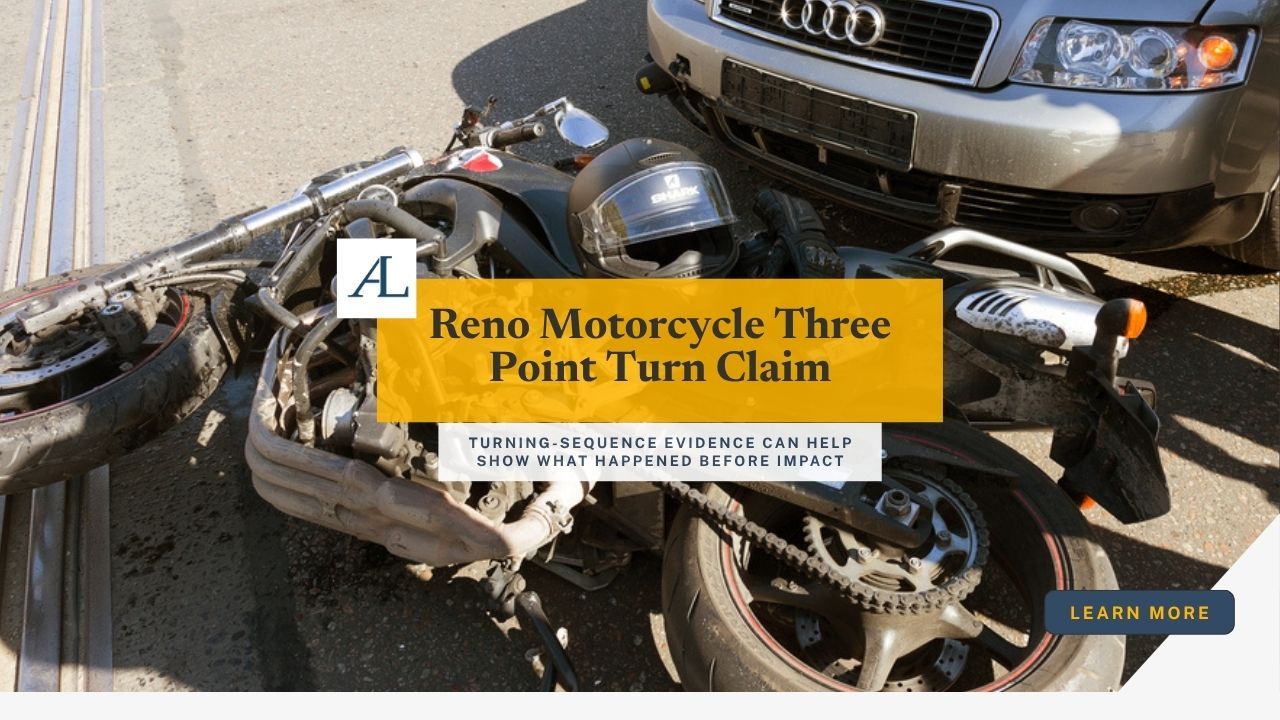
A Reno motorcycle three point turn claim can become complicated because a three-point turn is not one movement. A driver may pull forward, stop, reverse, change steering direction, and then move forward again before completing the maneuver. During those movements, the vehicle may cross more than one lane and repeatedly change its relationship to an approaching motorcycle. A collision can happen during the first forward movement, while the vehicle is reversing, or as the driver completes the final turn.
The sequence matters because the driver and motorcyclist may remember very different versions of what happened. The driver may say the motorcycle appeared only after the vehicle was already positioned for the turn. The rider may remember seeing the vehicle begin crossing the roadway and having very little time to react. A witness may have seen only the final portion of the maneuver. Video, vehicle damage, tire marks, final resting positions, and other evidence can help establish the sequence more reliably than any single statement.
Nevada DMV guidance states that U-turns are generally allowed when they can be completed safely, but specific restrictions apply, including limitations in business areas and where visibility is less than 500 feet in either direction. The official Nevada DMV Traffic Laws — U-Turns provides the current guidance and identifies NRS 484B.403 as the applicable U-turn statute.
A three-point turn is not necessarily identical to a U-turn under Nevada law. The exact roadway, maneuver, location, and movements should therefore be evaluated from the facts rather than assuming the statute resolves every collision. What remains critical in a Reno motorcycle three point turn claim is whether the driver could safely complete the maneuver and whether the motorcycle was reasonably visible before the vehicle moved across its path.
Motorcycles can present special visibility problems because of their smaller size. Nevada DMV specifically warns that motorcycles may appear farther away than they actually are and that it can be difficult for drivers to judge motorcycle speed. The state also advises motorists to leave additional following distance and watch for motorcycle movement and signals. (dmv.nv.gov)
When a turning vehicle leaves a motorcyclist injured, choosing the right representation matters. An experienced Reno motorcycle accident lawyer at Avrek Law Firm can investigate the vehicle’s movements, preserve video and physical evidence, identify witnesses, and challenge unsupported arguments about rider speed or visibility. Avrek’s Reno motorcycle accident team handles serious motorcycle injury claims throughout Reno and surrounding communities.
Call 866-598-5548, start a live chat, or request a free case review today. There are no upfront legal fees, and you do not pay unless we win.
Reconstructing Each Stage of a Three-Point Turn
A Reno motorcycle three point turn claim should begin with the complete turning sequence rather than the final point of impact. A three-point maneuver may occupy several seconds and require the driver to move forward and backward while changing direction. The driver may cross the motorcycle’s expected path before the final turn is even underway.
The investigation should establish where the vehicle began, how far it traveled forward, where it stopped, when it reversed, where it changed direction again, and where the vehicle finally pointed. The motorcyclist’s lane position and direction should be plotted against each of those movements.
The roadway itself may influence the maneuver. A narrow residential street can produce a very different sequence from a multilane arterial. A driver turning around near a shopping center, hotel driveway, parking lot, or median opening may use additional space outside the main travel lane. A motorcycle approaching from behind or from the opposite direction may encounter the vehicle at a different stage of the maneuver.
The Vehicle’s Starting Position and Direction of Travel
The vehicle’s original position provides the starting point for a Reno motorcycle three point turn claim. Investigators should determine whether the driver was traveling normally, stopped along the curb, exiting a driveway, leaving a parking area, or preparing to turn around after missing a destination.
The driver’s starting lane matters because it establishes where the motorcycle and other traffic would ordinarily expect the vehicle to continue. A car that begins at the curb and moves across multiple lanes creates a different path from one that starts near the center of the roadway.
Photographs should show the road width, lane markings, center line, curb, parked vehicles, driveways, medians, and any signs restricting turns. A wide-angle image from the approaching motorcycle’s perspective can help establish the initial sightline.
The exact location of the vehicle at the beginning of the maneuver should be documented before relying on a driver’s statement. A vehicle may have been farther into the roadway than the driver remembers, particularly if the driver stopped, repositioned, and then resumed the maneuver.
The driver’s destination may also explain the maneuver. A driver who missed a driveway or turn may make a three-point turn unexpectedly. A driver searching for parking may reverse into a new position. A delivery or rideshare driver may be navigating an unfamiliar area. Those circumstances do not by themselves establish negligence, but they may explain why an unusual maneuver occurred.
Forward, Reverse, and Final Turning Movements
Breaking the maneuver into stages is one of the most important steps in a Reno motorcycle three point turn claim. Investigators should identify the first forward movement, stopping point, reverse movement, second steering movement, and final departure direction.
The reversing stage deserves special attention. A motorcyclist may be approaching while the vehicle is moving backward, and the driver may be looking in one direction before turning the steering wheel and moving forward again. Reverse lights, brake lights, steering position, backup-camera footage, and witness observations may show what the driver was doing.
The Nevada Motorcycle Handbook emphasizes controlled motorcycle operation during turns and notes that riders should slow before a turn, look through the turn, and use appropriate control techniques. Those principles primarily address motorcycle operation rather than establish liability for a particular crash, but they can be relevant when reconstructing the rider’s position and movement. The official Nevada Motorcycle Handbook provides the state’s motorcycle guidance.
For the vehicle driver, the sequence should also consider whether the driver had a clear view before each movement. A driver who looks forward during one stage and backward during another may have different visibility at different moments. A motorcycle can enter a potentially dangerous path while the driver is transitioning between those views.
Final vehicle orientation should be documented as well. The car may finish facing the opposite direction, diagonally across the roadway, or partly across another lane. The final position can help investigators work backward from the impact to understand how much of the maneuver had already been completed.
The Motorcyclist’s Lane Position and Distance From the Vehicle
The motorcycle’s position should be reconstructed alongside the vehicle’s movements. A Reno motorcycle three point turn claim may involve a rider traveling in a normal traffic lane, approaching near the center line, moving along the outside portion of the lane, or responding to another vehicle’s position.
Distance matters because motorcycle size can affect how drivers perceive speed and proximity. Nevada DMV specifically warns that motorcycles can appear farther away than they are and that it can be difficult to judge their speed. (dmv.nv.gov)
The rider’s location should be established using dashcam or helmet-camera footage, witnesses, lane markings, damage, debris, and final positions. If no camera exists, scene photographs and accident-reconstruction analysis may help estimate the path.
The rider should avoid guessing about exact distance if there is no reliable basis. A statement such as “the vehicle was already moving across my lane when I first saw it” can be more accurate than estimating that the vehicle was exactly 100 feet away.
The motorcycle’s speed can also become disputed. A driver may claim the motorcycle was traveling too fast to avoid the maneuver. The rider may believe they were traveling normally. Speed should be evaluated through available evidence rather than assumption, including video, vehicle data where available, road geometry, skid evidence, and witness observations.
Scene and Digital Evidence to Preserve
A Reno motorcycle three point turn claim can depend heavily on physical evidence because the final vehicle positions may not reveal every stage of the maneuver. Evidence should be preserved before the motorcycle is repaired, the roadway is altered, or a vehicle is moved or sold.
Photographs should cover the complete scene, not just the damaged motorcycle and car. The roadway, turn area, nearby vehicles, signs, traffic controls, lighting, lane markings, curb, landscaping, buildings, and potential camera locations may all become relevant later.
Damage Locations, Tire Marks, Debris, and Final Resting Positions
Damage locations can help establish which part of the motorcycle contacted the vehicle. Front-corner damage, side damage, mirror damage, foot-control damage, or marks along the motorcycle’s fairing may provide clues about the relative positions at impact.
Vehicle damage should also be photographed before repairs. The location and height of damage may help indicate whether the motorcycle struck the vehicle while it was turning, reversing, or moving forward.
Tire marks and debris can help identify movement immediately before and after the collision. A motorcycle may leave a braking mark or slide in a particular direction. Broken plastic, glass, metal, and personal property may indicate where contact occurred.
Final resting positions should be documented before the vehicles are moved whenever possible. If the motorcycle ends up several feet away from the vehicle, that position may provide additional information about the direction of movement after impact. Police photographs, witness photographs, and nearby surveillance may preserve these details even if the vehicles were moved before investigators arrived.
Avrek’s related article on How Comparative Fault Affects Motorcycle Accident Claims and Compensation discusses why police reports, witness accounts, accident reconstruction, and dashcam footage can become important when an insurer argues that a motorcycle rider contributed to a collision. That same evidence becomes particularly useful when the dispute involves the stages of a three-point turn.
Helmet Cameras, Dashcams, Business Video, and Residential Cameras
Video can be one of the most powerful sources of evidence in a Reno motorcycle three point turn claim because a three-point maneuver unfolds quickly. A helmet camera may show when the vehicle first entered the rider’s path. A dashcam may capture the full motorcycle approach. A business camera may show the vehicle from the side, revealing movements that a rider-facing camera cannot.
Nearby cameras may be located at hotels, casinos, restaurants, gas stations, apartment buildings, offices, parking lots, residences, and traffic intersections. A camera does not have to capture the actual collision to be useful. Footage showing the vehicle entering the roadway or the motorcycle approaching several seconds earlier may help establish the available reaction time.
The original file should be saved along with the surrounding footage. The memory card should not be reformatted or reused if doing so could overwrite the recording. Edited clips can be provided for convenience, but they should not replace the original.
Witness Accounts From Drivers, Passengers, and Nearby Pedestrians
Witnesses may see different stages of a three-point turn. A pedestrian may watch the vehicle reverse. Another driver may see the initial forward movement. A passenger may notice the driver looking backward while the motorcycle approaches.
A Reno motorcycle three point turn claim should preserve those accounts separately. Witnesses should describe where they were standing or driving and what they personally observed. Their statements should not be combined merely because they witnessed the same collision.
Useful questions include whether the vehicle was stopped, moving forward, reversing, or completing the final turn; whether the motorcycle’s headlight was visible; whether the driver appeared to check for traffic; and whether other vehicles or objects blocked the view.
Witnesses may also remember statements made immediately after impact. A driver who says “I was trying to turn around” provides a different type of information from a witness who says “the car backed into the motorcycle.” Both should be preserved accurately.
Visibility and Signaling Questions
Visibility is often central to a Reno motorcycle three point turn claim. The driver may say the motorcycle was difficult to see or appeared suddenly. The rider may say the vehicle entered the lane without warning. The physical scene should be evaluated to determine whether the motorcycle was visible before each phase of the maneuver.
Nevada DMV specifically warns motorists that motorcycles are smaller and can appear farther away than they really are. It also advises drivers to watch motorcycle movement and to leave plenty of space when approaching a motorcycle. (dmv.nv.gov)
The investigation should distinguish between a motorcycle being physically visible and a driver actually noticing it. A motorcycle may have been within the driver’s line of sight but outside the driver’s attention because the driver was checking mirrors, looking behind during the reverse phase, navigating, or watching another part of the roadway.
Turn Signals, Reverse Lights, Headlights, and Motorcycle Lighting
Turn signals can provide an important warning during a three-point maneuver. A driver may activate the signal before the first movement, leave it on through the maneuver, activate it only shortly before the final turn, or fail to use it. Video and witness accounts may help establish which occurred.
Reverse lights can be particularly important when the vehicle backs during the middle stage. A motorcycle approaching a reversing vehicle may have a different opportunity to react than one approaching a vehicle that appears stationary.
Motorcycle headlights and lighting equipment may also become part of the dispute. Nevada DMV notes that motorcycle riders have visibility challenges because of their size, but the driver’s responsibility to observe surrounding traffic remains important. (dmv.nv.gov)
Lighting conditions should be documented. A daytime crash near a shaded building may have different visibility from a nighttime crash on an illuminated road. Headlight glare, sunset direction, streetlights, rain, and reflective surfaces may affect what a driver could see.
Parked Vehicles, Landscaping, Road Curves, and Other Obstructions
Physical obstructions can change the sightline during a three-point turn. Parked vehicles may hide a motorcycle until it approaches the turning car. Landscaping, walls, signs, dumpsters, construction equipment, or a curved roadway may reduce visibility in one direction.
A Reno motorcycle three point turn claim should photograph these objects from the driver’s and rider’s perspectives. Their height and position may matter. A low sedan may create a very different blind area from a pickup or SUV.
Temporary conditions should also be considered. A parked delivery vehicle that left the area after the crash may no longer be present when investigators return. Construction barriers may have moved. A business may have changed where customers park. Early photographs therefore become especially valuable.
The driver’s sightline may also change between phases of the maneuver. A vehicle may have a clear view while moving forward but a restricted rear view while reversing. A motorcycle may become visible only after the car changes direction. Reconstructing each stage separately avoids treating “visibility” as one fixed condition.
Driver Statements About Speed or Not Seeing the Rider
Drivers may say they did not see the motorcycle or believed it was farther away. Nevada DMV acknowledges that motorcycles can appear farther away and that judging their speed can be difficult. (dmv.nv.gov)
That information can explain why a driver claims not to have recognized the motorcycle’s position, but it does not independently establish that the driver acted reasonably. The investigation should examine whether the driver had enough opportunity to observe, wait, or complete the maneuver safely.
A driver’s statement should also be compared with physical evidence. If the driver says the motorcycle appeared only after the vehicle was already facing the opposite direction, the damage and video should be checked to determine whether the motorcycle could have been visible during the earlier stages.
Similarly, a rider’s estimate of the vehicle’s speed should not be treated as precise unless supported by evidence. Both sides may remember the event differently because it lasted only seconds.
Injury and Insurance Documentation
A Reno motorcycle three point turn claim should document both the crash mechanics and the rider’s injuries. Motorcycle riders have less physical protection than occupants of enclosed vehicles, so a relatively short collision sequence can produce substantial injuries.
The medical record should begin with emergency treatment and continue through specialist care, therapy, rehabilitation, work restrictions, and future treatment where appropriate.
Motorcycle, Helmet, and Protective Gear Damage
Motorcycle and protective-gear evidence can help explain how the crash affected the rider. Photographs should show the motorcycle before repair, including the front, rear, sides, handlebars, wheels, foot controls, exhaust, fairings, engine area, and other damaged components.
A damaged helmet may provide additional physical evidence. Scratches, cracks, abrasions, or impact marks should be photographed before the helmet is discarded or replaced. Jackets, gloves, boots, pants, and other gear should also be preserved when they show crash damage.
A Reno motorcycle three point turn claim should document whether the rider was wearing protective gear and what happened to it during the collision. Gear use should not distract from the central liability question. The evidence needs to show the full crash sequence and the resulting injuries.
Repair records should include estimates, photographs, supplements, parts replaced, labor, diagnostic information, and final invoices. If a shop determines that the motorcycle is a total loss, preserve the initial condition and valuation evidence before ownership changes.
Emergency Care, Specialist Treatment, and Rehabilitation
Motorcycle crash injuries may include fractures, road rash, shoulder injuries, knee injuries, spinal trauma, head injuries, or other conditions. The exact diagnosis should come from qualified medical providers.
Emergency records can establish the first symptoms and injuries. Follow-up treatment can show whether the condition improved, required surgery, or developed into a longer rehabilitation process. Physical therapy records may document range-of-motion limitations, strength deficits, pain, balance problems, and restrictions on activity.
A Reno motorcycle three point turn claim should also document missed work, reduced duties, transportation problems, and daily limitations. A rider who cannot operate a motorcycle or drive a car because of an injured arm or leg may have transportation expenses beyond medical costs.
Family members may provide transportation or assistance with daily tasks. A simple caregiving record can show the nature and frequency of that support.
Treatment gaps should be explained honestly rather than left unexplained. A rider may delay care because symptoms seemed manageable, transportation was difficult, or the person expected improvement. The medical timeline should reflect what actually happened.
Recorded Statements and Settlement Offers Before Evidence Is Reviewed
An insurer may quickly ask the rider for a recorded statement, particularly when the driver disputes fault. Questions may include speed, lane position, distance, headlight use, braking, and whether the rider could have avoided the vehicle.
The rider should answer truthfully but should not guess. A Reno motorcycle three point turn claim can be weakened when an injured rider gives a precise speed or distance estimate without actually knowing it. “I do not know” is a legitimate answer when memory or visibility makes an exact answer impossible.
The insurer may also offer an early settlement based on the initial emergency bills and a disputed liability assessment. That offer may arrive before the motorcycle has been inspected, before video is collected, and before future medical treatment is understood.
Avrek’s Reno motorcycle accident practice emphasizes prompt investigation and evidence preservation in serious rider injury claims.
The rider should preserve every letter, email, claim number, recorded-statement request, medical authorization, repair estimate, and settlement offer. Different insurers may contact the rider if several vehicles were involved, and their positions may conflict.
Comparing Nevada Motorcycle Guidance With the Actual Crash Evidence
Nevada DMV provides general motorcycle and traffic guidance, but that guidance does not determine liability in a particular collision. A Reno motorcycle three point turn claim still requires investigation of the actual roadway, vehicle movements, rider position, lighting, visibility, and evidence.
Nevada DMV states that U-turns are generally permitted when safely completed, but identifies locations where they are not allowed, including where prohibited by a sign or signal or where visibility is less than 500 feet in both directions. In business areas, the DMV notes additional location restrictions. Nevada DMV Traffic Laws — U-Turns provides the current summary.
The distinction between a three-point turn and a U-turn should be addressed carefully. Some three-point maneuvers may occur on residential streets or other areas where the legal analysis differs from a straightforward U-turn. The exact conduct, roadway, signage, and location matter.
The evidence should therefore answer practical questions: Was the driver allowed to attempt the maneuver there? Was the roadway sufficiently visible? Was the motorcycle already approaching? Did the driver reverse into a lane? Did the vehicle cross the rider’s expected path? Did the driver have time to wait?
Those questions provide a more useful framework than simply labeling the accident a “U-turn.”
Deadlines for a Reno Motorcycle Three Point Turn Claim
A Reno motorcycle three point turn claim should be investigated promptly because the most useful evidence may disappear long before the legal filing deadline. Motorcycle repairs can change physical evidence. Vehicles can be sold. Businesses can overwrite surveillance. Witnesses can become difficult to locate.
Nevada Revised Statutes Section 11.190 contains multiple limitation periods. For many claims involving injury to a person caused by another’s wrongful act or neglect, the statute provides a two-year period, subject to specified exceptions and different rules for particular causes of action. The current official statute is available at Nevada Revised Statutes Section 11.190.
The legal deadline should be calculated from the specific facts rather than assumed from a general article. Evidence preservation should begin immediately regardless of how much time appears to remain.
Frequently Asked Questions About a Reno Motorcycle Three Point Turn Claim
What Is a Reno Motorcycle Three Point Turn Claim?
A Reno motorcycle three point turn claim generally concerns a collision in which a vehicle performs a three-point turn and crosses or enters the path of a motorcycle. The investigation may examine the vehicle’s initial movement, reverse movement, final turn, motorcycle position, visibility, signals, and roadway conditions.
Are Three-Point Turns Legal in Nevada?
The legality of a particular maneuver depends on where and how it was performed. Nevada DMV states that U-turns are generally permitted when they can be completed safely, but restrictions apply based on location, visibility, and signage.
A three-point turn should be evaluated based on its actual movements and the roadway rather than assuming every such maneuver is automatically permitted or prohibited.
What Evidence Can Show How the Three-Point Turn Happened?
Useful evidence may include helmet-camera footage, dashcams, business surveillance, residential cameras, photographs, vehicle damage, tire marks, debris, witness statements, police diagrams, and final vehicle positions.
The most important evidence often shows the vehicle before the final impact so investigators can reconstruct each stage of the maneuver.
What if the Driver Says They Did Not See the Motorcycle?
That statement does not by itself resolve fault. Nevada DMV acknowledges that motorcycles can appear farther away than they actually are and can be difficult for drivers to judge for speed.
The investigation should determine whether the motorcycle was visible, when the driver could have seen it, and whether other vehicles or objects affected the sightline.
What if the Driver Was Reversing?
Reverse movement can be important because it is a distinct stage of the maneuver. Investigators should examine reverse lights, backup-camera footage, witness statements, vehicle position, and motorcycle movement.
A Reno motorcycle three point turn claim should establish whether the motorcycle approached while the vehicle was stationary, reversing, or beginning another forward movement.
Can My Helmet Camera Help Prove What Happened?
Yes. Helmet-camera footage may capture the motorcycle’s lane position, the vehicle entering the roadway, signals, road conditions, and the moments before impact.
Preserve the original recording, memory card, camera, and settings. Do not rely solely on a trimmed or edited copy.
What if the Police Report Says the Motorcycle Was Traveling Too Fast?
The police report may contain statements from drivers or witnesses, but the speed allegation should be compared with the available evidence. Dashcam or helmet-camera footage may provide a better view of the motorcycle’s actual movement.
A Reno motorcycle three point turn claim should not treat an unsupported speed allegation as established fact.
What if I Was Injured but the Motorcycle Damage Is Minor?
Vehicle damage and bodily injury are separate issues. A rider can sustain significant injuries even when the motorcycle’s visible damage appears limited. Medical documentation should establish the nature and extent of the injuries.
The claim should not be valued solely from the repair estimate.
Should I Give the Insurance Company a Recorded Statement?
Be careful about giving detailed statements before the evidence is reviewed. State what you genuinely remember and avoid guessing about speed, distance, or events you could not see.
An insurer may use an uncertain estimate as though it were a definitive admission.
How Long Do I Have to File a Reno Motorcycle Accident Claim?
Nevada’s limitation statute contains a two-year period for many personal injury actions, subject to exceptions and other applicable rules. The official Nevada Revised Statutes Section 11.190 should be reviewed for the circumstances of a particular claim.
Do I Need a Lawyer for a Three-Point-Turn Motorcycle Accident?
Legal representation can be particularly valuable when the driver disputes visibility, the crash sequence is unclear, multiple cameras may exist, or an insurer alleges that the motorcyclist was speeding.
A Reno motorcycle accident lawyer can help preserve the physical and digital evidence while investigating the driver’s movements, insurance coverage, and the rider’s injuries.
Call or Contact Avrek Law Firm 24/7 for a Free Consultation and Pay Nothing Unless We Win
A Reno motorcycle three point turn claim can become difficult when the driver says the motorcycle was too far away to pose a danger, the rider says the vehicle entered the path without warning, or important evidence disappears before the sequence can be reconstructed.
These claims may depend on the driver’s forward and reverse movements, motorcycle lane position, turn signals, reverse lights, headlights, dashcam or helmet-camera footage, business surveillance, vehicle damage, tire marks, witnesses, police records, medical treatment, and insurance communications.
Avrek Law Firm helps injured motorcyclists throughout Reno and surrounding Nevada communities. Our team can move quickly to preserve motorcycle and vehicle evidence, identify witnesses and camera sources, investigate the turning sequence, handle insurance communications, and document medical and financial losses.
If you or someone you love was injured when a vehicle made a three-point turn across a motorcycle’s path in Reno, Avrek Law Firm is ready to help.
Call 866-598-5548, start a live chat, or complete our online consultation form today for a free, no-obligation case review. There are no upfront legal fees, and you do not pay unless we win.
Serving the Reno Community
Avrek Law Firm represents injured motorcyclists throughout Reno and surrounding areas, including Sparks.
Local context matters in a Reno motorcycle three point turn claim because drivers may attempt turning maneuvers around busy commercial corridors, residential streets, hotel and casino entrances, parking areas, and major roads such as South Virginia Street, McCarran Boulevard, Plumb Lane, Kietzke Lane, and other routes connecting Reno and Sparks.
A Reno motorcycle accident lawyer can help reconstruct the vehicle’s movement and the rider’s position, while a Reno personal injury lawyer can document the effect of the crash on medical treatment, work, transportation, mobility, and everyday life.
A Reno motorcycle three point turn claim should be investigated quickly. The turning maneuver may last only seconds, but the evidence showing each stage of that maneuver can determine how the collision is understood.
- 📩 Submit a request through our online form
- 📞 Call 866-598-5548 now to speak with our team
- 💬 Start a live chat for immediate assistance
There are no upfront fees, and you don’t pay unless we win.