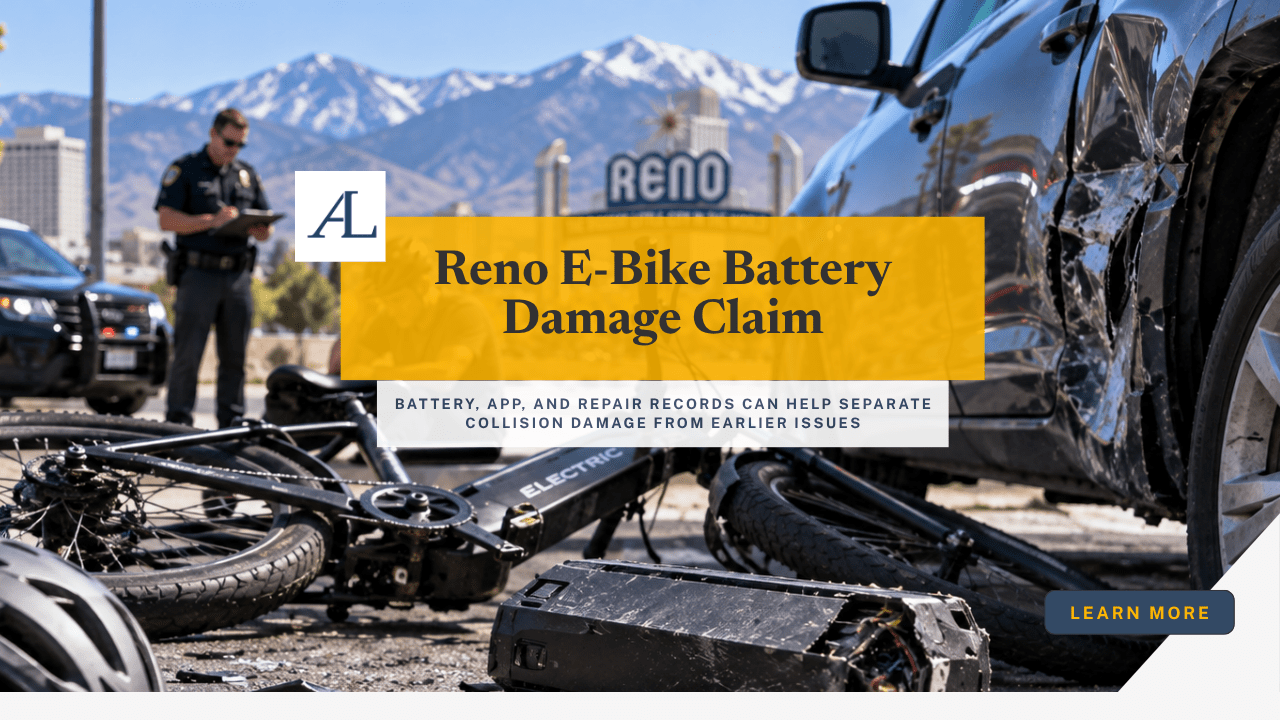
A Reno e-bike battery damage claim can become complicated quickly because a vehicle collision may damage more than the bicycle’s frame, wheels, handlebars, and brakes. The impact may crush the battery housing, bend its mounting rail, pull wiring from the frame, damage the charging port, break the display, or create an internal battery problem that is not immediately visible from the outside. If the e-bike is moved, charged, powered on, repaired, or dismantled before its condition is documented, important evidence may be changed or lost.
The battery can also create a safety concern that does not exist with a traditional bicycle. Lithium-ion batteries can retain energy after a crash, and damaged batteries may present a fire risk. The Environmental Protection Agency advises consumers not to place lithium-ion batteries in household trash or municipal recycling and says that when a lithium-ion battery is damaged, the user should contact the battery or device manufacturer for specific handling instructions. The official EPA Used Lithium-Ion Battery Guidance provides additional information about safe management and disposal.
That creates a tension between safety and evidence preservation. The rider may need the battery preserved for inspection, but no one should handle, charge, open, transport, or store a visibly damaged battery in a way that creates an immediate danger. Safety comes first. If the battery is hot, smoking, burning, or otherwise presenting an emergency, the rider should move away and call 911. The manufacturer, fire department, qualified battery professional, storage facility, or other appropriate expert may need to determine how the equipment can be secured safely.
A Reno e-bike battery damage claim should identify the e-bike’s legal classification and equipment information as well. Nevada law defines an electric bicycle as a two- or three-wheeled bicycle with operable pedals, a seat or saddle, and a motor producing no more than 750 watts. Nevada divides qualifying e-bikes into three classes based on whether the motor assists while pedaling, whether it can propel the bike without pedaling, and whether assistance ends at 20 or 28 miles per hour. The current definitions appear in Nevada Revised Statutes Chapter 484B.
Nevada also requires qualifying e-bikes manufactured or distributed in the state after January 1, 2022, to carry a permanent label listing the classification number, maximum assisted speed, and motor wattage. That label, together with the frame serial number, battery model, charger information, and purchase record, can help establish what equipment was involved before an insurer claims the device had been modified or improperly configured. The labeling requirements appear in NRS 484B.784.
When a vehicle collision leaves an e-bike rider injured and the battery damaged, choosing the right legal representation matters. An experienced Reno bicycle accident attorney at Avrek Law Firm can help preserve the bicycle, battery, charger, app data, vehicle evidence, and repair records before an insurer, shop, manufacturer, or storage facility changes the equipment. Avrek’s Reno bicycle accident practice represents riders injured because of negligent motorists and handles claims involving medical care, lost income, bicycle damage, and ongoing recovery needs.
Call 866-598-5548, start a live chat, or request a free case review today. There are no upfront legal fees, and you do not pay unless we win.
Documenting a Reno E-Bike Battery Damage Claim
A Reno e-bike battery damage claim should begin with a complete record of the bicycle and battery before anyone attempts a repair. The rider should not assume that photographing a bent wheel or scraped frame is enough. The electrical system may contain separate evidence showing how the vehicle contacted the bike, whether the battery moved inside its mount, and which components stopped functioning after the crash.
The condition should be documented from several distances and angles. Wide photographs can show the entire bicycle, the vehicle, the roadway, and the final resting positions. Medium-range photographs can show the battery’s relationship to the frame and impact area. Close-up photographs can preserve cracks, scratches, bent mounts, exposed wiring, damaged connectors, warning lights, and labels.
The rider should also document who first moved the bicycle, where it was taken, whether the battery was removed, and whether anyone attempted to turn the system on. A towing company, police officer, family member, bicycle shop, insurer, or vehicle driver may have handled the equipment before the rider saw it again. That handling history can matter if the battery later appears more damaged or if parts are missing.
Battery Housing, Mounting Points, Wiring, Controls, and Display Damage
The battery housing should be photographed on every visible side without dismantling it. A Reno e-bike battery damage claim may involve dents, punctures, abrasions, cracks, separation between housing panels, broken locks, bent rails, or damage around the charging port. Even when the battery remains attached, the mount may have shifted or partially released during impact.
Mounting points deserve special attention because they connect the battery to the frame. A vehicle may strike the side of the bicycle and bend the downtube, battery cradle, rack, rail, or locking mechanism. A battery that appears intact after being removed may have been subjected to significant force while attached to a distorted frame.
The rider should not remove a damaged battery simply to obtain better photographs unless the manufacturer, fire department, or qualified professional determines that removal can be performed safely. Evidence preservation does not justify exposing anyone to an avoidable battery hazard.
Wiring should be documented where it enters and leaves the battery, motor, controller, display, lights, and sensors. Torn insulation, disconnected plugs, crushed cables, pinched wiring, or bent terminals may help show how the collision affected the electrical system. The location of damage may also correspond with the motor vehicle’s contact point.
The controls and display may contain important information. Photographs should preserve the screen, odometer, remaining charge, assist level, error message, warning icon, and any unusual reading before the system loses power. The rider should not repeatedly power the bike on to recreate an error. If the display already shows a message, one safe photograph may preserve information that later disappears.
The throttle, brake cutoffs, cadence sensor, torque sensor, speed sensor, and motor controller may also need inspection depending on the model. Those components should not be replaced or discarded before their connection to the collision is considered.
Serial Numbers, Model Information, and Pre-Crash Condition
The bicycle’s frame serial number and manufacturer label should be photographed clearly. The battery may have its own serial number, model number, voltage, capacity, production date, warning label, certification information, and barcode. The motor, display, controller, and charger may have separate identifying information.
A Reno e-bike battery damage claim should connect those identifiers to the purchase and ownership records. The rider should preserve the original receipt, online order, financing records, warranty registration, owner’s manual, shipping documents, assembly record, and any photographs taken when the bike was new.
Nevada’s classification and labeling laws make the manufacturer’s label particularly useful. A photograph of the label can show whether the bike was identified as Class 1, 2, or 3, along with the listed assisted speed and wattage. That can help answer questions about whether the bike met Nevada’s statutory definition or whether the insurer is incorrectly characterizing it as a moped or motorcycle.
Pre-crash condition should be documented with more than the rider’s memory whenever possible. Earlier photographs, ride videos, maintenance invoices, app history, battery-health screens, charging records, and repair-shop notes may show that the e-bike operated normally before the vehicle impact.
The rider should preserve information about replacement components. If the original battery, motor, charger, controller, or display had previously been replaced, the claim should identify who supplied and installed the component. Hiding an earlier repair can create a credibility problem, while a complete service history may show that the replacement was properly performed and functioning before the collision.
Modifications should also be documented accurately. Nevada law limits certain modifications that change an electric bicycle’s speed capability unless the label is replaced with accurate classification information. A modified bike does not automatically eliminate a rider’s claim against a negligent driver, but the equipment history may become part of the insurer’s investigation.
Photos Before the Bike or Battery Is Moved, Altered, or Repaired
Scene photographs may become some of the strongest evidence in a Reno e-bike battery damage claim. The rider, witness, or family member should photograph the bicycle’s final position, the battery’s position, the motor vehicle, debris, roadway marks, lane or bike-lane markings, curb, driveway, traffic signals, and any detached components when it is safe.
The photographs should show whether the battery remained attached, came loose, slid across the roadway, or was trapped under the vehicle. A battery resting away from the bicycle may have been ejected during impact, moved by a responder, or detached later. The person taking the photos should avoid making assumptions and simply preserve the condition.
If the scene has already been cleared, the next-best record may come from police photographs, witness phones, dashcams, business surveillance, towing records, or repair-shop intake photographs. The rider should identify those sources immediately because footage and intake records may not be kept indefinitely.
At the bicycle shop, the rider should request a full photographic intake before disassembly. The shop should photograph the frame, fork, wheels, battery, mount, motor, wiring, controller, display, brakes, and accessories. Written notes should identify what the technician observed before removing parts.
The bicycle and battery should not be repaired merely because an insurer issued an early estimate. Repairs can change frame geometry, erase contact marks, clear error codes, disconnect damaged wiring, or replace components that later become central to the claim.
Digital and Maintenance Records in a Reno E-Bike Battery Damage Claim
A Reno e-bike battery damage claim may involve more digital evidence than a traditional bicycle collision. Many e-bikes connect to a phone application, record mileage, store assist settings, display error codes, or communicate with a manufacturer account. Cycling apps and phones may separately preserve GPS routes, speed, elevation, trip timing, and crash-related information.
The rider should preserve original records before reinstalling an app, resetting the display, updating firmware, or pairing the bike with a new phone. A screenshot is helpful, but it may not contain all the information stored in the account or device.
The claim should also preserve ordinary maintenance and charging records. The insurer may argue that battery failure resulted from an earlier defect, incompatible charger, improper storage, or poor maintenance. The rider may need records showing what equipment was used, how the bike was serviced, and whether any warnings occurred before the crash.
App Data, Motor-Assist Settings, GPS History, and Error Messages
Manufacturer apps may show battery charge, estimated range, firmware version, total mileage, trip history, assist settings, battery health, diagnostic messages, and connected devices. The available information depends on the brand and model.
A Reno e-bike battery damage claim should preserve screenshots and downloadable records before the app is updated or the bike is removed from the account. The rider should also note the phone model, app version, username, and date the information was accessed.
Motor-assist settings may become relevant if the insurer alleges that the rider was traveling too fast or using the bike in a manner inconsistent with its classification. The current setting does not necessarily show the setting at the time of the collision, so the claim should avoid overstating what one screenshot proves.
GPS history can help establish the rider’s route, direction, location, and timing. A cycling app may show the rider approaching an intersection or driveway at a particular speed. Phone-location data may provide additional context. These records should be preserved in their original form when possible rather than relying only on a manually recreated map.
Error messages can be especially important after battery impact. The display or app may show a communication fault, voltage problem, controller error, temperature warning, motor fault, or battery-management message. The rider should photograph the exact message and avoid clearing it.
A shop may perform a diagnostic scan or connect the bike to manufacturer software. The complete diagnostic report should be requested, not just the technician’s summary. The report should identify the bike, battery, date, software, and person performing the scan.
Purchase, Charging, Inspection, and Repair Records
The original purchase record can establish the e-bike’s model, price, included battery, charger, warranty, and seller. If the bike was purchased used, the rider should preserve the listing, messages with the seller, bill of sale, payment record, and any description of its condition.
Charging records may include smart-plug logs, charger receipts, manufacturer app history, support communications, or ordinary photographs showing the original charger. The CPSC advises e-bike and micromobility users to use the supplied or manufacturer-approved charger, remain present while charging, follow the manufacturer’s instructions, and avoid charging while sleeping. The official CPSC Micromobility Battery Charging Safety page provides current battery-charging guidance.
An insurer may ask whether the rider used a so-called universal charger. The CPSC has warned that a charger may physically fit a battery but still be electrically incompatible, creating a potential fire hazard. If the original charger was used, the rider should preserve it and photograph its model and label. If a replacement charger was used, the rider should preserve the purchase record and any manufacturer confirmation that it was compatible.
Maintenance records can include brake adjustments, tire work, software updates, battery inspections, motor service, wiring repairs, display replacement, frame checks, and general tune-ups. A Reno e-bike battery damage claim should identify whether a shop inspected the bike before the collision and whether the shop documented any battery concern.
The absence of earlier battery complaints may help establish that the system appeared to function normally before impact. Earlier battery concerns may still be relevant, but they should be evaluated honestly. The legal issue may be whether the collision created new damage, aggravated an earlier issue, or made a previously manageable problem unsafe.
Repair records should include photographs, estimates, work orders, technician notes, removed-part lists, diagnostic reports, and final invoices. A repair shop should not dispose of the damaged battery, mount, controller, display, or wiring before preservation and inspection questions are addressed.
Communications With the Manufacturer, Retailer, or Repair Shop
The rider may contact the manufacturer immediately after the crash to ask whether the battery is safe. Those communications should be preserved in full. A manufacturer may request photographs, serial numbers, app logs, charger information, or shipment of the battery.
A Reno e-bike battery damage claim can be affected if the rider sends the only battery to the manufacturer without documenting its condition, establishing handling procedures, or clarifying whether it will be returned. The manufacturer’s safety instructions should be followed, but the evidentiary consequences should also be considered.
Retailer communications may show the product’s condition before the crash, previous warranty work, replacement parts, or advice about safe storage. A shop may also state that it cannot accept a damaged lithium-ion battery because of fire risk. That refusal should be preserved because it can explain why the rider could not obtain an ordinary repair estimate.
Manufacturers and retailers may maintain product-safety notices or recall information. The CPSC has issued warnings and recalls involving several e-bike batteries because of fire, burn, ignition, or explosion hazards. Those product-specific actions do not prove that a different battery was defective, but they show why model and serial-number identification is important.
The rider should also preserve any communication stating that the battery must be disposed of. Safety may require disposal, but the process should be documented. Before evidence is destroyed, the parties may need photographs, a qualified inspection, an agreement regarding disposal, or another preservation method that does not create an unsafe condition.
Separating Collision Damage From Prior Equipment Issues
A Reno e-bike battery damage claim may generate two competing explanations. The rider may believe the vehicle impact damaged the battery and electrical system. The insurer may argue that the battery was already defective, improperly charged, modified, worn out, or unrelated to the crash.
The strongest response is not simply to insist that the battery worked before. The claim should compare pre-crash records, impact evidence, frame damage, battery damage, app data, technician findings, and the timing of the first malfunction.
A battery that stops charging immediately after the collision presents a different timeline from one that continued operating for months. A battery that was struck directly by the vehicle may warrant a different analysis from one mounted on the opposite side of the bicycle. The evidence should explain those differences.
Vehicle Contact Points and Damage to the Bicycle Frame
The vehicle’s contact point should be documented alongside the bicycle’s damage. Paint transfer, scratches, dents, broken trim, tire marks, and vehicle photographs may help identify where the car struck the e-bike.
A Reno e-bike battery damage claim may be stronger when frame deformation corresponds with battery or mounting damage. For example, a side impact to the downtube may bend the battery rail, while a rear impact may damage a rack-mounted battery or wiring routed near the rear wheel.
The bicycle frame should be inspected for cracks, bending, alignment changes, weld damage, fork damage, wheel displacement, and other structural concerns. Repairing or straightening the frame before inspection can eliminate evidence of the force and direction of impact.
Damage outside the battery also matters. Broken handlebars, wheels, pedals, cranks, racks, fenders, brakes, motor housing, lights, and accessories can help reconstruct the collision. A complete inspection avoids treating the battery as an isolated component.
The motor vehicle should be photographed before repair. Even a small scrape, indentation, or rubber mark may correspond with a particular bicycle component. The insurer should not be permitted to rely only on photographs selected to minimize the vehicle damage.
Witnesses, Camera Footage, and the Rider’s Travel Path
Witnesses may establish how the vehicle contacted the e-bike and what happened immediately afterward. A passenger may see the battery detach. A pedestrian may notice the bike being dragged. A nearby cyclist may observe sparks, exposed wiring, or the display shutting off.
Camera footage can provide an even clearer sequence. Helmet cameras, dashcams, business surveillance, traffic cameras, residential systems, and phone video may show the rider’s route, vehicle movement, impact point, and the bicycle’s movement after contact.
A Reno e-bike battery damage claim should preserve route data alongside video. The rider’s GPS history can help establish direction and location, while scene photographs show the roadway configuration.
Avrek’s related article on Newport Beach e-bike tourist traffic accident claims explains why e-bike classification, rider path, vehicle movement, camera footage, and property damage may become disputed after a motor vehicle collision. The Reno article adds the separate need to preserve a damaged lithium-ion battery and its digital records.
Similarly, Avrek’s article on Long Beach e-bike accidents at driveways and parking lots addresses situations in which drivers pull across a rider’s path in areas with overlapping vehicle and bicycle movement. Those same travel-path questions may become important when a Reno driver strikes the battery side of an e-bike.
Independent Inspection Questions Before Parts Are Replaced
An independent inspection may be appropriate when the insurer disputes whether the collision damaged the battery, motor, controller, or frame. The inspection should be conducted by someone qualified to evaluate the relevant equipment and should account for battery safety.
The rider should not personally open the battery pack. Internal examination may create electrical, chemical, or fire hazards and can permanently alter the evidence. Any destructive testing should occur only through an agreed and professionally managed process.
A Reno e-bike battery damage claim should identify who controls the equipment, where it is stored, and who has inspected it. A written handling log can record when the bike was collected, moved, photographed, or transferred.
The insurer may request its own inspection. Reasonable inspection may help move the claim forward, but the rider should understand whether the insurer wants temporary access or permanent possession. The terms should address safety, transportation, storage, photography, testing, notice, removed parts, and return of the equipment.
If the battery must be destroyed for safety reasons, the parties may be able to preserve high-resolution photographs, scans, labels, diagnostic information, technician findings, and representative components first. The appropriate process depends on the condition of the battery and the advice of qualified professionals.
Injury, Property, and Insurance Documentation
A Reno e-bike battery damage claim should not allow the battery dispute to overshadow the injured rider. The rider may suffer fractures, concussion symptoms, head or facial trauma, road rash, shoulder injuries, wrist injuries, knee trauma, back or neck pain, dental injuries, or other conditions after being struck or thrown from the e-bike.
Medical documentation should explain the collision accurately. The rider should tell providers that a motor vehicle struck an electric bicycle, identify the direction of impact, describe the fall, and report whether the bicycle or battery landed on the rider.
The claim should separately document the bicycle and battery losses. E-bikes can include expensive electrical systems, proprietary parts, integrated batteries, displays, motors, racks, lights, locks, and accessories. A photo-only insurer estimate may not capture the cost of manufacturer-compatible replacement parts, diagnostics, shipping, specialized labor, or battery handling.
Medical Records and Symptoms Associated With the Collision
Emergency and follow-up records can help connect the collision to the rider’s injuries. Ambulance notes, emergency-department records, imaging, specialist referrals, therapy, surgery, medications, and work restrictions should be preserved.
The medical history should remain factual. A rider can describe being struck by a vehicle and falling onto the roadway without trying to estimate impact force or diagnose an injury.
Symptoms may evolve. Headaches, dizziness, stiffness, swelling, numbness, or concentration problems may become more noticeable after the initial shock fades. The rider should report new or worsening symptoms promptly to a qualified provider.
A Reno e-bike battery damage claim may also involve burns or smoke exposure if the battery overheated or ignited, although that is not present in every collision. Any such symptoms require immediate medical and emergency attention.
The rider should preserve work notes, wage records, school records, transportation expenses, caregiving logs, and a reasonable record of daily limitations. Medical bills show part of the loss, but not the full effect on mobility, independence, recreation, employment, or family responsibilities.
Bicycle, Battery, Accessory, and Personal Property Replacement Costs
The property claim should identify every damaged item individually. That may include the frame, fork, wheels, tires, brakes, motor, battery, charger, controller, display, wiring, lights, rack, fenders, lock, helmet, clothing, phone, glasses, bag, child seat, cargo accessories, and tools.
A Reno e-bike battery damage claim should preserve the original purchase price but also document the realistic replacement cost. Some models may no longer be available. A proprietary battery may cost substantially more than a generic replacement, and a generic battery may not be safe or compatible.
Repair estimates should state whether the shop can restore the e-bike safely. A shop may determine that the frame, battery, or electrical system cannot be repaired. That conclusion should be supported by photographs and written findings rather than a verbal statement alone.
The rider should save towing, transportation, storage, diagnostic, shipping, hazardous-handling, and inspection expenses. These costs may be necessary simply to determine whether the e-bike can be safely evaluated.
Depreciation and total-loss value may become disputed. The rider should preserve mileage, condition photographs, recent upgrades, maintenance, accessories, and comparable replacement listings.
Insurer Requests to Inspect or Take Possession of the Equipment
An insurer may ask to inspect the bicycle and battery. That request may be reasonable, but the rider should understand exactly what is being requested.
Inspection is different from surrendering possession. A Reno e-bike battery damage claim can be harmed if the insurer takes the only battery, ships it elsewhere, removes components, or destroys it without a documented agreement.
Before transfer, the equipment should be fully photographed and inventoried. Serial numbers, labels, condition, missing parts, packaging, storage method, and current custodian should be documented.
The written agreement should identify who will transport the battery, where it will be stored, what testing is permitted, whether destructive testing is allowed, who may attend, how much notice will be provided, and whether the equipment will be returned.
Safety considerations may make ordinary shipping inappropriate. Lithium-ion batteries are subject to transportation rules, and a damaged battery may require specialized handling. The rider should not package or ship the battery based solely on an adjuster’s informal instruction.
If an insurer refuses to pay without taking permanent possession, legal review may be especially important. The rider should not be forced to choose between immediate property payment and preservation of the evidence needed for the injury or product-related portions of the claim.
What to Do After an E-Bike Battery Is Damaged in a Reno Collision
Medical and fire safety come first. Call 911 after a serious collision or whenever the battery presents an immediate hazard. Keep people away from a smoking, burning, hot, leaking, or otherwise dangerous battery and follow emergency instructions.
Do not charge, power on, open, or test a visibly damaged battery. Contact the manufacturer for handling instructions and explain that the damage resulted from a collision. The EPA advises consumers to contact the battery or device manufacturer when a lithium-ion battery is damaged and not to place lithium-ion batteries in trash or municipal recycling.
Photograph the bicycle, battery, vehicle, roadway, debris, final positions, visible injuries, and every label or serial number when it is safe. Save the app history, route data, error messages, purchase records, charging equipment, maintenance files, and communications.
Identify where the e-bike will be stored. A standard bicycle shop, tow yard, or residence may not be willing or equipped to hold a collision-damaged battery. Obtain written confirmation of the storage location and handling instructions.
Seek medical evaluation and preserve treatment records. Report the collision to the appropriate insurers, but avoid guessing about whether the battery was defective before the crash. That is a technical question that should be answered through evidence and qualified evaluation.
Deadlines for a Reno E-Bike Battery Damage Claim
A Reno e-bike battery damage claim should be investigated immediately because the equipment can be altered, disposed of, or repaired long before a legal filing deadline approaches.
Nevada Revised Statutes Section 11.190 contains limitation periods for Nevada civil actions. For many actions seeking damages for personal injury caused by another person’s wrongful act or neglect, the statute provides a two-year period, subject to exceptions and other applicable rules.
The correct deadline depends on the parties and claims involved. A negligent-driver claim, product claim, claim involving a government entity, or another cause of action may require separate analysis.
The legal deadline should not be confused with the evidence deadline. App data can change. Shops may discard parts. Manufacturers may request disposal. Video can be overwritten. A damaged battery may require urgent safety handling.
Preservation should begin as soon as the rider’s immediate safety and medical needs are addressed.
Frequently Asked Questions About a Reno E-Bike Battery Damage Claim
What Evidence Should Be Preserved After an E-Bike Battery Is Damaged?
A Reno e-bike battery damage claim may require the e-bike, battery, charger, mount, wiring, controller, motor, display, damaged frame parts, helmet, clothing, app data, GPS records, purchase information, maintenance files, repair-shop notes, photographs, video, and insurer communications.
Safety should guide how the battery is stored and inspected.
Should I Charge the Battery to See Whether It Still Works?
No one should charge or test a visibly damaged e-bike battery merely to prove whether it operates. A collision-damaged lithium-ion battery may present a fire risk.
Contact the manufacturer or an appropriately qualified professional for safe handling instructions. Preserve the battery’s existing condition without powering it on when doing so would create unnecessary risk.
Can I Put a Damaged E-Bike Battery in the Trash?
No. The EPA advises consumers not to place lithium-ion batteries in household trash or municipal recycling. Damaged batteries should be handled through appropriate hazardous-waste or battery-management channels after obtaining safe handling instructions. EPA Used Lithium-Ion Battery Guidance provides additional information.
What if the Battery Looks Normal but No Longer Charges?
External appearance does not necessarily establish whether internal damage occurred. Preserve the battery, charger, app data, error messages, and frame condition, then obtain an appropriate inspection.
Do not repeatedly charge or test the battery in an effort to recreate the failure.
Why Do Serial Numbers and Labels Matter?
They can identify the exact bicycle, battery, production information, charger, classification, and product history. Nevada requires qualifying e-bikes to display a permanent label with classification, maximum assisted speed, and motor wattage.
Those records can also help locate purchase, warranty, recall, and service information.
What if the Insurer Says the Battery Was Already Defective?
The claim should compare pre-crash photographs, app data, charging history, repair records, service history, prior complaints, impact evidence, frame damage, and the timing of the first malfunction.
A prior issue does not automatically establish that the vehicle collision caused no additional damage.
Can the Insurer Take the E-Bike and Battery?
An insurer may request an inspection, but permanent possession, shipment, disassembly, or destructive testing should be addressed through a clear written agreement.
The rider should preserve photographs, serial numbers, an inventory, and the chain of custody before transferring anything.
What if the Manufacturer Says the Battery Must Be Disposed Of?
Safety instructions should be taken seriously. Before disposal, document the battery thoroughly and determine whether a safe inspection, shared inspection, diagnostic download, or other preservation method is possible.
No one should preserve evidence in a manner that creates an unreasonable fire risk.
Can I Recover the Cost of the E-Bike and Battery?
Potentially. Property losses may include the bicycle, battery, charger, motor, display, electrical components, accessories, helmet, clothing, phone, storage, diagnostic fees, transportation, and other collision-related expenses.
The amount depends on the equipment, evidence, insurance coverage, repairability, depreciation, and applicable law.
Does Nevada Treat an E-Bike as a Bicycle?
Nevada defines qualifying electric bicycles as pedal-equipped bicycles with motors producing no more than 750 watts and divides them into three classes. The definition excludes mopeds and electric scooters. The current language appears in Nevada Revised Statutes Chapter 484B.
How Long Do I Have to File a Reno E-Bike Accident Claim?
Nevada Revised Statutes Section 11.190 provides a two-year period for many personal injury actions, subject to exceptions and other rules. The correct deadline should be evaluated from the specific facts.
Battery, app, video, and repair evidence should be preserved immediately regardless of the court filing deadline.
Do I Need a Lawyer for an E-Bike Battery Damage Claim?
Legal help may be especially important when the battery creates a safety concern, an insurer disputes whether the crash damaged the electrical system, a manufacturer requests the equipment, or several parties want to inspect or dispose of the same evidence.
A Reno bicycle accident attorney can investigate the driver and collision, while a Reno personal injury lawyer can organize the medical, property, insurance, and evidence-preservation issues.
Call or Contact Avrek Law Firm 24/7 for a Free Consultation and Pay Nothing Unless We Win
A Reno e-bike battery damage claim can become difficult when the battery appears intact but stops functioning, a shop refuses to store it, the insurer blames an earlier equipment issue, or the manufacturer asks for the battery before an independent inspection occurs. These cases may depend on the physical bicycle, battery housing, mounting system, frame damage, app data, error codes, GPS history, charger, purchase records, repair notes, camera footage, medical records, and a carefully documented handling history.
Avrek Law Firm helps injured cyclists and e-bike riders investigate motor vehicle collisions throughout Reno and surrounding Nevada communities. Our team can move quickly to preserve the bicycle and digital evidence, identify the driver and available insurance, coordinate appropriate inspections, document the rider’s injuries, and pursue compensation for medical expenses, lost income, property loss, pain, and future care.
If you or someone you love was injured in a Reno vehicle collision that damaged an e-bike battery or electrical system, Avrek Law Firm is ready to help.
Call 866-598-5548, start a live chat, or complete our online consultation form today for a free, no-obligation case review. There are no upfront legal fees, and you do not pay unless we win.
Serving the Reno Community
Avrek Law Firm represents bicycle and e-bike accident victims throughout Reno, Sparks, and nearby communities. Its Reno bicycle accident page explains that bicycle crashes may involve negligent motorists, roadway conditions, defective bicycle components, weather, and other contributing factors.
Local context matters in a Reno e-bike battery damage claim because e-bike riders may travel through downtown streets, commercial corridors, neighborhood roads, parking areas, multi-use routes, driveways, and intersections where vehicles and bicycles share limited space.
A crash near South Virginia Street, McCarran Boulevard, Plumb Lane, Kietzke Lane, downtown Reno, a parking structure, a shopping area, or a residential driveway may involve business cameras, app route data, witnesses, and different vehicle movements that should be documented quickly.
A Reno bicycle accident attorney can help investigate the vehicle collision and preserve the e-bike, while a Reno personal injury lawyer can document the injury, employment, transportation, property, and insurance consequences.
A Reno e-bike battery damage claim should be handled with urgency and respect for battery safety. The rider should not be forced to choose between safely managing a damaged lithium-ion battery and preserving the evidence needed to prove what the vehicle collision caused.
- 📩 Submit a request through our online form
- 📞 Call 866-598-5548 now to speak with our team
- 💬 Start a live chat for immediate assistance
There are no upfront fees, and you don’t pay unless we win.