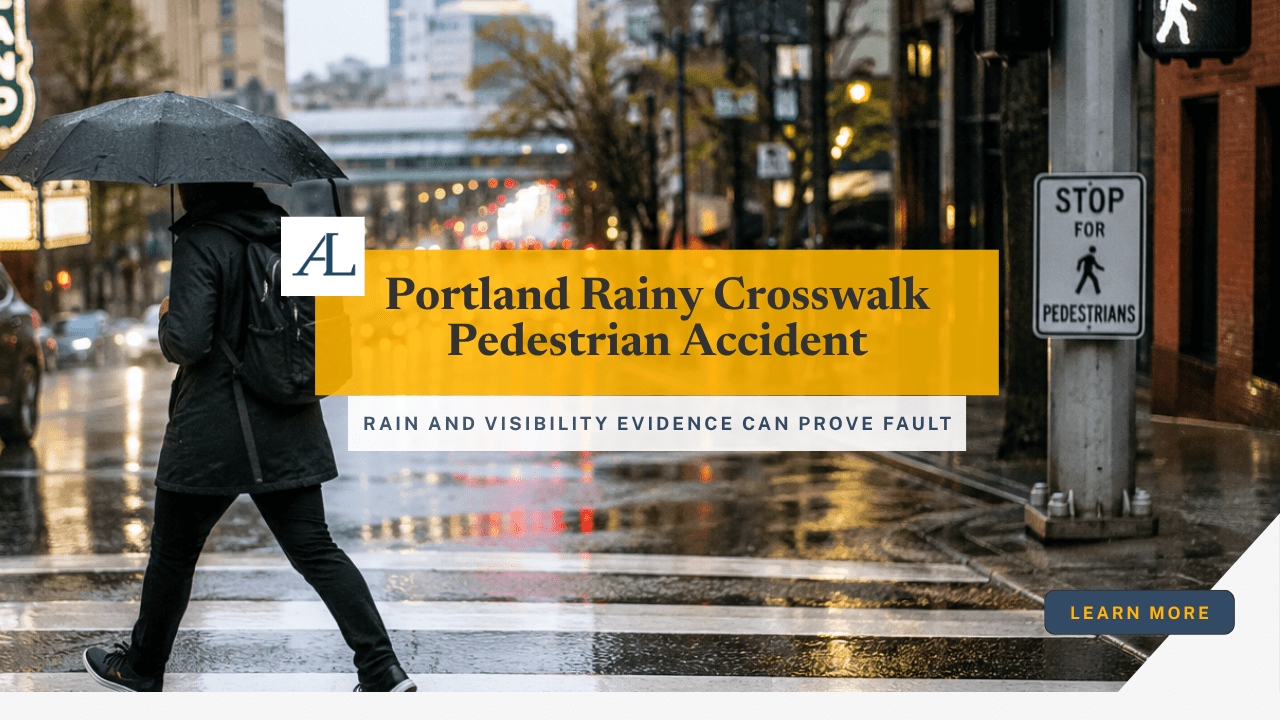
A Portland rainy crosswalk pedestrian accident claim can become complicated because rain changes the way drivers, pedestrians, cyclists, and transit users move through the city. Wet pavement increases stopping distance. Windshield glare can make pedestrians harder to see. Umbrellas, hoods, dark clothing, headlights, streetlights, puddles, and reflected traffic signals can all affect visibility. In a city where rainy conditions are common, drivers still have a duty to adjust their speed, attention, and stopping distance before approaching a crosswalk.
These crashes may happen in Downtown Portland, the Pearl District, Old Town/Chinatown, Northwest Portland, Central Eastside, Lloyd District, South Waterfront, near MAX stations, near bus stops, outside hotels, near restaurants, around schools, and along busy streets such as Burnside, Division, Hawthorne, Broadway, Sandy, Martin Luther King Jr. Boulevard, Grand Avenue, Naito Parkway, and 82nd Avenue. A Portland rainy crosswalk pedestrian accident claim may involve a driver turning right across a crosswalk, rolling through a wet intersection, passing a stopped vehicle, failing to see a pedestrian in low light, or sliding into the crossing because they were driving too fast for conditions.
A pedestrian hit in a rainy crosswalk may suffer fractures, traumatic brain injuries, concussions, back and neck injuries, hip injuries, knee trauma, shoulder injuries, internal injuries, nerve symptoms, and long-term mobility problems. Even a low-speed impact can cause serious harm when a pedestrian is knocked onto wet pavement or pushed into a curb, vehicle, bike lane, or transit area. A Portland rainy crosswalk pedestrian accident claim should document not only the driver’s actions, but also the weather, lighting, crosswalk markings, signal timing, sight lines, nearby cameras, and medical treatment.
When a rainy crosswalk crash leaves you injured, choosing the right legal representation matters. An experienced Portland pedestrian accident lawyer at Avrek Law Firm can investigate the driver, preserve video footage, document rainy roadway conditions, identify all available insurance coverage, and pursue compensation for the full impact of your injuries.
Call 866-598-5548, start a live chat, or request a free case review today. There are no upfront fees, and you do not pay unless we win.
Why a Portland Rainy Crosswalk Pedestrian Accident Claim Is Often Disputed
A Portland rainy crosswalk pedestrian accident claim is often disputed because drivers and insurers may blame the weather instead of the conduct that caused the crash. A driver may say the pedestrian was hard to see, the pavement was slick, the windshield was foggy, or the pedestrian entered the crosswalk suddenly. Those facts may matter, but they do not automatically excuse the driver. In Portland, rain is foreseeable. A careful driver should expect wet streets, reduced visibility, and pedestrians using crosswalks during rainy conditions.
Portland Bureau of Transportation guidance explains that every intersection, and some mid-block crossings, are legal crosswalks under Oregon law. PBOT also notes that crosswalks vary, with some unmarked and others using stop lines, median islands, rapid-flashing beacons, or other safety elements.
That local context is important in a Portland rainy crosswalk pedestrian accident claim because a driver may claim there was no crosswalk simply because painted lines were faded, wet, or absent. In Oregon, the crosswalk analysis may involve both marked and unmarked crossings. The location of sidewalks, curb ramps, shoulders, intersections, traffic signals, and pedestrian signals can all matter.
Rain Does Not Automatically Excuse a Driver
A Portland rainy crosswalk pedestrian accident claim should not accept “it was raining” as a complete defense. Rain may explain why the crash happened, but it can also show why the driver needed to slow down and pay closer attention. Wet roads, dark skies, traffic spray, and glare from headlights are conditions drivers should anticipate in Portland.
Oregon’s basic speed rule states that a person violates the rule if they drive at a speed greater than is reasonable and prudent, considering traffic, roadway surface and width, hazards at intersections, weather, visibility, and other existing conditions.
This rule may become central in a Portland rainy crosswalk pedestrian accident claim. A driver may be traveling below the posted speed limit and still be driving too fast for rain, poor visibility, a busy crosswalk, or a crowded downtown curb zone. The issue is not only how fast the driver was going. The issue is whether that speed was safe for the actual conditions.
Wet Crosswalks Can Hide Important Evidence
A Portland rainy crosswalk pedestrian accident claim can be harder to prove if evidence is not preserved quickly. Rain can wash away skid marks, scatter debris, blur tire impressions, and make it harder to see where the pedestrian fell. A driver may move the vehicle. A bus may leave the stop. Traffic may return to normal. Within minutes, the scene may look very different.
This is why photos and video matter. Scene evidence should show the crosswalk, pedestrian signal, traffic light, curb ramp, wet pavement, puddles, skid marks, vehicle position, streetlights, lane markings, signs, nearby parked vehicles, and any visibility obstructions. A Portland rainy crosswalk pedestrian accident claim becomes stronger when the evidence shows the conditions at the time of the crash, not hours later when the rain has changed or stopped.
Visibility Disputes Require More Than Driver Statements
A driver may claim they could not see the pedestrian until it was too late. In a Portland rainy crosswalk pedestrian accident claim, that statement should be investigated carefully. Was the pedestrian already in the crosswalk? Did the pedestrian have a walk signal? Was the driver turning across the pedestrian’s path? Did another vehicle stop for the pedestrian? Did poor lighting, parked vehicles, bus traffic, or a wet windshield affect the driver’s view?
PBOT’s vision clearance guidance recognizes that vehicles parked on Portland streets can block sightlines and make intersections difficult to navigate, and PBOT supports setting back on-street parking at certain uncontrolled approaches to crosswalks on pedestrian priority streets.
A Portland rainy crosswalk pedestrian accident claim should examine whether the driver’s visibility problem was caused by weather alone or by preventable issues such as blocked sight lines, unsafe speed, poor stopping distance, illegal passing, or failure to scan the crosswalk before turning.
Oregon Crosswalk Laws That May Affect a Portland Rainy Crosswalk Pedestrian Accident Claim
A Portland rainy crosswalk pedestrian accident claim often depends on Oregon pedestrian and driver rules. These laws help determine whether the pedestrian was lawfully crossing, whether the driver had to stop, whether the driver should have remained stopped, and whether either party failed to use reasonable care. The law does not automatically decide every claim, but it provides the framework for evaluating fault.
ORS 801.220 defines “crosswalk” and explains how marked and unmarked crosswalks are identified at intersections and elsewhere. It includes marked crosswalks indicated by lines or other roadway markings and also describes unmarked crosswalks at intersections based on sidewalks, shoulders, roadway edges, and related geometry.
This definition can matter in a Portland rainy crosswalk pedestrian accident claim when an insurer argues that the pedestrian was not in a crosswalk. The absence of bright painted lines does not always mean there was no legal crosswalk. The location of the intersection, sidewalk alignment, curb ramps, and crossing path should be reviewed before accepting the insurer’s argument.
Drivers Must Stop and Remain Stopped for Pedestrians in Crosswalks
A Portland rainy crosswalk pedestrian accident claim may involve a driver who slowed but did not fully stop, stopped too late, or started moving before the pedestrian cleared the danger zone. Oregon law addresses this directly. ORS 811.028 states that a driver commits failure to stop and remain stopped for a pedestrian when the driver does not stop and remain stopped for a pedestrian who is proceeding according to a traffic control device or crossing the roadway in a crosswalk and is located in the driver’s lane, an adjacent lane, the lane into which the driver is turning, or certain nearby turning-lane areas described by the statute.
This law can become one of the most important sources in a Portland rainy crosswalk pedestrian accident claim. If a pedestrian was in the crosswalk and the driver failed to stop, rolled forward, turned too close, or resumed movement too soon, the driver’s conduct should be examined closely. Wet pavement and reduced visibility may make stopping harder, but those conditions also make careful driving more important.
Pedestrian Signals and Traffic Control Devices Matter
A Portland rainy crosswalk pedestrian accident claim may involve a dispute about whether the pedestrian had the walk signal. ORS 814.010 describes appropriate pedestrian responses to traffic control devices, including when a pedestrian may proceed on a walk signal and when a pedestrian may not start crossing on a “Wait,” “Don’t Walk,” or other signal indicating not to proceed.
Signal timing can be critical in a Portland rainy crosswalk pedestrian accident claim. A pedestrian may start crossing on a walk signal and still be in the crosswalk when the signal changes. A driver may see flashing countdown numbers and assume the pedestrian should not be there. A careful investigation should determine when the pedestrian entered the crosswalk, what the pedestrian signal showed, and whether the driver had time to stop.
Pedestrians Also Have Duties, but Drivers Still Must Use Due Care
Insurance companies often argue that the pedestrian caused the crash by entering the roadway too quickly, crossing outside a marked crosswalk, wearing dark clothing, or not looking carefully. Oregon law does recognize pedestrian duties. ORS 814.040 states that a pedestrian commits failure to yield to a vehicle if the pedestrian suddenly leaves a curb or place of safety and moves into the path of a vehicle close enough to create an immediate hazard, or fails to yield when crossing outside a marked crosswalk or unmarked intersection crosswalk.
However, Oregon law also states that nothing in the vehicle code relieves either pedestrians or drivers from the duty to exercise due care.
This balance matters in a Portland rainy crosswalk pedestrian accident claim. A pedestrian’s conduct may be reviewed, but drivers cannot ignore crosswalks, weather, speed, visibility, and pedestrian movement. The insurer’s attempt to blame the pedestrian should be tested against all evidence.
Common Causes of a Portland Rainy Crosswalk Pedestrian Accident Claim
A Portland rainy crosswalk pedestrian accident claim can arise from several different driving behaviors. Some crashes happen because a driver turns across a pedestrian’s path. Others happen because a driver fails to stop before the crosswalk, passes another vehicle stopped for a pedestrian, drives too fast for wet conditions, or cannot see because of glare or fogged windows. Each pattern requires different evidence.
Rain often makes these crashes more severe because it reduces the margin for error. A driver who is distracted for one second may travel farther before braking. A pedestrian may slip while trying to avoid a vehicle. A car may slide after the driver brakes late. A Portland rainy crosswalk pedestrian accident claim should look at the driver’s speed, vehicle condition, tires, windshield visibility, lighting, signal timing, and the pedestrian’s path.
Right-Turn and Left-Turn Crosswalk Crashes
A Portland rainy crosswalk pedestrian accident claim frequently involves a turning driver. A driver turning right may look left for traffic and fail to notice a pedestrian crossing from the right. A driver turning left may focus on oncoming vehicles and miss someone crossing the lane into which the vehicle is turning. Rain can worsen both situations because reflections, wet glass, and low light make scanning harder.
The key question is whether the driver stopped and remained stopped when required, looked in the direction of pedestrian travel, and adjusted to rainy conditions. A driver who says they never saw the pedestrian may still be responsible if the pedestrian was visible and lawfully crossing. Video, witness statements, and signal timing can be especially important in these cases.
Passing a Vehicle Stopped at a Crosswalk
A Portland rainy crosswalk pedestrian accident claim may also involve a driver who passes another vehicle stopped for a pedestrian. This can happen on multi-lane streets when one driver stops at a crosswalk and another driver continues in the adjacent lane. In rain, the stopped vehicle may block the pedestrian from view, but the second driver still needs to recognize the risk.
ORS 811.020 states that a driver commits passing a stopped vehicle at a crosswalk if the driver approaches from the rear another vehicle that is stopped at a marked or unmarked crosswalk at an intersection to permit a pedestrian to cross, and then overtakes and passes the stopped vehicle.
This law can be important in a Portland rainy crosswalk pedestrian accident claim because passing a stopped vehicle at a crosswalk creates a severe pedestrian hazard. The driver may say they did not know why the first vehicle stopped, but that is exactly why extra caution is required.
Poor Visibility, Dark Clothing, and Headlight Glare
A driver may argue that the pedestrian was wearing dark clothing or was hard to see in the rain. A Portland rainy crosswalk pedestrian accident claim should examine that argument carefully. Dark clothing may be relevant, but it does not automatically defeat the claim. Drivers in rainy conditions should use headlights, keep windshields clear, slow down, and scan crosswalks before turning or entering intersections.
Lighting evidence can matter. Was the streetlight working? Were vehicle headlights on? Was there glare from wet pavement? Was the pedestrian signal visible? Was the crosswalk marked or unmarked? Were parked vehicles blocking sight lines? A Portland rainy crosswalk pedestrian accident claim should document the visibility conditions instead of relying on the driver’s statement.
Who May Be Liable in a Portland Rainy Crosswalk Pedestrian Accident Claim?
A Portland rainy crosswalk pedestrian accident claim may involve several responsible parties. The driver who hit the pedestrian is often the first party investigated, but the full claim may also involve a rideshare driver, delivery driver, commercial vehicle operator, employer, vehicle owner, property owner, public entity, or another motorist who contributed to the crash.
Liability depends on who created the danger and who failed to act reasonably. A driver may be liable for failing to stop, driving too fast for rain, turning without checking, or passing a stopped vehicle. A delivery company may be liable if its driver was working. A public entity may need review if poor crosswalk design, failed lighting, broken signals, or unsafe sight lines contributed to the crash. A Portland rainy crosswalk pedestrian accident claim should identify every potential source of responsibility before settlement discussions begin.
The Driver Who Hit the Pedestrian
The driver may be liable if they failed to stop and remain stopped, drove too fast for rainy conditions, turned through the crosswalk, passed a stopped vehicle, drove distracted, failed to use headlights, or entered the intersection without checking for pedestrians. A Portland rainy crosswalk pedestrian accident claim should compare the driver’s version with objective evidence.
Vehicle damage, impact location, dashcam footage, skid marks, traffic signal timing, pedestrian signal timing, and witness statements can all show whether the driver acted reasonably. A driver who claims the pedestrian was invisible may still be responsible if they failed to slow for rain, failed to scan the crosswalk, or drove into a legal crossing area without stopping.
Rideshare, Delivery, and Commercial Drivers
A Portland rainy crosswalk pedestrian accident claim may involve a rideshare driver, delivery driver, taxi, shuttle, freight vehicle, city vehicle, or company car. These drivers may be working under time pressure, using navigation, watching app screens, or stopping near curb zones. Rain can make those distractions more dangerous.
If the driver was working, additional records may matter. App status, delivery logs, GPS data, employer policies, dispatch communications, dashcam footage, and commercial insurance coverage may help establish liability. A personal auto policy may not be the only source of coverage. A Portland rainy crosswalk pedestrian accident claim should determine whether the driver was on duty before accepting a coverage denial or low settlement offer.
Public Entity or Crosswalk Design Issues
A Portland rainy crosswalk pedestrian accident claim may involve a public entity if the crash was connected to unsafe crosswalk design, poor lighting, defective signals, blocked sight lines, missing signage, worn markings, dangerous curb design, or a public vehicle. Public body claims in Oregon can have shorter notice requirements.
ORS 30.275 generally requires notice of claim within 180 days for non-wrongful-death claims against a public body, subject to the statute’s terms.
This deadline can matter in a Portland rainy crosswalk pedestrian accident claim involving city streets, public crosswalks, public signals, public sidewalks, or roadway maintenance. These claims should be reviewed quickly because public notice deadlines may pass long before the ordinary personal injury deadline.
Evidence That Can Strengthen a Portland Rainy Crosswalk Pedestrian Accident Claim
A Portland rainy crosswalk pedestrian accident claim depends on evidence collected quickly. Rainy scenes change fast. Puddles move. Traffic clears. Reflections disappear. The driver leaves. Witnesses leave. Video footage may be overwritten. The pedestrian may be taken to the hospital before they can photograph anything.
The strongest evidence usually shows the crash sequence, the weather, the crosswalk, the driver’s path, and the pedestrian’s position. This may include scene photos, surveillance video, dashcam footage, bus footage, witness statements, police reports, medical records, shoes and clothing, vehicle damage, signal timing, and roadway design evidence. A Portland rainy crosswalk pedestrian accident claim should preserve proof before the insurer can argue that visibility and fault are unclear.
Photos of the Crosswalk, Weather, and Driver View
Photos should show the crosswalk from multiple angles. In a Portland rainy crosswalk pedestrian accident claim, the most useful photos may include the pedestrian’s view, the driver’s view, and a wide view of the entire intersection. Photos should capture wet pavement, crosswalk markings, curb ramps, pedestrian signals, traffic lights, stop lines, lane markings, parked vehicles, bus stops, bike lanes, and nearby lighting.
If the driver says the pedestrian was hard to see, driver-view photos are especially important. They can show whether the driver had a clear line of sight, whether parked vehicles blocked the crossing, whether streetlights were working, and whether the pedestrian should have been visible before impact. Wet pavement reflections should be documented because they may explain glare and lighting conditions.
Business Cameras, Bus Cameras, Dashcams, and Doorbell Cameras
Video may be one of the strongest forms of evidence in a Portland rainy crosswalk pedestrian accident claim. Nearby businesses, hotels, apartment buildings, restaurants, buses, rideshare vehicles, delivery vehicles, parking garages, and private homes may have cameras facing the crosswalk. Even if the footage does not show the exact moment of impact, it may show the pedestrian signal, vehicle speed, driver turn, stopped traffic, rainfall, or whether the pedestrian was already crossing.
Video should be requested quickly because many systems overwrite footage within days or weeks. A Portland rainy crosswalk pedestrian accident claim should not rely on an insurance company to identify every camera. The injured person’s legal team should investigate nearby footage sources before the evidence disappears.
Medical Records, Clothing, Shoes, and Injury Photos
Medical records are essential in a Portland rainy crosswalk pedestrian accident claim because insurers may argue that the impact was minor or that the injuries were caused by a slip rather than a vehicle. Emergency records, imaging, orthopedic care, neurology visits, physical therapy, prescriptions, surgery notes, and work restrictions can help connect the injuries to the crash.
Shoes and clothing should also be preserved. Wet shoes, damaged clothing, torn bags, broken glasses, or damaged phones can help show how the pedestrian fell or was struck. Photos of bruising, swelling, cuts, and road rash should be taken over time because some injuries become more visible after the first day.
Insurance Defenses in a Portland Rainy Crosswalk Pedestrian Accident Claim
A Portland rainy crosswalk pedestrian accident claim may face aggressive insurance defenses. The insurer may blame the pedestrian for crossing too late, wearing dark clothing, walking outside the crosswalk, looking at a phone, moving too quickly, or failing to make eye contact with the driver. The insurer may blame rain, glare, or road conditions as if those conditions were unavoidable. These defenses should be challenged with evidence.
Oregon’s comparative fault statute provides that contributory negligence does not bar recovery when the claimant’s fault was not greater than the combined fault of the relevant parties, but damages are reduced in proportion to the claimant’s percentage of fault.
This matters because fault allocation can affect the value of a Portland rainy crosswalk pedestrian accident claim. If the insurer unfairly assigns fault to the pedestrian, the settlement offer may be reduced. Evidence of the driver’s speed, failure to stop, visibility, crosswalk location, traffic signal, and wet road conditions can help push back.
Claims That the Pedestrian “Came Out of Nowhere”
A driver may say the pedestrian suddenly appeared. A Portland rainy crosswalk pedestrian accident claim should test that statement against the evidence. If the pedestrian was already in the crosswalk, had the walk signal, or was crossing at an intersection where pedestrians are expected, the driver’s statement may reflect inattention rather than an unavoidable emergency.
Photos, video, and witness accounts can help show how long the pedestrian was visible before impact. The driver’s lane position, turning path, speed, windshield condition, and lighting should also be reviewed. A driver who fails to see a pedestrian because they were looking for vehicles, watching a phone, or driving too fast for rain may still be responsible.
Claims That Rain Made the Crash Unavoidable
Rain may make driving harder, but a Portland rainy crosswalk pedestrian accident claim should not treat rain as a complete defense. Oregon’s basic speed rule specifically includes weather and visibility among the conditions drivers must consider. If a driver could not stop because the road was wet, that may mean the driver was going too fast or following too closely for the conditions.
A careful claim should ask whether the driver slowed before the crosswalk, whether wipers and lights were working, whether the driver’s tires were safe, whether the vehicle slid, and whether the driver entered the intersection cautiously. Rainy weather is not a surprise in Portland. It is a condition drivers should expect and manage.
What to Do After a Portland Rainy Crosswalk Pedestrian Accident
After a rainy crosswalk crash, medical care comes first. A pedestrian should call 911 or seek emergency treatment if injured. If possible, the pedestrian or a witness should photograph the vehicle, license plate, driver, crosswalk, traffic signal, pedestrian signal, wet pavement, shoes, clothing, visible injuries, and surrounding businesses. Witness names and phone numbers should be saved immediately.
A Portland rainy crosswalk pedestrian accident claim should also include official reports and insurance records. Oregon DMV states that drivers involved in a reportable motor vehicle collision must submit an Oregon Traffic Collision and Insurance Report within 72 hours when injury or death resulted, when damage to the driver’s vehicle is over $2,500, when damage to any vehicle is over $2,500 and any vehicle is towed, or when damage to property other than a vehicle is over $2,500. DMV also states the report is required even if law enforcement files a report.
A pedestrian may not be the driver required to file the DMV report, but a Portland rainy crosswalk pedestrian accident claim should still preserve all crash reports, medical records, insurance communications, photos, witness information, and video sources.
Deadlines After a Portland Rainy Crosswalk Pedestrian Accident Claim
A Portland rainy crosswalk pedestrian accident claim should be reviewed quickly because legal deadlines and evidence deadlines are different. Oregon law generally requires actions for injury to the person or rights of another, not arising on contract and not otherwise specifically listed, to be commenced within two years under ORS 12.110.
Two years may sound like a long time, but rainy crosswalk evidence can disappear almost immediately. Video may be overwritten, witnesses may become hard to locate, vehicle damage may be repaired, and roadway conditions may change. A Portland rainy crosswalk pedestrian accident claim becomes stronger when the scene is documented and evidence is preserved early.
If a public body may be involved, the Oregon Tort Claims Act notice rule may require action much sooner. ORS 30.275 generally requires notice of claim within 180 days for non-wrongful-death claims against a public body, subject to the statute’s terms. A Portland rainy crosswalk pedestrian accident claim involving public road design, public signals, public lighting, public sidewalks, or government vehicles should be reviewed quickly.
Frequently Asked Questions About a Portland Rainy Crosswalk Pedestrian Accident Claim
Can rainy conditions affect fault in a Portland crosswalk accident?
Yes. Rainy conditions can affect fault in a Portland rainy crosswalk pedestrian accident claim, but rain does not automatically excuse a driver. Rain may reduce visibility, increase stopping distance, and make the roadway slick, which means drivers should slow down and use extra care near crosswalks. If a driver failed to adjust to wet conditions, the rain may actually support the argument that the driver acted unreasonably.
The claim should examine speed, lighting, windshield visibility, tires, braking, signal timing, and whether the pedestrian was lawfully crossing. The driver’s statement that the pedestrian was hard to see should be compared against the actual scene evidence.
Do drivers have to stop for pedestrians in unmarked crosswalks in Portland?
Yes, Oregon law recognizes marked and unmarked crosswalks. A Portland rainy crosswalk pedestrian accident claim may involve an unmarked crosswalk at an intersection even if painted lines are not visible. PBOT also explains that every intersection and some mid-block crossings are legal crosswalks under Oregon law.
This is important because insurers may argue there was no crosswalk if no painted lines were present. The location should be reviewed carefully. Sidewalk alignment, curb ramps, intersection layout, and Oregon’s crosswalk definition may show that the pedestrian was in a legally protected crossing area.
What if the driver says I stepped out suddenly?
A driver’s claim that you stepped out suddenly does not automatically defeat a Portland rainy crosswalk pedestrian accident claim. The investigation should determine where you were, whether you had the walk signal, whether you were in a marked or unmarked crosswalk, how fast the vehicle was moving, whether the driver stopped, and whether the driver had enough time to see you.
Video footage, witness statements, scene photos, and traffic signal evidence can help prove whether the pedestrian was visible before impact. If the driver was turning, rolling through the intersection, or driving too fast for rainy conditions, the driver may still be responsible.
What evidence should I save after a rainy crosswalk crash?
Important evidence in a Portland rainy crosswalk pedestrian accident claim includes photos of the crosswalk, traffic signal, pedestrian signal, wet pavement, vehicle damage, license plate, injuries, shoes, clothing, nearby signs, streetlights, parked vehicles, and any visibility obstructions. Witness contact information should be saved right away.
Video may be especially important. Nearby businesses, buses, rideshare vehicles, apartment buildings, parking garages, and dashcams may have recorded the crash or the minutes before it. Footage can be overwritten quickly, so preservation requests should be sent as soon as possible.
Can I still recover compensation if I was partly at fault?
Possibly. Oregon comparative fault law may still allow recovery if your fault was not greater than the combined fault of the responsible parties, though compensation may be reduced by your percentage of fault. In a Portland rainy crosswalk pedestrian accident claim, insurers may try to blame the pedestrian for clothing, timing, distraction, or crossing location.
Those arguments should be tested against evidence. If the driver failed to stop, drove too fast for rain, turned without checking, or ignored a pedestrian signal or crosswalk, the driver may still bear significant responsibility.
What if I was hit while crossing with the walk signal?
A Portland rainy crosswalk pedestrian accident claim may be strong if you were crossing with the walk signal and a driver hit you. Oregon law addresses pedestrian responses to traffic control devices and driver duties to stop and remain stopped for pedestrians in qualifying crosswalk situations. The driver’s claim that rain limited visibility should not erase the fact that you were lawfully crossing.
The evidence should show the signal timing, where you were in the crosswalk, and how the driver moved. Witnesses, camera footage, and intersection photos can help prove that the pedestrian had the right to cross.
Can a public entity be responsible for a rainy crosswalk accident?
Possibly. A Portland rainy crosswalk pedestrian accident claim may involve a public body if unsafe crosswalk design, defective signals, poor lighting, blocked sight lines, worn markings, dangerous curb ramps, or public roadway maintenance contributed to the crash. These claims are fact-specific and can involve strict notice requirements.
Oregon public body claims may require notice within 180 days for many non-wrongful-death claims. If public infrastructure may have contributed, the case should be reviewed quickly so evidence and deadlines are protected.
How long do I have to file a Portland rainy crosswalk pedestrian accident claim?
Oregon generally gives two years for many personal injury claims, but a Portland rainy crosswalk pedestrian accident claim should be investigated much sooner. Rainy scene evidence may disappear quickly, video may be overwritten, and witnesses may become difficult to find.
If a public body may be involved, Oregon tort claim notice rules may require notice within 180 days. Early legal review helps protect both evidence and deadlines.
Do I need a lawyer after a rainy crosswalk pedestrian accident?
Yes. A Portland rainy crosswalk pedestrian accident claim can involve disputed crosswalk location, rainy visibility arguments, Oregon pedestrian laws, comparative fault, medical documentation, camera footage, public entity issues, and multiple insurers. These claims can become difficult quickly when the driver says the pedestrian was hard to see.
A Portland pedestrian accident lawyer can preserve evidence, request video, analyze crosswalk laws, investigate driver conduct, document weather and visibility conditions, handle insurers, and pursue compensation for the full impact of the injury. This is especially important when the pedestrian suffered fractures, head injury, surgery, lost wages, long-term pain, or mobility problems.
Call or Contact Avrek Law Firm 24/7 for a Free Consultation and Pay Nothing Unless We Win
A Portland rainy crosswalk pedestrian accident claim can become complicated when the driver blames rain, the insurer claims the pedestrian was not visible, or the crash report does not capture the full crosswalk sequence. These cases often depend on evidence that can disappear quickly, including video footage, witness statements, wet pavement photos, crosswalk markings, signal timing, vehicle damage, and medical documentation.
Avrek Law Firm helps injured pedestrians investigate rainy crosswalk crashes, preserve critical evidence, challenge unfair insurance arguments, and pursue compensation for medical bills, lost income, pain, future care, and long-term recovery needs. Our team understands how insurers defend pedestrian claims and how important it is to prove the full scene, not just the driver’s version.
Speaking with a Portland pedestrian accident lawyer may help you understand whether a driver, rideshare operator, delivery driver, employer, property owner, public entity, or another party may be responsible. These cases may also overlap with issues handled by a Portland personal injury lawyer or Portland car accident lawyer, especially when injuries are serious or multiple parties are involved.
If you or someone you love was injured in a rainy crosswalk accident in Portland, Avrek Law Firm is ready to help.
Call 866-598-5548, start a chat, or complete our online form today for a free, no-obligation consultation. There are no upfront fees, and you do not pay unless we win.
Serving the Portland Community
Avrek Law Firm represents injured pedestrians, cyclists, passengers, drivers, workers, students, commuters, and families throughout Portland and surrounding communities. Local context matters in a Portland rainy crosswalk pedestrian accident claim because the location often shapes the evidence.
A rainy crosswalk crash in Downtown Portland may involve buses, MAX stations, office traffic, and heavy pedestrian movement. A crash in the Pearl District may involve apartment driveways, restaurant traffic, and rideshare pickups. A crash in Southeast Portland may involve neighborhood greenways, bike traffic, and unmarked crossings. A crash near Burnside, Division, Hawthorne, Sandy, Broadway, Naito Parkway, or 82nd Avenue may involve visibility problems, speed issues, and complex crosswalk design.
A Portland rainy crosswalk pedestrian accident claim should be handled with urgency, precision, and attention to the rainy-weather details that insurers often overlook. Avrek Law Firm can meet with injured clients by phone, video, or in person, and our team can assist pedestrians who are unable to travel because of their injuries.
- 📩 Submit a request through our online form
- 📞 Call 866-598-5548 now to speak with our team
- 💬 Start a live chat for immediate assistance
There are no upfront fees, and you don’t pay unless we win.