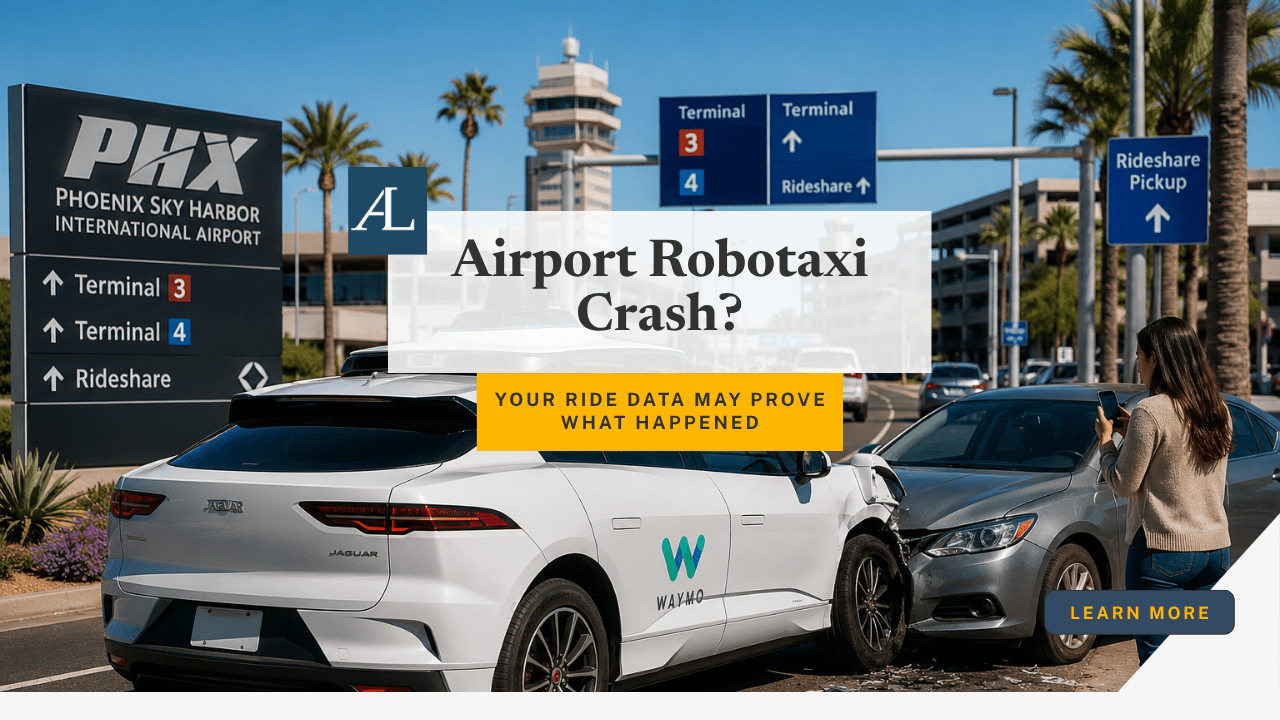
Phoenix Waymo robotaxi airport accident claim cases can be more complicated than ordinary rideshare crashes because there may be no human driver behind the wheel, no driver statement to compare against the passenger’s account, and multiple digital records that may control how the claim is evaluated. A passenger may be injured during an airport pickup, curbside drop-off, sudden stop, collision with another vehicle, door incident, luggage-loading issue, or crash involving a driverless vehicle near Phoenix Sky Harbor.
Phoenix is one of the most established markets for autonomous rideshare service. Waymo’s Phoenix page says anyone in Metro Phoenix can take an autonomous ride through the Waymo app, and its local territory includes Downtown Phoenix, Scottsdale, and parts of Tempe, Mesa, and Chandler. Waymo also describes its Phoenix ride service as using all-electric Jaguar I-PACE vehicles with no human behind the steering wheel.
Airport rides add another layer of complexity. Phoenix Sky Harbor’s rideshare page lists Waymo among mobile-app rideshare options and states that Waymo curbside pickup and drop-off service to Terminal 3 and Terminal 4 curbs is offered at each terminal’s rideshare location 24 hours a day, seven days a week.
When an autonomous airport ride leaves you injured, choosing the right legal representation matters. An experienced Phoenix rideshare accident lawyer at Avrek Law Firm can investigate trip data, preserve app records, identify insurance coverage, and pursue compensation when a driverless ride, another motorist, or an unsafe pickup location contributes to the injury.
Call 866-598-5548, start a chat, or request a free case review today. There are no upfront fees, and you don’t pay unless we win.
Why a Phoenix Waymo Robotaxi Airport Accident Claim Is Different From a Regular Rideshare Crash
A Phoenix Waymo robotaxi airport accident claim is different because traditional rideshare evidence may not be enough. In a typical Uber or Lyft crash, the case often begins with driver conduct, driver app status, insurance period, and whether the rideshare driver made a careless decision. In a Waymo robotaxi case, the investigation may turn on autonomous vehicle data, trip records, pickup and drop-off instructions, passenger support logs, airport curbside rules, and whether another road user caused or contributed to the crash.
A passenger may not know what the vehicle detected, how it responded, whether the incident was internally reported, or what camera and sensor data exists. That information may be controlled by companies, public agencies, insurers, or property operators—not the injured rider.
There May Be No Human Driver Statement
In a standard crash, each driver usually explains what happened. A driver may say they braked, changed lanes, looked left, or failed to see another vehicle. In a robotaxi crash, there may be no human driver available to describe the sequence.
That makes digital evidence more important. A Phoenix Waymo robotaxi airport accident claim may require app screenshots, trip receipts, route information, passenger support messages, vehicle identification, location details, medical records, airport camera footage, and witness statements.
The lack of a human driver does not mean there is no evidence. It means the evidence may be technical and must be preserved quickly.
Airport Pickup and Drop-Off Areas Create Unique Risks
Airport pickup areas are busy by design. Travelers are loading luggage, checking phones, looking for vehicles, watching traffic, and moving between curbs, doors, rideshare zones, and terminal entrances. Other drivers may be stopping suddenly, pulling around stopped cars, entering rideshare lanes, or changing lanes to reach the correct curb.
A Phoenix Waymo robotaxi airport accident claim may involve questions about where the passenger was picked up or dropped off, whether the vehicle stopped in the correct location, whether another driver struck the robotaxi, whether the rider was entering or exiting, and whether luggage or door movement contributed to the injury.
Curbside claims are often disputed because several parties may share the same crowded space. The robotaxi company may point to another driver. Another driver may point to the robotaxi. An insurer may argue the passenger stepped out carelessly. The full evidence must be reviewed before fault is accepted.
Trip Data Can Be Just as Important as Scene Photos
Scene photos matter, but trip data may be just as important in a robotaxi case. A passenger should preserve the ride receipt, pickup location, drop-off location, vehicle ID, trip time, route map, support messages, screenshots, and any incident report filed through the app.
A Phoenix Waymo robotaxi airport accident claim may depend on whether the ride had started, whether the passenger was entering or exiting, where the vehicle stopped, whether the app directed the passenger to a specific rideshare location, and whether the trip record confirms the vehicle’s route.
If the app view changes later, screenshots taken immediately after the incident may become valuable evidence.
What Evidence Riders Should Preserve After a Phoenix Airport Robotaxi Incident
A Phoenix Waymo robotaxi airport accident claim can be strengthened or weakened in the first hours after the incident. Passengers may be rushing to catch a flight, collect luggage, meet family, or leave the airport. That urgency can make it easy to forget evidence that may be difficult to recover later.
App Screenshots, Trip Receipts, and Support Messages
Passengers should save screenshots of the ride request, vehicle information, route, pickup point, drop-off point, fare receipt, ride time, cancellation notice if one appears, and any support or safety messages from the app. If the incident is reported through the app, save confirmation numbers, chat transcripts, emails, and claim references.
In a Phoenix Waymo robotaxi airport accident claim, these records may help prove whether the passenger was actively using the service, where the vehicle was located, and what the company knew after the incident.
Do not assume the app company will preserve everything in the way that helps your claim. Save your own copies.
Photos of the Airport Pickup Area and Vehicle Position
If it is safe, photograph the vehicle, license plate or identifying details, damage, luggage area, passenger door, curb markings, terminal signs, rideshare lane, traffic flow, crosswalks, and nearby cameras. Wide photos help show the full pickup environment. Close photos help document vehicle damage, trip details, injuries, and personal items.
A Phoenix Waymo robotaxi airport accident claim may involve a dispute over whether the vehicle stopped in the correct pickup location or whether another driver caused the impact. Photos of the surrounding airport area can help explain the crash context.
If you are too injured to take photos, ask someone you trust to help if possible.
Witnesses, Airport Staff, and Nearby Camera Sources
Witnesses may include other travelers, rideshare drivers, airport workers, shuttle drivers, family members, security staff, pedestrians, or passengers in nearby vehicles. Their statements may help explain what happened before the injury.
Airport areas may also have cameras. Footage may come from terminal cameras, rideshare-area cameras, dashcams, shuttle vehicles, nearby taxis, buses, or other rideshare vehicles. A Phoenix Waymo robotaxi airport accident claim may require fast preservation requests because video can be overwritten or difficult to obtain later.
A witness who saw the vehicle stop, a passenger fall, another car hit the robotaxi, or the door open into traffic may become critical if insurers later dispute fault.
Who May Be Responsible After a Phoenix Waymo Robotaxi Airport Accident?
A Phoenix Waymo robotaxi airport accident claim may involve several possible responsible parties. The facts determine whether the claim focuses on the autonomous vehicle operator, another driver, airport pickup conditions, vehicle maintenance, or multiple insurance policies.
The Robotaxi Operator or Related Corporate Entities
If the vehicle’s operation, stop location, route behavior, braking, door function, passenger instructions, or incident response contributed to the injury, the robotaxi operator and related entities may need to be investigated.
This does not mean every robotaxi injury is automatically the company’s fault. It means the company may control critical evidence. A Phoenix Waymo robotaxi airport accident claim may require trip logs, vehicle data, support communications, incident records, safety reports, and maintenance information.
Without early preservation, the injured passenger may have only their memory while the company controls the technical record.
Another Driver at the Airport
Another driver may cause or contribute to the crash. Airport rideshare zones often involve private cars, taxis, buses, shuttle vans, delivery vehicles, rental car traffic, and drivers unfamiliar with the airport layout. Another driver may rear-end the robotaxi, sideswipe it, turn across it, strike an open door, or hit a passenger walking toward the vehicle.
In that situation, the other driver’s insurance may be part of the claim. However, the robotaxi trip data may still matter because it can help show where the vehicle was, whether the ride was active, and how the crash sequence unfolded.
Airport, Curbside, or Property Conditions
Some injuries may involve pickup-location conditions rather than a moving collision. A passenger may be hurt because of confusing pickup directions, uneven walking surfaces, blocked curb access, poor lighting, crowded loading zones, or vehicle positioning that forces passengers into traffic.
A Phoenix Waymo robotaxi airport accident claim may require reviewing whether the airport pickup area, rideshare zone, signage, or curbside traffic pattern contributed to the injury. Claims involving public entities or airport-related operations can involve special notice requirements and shorter deadlines.
Arizona law generally gives two years for personal injury actions under A.R.S. § 12-542, but claims against a public entity or public employee may require a notice of claim within 180 days under A.R.S. § 12-821.01.
Reporting and Autonomous Vehicle Records That May Matter
A Phoenix Waymo robotaxi airport accident claim may involve ordinary injury evidence and autonomous-vehicle reporting issues. These records can help establish what happened, when it was reported, and which parties had notice of the incident.
NHTSA Automated Driving Crash Reporting
The National Highway Traffic Safety Administration says its Standing General Order requires identified manufacturers and operators to report certain crashes involving vehicles equipped with automated driving systems or SAE Level 2 advanced driver assistance systems. NHTSA states that the order is designed to help it obtain timely crash notifications involving ADS and Level 2 ADAS vehicles and respond to crashes that raise safety concerns.
This can matter in a Phoenix Waymo robotaxi airport accident claim because crash reporting, internal incident review, and vehicle data may create records beyond what a passenger can see in the app.
Company Support Records and Claim Communications
Passengers should save every support message, claim number, email, phone log, chat transcript, and written response from the robotaxi company, insurer, airport representative, or other driver’s insurance company.
In a Phoenix Waymo robotaxi airport accident claim, early communications may show when the company was notified, whether the incident was acknowledged, what information was requested, and whether an insurer attempted to narrow the claim before evidence was reviewed.
Do not rely only on phone conversations. Written documentation is easier to preserve and compare later.
Medical Records and Delayed Symptoms
Airport incidents can cause injuries that may not feel serious immediately. A sudden stop, impact, fall, door incident, or curbside collision may cause neck pain, back pain, headaches, dizziness, shoulder injuries, knee injuries, hip injuries, anxiety, or concussion symptoms. Some symptoms may appear after the traveler has left the airport.
A Phoenix Waymo robotaxi airport accident claim should include medical records that connect symptoms to the incident. Emergency care, urgent care, imaging, specialist referrals, prescriptions, physical therapy, and work restrictions may all matter.
Insurers may argue the injury was minor, unrelated, or caused somewhere else during travel. Prompt documentation helps respond to those arguments.
Common Insurance Disputes After a Phoenix Airport Robotaxi Injury
A Phoenix Waymo robotaxi airport accident claim may involve several insurers and several defenses. The robotaxi company may point to another driver. Another driver may blame the robotaxi. An airport-related entity may deny involvement. An insurer may argue the passenger did not preserve enough proof.
Disputes Over What Caused the Injury
Insurance companies may question whether the injury happened during the ride, during airport walking, while loading luggage, during vehicle entry, or from a separate event. This is why timing and location records matter.
Trip screenshots, medical records, witness statements, photos, airport camera footage, and support messages can help connect the injury to the robotaxi incident.
Disputes Over Vehicle and Trip Data
The most important records may be controlled by the robotaxi company. Passengers usually cannot independently download sensor data, internal incident reports, camera footage, routing behavior, or vehicle operation logs.
A Phoenix Waymo robotaxi airport accident claim may require legal action to preserve and request those records. Waiting too long may allow evidence to become harder to locate or easier for insurers to characterize without the passenger’s input.
Early Settlement Pressure Before the Medical Picture Is Clear
A passenger may receive communication before symptoms are fully evaluated. Early settlement offers can be risky because airport and rideshare injuries may involve delayed pain, missed work, therapy needs, or future medical care.
A Phoenix Waymo robotaxi airport accident claim should not be resolved before the full injury picture and the key trip evidence are reviewed. Once a release is signed, the passenger may lose the right to seek additional compensation later.
Frequently Asked Questions About a Phoenix Waymo Robotaxi Airport Accident Claim
Can I file a claim if I was injured during a Waymo airport ride in Phoenix?
Yes. You may have a claim if you were injured during a Waymo airport pickup, drop-off, ride, sudden stop, crash, door incident, or luggage-loading event. A Phoenix Waymo robotaxi airport accident claim should review trip records, airport pickup location, vehicle data, medical documentation, and all possible insurance coverage.
What evidence should I save after a robotaxi airport accident?
Save app screenshots, trip receipts, pickup and drop-off records, support messages, claim numbers, vehicle photos, airport location photos, witness information, medical records, and any insurance communications.
What if another driver hit the Waymo vehicle?
Another driver may be responsible, but the robotaxi trip data can still be important. Vehicle records may help show the robotaxi’s position, route, speed, and movement before the crash. The claim may involve both the other driver’s insurance and robotaxi-related records.
Does airport pickup location matter?
Yes. Airport pickup location can matter if the injury happened while entering or exiting the vehicle, loading luggage, walking through a rideshare zone, or dealing with crowded curbside traffic. Pickup-zone evidence may help prove whether the stop was safe and whether another party contributed to the injury.
Do I need a lawyer for a Phoenix Waymo robotaxi accident claim?
Yes. These claims may involve technical data, airport records, multiple insurance policies, and company-controlled evidence. A Phoenix rideshare accident lawyer can help preserve records, identify responsible parties, and protect you from early insurer pressure.
Call or Contact Avrek Law Firm 24/7 for a Free Consultation and Pay Nothing Unless We Win
A Phoenix Waymo robotaxi airport accident claim can involve app records, autonomous vehicle data, airport pickup rules, medical documentation, third-party drivers, property conditions, and insurance disputes. These cases are not always handled like ordinary rideshare crashes because the most important evidence may be digital and controlled by companies, airport entities, or insurers.
Avrek Law Firm helps injured riders investigate robotaxi and rideshare accident claims, preserve trip records, identify all available coverage, and challenge insurers when they attempt to shift responsibility or minimize injuries.
Speaking with a Phoenix rideshare accident lawyer may help you understand what evidence should be preserved after a driverless airport ride incident. These cases may also overlap with issues handled by a Phoenix personal injury lawyer, especially when injuries are serious, fault is disputed, or multiple companies may be involved.
If you or someone you love was injured during a Waymo airport ride, pickup, or drop-off in Phoenix, Avrek Law Firm is ready to help.
- 📩 Submit a request through our online form
- 📞 Call 866-598-5548 now to speak with our team
- 💬 Start a live chat for immediate assistance
There are no upfront fees, and you don’t pay unless we win.