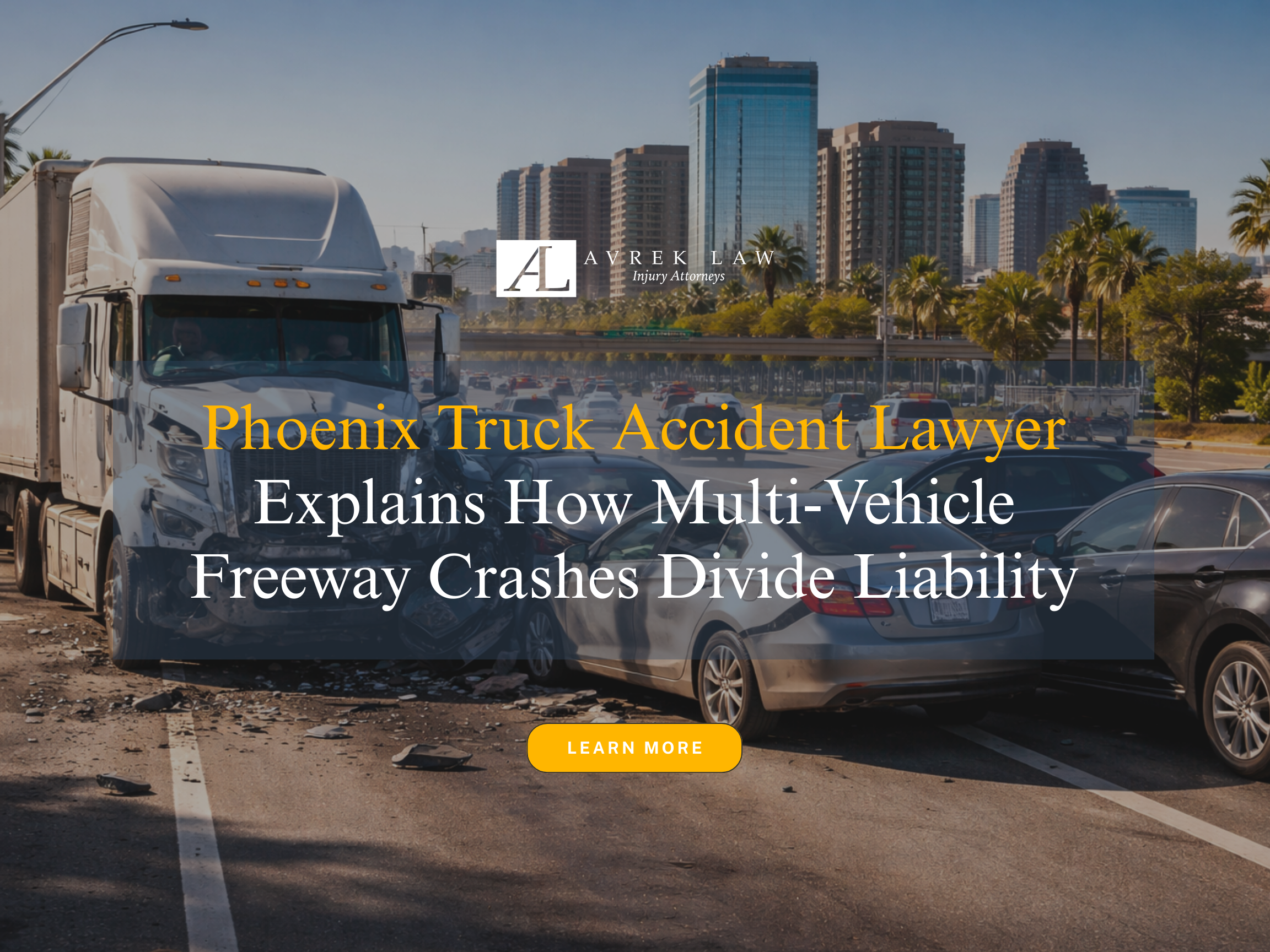
Phoenix freeway corridors such as I-10, I-17, and Loop 101 experience high-speed traffic flow that can quickly turn into chain-reaction collisions when a commercial truck is involved.
A Phoenix truck accident lawyer knows that multi-vehicle crashes rarely result in clear-cut liability. When several cars and a commercial truck collide in succession, fault allocation becomes layered and heavily disputed.
At Avrek Law, we represent truck accident victims across Phoenix and Maricopa County. With more than two billion dollars recovered nationwide, we understand how complex liability distribution can shape the outcome of high-exposure freeway claims.
Call 866-598-5548 today for a free case review. You only pay if we win.
Why Multi-Vehicle Truck Crashes Are Different
In a single-vehicle collision, the chain of events is usually easier to reconstruct.
In multi-vehicle truck crashes, however, questions quickly arise:
Who made initial contact
Which vehicle initiated braking
Whether the truck driver had adequate stopping distance
Whether another vehicle triggered the chain reaction
Whether road conditions contributed
Commercial trucks require significantly more distance to stop than passenger vehicles. In high-speed Phoenix freeway traffic, even seconds matter.
Primary Impact Versus Secondary Collisions
Multi-vehicle crashes often involve a primary impact followed by secondary collisions.
The primary impact is the first contact that begins the chain reaction.
Secondary collisions may involve:
Vehicles striking each other after the initial hit
Cars pushed into adjacent lanes
Vehicles colliding after losing control
Determining which impact caused which injury becomes critical.
A Phoenix truck accident lawyer evaluates crash sequence through:
Accident reconstruction analysis
Vehicle damage mapping
Brake timing
Traffic camera review
Event data recorders
Comparative Fault in Arizona Multi-Vehicle Crashes
Arizona follows a pure comparative fault system. This means that each party may be assigned a percentage of fault based on their contribution to the crash.
In chain-reaction collisions, insurers may argue:
A passenger vehicle initiated sudden braking
The truck driver reacted reasonably
Another driver created unsafe conditions
Weather or debris played a role
Each percentage allocation directly affects recovery.
For general civil procedure guidance, see Arizona Judicial Branch Civil Overview.
Why Commercial Trucks Increase Injury Severity
Due to weight and momentum, 18-wheelers often produce:
Crush injuries
Multiple impact trauma
Spinal injuries
Severe head trauma
Extended hospitalization
Even if the truck was not the initial impact vehicle, its involvement may amplify injury severity.
Frequently Asked Questions About Phoenix Multi-Vehicle Truck Accidents
How is fault determined when several vehicles are involved in a chain-reaction crash?
In multi-vehicle truck crashes, investigators do not rely on a single factor. Fault analysis typically involves reviewing vehicle damage patterns, braking data, skid marks, event data recorders, and eyewitness testimony. In some cases, reconstruction specialists map the crash sequence frame by frame to determine which impact occurred first and how subsequent collisions unfolded. The distinction between the primary impact and secondary collisions can significantly affect which party bears the majority of liability.
If the truck did not hit me first, can I still hold the trucking company responsible?
Yes, potentially. In chain-reaction crashes, a truck’s involvement can amplify the force of secondary impacts. If the truck’s speed, braking delay, or following distance contributed to the overall collision sequence, the trucking company may still bear partial responsibility. Liability is not limited only to the first vehicle that made contact. What matters is whether the truck driver’s conduct played a role in creating or worsening the chain of events.
Why do insurance companies push shared fault in multi-vehicle crashes?
Shared fault reduces payout exposure. When insurers assign percentages across multiple drivers, they lower the financial obligation of each party. In a serious injury case, even a small percentage allocation can significantly reduce recovery. For example, if damages total $500,000 and you are assigned 20 percent fault, your recovery drops by $100,000. This is why fault distribution becomes a central negotiation issue in freeway pileups.
What role does speed play in determining liability?
Speed influences both stopping distance and impact severity. In Phoenix freeway traffic, commercial trucks require significantly more distance to stop than passenger vehicles. If a truck was traveling at a speed that prevented safe braking under traffic conditions, that factor may influence liability. However, speed allegations must be supported by evidence such as event data recorders or reconstruction analysis, not assumptions.
Can multiple trucking companies be involved in a single crash?
Yes. In some situations, more than one commercial carrier may be involved, particularly in freight-heavy corridors. Additionally, a trucking company may operate under layered insurance policies, and separate entities may control the tractor and trailer. Identifying which company controlled the driver, vehicle maintenance, and route scheduling can affect how liability is assigned.
What evidence should be preserved immediately after a truck pileup?
Critical evidence may include:
Traffic camera footage
Dashcam recordings
Electronic logging data
Event data recorder downloads
Maintenance records
Witness contact information
Because some electronic data may be overwritten or lost over time, early legal action can help ensure preservation requests are made promptly.
How long do I have to file a truck accident claim in Arizona?
Under Arizona law, most personal injury claims must be filed within two years from the date of the accident. However, if a government entity is involved, notice requirements may be shorter. Failing to file within the statutory deadline can permanently bar recovery.
Will filing a lawsuit automatically mean going to trial?
Not necessarily. Many truck accident cases resolve before trial. However, filing suit may shift the negotiation dynamic by triggering formal discovery and increasing litigation exposure for defendants. The decision to file should be strategic and based on case-specific factors.
Before Fault Percentages Are Fixed
In Phoenix multi-vehicle truck crashes, insurers often move quickly to assign comparative percentages. Once internal allocations are set, settlement posture becomes harder to adjust.
If you were injured in a freeway truck collision, speaking with a Phoenix truck accident lawyer before negotiations begin can protect your recovery.
Call 866-598-5548 today for a free consultation.