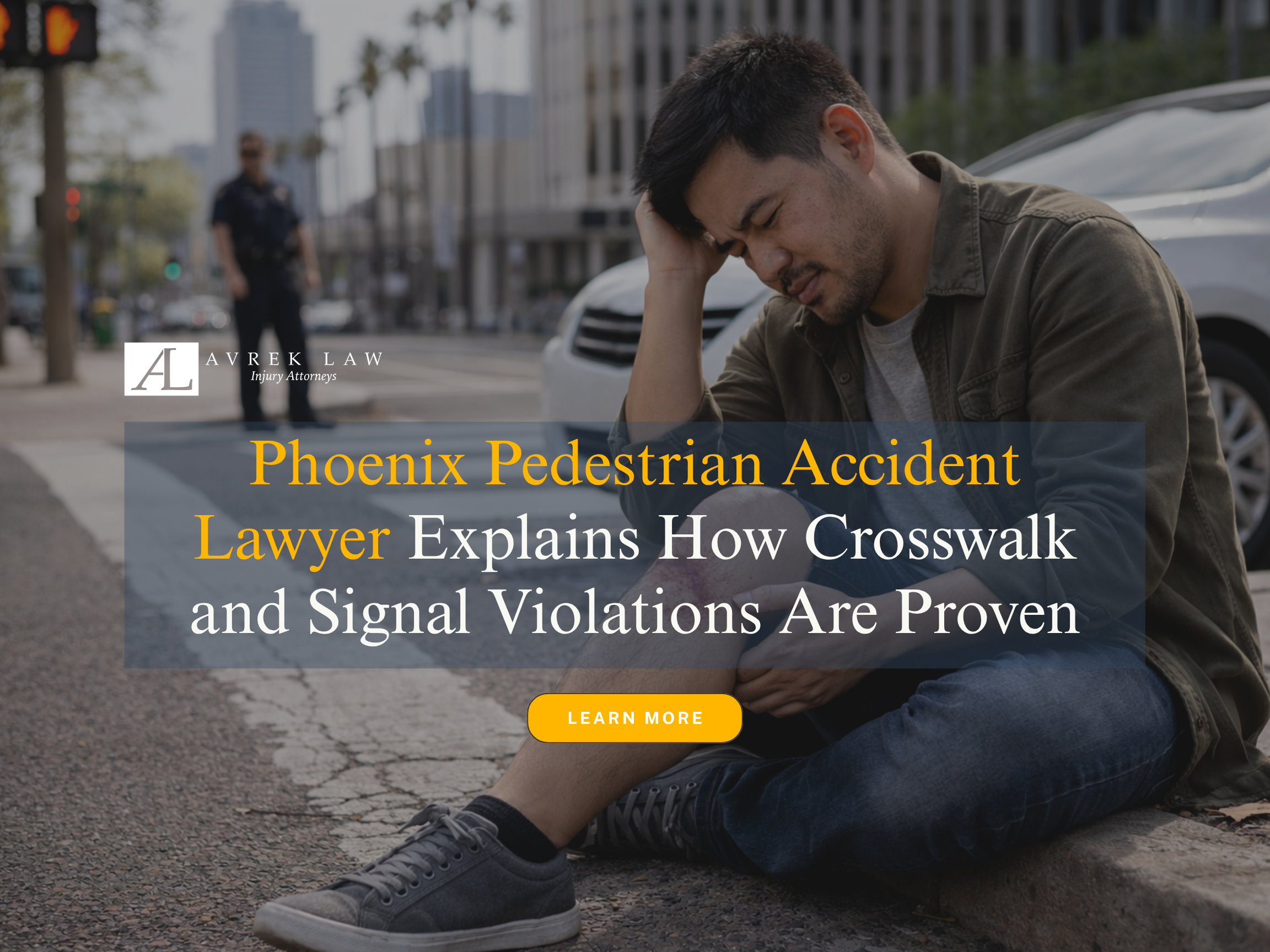
A Phoenix pedestrian accident lawyer knows that crosswalk accidents are rarely as simple as they appear. While many assume the driver is automatically at fault, liability often becomes a dispute over timing, visibility, and right-of-way.
In high-traffic Phoenix areas—downtown corridors, Camelback Road, and intersections near I-10 and Loop 101—pedestrian collisions frequently occur during turning movements, signal transitions, and congested traffic flow.
Insurance companies begin evaluating these cases immediately, often attempting to assign partial fault to the pedestrian before all evidence is reviewed.
At Avrek Law, we represent injured pedestrians throughout Phoenix and Maricopa County. With more than $2 billion recovered nationwide, we understand how crosswalk violations are proven—and how fault is often mischaracterized early in the process.
📞 Call 866-598-5548, start a chat, or request a free case review today. You don’t pay unless we win.
Understanding Pedestrian Right-of-Way in Arizona
Arizona law requires drivers to yield to pedestrians lawfully within a crosswalk. However, the legal question is not just whether a crosswalk exists—it is whether the pedestrian had the right-of-way at the moment of impact.
Key factors include:
- Traffic signal phase timing
- Whether the pedestrian entered lawfully
- Vehicle turning movement (left or right turn)
- Visibility and lighting conditions
For general civil case guidance, see Arizona Judicial Branch – Civil Case Overview: https://www.azcourts.gov/selfservicecenter/Civil-Case
Even when a pedestrian is in a marked crosswalk, insurers may still attempt to dispute liability.
How Crosswalk Violations Are Proven
Proving a pedestrian right-of-way violation requires more than pointing to painted lines on the road.
Evidence may include:
- Traffic signal timing data
- Intersection or surveillance camera footage
- Dashcam recordings
- Witness statements
- Vehicle speed and braking distance
- Impact angle and vehicle positioning
In Phoenix intersections, left-turn collisions are especially common. Drivers often focus on oncoming traffic and fail to check the crosswalk before turning.
A Phoenix pedestrian accident lawyer evaluates whether the driver had sufficient time and visibility to avoid the collision.
Why Insurers Try to Shift Fault to Pedestrians
Insurance companies often attempt to reduce exposure by assigning partial fault to the pedestrian.
Common arguments include:
- The pedestrian entered the roadway too quickly
- The pedestrian was distracted
- The pedestrian crossed outside designated boundaries
- Lighting conditions limited visibility
- The driver had insufficient reaction time
Arizona follows a pure comparative fault system. Even a small percentage of assigned fault can significantly reduce compensation.
The Role of Intersection Design and Visibility
Not all intersections are created equal.
Some Phoenix intersections include:
- Protected turn signals
- Poor lighting conditions
- Wide multi-lane crossings
- Limited pedestrian visibility zones
In some cases, intersection design and traffic flow contribute to the crash.
Evaluating these factors helps determine whether the driver exercised reasonable care.
Why Pedestrian Injuries Require Careful Evaluation
Pedestrians have no physical protection in a collision.
As a result, injuries often include:
- Traumatic brain injuries
- Pelvic and lower extremity fractures
- Spinal injuries
- Internal bleeding
- Long-term disability
Because of severity, these claims often involve long-term medical care and higher compensation—but also increased resistance from insurers.
What Changes When a Lawyer Gets Involved Early
When a Phoenix pedestrian accident lawyer becomes involved early:
- Signal timing and evidence are preserved
- Fault allocation is challenged
- Visibility arguments are analyzed
- Medical documentation is structured properly
- Settlement strategy is built proactively
This prevents insurers from defining liability before the full case is understood.
Frequently Asked Questions – Phoenix Pedestrian Accident Claims
Is a driver automatically at fault in a crosswalk accident?
Not automatically. While drivers must yield to pedestrians lawfully in a crosswalk, liability depends on timing, signal phase, and positioning. Evidence must show that the pedestrian had the right-of-way at the moment of impact.
What if the driver says they didn’t see me?
Failure to see a pedestrian does not eliminate responsibility. Drivers must remain alert and check crosswalks before turning. Visibility arguments must be evaluated against lighting, positioning, and traffic conditions.
Can I recover compensation if I was partially at fault?
Yes. Arizona’s comparative fault system allows recovery even if you share responsibility. However, your compensation will be reduced by your percentage of fault.
How is reaction time evaluated in pedestrian accidents?
Reaction time is analyzed using factors such as vehicle speed, distance, and visibility. However, drivers are expected to adjust their behavior based on traffic conditions and pedestrian presence.
What evidence is most important in crosswalk cases?
Traffic camera footage, signal timing data, witness statements, and vehicle positioning are often critical. Early evidence preservation can significantly impact the case.
How long do I have to file a pedestrian injury claim in Arizona?
Most personal injury claims must be filed within two years. Claims involving government entities may require earlier notice.
Should I speak with the insurance company after a pedestrian accident?
Caution is important. Early statements may be used to assign fault. Speaking with a lawyer first can help protect your claim and ensure accurate representation of the facts.
Before Fault Is Shifted Away From the Driver
In Phoenix pedestrian accident cases, insurers often attempt to assign fault quickly—before all evidence is reviewed. Once those internal decisions are made, changing them becomes more difficult.
If you were injured in a crosswalk or pedestrian accident, speaking with a Phoenix pedestrian accident lawyer early can help ensure liability is evaluated based on evidence—not assumptions.
📞 Call 866-598-5548, start a chat, or request a free case review today. You only pay if we win.