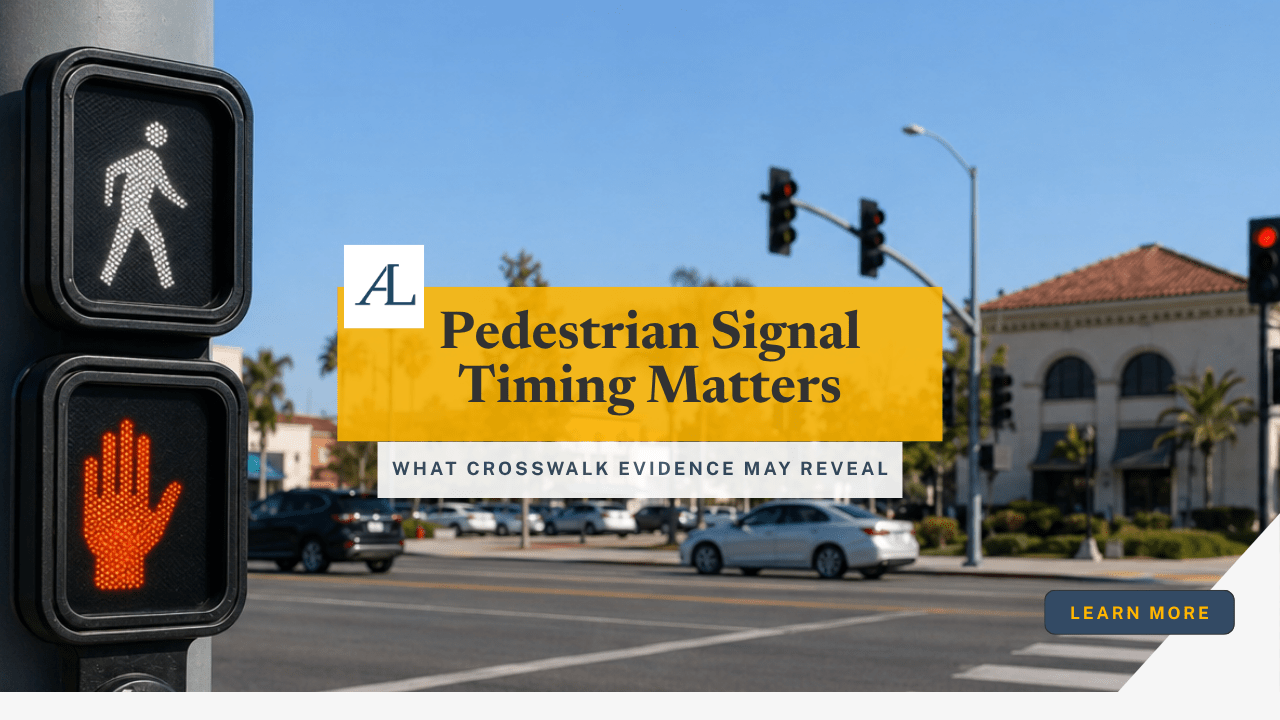
Pedestrian signal timing in Santa Ana can become one of the most important details after a serious intersection accident. When a pedestrian is hit in or near a crosswalk, the question is rarely limited to whether the collision happened. The deeper question is often what the signal showed, how traffic was moving, whether a driver was turning, and whether the crossing sequence gave the pedestrian enough time and visibility to cross safely.
Intersection accidents are often confusing because several things happen at once. A pedestrian may be watching the walk signal. A driver may be watching a green light or turn arrow. Another vehicle may block visibility. The countdown may be flashing. Traffic may be turning through the same space the pedestrian is using. In those cases, pedestrian signal timing in Santa Ana may help clarify whether the crash resulted from driver inattention, a timing dispute, poor visibility, or conflicting accounts of what happened.
Insurance companies often try to simplify pedestrian accident claims quickly. They may argue that the pedestrian entered too late, stepped out unexpectedly, or failed to watch traffic carefully. At the same time, drivers have duties at marked and unmarked crosswalks, especially when pedestrians are already crossing. The timing of the signal can help determine whether those arguments are supported by evidence or simply assumptions made after the crash.
At Avrek Law, we help injured pedestrians and families understand what intersection evidence may matter after a collision. Pedestrian signal timing in Santa Ana may not tell the entire story by itself, but it can become a key part of reconstructing how the accident occurred and whether fault is being evaluated fairly.
Signal Details That May Matter After a Pedestrian Collision
Signal details can affect how an intersection accident is investigated because they help establish what each person may have seen and when they may have had permission to move. In a pedestrian collision, the walk signal, traffic light sequence, turn phase, crosswalk design, and countdown timing may all become relevant. Pedestrian signal timing in Santa Ana can be especially important when a driver and pedestrian describe the same moment differently.
Walk signal, flashing countdown, and solid “don’t walk” phases
The pedestrian signal phase often becomes one of the first issues reviewed after a crosswalk collision. A walk signal generally indicates that a pedestrian may begin crossing in the direction of the signal, while a flashing countdown often means the pedestrian phase is ending and the person should complete the crossing before the solid hand appears. California Vehicle Code § 21456 addresses pedestrian control signals, including walk symbols, flashing countdowns, and steady “don’t walk” signals.
These distinctions can matter after a crash because the legal and factual analysis may change depending on when the pedestrian entered the crosswalk. A pedestrian who began crossing during the walk phase may still be in the roadway when the countdown begins. That does not automatically mean the pedestrian acted improperly. The sequence must be reviewed carefully because the signal may have allowed the person to start crossing before the crash occurred.
Pedestrian signal timing in Santa Ana may also help explain whether the crossing time was reasonable for the location. Some pedestrians move more slowly because of age, disability, injury, children, or mobility limitations. If the timing appears unusually short or the crossing distance is long, the signal data may become relevant to understanding whether the intersection design contributed to the collision.
California Vehicle Code § 21456 explains how pedestrian control signals apply to walk symbols, flashing countdowns, and steady “don’t walk” signals.
Traffic light sequence and turning vehicle movements
Pedestrian crashes often happen when a vehicle turns through a crosswalk while the pedestrian is crossing. A driver may see a green light and assume they have the right to proceed, but that does not necessarily resolve the pedestrian’s right-of-way. The timing of left-turn arrows, permissive turns, protected phases, and pedestrian walk signals can all affect how the accident is evaluated.
Pedestrian signal timing in Santa Ana may help determine whether a driver turned during a phase when pedestrians were expected to be in the crosswalk. This is especially important at busy intersections where drivers focus on gaps in traffic and fail to scan the full crossing path before turning. A collision may occur even though both the pedestrian and driver believed they were following the signal.
The traffic light sequence may also help explain why witnesses disagree. One person may remember that the vehicle had a green light. Another may remember that the pedestrian had a walk signal. Both statements may be true if the intersection allowed turning traffic during the pedestrian crossing phase. That is why signal timing must be evaluated alongside vehicle movement, visibility, and driver attention.
Crosswalk markings, pedestrian islands, and curb ramps
The physical design of the crossing may also affect the investigation. Crosswalk markings help define where pedestrians are expected to walk and where drivers should anticipate foot traffic. Pedestrian islands may divide a longer crossing into multiple stages. Curb ramps may affect where a pedestrian enters the roadway and how visible they are to drivers.
Pedestrian signal timing in Santa Ana should be reviewed in the context of the actual intersection layout. A countdown signal may appear reasonable on paper, but the crossing distance, number of lanes, turning radius, and pedestrian island placement may affect how safely a person can complete the crossing. If a pedestrian was hit near the far side of the road, the investigation may need to examine whether the timing allowed enough opportunity to reach that point safely.
Crosswalk markings can also become relevant when insurance companies argue that the pedestrian was outside the proper crossing path. Photographs, scene measurements, and intersection diagrams may help show whether the pedestrian was within the marked area, near a curb ramp, or crossing at an expected pedestrian location. Those details may become important when fault is disputed.
Visibility and Roadway Factors at the Intersection
Signal timing does not exist in isolation. Even when signals are functioning correctly, visibility and roadway conditions can affect whether a driver sees a pedestrian in time to stop. This is why pedestrian signal timing in Santa Ana should often be evaluated together with lighting, obstructions, lane design, and vehicle approach angles.
Lighting, shadows, glare, and weather conditions
Lighting can make a major difference in pedestrian accident investigations. A collision at dusk, at night, or during early morning glare may create visibility questions that are not obvious from the police report alone. Shadows from buildings, trees, overpasses, or parked vehicles may also affect whether the pedestrian was visible as they entered or moved through the crosswalk.
Pedestrian signal timing in Santa Ana may become more difficult to interpret without understanding these conditions. A pedestrian may have had the signal to cross, but poor lighting or glare may have affected the driver’s ability to see them. That does not automatically excuse the driver, but it helps explain why the investigation must include more than the signal phase alone.
Weather may also play a role. Rain, fog, wet pavement, or windshield glare can reduce visibility and increase stopping distance. If an insurer argues that the pedestrian entered suddenly, the surrounding visibility conditions may help determine whether the driver was traveling at a safe speed for the intersection.
Parked cars, landscaping, signs, and other obstructions
Obstructions near intersections can affect both pedestrians and drivers. Parked vehicles may block a driver’s view of someone waiting at the curb. Landscaping, signs, utility poles, outdoor dining structures, bus stops, or construction barriers may interfere with sightlines. In some cases, a pedestrian may be visible only after stepping beyond an obstruction.
Pedestrian signal timing in Santa Ana may become especially important when visibility is partially blocked. If the pedestrian entered during a walk signal but was hidden from a turning driver by a parked vehicle or sign, the timing evidence must be considered alongside the sightline evidence. A driver may still have a duty to slow, scan, and yield when approaching a crosswalk where pedestrians are expected.
Obstruction evidence can disappear quickly. Parked cars leave. Construction signs move. Landscaping changes. Temporary barriers may be removed. That is why photographs taken soon after the collision can become important when reconstructing what each person could see.
Lane width, turning radius, and vehicle approach angle
Intersection design often affects how pedestrian accidents occur. Wide lanes may increase crossing distance. Large turning radii may allow vehicles to turn faster. Multiple turn lanes can create confusion because one driver may stop for a pedestrian while another driver continues moving. These design factors can influence both driver behavior and pedestrian exposure time.
Pedestrian signal timing in Santa Ana may need to be compared with the width of the roadway and the time required to cross it. A short signal phase at a wide intersection may raise questions about whether the crossing sequence gave pedestrians adequate time. The vehicle’s approach angle may also show whether the driver had a clear view of the pedestrian before impact.
Turning radius matters because drivers making wide or fast turns may enter the crosswalk at a sharper angle than expected. In some cases, the pedestrian is not hit by a vehicle traveling straight ahead, but by a vehicle turning across the pedestrian path. That distinction can change how liability is evaluated.
Evidence Sources That May Help Reconstruct the Crossing
After a pedestrian collision, evidence can disappear quickly. Video footage may be overwritten, witnesses may become difficult to contact, and signal timing data may require formal requests. Pedestrian signal timing in Santa Ana is strongest when it is supported by multiple sources of evidence rather than one person’s memory alone.
Nearby business cameras, residential cameras, and dashcam footage
Video evidence can be extremely valuable after an intersection accident. Nearby businesses, apartment buildings, homes, buses, rideshare vehicles, delivery vehicles, and dashcams may capture the seconds before impact. Even if the camera does not show the collision directly, it may show the pedestrian entering the crosswalk, the signal phase, traffic movement, or the driver’s approach.
Pedestrian signal timing in Santa Ana may be easier to evaluate when video footage shows the countdown or traffic light sequence. In other cases, footage may show pedestrian and vehicle movement clearly enough to estimate the signal phase based on surrounding traffic patterns. This can be especially helpful when witness accounts conflict.
The challenge is that many camera systems automatically overwrite footage within days or weeks. Injured pedestrians and families may not know which businesses or vehicles had cameras nearby. Early investigation often matters because once footage is deleted, it may not be recoverable.
Traffic signal records and timing data to research
Traffic signal records may help establish how the intersection was programmed at the time of the crash. Timing data may show the length of the walk phase, flashing countdown, yellow light, red light, left-turn phase, and traffic cycle. In some cases, records may also show whether the signal was operating normally or whether maintenance issues had been reported.
Pedestrian signal timing in Santa Ana may become central when the parties disagree about whether the pedestrian had enough time to cross safely. If the signal timing data shows a short crossing phase, unusual sequencing, or a conflict between turning traffic and pedestrian movement, those details may affect the investigation.
Signal records may require research through city, county, or traffic engineering sources depending on the intersection. These records are not always simple for injured pedestrians to obtain on their own, but they can become important when fault depends on the exact crossing sequence.
Witness statements and 911 call information to research
Witnesses may provide important context about what happened before and after the collision. Some witnesses may remember whether the pedestrian had a walk signal. Others may remember the vehicle’s speed, turning movement, horn, braking, or whether the driver appeared distracted. A witness may also describe lighting, traffic flow, or the pedestrian’s position in the crosswalk.
Pedestrian signal timing in Santa Ana may be supported or challenged by witness statements, but memory alone can be imperfect. That is why statements should be compared with video footage, signal records, physical evidence, and the police report. The strongest cases often involve several evidence sources pointing in the same direction.
911 call information may also provide useful timing details. Call logs may help establish when the collision occurred and how quickly emergency response began. In some cases, callers describe what they saw in real time, before later insurance narratives develop.
Fault Questions Writers Should Research Under California Law
Fault in pedestrian intersection cases is rarely automatic. California law recognizes driver duties and pedestrian responsibilities, and insurance companies often use that balance to argue comparative fault. Pedestrian signal timing in Santa Ana can help clarify whether fault arguments are based on evidence or assumptions.
Driver duties at marked and unmarked crosswalks
Drivers in California have duties toward pedestrians in marked and unmarked crosswalks. California Vehicle Code § 21950 states that drivers must yield to pedestrians crossing within marked crosswalks or unmarked crosswalks at intersections, and it also requires drivers approaching pedestrians to exercise due care and take action necessary to safeguard pedestrian safety.
This does not mean every pedestrian collision automatically results in full driver liability. The facts still matter. The signal phase, pedestrian position, vehicle movement, speed, visibility, and driver reaction all need to be evaluated.
Pedestrian signal timing in Santa Ana may help determine whether a driver should have anticipated pedestrian movement through the crosswalk. If a driver turned during an active pedestrian phase, the timing may support the argument that the driver failed to yield or failed to scan the crossing path carefully.
Pedestrian duties when entering or crossing the roadway
Pedestrians also have responsibilities when entering or crossing the roadway. California law does not allow a pedestrian to suddenly leave a curb and move into the path of a vehicle that is close enough to create an immediate hazard. Pedestrians also have a general duty to use care for their own safety.
Insurance companies often focus heavily on pedestrian conduct. They may argue that the pedestrian entered too late, crossed too slowly, looked at a phone, or failed to use the crosswalk correctly. These arguments can affect the claim if they are not tested against the evidence.
Pedestrian signal timing in Santa Ana may help evaluate whether those arguments are fair. If the pedestrian entered during an appropriate signal phase and was already established in the crosswalk, the timing evidence may contradict claims that the pedestrian appeared suddenly or crossed unpredictably.
Comparative fault concepts and how they may be evaluated
California uses comparative fault principles, which means more than one party may share responsibility for an accident. In a pedestrian intersection claim, insurers may attempt to assign a percentage of fault to the pedestrian, the driver, or sometimes another party connected to roadway design, signal operation, or visibility conditions.
Pedestrian signal timing in Santa Ana can influence comparative fault analysis because it helps show what each person was expected to do at the time of the collision. If the pedestrian had the walk signal and the driver turned through the crosswalk, the evidence may point one way. If the pedestrian entered against a solid “don’t walk” signal, the analysis may be different. If visibility or signal design created confusion, additional questions may need to be reviewed.
Comparative fault arguments can significantly affect settlement discussions. Even a small percentage assigned to the pedestrian may reduce the value of the claim. That is why signal timing, video evidence, witness statements, and roadway factors should be evaluated early rather than accepted at face value.
Before Signal Timing Gets Overlooked
Pedestrian intersection accidents are often reduced to simple questions too quickly. Insurance companies may ask whether the driver had a green light or whether the pedestrian was in the crosswalk, but those answers may not fully explain what happened. Pedestrian signal timing in Santa Ana can reveal the sequence behind the collision, including when the pedestrian entered, how turning traffic moved, and whether the crossing phase matched the physical evidence.
When serious injuries are involved, details like countdown timing, traffic light sequencing, visibility, camera footage, and witness statements may become critical. These details can disappear or become harder to obtain as time passes. A camera may overwrite footage. A witness may become unreachable. A signal timing record may require a specific request before it is reviewed.
Speaking with a Santa Ana pedestrian accident lawyer may help injured pedestrians and families understand what evidence could matter after an intersection collision. In many cases, these claims also overlap with issues handled by a Santa Ana personal injury lawyer, especially when insurers argue comparative fault or when injuries require long-term medical documentation.
Avrek Law helps injured pedestrians evaluate signal timing, crosswalk evidence, driver conduct, and insurance disputes after serious intersection accidents throughout Santa Ana and Southern California. If you or someone you love was hurt in a pedestrian collision, our team can review what happened and explain what options may exist moving forward.
- 📩 Submit a request through our online form
- 📞 Call 866-598-5548 now to speak with our team
- 💬 Start a live chat for immediate assistance
There are no upfront fees, and you don’t pay unless we win.