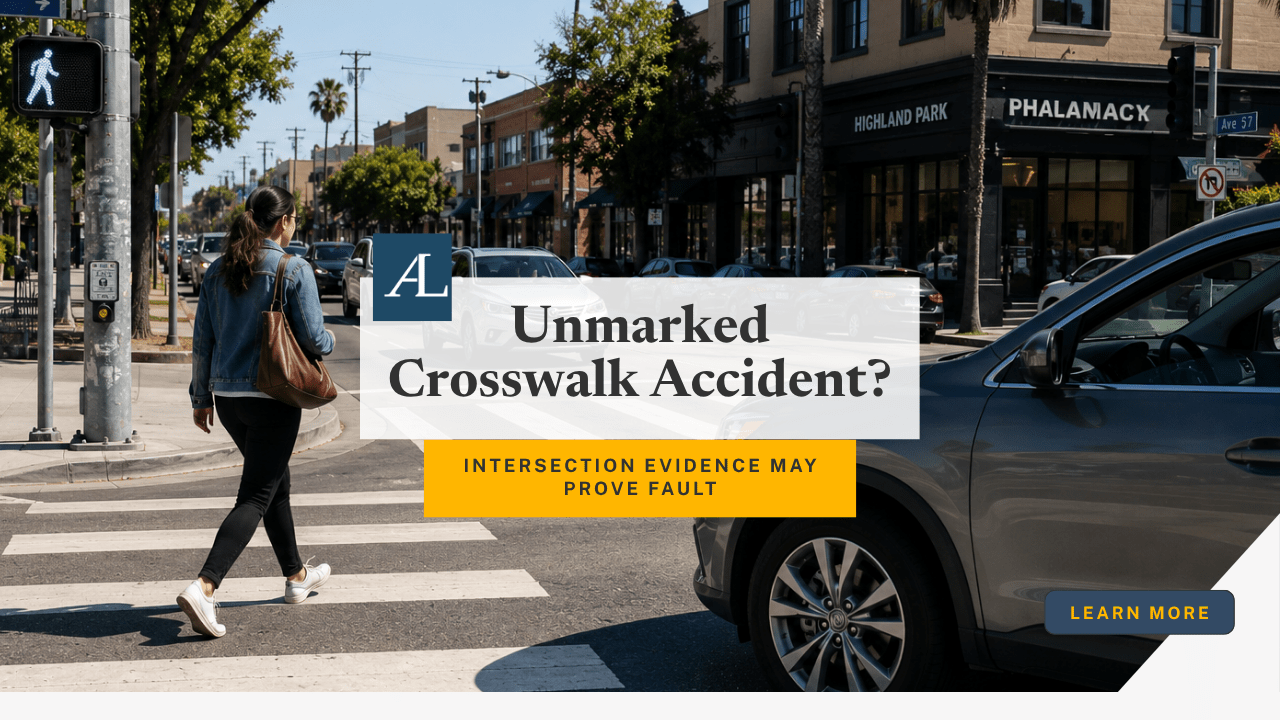
Pasadena pedestrian accident unmarked crosswalk claim cases can become confusing because many people assume a crosswalk only exists when painted lines are visible on the street. In reality, a pedestrian may still be crossing within a legal crosswalk at an intersection even if there are no zebra stripes, ladder markings, or painted lines. That distinction can matter after a crash because insurance companies may try to argue that the pedestrian was “not in a crosswalk” simply because the crosswalk was unmarked.
A pedestrian hit at an unmarked intersection crossing may face serious injuries, medical bills, missed work, and pressure from the driver’s insurance company. The driver may say the pedestrian came out of nowhere. The insurer may claim the pedestrian should have crossed somewhere else. A witness may remember only the impact, not the seconds before it. In a Pasadena pedestrian accident unmarked crosswalk claim, the evidence must show where the pedestrian was, how the intersection was configured, what the driver could see, and whether the driver should have yielded.
These cases are especially important in Pasadena because pedestrians often cross near residential neighborhoods, shopping corridors, school zones, Old Pasadena, parking structures, bus stops, and intersections where marked crosswalks may not appear on every side. A missing painted crosswalk does not automatically mean the pedestrian had no rights. The legal analysis often depends on whether the crossing occurred at an intersection, whether sidewalks or boundary lines extended across the roadway, whether signs prohibited crossing, and whether the driver used reasonable care.
When a pedestrian accident leaves you injured, choosing the right legal representation matters. Avrek Law Firm helps injured pedestrians investigate intersection evidence, preserve camera footage, challenge insurance fault arguments, and pursue compensation after serious pedestrian crashes.
Call 866-598-5548, start a chat, or request a free case review today. There are no upfront fees, and you pay nothing unless we win.
Why a Pasadena Pedestrian Accident Unmarked Crosswalk Claim Can Still Be Valid
A Pasadena pedestrian accident unmarked crosswalk claim can still be valid because California law recognizes both marked and unmarked crosswalks. The absence of painted lines does not automatically remove the driver’s duty to watch for pedestrians or yield when required. A legal crosswalk may exist at an intersection based on the continuation of sidewalk boundary lines across the roadway.
California Vehicle Code Section 275 defines a crosswalk as either the portion of roadway included within the extension of sidewalk boundary lines at certain intersections or any roadway portion marked for pedestrian crossing. The statute also notes that there is no crosswalk where local authorities have placed signs indicating no crossing.
This definition matters because an insurer may focus only on painted markings while ignoring the legal concept of an unmarked crosswalk. A Pasadena pedestrian accident unmarked crosswalk claim should begin by identifying the exact crossing location and determining whether the pedestrian was within an unmarked crosswalk at an intersection.
What an Unmarked Crosswalk Means Under California Law
An unmarked crosswalk generally exists where sidewalks continue across an intersection, even if the city has not painted visible crossing lines. This means a pedestrian crossing from one sidewalk corner to another may be inside a crosswalk even when the pavement does not show painted stripes.
That does not mean every place a pedestrian crosses is an unmarked crosswalk. The location matters. A midblock crossing away from an intersection may raise different issues than crossing at an intersection. A Pasadena pedestrian accident unmarked crosswalk claim should therefore examine the intersection layout, sidewalk alignment, curb ramps, traffic controls, pedestrian signs, and any “no crossing” signs.
The strongest claims often include photos taken from each corner of the intersection. These images can show whether sidewalks connect, where the pedestrian entered the roadway, where the driver approached, and whether the crossing area fits the legal definition of an unmarked crosswalk.
Why Painted Lines Are Not the Only Evidence of a Crosswalk
Painted lines are helpful, but they are not the only evidence of a crosswalk. Sidewalk placement, curb ramps, intersection geometry, signal poles, pedestrian buttons, street design, and traffic patterns may all help show how pedestrians were expected to cross.
In a Pasadena pedestrian accident unmarked crosswalk claim, the insurance company may say the pedestrian was outside a marked crosswalk because no painted lines were visible. That argument should be tested against California’s definition of a crosswalk and the physical design of the intersection.
If a pedestrian crossed directly between sidewalk corners at an intersection, the claim may be different from a pedestrian who crossed diagonally, crossed midblock, or entered from a location where crossing was prohibited. The details matter, and they should be documented before the scene changes.
How Drivers May Misunderstand Their Duty to Yield
Drivers may not understand that they still have duties around unmarked crosswalks. Some drivers only look for painted stripes or flashing pedestrian signals. Others focus on traffic gaps and fail to scan for people crossing at corners. In Pasadena, where pedestrians, cyclists, buses, parked cars, and turning vehicles often share tight intersections, driver attention becomes critical.
California Vehicle Code Section 21950 requires drivers to yield the right-of-way to pedestrians crossing within a marked crosswalk or within an unmarked crosswalk at an intersection. The same section also states that drivers approaching pedestrians in marked or unmarked crosswalks must exercise due care and reduce speed or take other action necessary to safeguard pedestrian safety.
A Pasadena pedestrian accident unmarked crosswalk claim often turns on whether the driver looked carefully, slowed appropriately, and recognized that the pedestrian had a lawful crossing position.
Evidence That Can Help Prove the Driver Should Have Yielded
A Pasadena pedestrian accident unmarked crosswalk claim is strongest when the evidence explains the crossing path, the driver’s approach, and the intersection layout. Because unmarked crosswalks are not always obvious in photographs, the claim may require more detailed evidence than a standard marked-crosswalk case.
Photos of the Intersection, Sidewalk Lines, and Curb Ramps
Photographs should show the entire intersection, not just the impact point. Wide photos can show the sidewalk corners, curb ramps, street width, lane markings, traffic signals, stop signs, lighting, parked vehicles, and the direction each person traveled. Close-up photos can show debris, skid marks, scuff marks, personal items, curb damage, and vehicle contact points.
In a Pasadena pedestrian accident unmarked crosswalk claim, sidewalk alignment can become a key detail. If the pedestrian was crossing from one sidewalk corner to another at an intersection, photos may help show that the crossing area followed the natural continuation of the sidewalk.
Driver-view photos can also help. A photograph taken from the driver’s approach may show whether the pedestrian should have been visible before impact, whether a parked car blocked the view, or whether the driver had enough time to slow down.
Traffic Signals, Stop Signs, and Driver Approach Direction
Traffic controls may shape the liability analysis. If the driver turned right, turned left, rolled through a stop sign, exited a driveway, or approached a pedestrian while looking toward another lane, those facts can matter. The direction of travel may explain why the driver failed to see the pedestrian.
A Pasadena pedestrian accident unmarked crosswalk claim should document whether the driver was turning, whether the pedestrian had a walk signal, whether the intersection had stop signs, whether visibility was affected by lighting or traffic, and whether the driver’s attention appeared focused elsewhere.
Some crashes occur when a driver turns through an unmarked crosswalk while watching oncoming traffic rather than the pedestrian’s path. Others happen when a driver accelerates from a stop and fails to check the crossing area again. The timeline before impact is often just as important as the impact itself.
Witness Statements and Nearby Camera Footage
Witnesses can help explain what happened before the driver hit the pedestrian. A person standing near a storefront, bus stop, parking garage, restaurant, school, or adjacent corner may have seen the pedestrian begin crossing. Another driver may have seen whether the vehicle slowed, stopped, accelerated, or turned without yielding.
Video footage may be even more important. Pasadena businesses, apartment buildings, parking structures, dashcams, security cameras, and doorbell cameras may capture part of the crossing. A camera may not show every detail, but it may confirm the pedestrian’s location, the vehicle’s movement, lighting conditions, or whether the driver failed to slow.
A Pasadena pedestrian accident unmarked crosswalk claim should identify video sources quickly because many systems overwrite footage within days or weeks. Waiting too long may allow the most important evidence to disappear.
Common Insurance Arguments in Unmarked Crosswalk Pedestrian Claims
Insurance companies often challenge pedestrian claims when there are no painted crosswalk lines. A Pasadena pedestrian accident unmarked crosswalk claim may face arguments that the pedestrian crossed improperly, entered unexpectedly, wore dark clothing, failed to look, or was outside the crosswalk.
These arguments should not be accepted without reviewing the law and the evidence. A pedestrian’s conduct may matter, but the driver’s duty to use due care remains important.
Claims That the Pedestrian Was Jaywalking
One of the most common insurer arguments is that the pedestrian was jaywalking. This can be misleading if the pedestrian was actually crossing at an intersection within an unmarked crosswalk. The insurer may use the word “jaywalking” loosely to suggest fault, even when the crossing location deserves closer review.
A Pasadena pedestrian accident unmarked crosswalk claim should focus on the precise crossing point. Was the pedestrian crossing between sidewalk corners? Was the crossing at an intersection? Were there signs prohibiting crossing? Were marked crosswalks available on other sides of the intersection? Did the driver have a stop sign or traffic signal?
The word “jaywalking” should not replace a proper evidence analysis. The correct question is whether the pedestrian was lawfully crossing and whether the driver failed to yield or exercise due care.
Claims That the Driver Could Not See the Pedestrian
Drivers may claim they could not see the pedestrian. Sometimes visibility issues are real. Parked cars, darkness, glare, trees, signs, rain, construction, or traffic may reduce visibility. However, limited visibility may also mean the driver needed to slow down, look more carefully, or proceed with greater caution.
In a Pasadena pedestrian accident unmarked crosswalk claim, the driver’s visibility argument should be compared with photos, video, lighting conditions, street design, witness statements, and the pedestrian’s location. A driver who says they did not see the pedestrian may still be responsible if the pedestrian was visible long enough for a careful driver to react.
The question is not only whether the driver saw the pedestrian. The question is whether the driver should have seen the pedestrian and taken action before impact.
Claims That the Pedestrian Entered the Roadway Suddenly
Insurance companies may argue that the pedestrian suddenly left the curb and gave the driver no time to stop. California law does require pedestrians to use due care and not suddenly enter the path of a vehicle that is close enough to create an immediate hazard. However, that does not eliminate the driver’s duty to use due care for pedestrian safety.
This issue is fact-specific. A Pasadena pedestrian accident unmarked crosswalk claim may require measuring distances, reviewing vehicle speed, locating the point of impact, and comparing witness statements. If the pedestrian was already in the crossing area and the driver failed to slow, the “sudden entry” argument may not match the evidence.
Insurers often raise this defense early because it shifts attention away from driver conduct. A careful investigation can show whether the defense is supported or whether it is simply an attempt to reduce responsibility.
Medical and Daily-Life Documentation After a Pasadena Pedestrian Accident
A Pasadena pedestrian accident unmarked crosswalk claim also depends on documenting the injury itself. Pedestrian crashes can cause serious harm even at low speeds because the body absorbs the impact directly. Medical records, symptom notes, work records, and daily-life documentation help show how the crash affected the injured person.
Emergency Care, Imaging, and Follow-Up Treatment
Pedestrians should seek medical care after being hit by a vehicle, even when pain seems manageable at first. Some injuries are obvious immediately, such as fractures, cuts, head trauma, or severe bruising. Others may develop over time, including neck pain, back pain, headaches, dizziness, hip pain, knee injuries, shoulder pain, or nerve symptoms.
A Pasadena pedestrian accident unmarked crosswalk claim may involve emergency room records, urgent care notes, imaging, orthopedic evaluations, neurological exams, physical therapy, prescriptions, and specialist referrals. These records help connect the crash to the injuries and show how treatment developed.
Insurance companies often look for gaps in care or inconsistent symptom reports. Prompt and consistent medical documentation can help reduce those arguments.
Clothing, Shoes, Bags, and Personal Items as Evidence
Personal items may become physical evidence after a pedestrian crash. Shoes, torn clothing, damaged glasses, broken phones, bags, backpacks, or personal items found in the roadway may help show where the pedestrian was and how the impact occurred.
In a Pasadena pedestrian accident unmarked crosswalk claim, the location of a shoe, phone, or bag may help support the pedestrian’s crossing path. Damage to clothing or personal items may also show the force and direction of the collision.
These items should be photographed and preserved when possible. They may seem unimportant at first, but they can help explain the mechanics of the crash if fault is disputed later.
Missed Work, Mobility Limits, and Pain Journals
Pedestrian injuries can affect work, transportation, childcare, school, errands, exercise, sleep, and daily independence. The injured person may struggle to walk, drive, sit, stand, climb stairs, lift items, or return to normal activities.
A Pasadena pedestrian accident unmarked crosswalk claim should include records of missed work, reduced hours, medical appointments, transportation costs, mobility aids, therapy instructions, and daily limitations. A pain journal can help document symptoms as they change over time.
Daily-life records may not replace medical records, but they can show how the injury affected the person outside the doctor’s office. This can be especially important when insurers try to undervalue pain, mobility limits, and long-term disruption.
What If the Pedestrian Was Not in a Crosswalk?
A Pasadena pedestrian accident unmarked crosswalk claim focuses on crossings that may qualify as unmarked crosswalks. However, some pedestrian accidents happen outside crosswalks. Even then, the analysis is not always over.
California Vehicle Code Section 21954 states that a pedestrian crossing outside a marked or unmarked crosswalk at an intersection must yield to vehicles close enough to create an immediate hazard, but it also says this does not relieve drivers from the duty to exercise due care for pedestrian safety.
This means the driver’s conduct may still matter. If the driver was speeding, distracted, impaired, failed to brake, ignored visible pedestrians, or violated traffic laws, the claim may still require review.
Why Comparative Fault May Become Part of the Claim
California allows fault to be divided between parties. In pedestrian accident cases, insurers may argue that the pedestrian shares responsibility. That may happen when the pedestrian crossed outside a crosswalk, entered suddenly, ignored a signal, or failed to use reasonable care.
A Pasadena pedestrian accident unmarked crosswalk claim may also face comparative fault arguments even when the pedestrian was in an unmarked crosswalk. The insurer may still claim the pedestrian could have avoided the crash. Those arguments should be tested through evidence rather than assumptions.
Fault allocation can affect settlement value, so the pedestrian’s crossing path, the driver’s speed, sight lines, lighting, and available reaction time should be reviewed carefully.
Why Driver Negligence Still Matters Outside a Marked Crosswalk
Drivers do not get permission to ignore pedestrians simply because painted lines are absent. Even outside a marked crosswalk, drivers must still use reasonable care. A driver who is distracted, speeding, turning without looking, or failing to brake may still be responsible for causing or worsening the crash.
In a Pasadena pedestrian accident unmarked crosswalk claim, this is especially important because the insurer may try to frame the case as “no painted crosswalk, no claim.” That is too simplistic. The correct review asks whether the pedestrian was in an unmarked crosswalk and, if not, whether the driver still failed to exercise due care.
The stronger the evidence, the harder it becomes for the insurer to rely on an oversimplified defense.
Frequently Asked Questions About a Pasadena Pedestrian Accident Unmarked Crosswalk Claim
A Pasadena pedestrian accident unmarked crosswalk claim often raises questions because many injured pedestrians do not know that unmarked crosswalks can exist under California law. These answers are designed for people researching what may matter after being hit near an intersection without painted crosswalk lines.
Can a pedestrian still have a claim if there were no painted crosswalk lines?
Yes. A pedestrian may still have a claim if they were crossing within an unmarked crosswalk at an intersection. California law recognizes unmarked crosswalks in certain intersection areas, and drivers may still be required to yield. The exact location, sidewalk alignment, signs, signals, and driver conduct should be reviewed.
What evidence helps prove an unmarked crosswalk existed?
Helpful evidence may include photos of the intersection, sidewalk boundary lines, curb ramps, street layout, traffic controls, signs, witness statements, police diagrams, and video footage. A Pasadena pedestrian accident unmarked crosswalk claim may depend on showing how the pedestrian crossed from one sidewalk area to another at an intersection.
Can the driver blame the pedestrian for crossing outside painted lines?
The driver or insurer may try to blame the pedestrian, but that does not automatically defeat the claim. Painted lines are not the only way a crosswalk can exist. The claim should be evaluated under California’s crosswalk definition, right-of-way rules, and the driver’s duty to use due care.
What should an injured pedestrian do after being hit in an unmarked crosswalk?
The injured pedestrian should seek medical care, report the crash, preserve photos, save damaged clothing or personal items, identify witnesses, request available video footage, and avoid giving detailed recorded statements before the evidence is reviewed. A Pasadena pedestrian accident unmarked crosswalk claim can become harder if scene evidence disappears.
Should I speak with a lawyer if the insurer says I was not in a crosswalk?
Yes. An insurer’s statement is not the final word. A pedestrian may still have rights if the crossing was legally an unmarked crosswalk or if the driver failed to use due care. Speaking with a Pasadena pedestrian accident lawyer may help clarify what evidence should be preserved.
Call or Contact Avrek Law Firm 24/7 for a Free Consultation and Pay Nothing Unless You Win
A Pasadena pedestrian accident unmarked crosswalk claim can become complicated when the insurance company focuses on the absence of painted lines instead of the full legal and factual picture. These claims may depend on intersection layout, sidewalk alignment, driver attention, traffic controls, lighting, camera footage, witness statements, medical records, and daily-life documentation.
Avrek Law Firm helps injured pedestrians investigate disputed crosswalk claims, preserve evidence, and challenge insurance companies when they try to shift blame unfairly. Our team understands how pedestrian injury claims are evaluated and how drivers may misunderstand their duty to yield at unmarked crosswalks.
Speaking with a Pasadena pedestrian accident lawyer may help you understand what evidence should be preserved after an intersection crash. These cases may also overlap with issues handled by a Pasadena personal injury lawyer, especially when injuries are serious, fault is disputed, or an insurer is pushing for an early settlement.
If you or someone you love was injured while crossing at an unmarked intersection in Pasadena, Avrek Law Firm is ready to help.
- 📩 Submit a request through our online form
- 📞 Call 866-598-5548 now to speak with our team
- 💬 Start a live chat for immediate assistance
There are no upfront fees, and you don’t pay unless we win.