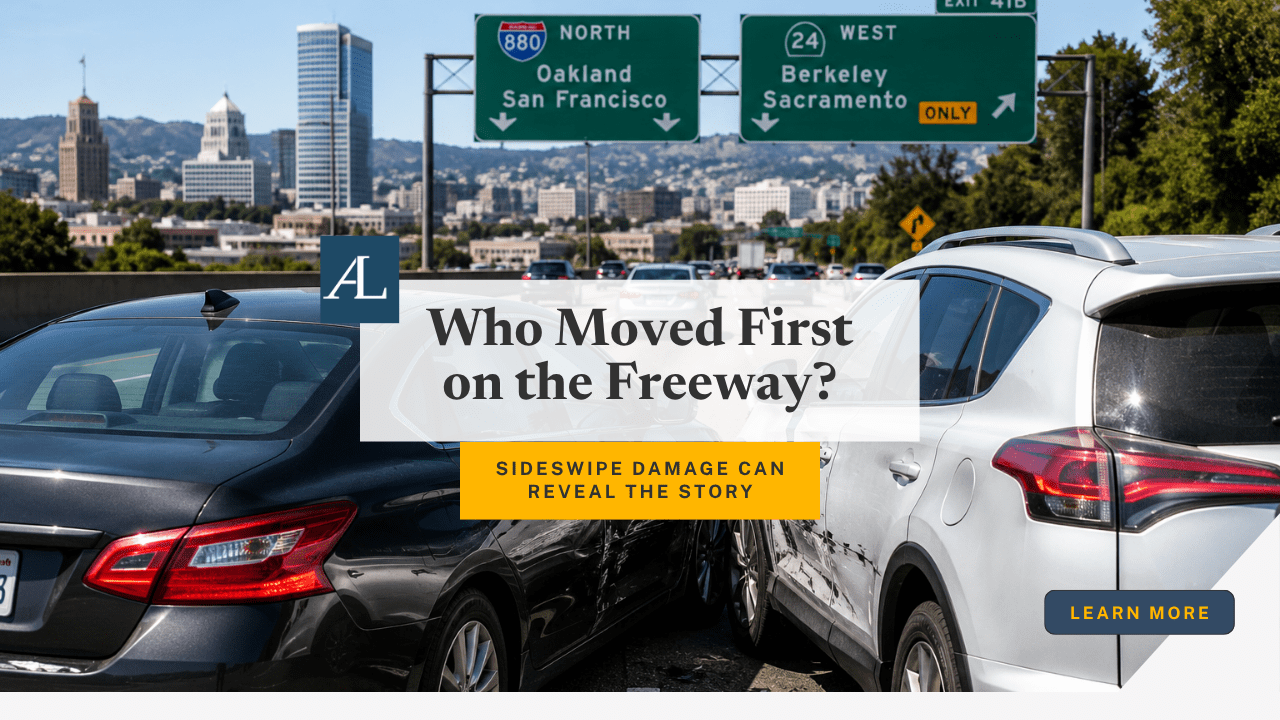
Oakland freeway lane change sideswipe accident claim cases can become difficult because both drivers may leave the crash with completely different stories. One driver may say they were holding their lane when another vehicle drifted into them. The other driver may say they were already established in the lane when the first vehicle sped up, failed to yield, or moved sideways. On busy Oakland freeways, where traffic can shift quickly across I-880, I-580, I-980, I-80, and connector ramps near the Bay Bridge, these disputes can become complicated fast.
A sideswipe collision may look minor at first, especially if both vehicles remain drivable. However, the crash can still cause neck injuries, back pain, shoulder trauma, headaches, soft tissue injuries, anxiety behind the wheel, and missed work. A sudden lane-change impact can also force a vehicle into another lane, barrier, shoulder, or multi-car collision. When the insurance company sees damage along the side of both vehicles, it may try to split fault or argue that the evidence is unclear.
An Oakland freeway lane change sideswipe accident claim should be reviewed through more than driver statements alone. Dashcam footage, lane markings, vehicle damage, paint transfer, mirror damage, debris location, police diagrams, traffic camera footage, witness accounts, phone records, and repair estimates may all help show which vehicle moved first. These details matter because insurance companies often use uncertainty to reduce claim value.
When a freeway sideswipe accident leaves you injured, choosing the right legal representation matters. Avrek Law Firm helps injured drivers and passengers preserve evidence, challenge unfair insurance arguments, and pursue compensation after disputed lane-change crashes.
Call 866-598-5548, start a chat, or request a free case review today. There are no upfront fees, and you pay nothing unless we win.
Why an Oakland Freeway Lane Change Sideswipe Accident Claim Is Often Disputed
An Oakland freeway lane change sideswipe accident claim is often disputed because sideswipe crashes happen quickly and rarely leave one obvious answer. A driver may feel a sudden impact, hear scraping, and react before fully understanding where the other vehicle came from. By the time the cars stop, both drivers may believe the other person caused the collision.
Freeway lane-change crashes are also difficult because the vehicles are usually moving in the same direction. Unlike a rear-end crash or broadside collision, the damage may stretch along doors, mirrors, fenders, or side panels instead of concentrating in one clear impact point. That can give insurers room to argue about who drifted, who merged, and who had control of the lane.
Drivers May Give Conflicting Accounts of Who Changed Lanes
The most common dispute in an Oakland freeway lane change sideswipe accident claim is who actually changed lanes. One driver may insist they were traveling straight. The other may say the first vehicle moved into them without signaling. Both may be confident, and both may be partially wrong because the crash happened in seconds.
Insurance adjusters may ask whether the driver checked mirrors, used a turn signal, saw the other vehicle, noticed blind spots, or had enough space to merge. These questions can affect fault, especially if one driver guesses or gives an incomplete recorded statement before reviewing the evidence.
A strong claim should focus on objective records. Damage location, dashcam footage, lane markings, traffic flow, and witness statements can help determine whether one vehicle crossed the lane line or whether both vehicles moved at nearly the same time. The goal is not to rely on memory alone. The goal is to build a timeline that shows what happened before contact.
Blind Spots, Merging Traffic, and Freeway Connector Lanes Can Complicate the Crash
Oakland freeways include fast-moving traffic, short merges, complex interchanges, truck traffic, rideshare vehicles, delivery vehicles, and commuter congestion. Sideswipe crashes may happen near freeway connectors, onramps, offramps, toll approaches, or lane drops where drivers are trying to position themselves quickly.
Blind spots are a common explanation, but they do not automatically excuse a lane-change crash. A driver changing lanes must make sure the movement can be made safely. If the other vehicle was already in the adjacent lane, the merging driver may still be responsible even if they claim the vehicle was difficult to see.
An Oakland freeway lane change sideswipe accident claim may also involve drivers who merge aggressively to avoid missing an exit, move across multiple lanes, drift while distracted, or fail to account for traffic slowing ahead. These details are important because the insurance company may try to reduce the crash to a simple “he said, she said” dispute when the actual roadway context tells a more complete story.
Why Side-Impact Damage Does Not Always Tell the Whole Story
Side-impact damage can help explain a sideswipe crash, but it rarely tells the whole story by itself. Damage along the front passenger door may mean one thing if the vehicle was merging and another if the other car drifted into the lane. Mirror damage may suggest the first point of contact. Paint transfer may show which vehicle scraped across the other. A dent pattern may show whether one car angled into another or whether the vehicles moved parallel for several seconds.
In an Oakland freeway lane change sideswipe accident claim, photographs should capture all vehicle damage before repairs begin. Repair estimates may also identify hidden damage beneath panels, wheel alignment issues, suspension damage, or damage patterns not obvious in casual photos.
The damage should be compared with the drivers’ accounts. If one driver claims they were fully in the lane before impact but the damage pattern suggests angled movement across a lane line, that contradiction may matter. Physical evidence can help challenge statements that do not match the crash mechanics.
California Lane-Change Rules That May Matter in a Sideswipe Claim
An Oakland freeway lane change sideswipe accident claim often depends on whether a driver moved right or left only when it was reasonably safe. California law addresses both lane movement and staying within a marked lane. These rules may become important when an insurer tries to determine whether a driver made an unsafe lane change or failed to maintain their lane.
California Vehicle Code Section 22107 states that a person must not turn from a direct course or move right or left on a roadway until the movement can be made with reasonable safety, and then only after giving an appropriate signal if another vehicle may be affected. This statute can become central when a sideswipe crash happens during a disputed lane change.
The Duty to Move Only When Reasonably Safe
The phrase “reasonably safe” matters because a driver cannot simply signal and move. A turn signal does not create the right to enter another lane. The driver must first check whether the movement can be made safely.
In an Oakland freeway lane change sideswipe accident claim, this may involve reviewing whether the lane-changing driver had enough space, whether the other vehicle was already close enough to be affected, whether the driver checked mirrors and blind spots, and whether the movement was abrupt or gradual.
A driver may argue that traffic was heavy or that they needed to merge before an exit. That does not eliminate the duty to avoid moving into another vehicle. Freeway urgency is not a defense to unsafe movement.
Staying Within a Marked Lane Until Movement Is Safe
California law also addresses marked lanes. California Vehicle Code Section 21658 states that when a roadway is divided into two or more clearly marked lanes for traffic in one direction, a vehicle must be driven as nearly as practical entirely within one lane and must not move from that lane until the movement can be made with reasonable safety.
This can help in an Oakland freeway lane change sideswipe accident claim where one driver drifted across a lane line without completing a full lane change. Not every sideswipe happens during an intentional merge. Some happen because a distracted driver drifts, a driver looks down at a phone, a truck pushes into another lane, or a vehicle moves within a lane due to speed, fatigue, or inattention.
The evidence should show whether the vehicle crossed lane markings, whether it was straddling lanes, and whether the movement affected another vehicle already traveling lawfully.
Turn Signals Do Not Automatically Make a Lane Change Safe
Drivers sometimes believe they are protected because they used a turn signal. A signal helps warn others, but it does not prove the lane change was safe. In a sideswipe claim, the key question is not only whether the signal was used. The key question is whether the lane was clear and the movement could be made safely.
An Oakland freeway lane change sideswipe accident claim may involve a driver who signaled for a split second before moving, signaled after already entering the lane, or failed to signal at all. Dashcam footage, witness statements, and driver admissions may help clarify this issue.
If a driver signals and immediately moves into a vehicle already beside them, the signal may not help their defense. The duty to avoid unsafe movement remains.
Evidence That Can Help Prove Who Moved First
An Oakland freeway lane change sideswipe accident claim often depends on evidence that shows vehicle movement before impact. Since both drivers may blame each other, objective evidence becomes critical. The strongest evidence may come from video, vehicle damage, witnesses, police diagrams, and records created close to the crash date.
Dashcam Footage From Both Vehicles or Nearby Drivers
Dashcam footage can be extremely helpful in sideswipe cases. A front-facing dashcam may show whether a nearby vehicle drifted, merged, cut across lanes, or failed to signal. A rear-facing camera may show a vehicle approaching from behind or attempting to pass. A nearby driver’s dashcam may capture both vehicles from a more neutral angle.
In an Oakland freeway lane change sideswipe accident claim, footage should be preserved quickly. Some dashcams overwrite automatically. Some drivers may not realize their footage captured the crash until later. If witnesses stop at the scene, injured drivers should ask whether they have dashcams and save contact information.
Video may not show everything, but even partial footage can help. A clip showing lane position, turn signals, traffic speed, or the seconds before contact may be enough to challenge an insurer’s version of fault.
Vehicle Damage, Paint Transfer, and Mirror Impact Evidence
Vehicle damage should be photographed from several angles. Close-up photos can show scratches, dents, paint transfer, broken mirrors, tire marks, wheel damage, and the first visible impact point. Wide photos can show the full vehicle and damage distribution.
An Oakland freeway lane change sideswipe accident claim may turn on whether damage appears along the front side, rear side, door panels, quarter panel, bumper edge, or mirror. If one vehicle has front-side damage and the other has rear-side damage, that may suggest one vehicle moved into the other. If both vehicles have long scrape marks, additional analysis may be needed.
Paint transfer can also matter. If the other vehicle’s paint appears on a door or fender, it may help establish contact direction. Repair estimates and body shop notes may provide additional detail.
Police Report Diagrams, Witness Statements, and Lane Markings
A police report may include driver statements, witness information, vehicle positions, a diagram, and the officer’s observations. The report may not be perfect, but it can provide an important starting point.
Witness statements can be especially valuable in an Oakland freeway lane change sideswipe accident claim. Another driver may have seen one vehicle cross a lane line or merge suddenly. A passenger may have seen a turn signal or lack of signal. A rideshare driver or commercial driver may remember the traffic pattern.
Lane markings also matter. Photos of the roadway, lane drops, exit-only lanes, merge areas, and lane-dividing lines can help explain the crash environment. If the crash happened near a connector or merge zone, the roadway layout may help show why one driver’s version is more plausible.
Insurance Tactics After an Oakland Sideswipe Crash
Insurance companies often treat sideswipe claims as disputed-liability cases. An Oakland freeway lane change sideswipe accident claim may be denied, delayed, or undervalued if the insurer believes the evidence is unclear. Adjusters may push for shared fault, argue that both vehicles moved at once, or claim that side damage does not prove liability.
Attempts to Split Fault Between Both Drivers
A common insurance tactic is to split fault. The insurer may argue that both drivers were changing lanes, both failed to maintain lane position, or both should have reacted differently. This can reduce the amount paid to the injured person.
An Oakland freeway lane change sideswipe accident claim should not accept shared fault without evidence. If one driver crossed into another lane, failed to signal, or merged when it was unsafe, that driver may bear responsibility. The claim should be evaluated based on physical evidence, video, witnesses, and lane layout, not simply the insurer’s desire to divide blame.
Fault allocation matters because it can affect settlement value. A small percentage shift may reduce compensation for medical bills, lost income, pain, and future care.
Recorded Statements Before the Evidence Is Reviewed
Adjusters may request recorded statements soon after the crash. They may ask about speed, lane position, turn signals, mirrors, blind spots, braking, and whether the driver saw the other vehicle before impact. These questions may sound routine, but answers can affect liability.
In an Oakland freeway lane change sideswipe accident claim, drivers should avoid guessing about speed, distance, or exact lane position if they are unsure. Freeway crashes happen quickly, and a person may not know what dashcam footage, witness statements, or damage analysis will later show.
A recorded statement given too early may later be compared against evidence the injured person had not yet reviewed. It is better to be accurate and cautious than to fill in gaps with assumptions.
Early Settlement Offers Before Injuries Are Fully Evaluated
Some sideswipe crashes cause delayed symptoms. Neck pain, back pain, headaches, shoulder pain, dizziness, anxiety, and soft tissue injuries may worsen after the first day. A person may feel shaken at the scene and more injured later.
An Oakland freeway lane change sideswipe accident claim should not be settled before the medical picture is clear. Once a release is signed, the injured person may lose the ability to seek additional compensation if symptoms worsen or new treatment is needed.
Early settlement offers may also arrive before fault evidence is fully collected. If dashcam footage, repair estimates, or witness statements later prove the other driver caused the crash, the claim may be worth more than the insurer first suggested.
Medical and Daily-Life Documentation After a Freeway Sideswipe
An Oakland freeway lane change sideswipe accident claim requires both liability evidence and injury documentation. Proving the other driver caused the crash is only part of the claim. The injured person must also show how the crash affected their health, work, and daily life.
Emergency Care, Follow-Up Appointments, and Delayed Symptoms
Medical care should be documented as soon as symptoms appear. Emergency records may show immediate complaints. Follow-up appointments may show whether pain developed or worsened over time. Physical therapy, orthopedic care, pain management, chiropractic treatment, imaging, and specialist referrals may all become relevant depending on the injury.
In an Oakland freeway lane change sideswipe accident claim, delayed symptoms should be explained clearly. If pain began the next morning or became worse after a few days, that timeline should be reported to a medical provider.
Insurance companies often argue that delayed care means the injuries were not related. Consistent medical records help respond to that argument.
Work Restrictions, Missed Wages, and Transportation Problems
A sideswipe crash can create financial consequences even when injuries are not catastrophic. The injured person may miss work, reduce hours, attend medical appointments, lose reliable transportation, or pay for rides while the vehicle is repaired.
An Oakland freeway lane change sideswipe accident claim may include wage records, employer notes, work restriction forms, vehicle repair estimates, rental car receipts, rideshare costs, and appointment calendars. These records help show the practical impact of the crash.
Transportation issues can matter in Oakland because many drivers depend on their cars for commuting across the Bay Area. A damaged vehicle and painful injuries can disrupt work, family responsibilities, and medical care.
Pain Journals and Activity Limitations
A pain journal can help document symptoms between medical visits. The injured person may note pain levels, sleep disruption, headaches, driving anxiety, stiffness, medication use, difficulty sitting, difficulty lifting, and activities they could not complete.
In an Oakland freeway lane change sideswipe accident claim, daily-life documentation can support medical records. A doctor may see the patient for 15 minutes, but the injury affects daily routines for hours or days at a time.
The goal is not to exaggerate. The goal is to preserve an honest record of how the crash changed the person’s life.
Reporting and Preserving Records After a California Freeway Collision
An Oakland freeway lane change sideswipe accident claim may require official reports, insurance records, DMV records, repair documents, and medical files. These records help organize the claim and prevent the insurer from controlling the story.
The California DMV explains that a driver, insurance agent, broker, or legal representative must complete an SR-1 report and send it to the DMV within 10 days if anyone is injured or killed, or if property damage exceeds $1,000. The DMV also states that the SR-1 report is required in addition to any report made to police, CHP, or an insurance company.
Police, CHP, and Freeway Crash Reports
Freeway crashes may involve local police or the California Highway Patrol depending on where the collision occurred. A report may document statements, vehicle locations, citations, witness names, and diagrams. Injured drivers should request a copy when available and review it for errors.
An Oakland freeway lane change sideswipe accident claim may become harder if the report incorrectly describes the lane positions or omits witness information. If the report is incomplete, other evidence may help correct the record.
Repair Estimates and Total Loss Documentation
Repair estimates may identify damage that is not visible in photos. A sideswipe impact can affect doors, mirrors, paint, sensors, alignment, wheels, suspension, and safety systems. If the vehicle is declared a total loss, the valuation documents should be saved.
In an Oakland freeway lne change sideswipe accident claim, repair records may help confirm the direction and extent of impact. They may also show whether the collision was more serious than the insurer first suggested.
Insurance Letters, Claim Numbers, and Adjuster Communications
All insurance communications should be saved. This includes claim numbers, adjuster names, emails, letters, text messages, settlement offers, recorded statement requests, and repair communications.
An Oakland freeway lane change sideswipe accident claim may involve multiple insurers if more than two vehicles were affected, if a commercial vehicle was involved, or if the at-fault driver was uninsured or underinsured. A clear record of communications helps prevent confusion and protects the injured person from repeated or inconsistent requests.
Frequently Asked Questions About an Oakland Freeway Lane Change Sideswipe Accident Claim
An Oakland freeway lane change sideswipe accident claim often raises questions because both drivers may blame each other and the damage may not clearly show who moved first. These answers are designed for people researching what matters after a freeway sideswipe crash in Oakland.
How do you prove who changed lanes first in a sideswipe accident?
You prove who changed lanes first by comparing driver statements with objective evidence. Dashcam footage, witness accounts, police diagrams, lane markings, paint transfer, mirror damage, repair estimates, and vehicle damage patterns may all help show which vehicle moved from its lane. In an Oakland freeway lane change sideswipe accident claim, the strongest evidence is usually gathered early before footage is overwritten and vehicles are repaired.
Does side damage automatically mean both drivers were at fault?
No. Side damage does not automatically mean both drivers were at fault. One driver may have drifted, merged unsafely, failed to signal, or moved into a lane that was already occupied. The damage must be reviewed with the roadway layout, lane position, witness statements, and any available video.
What if the other driver says I was in their blind spot?
A blind spot claim does not automatically excuse the other driver. A driver changing lanes must make sure the movement can be made safely. If the other driver moved into your lane without enough space, their blind spot explanation may not defeat your claim.
Should I give a recorded statement after a freeway sideswipe?
Be careful. Recorded statements can affect liability, especially in disputed lane-change cases. You should avoid guessing about speed, distance, lane position, or fault before reviewing the evidence. An Oakland freeway lane change sideswipe accident claim can be harmed by early statements that later conflict with video or physical evidence.
Can a sideswipe crash cause serious injuries?
Yes. A sideswipe crash can cause serious injuries, especially if the impact forces a vehicle into another lane, barrier, shoulder, or secondary collision. Even lower-speed sideswipes may cause neck pain, back pain, headaches, shoulder injuries, and soft tissue trauma.
Call or Contact Avrek Law Firm 24/7 for a Free Consultation and Pay Nothing Unless You Win
An Oakland freeway lane change sideswipe accident claim can become complicated when both drivers dispute who moved first, the insurance company tries to split fault, or the available evidence is incomplete. These cases may depend on dashcam footage, witness statements, lane markings, vehicle damage, paint transfer, repair estimates, medical records, and careful review of California lane-change rules.
Avrek Law Firm helps injured drivers and passengers investigate freeway sideswipe crashes, preserve critical evidence, and challenge insurance companies when they try to minimize injuries or shift blame unfairly. Our team understands how fast these claims can become disputed and how important early evidence preservation can be.
Speaking with an Oakland car accident lawyer may help you understand what records should be preserved after a lane-change sideswipe crash. These cases may also overlap with issues handled by an Oakland personal injury lawyer, especially when injuries are serious, fault is disputed, or an insurer is pushing for an early settlement.
If you or someone you love was injured in an Oakland freeway sideswipe accident, Avrek Law Firm is ready to help.laims after fatal motor vehicle accidents. We can review the available records, help identify what documentation may matter, and explain what options may exist moving forward.
- 📩 Submit a request through our online form
- 📞 Call 866-598-5548 now to speak with our team
- 💬 Start a live chat for immediate assistance
There are no upfront fees, and you don’t pay unless we win.