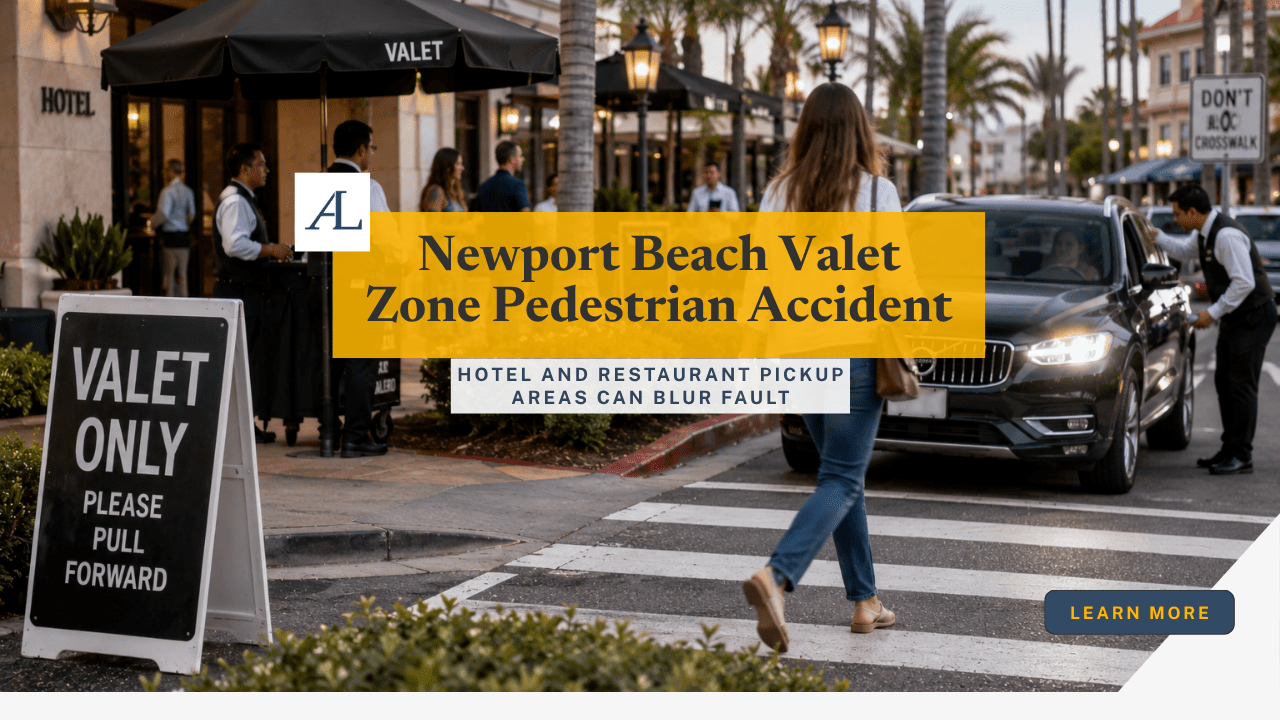
A Newport Beach valet zone pedestrian accident claim can become complicated because hotel entrances, restaurant drop-off areas, and curbside valet zones are designed for constant movement. Drivers pull forward, reverse, stop suddenly, hand keys to attendants, open doors, cross sidewalks, and move through crowded curbside spaces while pedestrians walk between restaurants, shops, hotels, parking lots, and rideshare pickup areas. In a busy coastal city like Newport Beach, one careless valet maneuver or poorly managed curbside area can leave a pedestrian seriously injured.
These accidents often happen in places that already feel chaotic. A hotel guest may step out near a valet stand while another vehicle is backing into a tight space. A restaurant patron may walk behind a car that a valet attendant is moving. A rideshare driver may stop beside the valet lane and block visibility. A delivery vehicle may create congestion near the curb. A pedestrian may be struck while walking near a marked crosswalk, hotel driveway, parking garage exit, or restaurant entrance. A Newport Beach valet zone pedestrian accident claim should examine the full curbside environment, not only the final point of impact.
Newport Beach has many locations where valet, restaurant, hotel, tourist, and pedestrian activity overlap, including Fashion Island, Balboa Peninsula, Lido Marina Village, Mariners Mile, Newport Center Drive, Coast Highway, Balboa Village, Corona del Mar, and waterfront restaurant districts. The City of Newport Beach provides detailed parking information for visitors and residents, including paid parking areas, municipal lots, and parking rules throughout the city, which shows how active and regulated curbside access can be in local visitor zones.\
When a pedestrian is injured near a valet zone, choosing the right legal representation matters. An experienced Newport Beach pedestrian accident lawyer at Avrek Law Firm can investigate the valet company, hotel, restaurant, property owner, driver, rideshare operator, delivery vehicle, surveillance footage, incident reports, and every insurance policy that may apply. A Newport Beach valet zone pedestrian accident claim may involve several parties trying to shift blame, and early evidence preservation can make the difference between a disputed claim and a strong case.
Why a Newport Beach Valet Zone Pedestrian Accident Claim Is Often More Complex Than a Regular Pedestrian Crash
A Newport Beach valet zone pedestrian accident claim is often more complex than an ordinary pedestrian accident because valet areas are controlled spaces with many moving parts. Unlike a regular roadway crash where one driver may hit one pedestrian, a valet zone may involve a restaurant, hotel, valet company, property owner, parking operator, security team, rideshare driver, delivery driver, or another guest’s vehicle. Each party may have a different version of what happened, and each insurance company may try to reduce its own responsibility.
Valet zones also create unique visibility problems. Vehicles may be parked close together near the curb. Attendants may move cars in tight spaces. Pedestrians may walk between parked vehicles, planters, hotel entrances, traffic cones, and curbside signs. Drivers may focus on valet instructions instead of pedestrians. A guest may open a door into a pedestrian’s path. A valet driver may reverse without checking behind the vehicle. These conditions can make a Newport Beach valet zone pedestrian accident claim much more evidence-driven than it first appears.
Insurance companies may argue that the pedestrian stepped into traffic, walked behind a moving vehicle, crossed outside a marked crosswalk, or failed to watch for cars. Those arguments should be tested against the facts. A valet zone is a place where pedestrians are expected. Hotels and restaurants invite guests to walk through these areas, and businesses that operate valet services should anticipate pedestrian movement. A Newport Beach valet zone pedestrian accident claim should therefore ask whether the curbside area was managed safely, whether drivers were trained properly, whether staff gave clear directions, and whether surveillance footage supports the injured person’s account.
Valet Zones Combine Drivers, Pedestrians, and Business Operations
A Newport Beach valet zone pedestrian accident claim may involve a business operation, not just a driver’s mistake. Valet service is offered to make parking easier for guests, but it also creates a duty to manage vehicle movement with reasonable care. If a restaurant or hotel accepts cars at the curb, directs guests through a loading area, or allows attendants to move vehicles near pedestrians, the operation must be safe enough for the people invited onto the property.
The same is true for valet companies. A valet company may be responsible for hiring, training, supervising, and monitoring attendants who drive customer vehicles. If an attendant backs up without checking, speeds through a parking lot, blocks a sidewalk, ignores pedestrian traffic, or fails to follow company safety procedures, the valet company may become a key party in a Newport Beach valet zone pedestrian accident claim.
The business that hired the valet company may also need review. A restaurant or hotel may argue that the valet company was an independent contractor, but that does not always end the analysis. The claim may need to examine who controlled the valet area, who designed the traffic flow, who placed cones or signs, who supervised the curb, who handled guest complaints, and who had authority to correct unsafe conditions.
Hotel and Restaurant Entrances Can Create Predictable Pedestrian Risks
A Newport Beach valet zone pedestrian accident claim often happens in places where pedestrian traffic is predictable. Hotel guests walk with luggage. Restaurant customers step out of vehicles. Tourists may be unfamiliar with the layout. Families may cross between parking areas and entrances. Valet attendants may jog between cars. Rideshare drivers may stop unexpectedly. Delivery workers may unload food or supplies nearby. None of this should surprise a hotel, restaurant, or valet operator.
When a business knows that pedestrians are constantly crossing a curbside area, it should take reasonable steps to reduce danger. That may include adequate lighting, visible pedestrian pathways, clear signs, properly placed cones, trained attendants, safe vehicle staging, controlled pickup and drop-off points, and policies that prevent vehicles from backing into pedestrian paths. If those protections are missing, a Newport Beach valet zone pedestrian accident claim may involve premises liability as well as driver negligence.
These cases are especially important in Newport Beach because many hotel and restaurant districts operate in tight coastal spaces where sidewalks, parking areas, bike lanes, loading zones, and valet stands sit close together. A valet zone that works on a quiet weekday may become dangerous during dinner rush, summer tourism, weekend events, or holiday traffic. The claim should look at the conditions at the time of the crash, not how the area appears later.
“I Did Not See the Pedestrian” Should Not End the Investigation
Drivers and valet attendants often say they did not see the pedestrian before impact. That statement may describe what the driver remembers, but it does not automatically excuse the crash. A Newport Beach valet zone pedestrian accident claim should examine whether the pedestrian should have been visible, whether the driver checked carefully, whether the vehicle had backup cameras or sensors, whether an attendant was directing traffic, and whether the valet zone layout created blind spots.
The fact that a pedestrian was near a hotel or restaurant entrance may actually make the driver’s explanation weaker. Pedestrians are expected in these areas. A driver moving through a valet zone should anticipate people walking near the curb, behind vehicles, near doors, and across driveways. The same applies to valet attendants because their job requires moving vehicles safely in pedestrian-heavy spaces.
A Newport Beach valet zone pedestrian accident claim may become stronger when video footage, witness statements, vehicle damage, or scene photos show that the driver had time to stop, should have yielded, or moved without checking the surrounding area. The investigation should focus on what the driver and business should have done before the impact.
California Pedestrian and Parking Laws That May Affect a Newport Beach Valet Zone Pedestrian Accident Claim
A Newport Beach valet zone pedestrian accident claim may involve several California laws, including pedestrian right-of-way rules, driver due care obligations, parking restrictions, crosswalk visibility rules, and accident reporting requirements. These laws do not automatically decide every case, but they help frame whether the driver, valet attendant, business, or property owner acted reasonably.
California Vehicle Code Section 21950 requires drivers to yield the right-of-way to pedestrians crossing within marked crosswalks or unmarked crosswalks at intersections, and it also requires drivers approaching pedestrians in crosswalks to exercise due care, reduce speed, or take other action necessary to safeguard pedestrians. The statute also says pedestrians must use due care and may not suddenly leave a curb into the path of a vehicle close enough to create an immediate hazard.
This law may become important in a Newport Beach valet zone pedestrian accident claim if the pedestrian was crossing near a hotel driveway, restaurant entrance, marked crosswalk, unmarked intersection crosswalk, parking lot exit, or valet lane. Even when a pedestrian’s conduct is questioned, drivers still have duties to slow, yield, and act with care when pedestrians are present.
Crosswalk Visibility Near Valet Zones
Crosswalk visibility can be central in a Newport Beach valet zone pedestrian accident claim. A valet stand, parked SUV, rideshare vehicle, delivery van, or hotel shuttle may block the view between a pedestrian and an approaching driver. If a business allows vehicles to stage too close to a crosswalk, that staging can create a foreseeable risk. A pedestrian may enter a crosswalk believing they are visible while the driver’s view is limited by a vehicle placed in the wrong location.
California’s pedestrian rules do not give drivers permission to ignore crosswalk risks simply because an area is busy. If anything, a crowded hotel or restaurant entrance should make drivers more cautious. A driver approaching a crosswalk near a valet zone should expect pedestrians to step into the roadway, especially during dinner hours, weekend events, weddings, conferences, hotel check-in times, or tourist activity.
A Newport Beach valet zone pedestrian accident claim should therefore document the crosswalk, curb markings, cones, valet stand, sight lines, stopped vehicles, lighting, and whether the valet operation created a blind approach. This evidence can help show whether the crash was caused by a driver’s failure to yield, a valet company’s poor traffic control, or a property owner’s unsafe design.
Pedestrians Outside Crosswalks Still Have Legal Protection
Insurance companies often argue that a pedestrian has no claim if they were not inside a marked crosswalk. That is not accurate. California Vehicle Code Section 21954 states that a pedestrian outside a marked crosswalk or unmarked intersection crosswalk must yield to vehicles close enough to create an immediate hazard, but it also states that this rule does not relieve drivers from the duty to exercise due care for pedestrian safety.
This can matter in a Newport Beach valet zone pedestrian accident claim because valet areas do not always have clearly marked pedestrian crossings. A hotel guest may walk from a car door to the entrance. A restaurant patron may cross from a valet stand to a sidewalk. A pedestrian may step around a stopped vehicle because the normal walking path is blocked. The insurer may claim the pedestrian was outside the crosswalk, but that does not automatically erase the driver’s duty to use reasonable care.
The analysis should consider whether the pedestrian’s path was foreseeable. If the business directed guests to walk through the valet zone, if attendants routinely guided pedestrians through that area, or if the property layout made that crossing predictable, the pedestrian’s location may support rather than weaken the claim.
Stopping, Parking, and Crosswalk “Daylighting” Issues
A Newport Beach valet zone pedestrian accident claim may also involve California Vehicle Code Section 22500, which restricts stopping, parking, or leaving a vehicle standing in several locations, including intersections, crosswalks, sidewalks, driveways, and certain areas where visibility or traffic flow may be affected. Section 22500 also includes crosswalk approach restrictions added through California’s daylighting law, which is designed to improve pedestrian visibility near crosswalks.
This law can be important when a valet vehicle, guest vehicle, rideshare car, hotel shuttle, or delivery vehicle was stopped too close to a crosswalk, blocking a sidewalk, interfering with a driveway, or creating a visibility obstruction. A Newport Beach valet zone pedestrian accident claim should examine whether the valet operation allowed vehicles to stage in places that made pedestrians harder to see.
The key issue is not just whether a vehicle was “parked.” In a valet area, vehicles may be attended and moving frequently, but they can still create hazards. If the valet operation depends on stopping vehicles in a way that blocks pedestrian visibility, that practice may become evidence of negligence.
Who May Be Liable in a Newport Beach Valet Zone Pedestrian Accident Claim?
A Newport Beach valet zone pedestrian accident claim may involve several responsible parties. The driver who hit the pedestrian is usually the first person investigated, but valet accidents often involve layers of responsibility. A valet attendant may have been driving the vehicle. A hotel or restaurant may have controlled the curbside area. A valet company may have employed or supervised the attendant. A property owner may have designed or maintained the traffic flow. A rideshare or delivery driver may have contributed to the congestion.
Liability depends on the facts. The investigation should examine who controlled the vehicle, who controlled the curb, who controlled pedestrian movement, who had authority to correct unsafe conditions, and whether any party had notice that the valet zone was dangerous. A Newport Beach valet zone pedestrian accident claim should not be limited to the first insurance company that contacts the injured person.
The Driver or Valet Attendant
The driver may be liable if they failed to yield, backed up without checking, turned into a pedestrian path, accelerated too quickly, failed to follow traffic directions, ignored a crosswalk, opened a door into a pedestrian, or drove distracted in the valet zone. If the driver was a valet attendant, the claim should examine training, supervision, company procedures, and whether the attendant was acting within the scope of employment.
A Newport Beach valet zone pedestrian accident claim involving a valet attendant should also review whether the attendant had permission to drive the vehicle, whether the attendant was properly licensed, whether the valet company had safety rules, and whether other attendants were directing traffic. A single driver error may point to a larger problem if the valet company did not train workers on pedestrian safety.
Vehicle movement evidence can be critical. Surveillance footage may show whether the driver checked behind the vehicle, whether another attendant waved them forward, whether the pedestrian was visible, or whether the driver moved too quickly for a crowded curbside area.
The Valet Company
A valet company may be responsible for a Newport Beach valet zone pedestrian accident claim if its employee or agent caused the crash while performing valet duties. The company may also be liable for negligent hiring, poor training, inadequate supervision, unsafe operating procedures, understaffing, or failure to manage vehicle flow safely.
Valet companies should anticipate pedestrian hazards because valet service exists in pedestrian-heavy environments. A reasonable valet operation should have procedures for moving vehicles, checking blind spots, guiding guests, controlling congestion, and separating pedestrian paths from vehicle paths where possible. If attendants are rushing, distracted, poorly trained, or forced to move cars through crowded pedestrian spaces without proper controls, the valet company may become a major defendant.
A Newport Beach valet zone pedestrian accident claim may require reviewing the valet contract, employee handbook, training materials, shift records, staffing levels, incident history, insurance coverage, and communications between the valet company and the hotel or restaurant.
The Hotel, Restaurant, or Property Owner
A hotel, restaurant, or property owner may be liable if unsafe property design or poor curbside management contributed to the crash. This may include inadequate lighting, confusing pedestrian routes, poor signage, lack of marked walking paths, unsafe valet stand placement, blocked sight lines, overcrowded drop-off areas, or repeated complaints about near misses.
A Newport Beach valet zone pedestrian accident claim may also involve the business that hired the valet operator. A restaurant or hotel may not be able to avoid responsibility simply by pointing to the valet company if the business controlled the area, knew the layout was unsafe, or benefited from a system that placed pedestrians and vehicles in conflict.
These cases require careful investigation because contracts and control matter. The injured person may not know whether the valet company, restaurant, hotel, property manager, or landlord was responsible for the specific curbside area. Avrek Law Firm can help identify each party’s role before insurers narrow the claim.
Rideshare Drivers, Delivery Vehicles, and Other Third Parties
A Newport Beach valet zone pedestrian accident claim may involve third parties who are not part of the valet operation. A rideshare driver may stop in the valet lane and block visibility. A delivery vehicle may double-park near the entrance. A hotel shuttle may stop in a pedestrian path. Another guest may open a door or reverse unexpectedly. These actions can contribute to the crash even if a valet driver caused the final impact.
When another driver was working at the time, commercial or platform-related coverage may apply. Uber, Lyft, delivery platforms, shuttle companies, and commercial operators may have different insurance rules depending on the driver’s status. A complete Newport Beach valet zone pedestrian accident claim should review all available insurance coverage rather than assuming only one policy applies.
Evidence That Can Strengthen a Newport Beach Valet Zone Pedestrian Accident Claim
A Newport Beach valet zone pedestrian accident claim often depends on evidence that disappears quickly. Valet areas return to normal after a crash. Cars are moved. Cones are repositioned. Witnesses leave. Video may be overwritten. Hotel or restaurant staff may prepare internal reports that the injured person never sees. If the injured person is taken to the hospital, they may lose the chance to document the scene themselves.
The strongest evidence usually shows the full valet environment: where the pedestrian was walking, where vehicles were staged, how the driver moved, whether crosswalks or pedestrian paths were visible, and whether the business had safe procedures. This type of evidence can prove that the crash was not a random accident but the result of unsafe traffic management.
A Newport Beach valet zone pedestrian accident claim should preserve video footage, incident reports, valet tickets, driver names, employee schedules, witness statements, parking layout photos, insurance records, and medical documentation.
Surveillance Video and Valet Records
Hotels, restaurants, shopping centers, parking garages, and nearby businesses often have cameras facing entrances, sidewalks, driveways, and valet lanes. Video may show the vehicle’s movement, the pedestrian’s path, the role of other cars, whether attendants were directing traffic, and whether the driver had time to stop. In a Newport Beach valet zone pedestrian accident claim, video may be the difference between a disputed story and clear liability.
Valet records can also be important. A valet ticket may identify the vehicle, time, guest, attendant, and transaction. Shift records may identify who was working. Incident reports may show what staff observed. The valet company may have internal communications about the crash. A hotel or restaurant may have security reports, guest complaints, or prior reports involving the same area.
These records are usually controlled by the business or valet company. A Newport Beach valet zone pedestrian accident claim should include preservation letters as soon as possible so that video and documents are not lost, deleted, or overwritten.
Scene Photos, Lighting, and Curbside Layout
Photos should show the exact valet zone, sidewalk, driveway, crosswalk, curb color, cones, signs, hotel entrance, restaurant entrance, parking lot exit, rideshare area, and vehicle staging pattern. The goal is to show how people and vehicles moved through the area. A close photo of the damaged vehicle is helpful, but a wide photo of the entire curbside layout may be more important.
Lighting can also matter in a Newport Beach valet zone pedestrian accident claim. Many valet accidents happen at night during dinner service, hotel check-in, events, or weekend activity. If lighting was poor, signs were hard to see, or pedestrians were directed through a shadowed area, the property owner or business may need review.
Photos should be taken from the pedestrian’s perspective and the driver’s perspective. The pedestrian’s view may show whether the walking route appeared safe. The driver’s view may show whether the pedestrian should have been visible before impact. These details help counter insurer arguments that the pedestrian “appeared suddenly.”
Witnesses, Employees, and Incident Reports
Witnesses in a Newport Beach valet zone pedestrian accident claim may include valet attendants, hotel guests, restaurant patrons, rideshare passengers, security officers, host stand employees, servers, delivery workers, nearby drivers, and pedestrians. Their statements may explain whether the valet area was crowded, whether the driver moved suddenly, whether attendants were directing traffic, or whether prior near misses had occurred.
Employees may have seen more than they initially disclose. A hotel security guard may know whether cameras recorded the crash. A valet attendant may know whether the area was understaffed. A restaurant manager may know whether delivery vehicles regularly block the curb. A parking attendant may know whether the same valet lane has caused complaints before.
A Newport Beach valet zone pedestrian accident claim should identify and contact witnesses early because memories fade and tourists may leave the area quickly. If the crash happened near a hotel or restaurant, staff turnover and guest travel can make later witness location difficult.
Reporting, Medical Records, and Deadlines After a Newport Beach Valet Zone Pedestrian Accident Claim
A Newport Beach valet zone pedestrian accident claim should be documented through medical records, incident reports, insurance records, and any required accident reports. Pedestrian injuries can be serious even when the vehicle was moving slowly. A person struck in a valet area may fall onto pavement, hit a curb, suffer a head injury, break a wrist, injure a knee or hip, or develop neck and back symptoms after the initial shock fades.
The California DMV states that an SR-1 report must be sent to DMV within 10 days if anyone is injured or killed, or property damage is over $1,000, and that the SR-1 is required in addition to any report made to police, CHP, or an insurance company.
A pedestrian may not personally file an SR-1 if they were not a driver, but the accident should still be documented carefully. A Newport Beach valet zone pedestrian accident claim may involve a driver’s SR-1, police report, hotel incident report, valet company report, emergency medical records, and insurance claim numbers. All of these records can help establish when and how the injury occurred.
Medical Documentation After a Valet Zone Pedestrian Injury
Medical documentation is essential in a Newport Beach valet zone pedestrian accident claim because insurers may argue that a low-speed valet crash could not have caused serious injuries. That argument ignores how pedestrians get hurt. Even a slow-moving vehicle can knock a person off balance, cause a fall, or push them into a curb, door, bumper, planter, or another vehicle.
Common injuries may include concussions, facial injuries, wrist fractures, hip injuries, knee injuries, shoulder trauma, back pain, neck pain, nerve symptoms, bruising, soft tissue injuries, and emotional distress. Older adults, hotel guests carrying luggage, and pedestrians with mobility limitations may be especially vulnerable.
A Newport Beach valet zone pedestrian accident claim should include emergency room records, urgent care notes, imaging, specialist referrals, physical therapy records, prescriptions, work restrictions, and follow-up visits. If symptoms worsen over time, the injured person should report those changes to medical providers rather than waiting until the claim is already disputed.
California Deadlines for Personal Injury and Public Entity Claims
Most California personal injury lawsuits must be filed within two years. California Code of Civil Procedure Section 335.1 states that actions for injury to, or death of, an individual caused by the wrongful act or neglect of another must be brought within two years.
A Newport Beach valet zone pedestrian accident claim may have shorter deadlines if a public entity is involved. California Government Code Section 911.2 states that a claim relating to injury to a person must generally be presented not later than six months after accrual when the claim is against a public entity.
This can matter if the accident involved a city-controlled parking area, public sidewalk defect, public curb design, public property, or a government vehicle. A Newport Beach valet zone pedestrian accident claim should be reviewed quickly so the correct deadlines are identified before evidence and rights are lost.
Insurance Issues in a Newport Beach Valet Zone Pedestrian Accident Claim
Insurance coverage in a Newport Beach valet zone pedestrian accident claim may be complicated because several policies may apply. The vehicle owner may have auto insurance. The valet company may have garagekeeper, garage liability, commercial auto, or general liability coverage. The hotel or restaurant may have commercial general liability coverage. A property owner or management company may have premises coverage. A rideshare or delivery driver may have platform-related coverage if they contributed to the crash.
Insurers may dispute which policy is primary. The vehicle owner’s insurer may blame the valet company. The valet company may blame the pedestrian. The hotel may blame an independent contractor. The property owner may argue the valet operator controlled the area. A Newport Beach valet zone pedestrian accident claim should identify all coverage early and avoid relying on one adjuster’s explanation.
Why Valet Accidents Create Coverage Disputes
A Newport Beach valet zone pedestrian accident claim can create coverage disputes because the vehicle involved may belong to a customer, but the person driving it may be a valet attendant. The valet company may have special insurance for vehicles in its care, custody, or control. The vehicle owner’s personal auto policy may apply in some situations but may dispute responsibility if someone else was driving for a business purpose.
If the crash involved a restaurant or hotel valet operation, the business contract may determine who was supposed to carry insurance and defend claims. That contract may not be available to the injured person without legal action. This is one reason an injured pedestrian should not accept early explanations from insurers without reviewing the full insurance picture.
A Newport Beach valet zone pedestrian accident claim should examine the valet company’s policy, the business’s commercial policy, the driver’s status, the vehicle owner’s policy, and any property-related coverage.
Commercial Insurers May Try to Shift Fault
Commercial insurers often defend valet pedestrian claims aggressively. They may argue that the pedestrian walked behind a vehicle, failed to use a crosswalk, ignored cones, stepped into a driveway, or should have waited for an attendant. These arguments may reduce the claim if they are not challenged with evidence.
A Newport Beach valet zone pedestrian accident claim should respond with facts. Was the pedestrian walking where guests are expected to walk? Was the valet area confusing? Did an attendant direct the pedestrian? Was there a marked path? Was the vehicle backing without warning? Did the driver move too quickly? Was the area crowded because of the business’s valet system?
California comparative fault rules may allow responsibility to be divided among parties. The insurer’s first fault assignment is not final. A strong Newport Beach valet zone pedestrian accident claim should use video, witnesses, scene photos, and business records to push back against unfair blame.
Frequently Asked Questions About a Newport Beach Valet Zone Pedestrian Accident Claim
Can I file a claim if I was hit by a valet driver in Newport Beach?
Yes. You may have a Newport Beach valet zone pedestrian accident claim if a valet driver hit you while moving, parking, reversing, retrieving, or staging a vehicle. The claim may involve the valet driver, valet company, hotel, restaurant, property owner, vehicle owner, or multiple insurance policies depending on how the accident happened.
These claims should be investigated quickly because important evidence may be controlled by the valet company or business. Surveillance footage, valet tickets, employee schedules, incident reports, and insurance contracts can help prove who was responsible. If the valet company claims the pedestrian was at fault, that claim should be tested against the video and layout of the valet zone.
Who is responsible if a pedestrian is hit near a restaurant valet area?
Responsibility depends on the facts. The driver may be liable if they failed to watch for pedestrians, backed unsafely, moved too quickly, or failed to yield. The valet company may be liable if its employee caused the crash or if poor training and supervision contributed. The restaurant or property owner may be liable if the valet area was unsafe, poorly designed, badly lit, or managed in a way that put guests in the path of moving vehicles.
A Newport Beach valet zone pedestrian accident claim should examine control over the valet area. The party that controlled cones, signs, staffing, vehicle staging, guest pathways, and traffic flow may have responsibility for unsafe conditions. In many cases, more than one party may share fault.
What if I was not in a crosswalk when I was hit?
You may still have a Newport Beach valet zone pedestrian accident claim even if you were not in a marked crosswalk. California law requires pedestrians outside crosswalks to yield to vehicles close enough to create an immediate hazard, but it also requires drivers to exercise due care for pedestrian safety. In valet areas, pedestrian movement is often expected even outside formal crosswalks.
If the hotel, restaurant, or valet layout directed guests to walk through the area where you were hit, that fact may support your claim. Video footage, scene photos, and witness statements can help show whether the pedestrian path was foreseeable and whether the driver or valet operation should have acted more carefully.
What evidence should I preserve after a valet zone pedestrian accident?
Important evidence in a Newport Beach valet zone pedestrian accident claim may include photos of the valet area, vehicle damage, curb markings, cones, signs, lighting, crosswalks, hotel or restaurant entrance, valet ticket, incident report, witness names, medical records, police report number, and insurance communications. Video footage is especially important because many valet areas have cameras.
You should also save clothing, shoes, bags, glasses, phones, or personal items damaged in the crash. These items may show impact, fall direction, and injury severity. If you were taken to the hospital and could not take photos, a family member or investigator should return to the scene as soon as possible.
Can the hotel or restaurant be liable if a valet company caused the accident?
Possibly. A hotel or restaurant may be liable if it controlled the valet area, hired the valet company, knew about unsafe conditions, failed to supervise the curbside operation, or allowed a dangerous layout to continue. The valet company may also be liable if its employee caused the crash or if its procedures were unsafe.
A Newport Beach valet zone pedestrian accident claim often requires reviewing contracts between the business and valet company. These contracts may show who was responsible for insurance, staffing, traffic control, and safety procedures. The injured person usually cannot access those records without legal help.
What if a rideshare or delivery driver contributed to the crash?
A rideshare or delivery driver may share responsibility if they blocked visibility, stopped in the valet lane, forced pedestrians into traffic, or caused the vehicle movement that led to the injury. A Newport Beach valet zone pedestrian accident claim may involve Uber, Lyft, delivery drivers, hotel shuttles, private cars, valet attendants, and business operators all at once.
Each party may have a different insurance policy. That is why the claim should identify app status, driver purpose, business relationship, vehicle ownership, and location control. The final impact may involve one vehicle, but the cause may involve several negligent decisions.
How long do I have to file a Newport Beach valet zone pedestrian accident claim?
In most California personal injury cases, the lawsuit deadline is two years, but some claims have shorter deadlines. If the claim involves a public entity, dangerous public property, city-controlled parking, or a government vehicle, a government claim may need to be filed within six months. A Newport Beach valet zone pedestrian accident claim should be reviewed quickly to identify the correct deadlines.
Waiting can also damage the claim even before the legal deadline arrives. Video footage may be overwritten, valet employees may become harder to locate, vehicles may be repaired, and scene conditions may change. Acting early helps preserve the proof needed to establish fault.
Do I need a lawyer for a valet zone pedestrian accident?
Yes. A Newport Beach valet zone pedestrian accident claim can involve commercial insurers, valet company records, hotel or restaurant liability, property control issues, surveillance footage, and disputed fault. These cases are rarely as simple as one driver hitting one pedestrian.
A lawyer can preserve evidence, identify all insurance policies, obtain incident reports, review valet contracts, communicate with adjusters, and protect you from early settlement pressure. This is especially important if you suffered a concussion, fracture, surgery, lost wages, long-term pain, or mobility limitations.
Call or Contact Avrek Law Firm 24/7 for a Free Consultation and Pay Nothing Unless We Win
A Newport Beach valet zone pedestrian accident claim can become complicated when drivers, valet companies, hotels, restaurants, property owners, rideshare drivers, delivery vehicles, and insurers each try to shift responsibility. These cases often depend on evidence that can disappear quickly, including surveillance footage, valet tickets, incident reports, employee schedules, scene photos, witness statements, and medical records.
Avrek Law Firm helps injured pedestrians investigate valet zone accidents, preserve critical evidence, identify every responsible party, and pursue compensation for medical bills, lost income, pain, future care, and long-term recovery needs. Our team understands how commercial insurers defend pedestrian injury claims and how important local evidence can be in Newport Beach hotel, restaurant, and coastal business districts.
Speaking with a Newport Beach pedestrian accident lawyer may help you understand whether a driver, valet company, hotel, restaurant, business owner, property manager, rideshare driver, delivery driver, or public entity may be responsible. These cases may also overlap with issues handled by a Newport Beach personal injury lawyer, especially when premises liability or multiple insurance policies are involved.
If you or someone you love was injured near a hotel entrance, restaurant valet stand, rideshare pickup area, parking garage, coastal business district, or curbside valet zone in Newport Beach, Avrek Law Firm is ready to help.
Call 866-598-5548, start a chat, or complete our online form today for a free, no-obligation consultation. There are no upfront fees, and you do not pay unless we win.
Serving the Newport Beach Community
Avrek Law Firm’s principal office is located in Newport Beach, and our team has a long-standing history of representing residents, visitors, hotel guests, restaurant patrons, pedestrians, cyclists, and workers throughout Newport Beach and surrounding coastal communities. Local knowledge matters in a Newport Beach valet zone pedestrian accident claim because the location often shapes the evidence.
A crash near Fashion Island, Balboa Peninsula, Mariners Mile, Lido Marina Village, Corona del Mar, Newport Center Drive, Coast Highway, or a waterfront restaurant may involve unique curbside conditions. A hotel valet area may operate differently during tourist season than during a quiet weekday. A restaurant entrance may become hazardous during evening service. A rideshare pickup zone may overlap with a valet stand. These details matter.
A Newport Beach valet zone pedestrian accident claim should be handled with urgency, precision, and attention to the local details that insurers often overlook. Avrek Law Firm can meet with injured clients by phone, video, or in person, and we can assist clients who are unable to travel because of their injuries.
- 📩 Submit a request through our online form
- 📞 Call 866-598-5548 now to speak with our team
- 💬 Start a live chat for immediate assistance
There are no upfront fees, and you don’t pay unless we win.