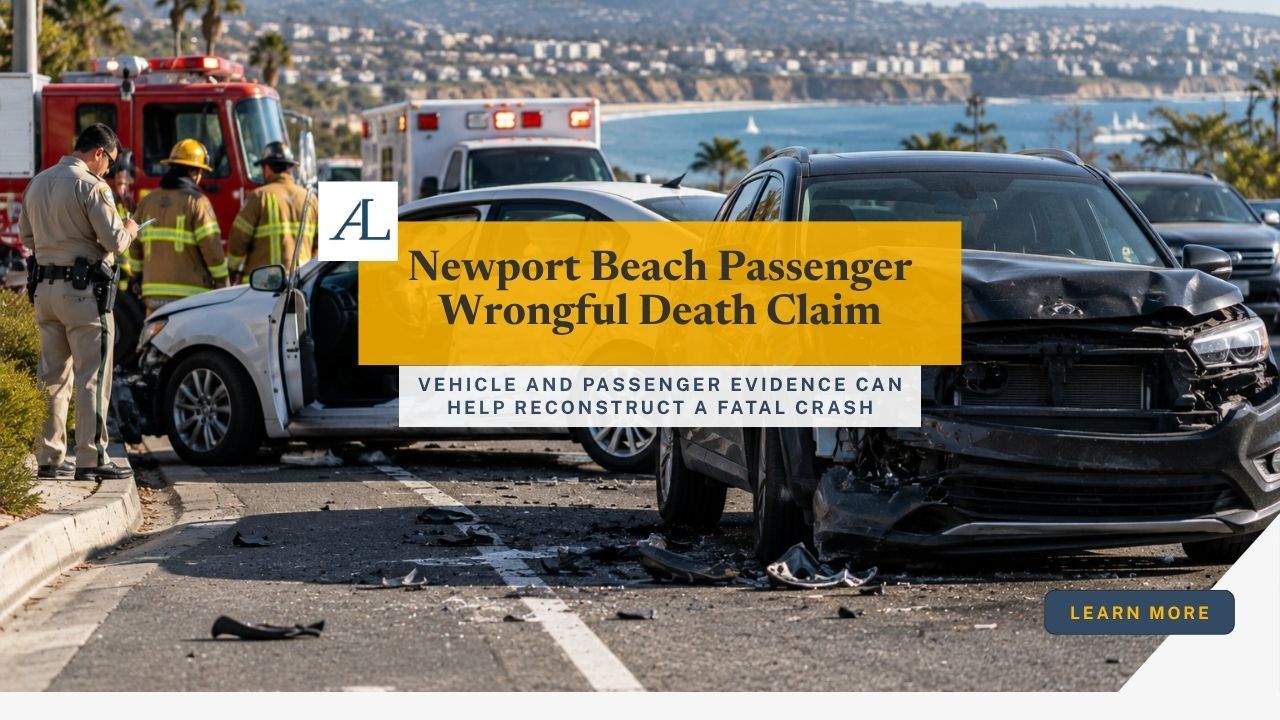
A Newport Beach passenger wrongful death claim can become complicated quickly because the person who died was not controlling either vehicle involved in the collision. The passenger may have been riding with a family member, friend, coworker, rideshare driver, commercial driver, or another person when a negligent decision caused the fatal crash. In these cases, the investigation often focuses on the drivers, the vehicles, the collision sequence, and every available insurance policy rather than on decisions made by the passenger.
A passenger’s death can leave the family with urgent questions about what happened, who was responsible, and which insurance company should handle the claim. One driver may blame another. A vehicle owner may say the driver did not have permission to use the car. An insurer may dispute whether the fatal injuries resulted from the first impact or a later collision. If several vehicles were involved, each insurance company may develop its own version of the crash before the family has received the complete police report.
A Newport Beach passenger wrongful death claim should therefore be organized around independent evidence. Vehicle damage, event data, final resting positions, surveillance footage, passenger records, witness statements, emergency-response documentation, and family financial records may all become important. The goal is to reconstruct the collision accurately while documenting how the loss affected the people who depended on and loved the passenger.
When a fatal crash takes the life of a passenger, choosing the right legal representation matters. An experienced Newport Beach wrongful death lawyer at Avrek Law Firm can help preserve evidence, identify every potentially responsible party, manage communications with multiple insurers, and pursue accountability for the family’s loss. Avrek also maintains a dedicated Newport Beach car accident lawyer resource for motor vehicle claims involving disputed fault, serious injuries, and multiple insurance policies.
Call 866-598-5548, start a live chat, or request a free case review today. There are no upfront fees, and families do not pay unless we win.
Why a Newport Beach Passenger Wrongful Death Claim Focuses on the Drivers and Vehicles
A Newport Beach passenger wrongful death claim usually focuses on the conduct of the drivers because the passenger was not steering, accelerating, braking, changing lanes, or choosing how to respond to traffic. The investigation may examine whether the driver of the passenger’s vehicle was speeding, distracted, impaired, following too closely, or making an unsafe turn. It may also examine whether another motorist ran a light, crossed into the lane, rear-ended the vehicle, made an unsafe merge, or triggered a multi-vehicle chain reaction.
The family should not assume that only the driver who physically struck the passenger’s side of the vehicle can be responsible. A different driver may have initiated the collision by forcing another vehicle into the passenger’s car. A commercial driver may have blocked visibility. A vehicle owner may have permitted an unsafe driver to use the car. Depending on the facts, an employer, rideshare company, delivery company, rental company, vehicle owner, maintenance provider, or public entity may also need to be investigated.
Because the passenger cannot explain the crash, the claim should rely on evidence that does not depend on one driver’s account. Each vehicle’s damage, location, electronic data, and recorded movement may help show what happened. Statements from surviving occupants and independent witnesses can then be compared with that physical evidence.
The Passenger’s Seat Position and Vehicle Occupancy
The passenger’s seat position can be important in a Newport Beach passenger wrongful death claim because it may help explain how the fatal injuries occurred. A front-seat passenger may experience a different impact than someone seated behind the driver. A person sitting on the side where another vehicle made contact may be exposed to more direct intrusion, while a passenger on the opposite side may still be injured by rotation, rollover, seat movement, or a second impact.
Investigators should identify where every person was sitting, whether the vehicle had multiple passengers, and whether anyone changed seats during the trip. Photographs of the interior may show seat positions, airbag deployment, intrusion, broken glass, seatbelt condition, personal belongings, and contact marks. Emergency personnel may also have documented where each occupant was found or removed.
Seatbelt evidence may become part of the insurance review, but it should not replace the investigation into who caused the crash. Insurers may raise restraint use when evaluating injury causation or damages. Avrek’s related article on what happens if a passenger was not wearing a seatbelt during a crash provides additional background on why restraint questions can become disputed. The family should avoid making assumptions about seatbelt use until the vehicle, medical records, and investigation materials have been reviewed.
Vehicle occupancy can also affect available insurance coverage. If several passengers were injured or killed, multiple claims may be presented against the same policy limits. That makes it especially important to identify every applicable policy before the family signs any release or accepts an early settlement.
Statements From Each Driver and Surviving Passenger
Statements from the drivers and surviving passengers may provide useful information, but they should not automatically be treated as complete or accurate. A person may have seen only one part of the collision. Another occupant may have been unconscious, disoriented, medicated, or focused on helping someone else. Drivers may also have a financial reason to minimize their responsibility or shift fault to another motorist.
A Newport Beach passenger wrongful death claim should compare all statements with photographs, video, event data, police diagrams, debris locations, and vehicle damage. If a driver says they were stopped before impact, the damage and data may support or contradict that account. If a surviving passenger remembers two separate impacts, the vehicle may contain physical evidence of front and rear contact. If witnesses describe an unsafe lane change, nearby camera footage may help confirm the movement.
Early statements can also differ from later accounts without necessarily proving dishonesty. Shock, trauma, and limited viewing angles can affect memory. The important question is whether objective evidence can clarify the sequence. Families should preserve any text messages, voicemails, social media posts, or written communications in which a driver or witness described the crash shortly after it happened.
Insurance adjusters may ask family members to repeat what surviving occupants told them. It is better to preserve the original source than to create a secondhand version. An attorney can contact witnesses directly, obtain formal statements, and compare those statements with the rest of the evidence.
Whether One or Multiple Vehicles Contributed to the Fatal Crash
A fatal passenger collision may involve one negligent driver or several contributing drivers. In a single-vehicle crash, the investigation may focus on the driver’s speed, attention, impairment, vehicle control, and reaction to roadway conditions. In a two-vehicle crash, both drivers’ decisions may be examined. In a multi-vehicle collision, the first contact may trigger several later impacts that expose the passenger to additional force.
A Newport Beach passenger wrongful death claim should identify the order of every contact. A rear-end collision may push the passenger’s vehicle into an intersection. A sideswipe may cause the driver to lose control and strike a barrier. A vehicle may avoid the first crash but collide with the passenger’s car during the resulting movement. The driver who caused the final impact may not be the only responsible party.
Each insurer may try to isolate its own driver’s role. One company may accept responsibility for property damage but deny that its impact caused the death. Another may argue that the fatal injury occurred during a different collision. A third may claim that its driver merely reacted to an emergency created by someone else. These arguments make collision-sequence evidence critical.
The family should not be pressured to choose one responsible driver before the investigation is complete. A full review may reveal that more than one party contributed and that more than one insurance policy should be included in the claim.
Evidence That Can Reconstruct a Newport Beach Passenger Wrongful Death Claim
Evidence is especially important in a Newport Beach passenger wrongful death claim because the person who died cannot provide their own account. The strongest claim may combine physical evidence, electronic records, video, witness testimony, emergency-response materials, and the passenger’s digital history. No single record may tell the whole story, but several sources can be compared to create a reliable timeline.
The investigation should begin before vehicles are repaired, released, sold, or destroyed. Nearby video should be requested before it is overwritten. Witnesses should be contacted while their memories remain fresh. The passenger’s phone and personal property should be preserved without deleting messages or resetting devices.
Vehicle Damage, Event Data, and Final Resting Positions
Vehicle damage can help identify the direction and severity of each impact. Intrusion into the passenger compartment, airbag deployment, seatbelt pretensioner activation, broken windows, roof damage, wheel damage, frame deformation, and damage on multiple sides may all help explain what happened.
A Newport Beach passenger wrongful death claim may also require inspection of electronic vehicle records. Some vehicles may store information about speed, brake application, accelerator input, steering, changes in velocity, restraint use, or multiple recorded events. Driver-assist systems, onboard cameras, connected services, and manufacturer applications may contain other information. Data availability depends on the specific vehicle and crash, so each car should be evaluated separately.
Final resting positions can help show how far the vehicles moved and whether there were several impacts. Photographs should identify lane markings, curbs, medians, barriers, traffic signals, signs, debris, skid or tire marks, and the position of each vehicle. If the crash happened near Pacific Coast Highway, Jamboree Road, MacArthur Boulevard, Newport Coast Drive, Balboa Peninsula, Corona del Mar, or a commercial entrance, the surrounding road design may also affect the reconstruction. Avrek’s Newport Beach location materials identify PCH, the 55 Freeway, Fashion Island, and Balboa Peninsula as significant local traffic environments.
High-value or technologically advanced vehicles may produce extensive diagnostic and repair documentation. Avrek’s related Newport Beach luxury vehicle accident injury claim article explains why specialty repair records, diagnostic scans, sensor information, and preservation before repair can matter. Those same principles may apply when a passenger is killed and vehicle evidence is needed to reconstruct the collision.
Dashcams, Traffic Cameras, Business Video, and Witnesses
Video may be one of the strongest forms of proof in a Newport Beach passenger wrongful death claim. Dashcams may capture speed, traffic flow, brake lights, lane changes, and the moments before impact. Business cameras may show vehicles approaching an intersection, entering a driveway, leaving a parking area, or traveling through a coastal commercial corridor. Residential cameras and phones may capture only part of the crash but still confirm timing or vehicle movement.
The family should identify possible camera sources immediately. Hotels, restaurants, shopping centers, valet areas, parking structures, apartment buildings, gas stations, marinas, and neighboring businesses may all have cameras. Even footage that does not show the impact may show the passenger’s vehicle moments before or after the collision.
Witnesses may include surviving occupants, nearby drivers, pedestrians, cyclists, employees, security personnel, rideshare drivers, delivery workers, or residents. Their contact information should be preserved even when police already spoke with them. The police report may contain an incomplete phone number or a brief summary rather than a detailed statement.
Witness accounts should be evaluated alongside the physical evidence. A witness may estimate speed incorrectly but accurately describe a red light, unsafe turn, or lane change. Another may hear several impacts without seeing the first one. Several partial accounts can become useful when combined.
The Passenger’s Phone, Messages, Navigation, and Travel Records
The passenger’s phone may contain evidence about the trip without implying that the passenger caused the collision. Messages may show who was driving, where the group was going, when they left, whether the driver was running late, or whether anyone expressed concern about the driving. Navigation history may identify the intended route and destination. Photos, app records, call logs, or location history may help establish timing.
A Newport Beach passenger wrongful death claim should preserve these records carefully. The family should avoid deleting data, resetting the device, canceling cloud storage, or discarding associated accounts before legal review. An attorney can help determine which records are relevant and how they should be collected while respecting privacy.
Travel records may also identify additional parties. A rideshare receipt may show that the passenger was in an active Uber or Lyft trip. A rental agreement may identify the vehicle owner and authorized driver. A work calendar may show that the passenger was traveling for employment. A hotel, restaurant, valet, or event record may help establish the trip timeline and reveal nearby cameras.
Personal property from the vehicle may also matter. Bags, receipts, keys, clothing, glasses, and other items can help establish occupancy, movement, and the passenger’s activities before the crash. Those items should be photographed and preserved when possible.
Insurance Questions in a Newport Beach Passenger Wrongful Death Claim
Insurance issues can become one of the most confusing parts of a Newport Beach passenger wrongful death claim. The family may receive calls from the insurer covering the passenger’s vehicle, another driver’s carrier, a rideshare insurer, a commercial carrier, or the family’s own insurer. Each company may open a different claim file and ask for overlapping records.
The first insurer to call is not necessarily the only insurer that matters. Families should keep a written log containing the carrier, claim number, adjuster, phone number, email, date, request, and any decision communicated. No settlement should be evaluated until the available coverage has been identified.
Policies Covering the Passenger’s Vehicle and Other Drivers
The vehicle in which the passenger was riding may have liability coverage, medical-related benefits, uninsured or underinsured motorist coverage, or other applicable provisions depending on the policy and facts. Another involved driver may have a separate liability policy. If the driver was working, transporting a rideshare passenger, making a delivery, or operating a commercial vehicle, additional coverage may be available.
A Newport Beach passenger wrongful death claim should not assume that the passenger vehicle’s driver and the other driver are the only potential sources of insurance. Vehicle owners, employers, rideshare companies, delivery companies, rental companies, and commercial operators may each have policies or contractual arrangements that require review.
Policy limits can become especially important when several people were injured or killed in the same crash. Multiple claims may compete for limited coverage. Early organization can help the family understand whether additional policies, umbrella coverage, or other responsible parties should be investigated.
Families should also be cautious when an insurer says another company is responsible. A denial or referral may represent only that carrier’s position. It does not establish the full legal or insurance picture.
Vehicle Ownership, Permission, and Household Coverage Questions
Vehicle ownership can affect a Newport Beach passenger wrongful death claim because the registered owner may be different from the driver. The vehicle may belong to a spouse, parent, employer, rental company, dealership, or business. The insurer may investigate whether the driver had permission to use it, whether the driver was listed on the policy, and whether an exclusion applies.
Permission disputes should be supported by evidence. Keys, messages, routine use, household relationships, rental documents, employer records, and prior driving arrangements may help show why the driver had possession of the vehicle. The family should not assume that an insurer’s initial coverage denial is final.
Household policies may also need review. Depending on the facts and policy language, a family’s own auto insurance may contain coverage relevant to an uninsured or underinsured driver. The existence and applicability of that coverage require a policy-specific analysis.
An experienced Newport Beach car accident lawyer can collect declarations pages, policy documents, reservation-of-rights letters, denial letters, and other coverage materials before the family makes decisions based on incomplete information.
Release or Settlement Documents From More Than One Insurer
A family may receive settlement or release documents from several insurers. One carrier may offer its policy limit. Another may offer a separate amount for a different driver’s role. A vehicle insurer may send property-related documents while a bodily injury adjuster sends a broader release. The wording matters.
A Newport Beach passenger wrongful death claim should not be resolved before the family understands which claims, parties, policies, and rights the release covers. A document labeled as a routine settlement may contain language releasing every person or company connected to the collision. Signing one release may affect the ability to pursue another insurer or party.
Early offers may also arrive before all losses are documented. Funeral costs may be known, but financial support, household services, benefits, caregiving, and the long-term effect on surviving family members may require more time to evaluate. Vehicle and camera evidence may still be outstanding.
The family should preserve every offer, letter, email, and authorization form. Insurers may request recorded statements or broad access to records before accepting liability. Legal review can help ensure the family provides necessary information without surrendering rights or creating avoidable inconsistencies.
Family Records That May Support a Newport Beach Passenger Wrongful Death Claim
A Newport Beach passenger wrongful death claim must document more than the collision itself. The family may need records showing the passenger’s medical care, emergency response, funeral arrangements, income, benefits, household contributions, and relationships. These materials help explain the practical and personal impact of the death.
California law identifies the people who may assert a wrongful death cause of action. California Code of Civil Procedure Section 377.60 includes a surviving spouse, registered domestic partner, children, issue of deceased children, and certain other qualifying persons depending on intestate succession, dependency, and household circumstances. Because eligibility depends on the family structure, families should obtain legal review rather than assume who must be included.
Documents such as marriage certificates, domestic partnership records, birth certificates, adoption records, guardianship documents, tax filings, shared leases, and dependency records may become relevant. These materials should be preserved early so the insurer cannot delay the claim by repeatedly asking for proof of relationship.
Medical, Emergency-Response, and Funeral Documentation
Medical and emergency-response records may establish the timeline from the crash through the passenger’s death. Relevant documents can include ambulance reports, emergency-department records, trauma records, imaging, surgical notes, hospital bills, physician records, coroner or medical examiner materials, and the death certificate.
A Newport Beach passenger wrongful death claim may also require records showing whether the passenger survived for any period after the crash and what treatment was provided. Families should preserve bills, explanations of benefits, insurance correspondence, and facility records rather than assume the hospital will retain everything in one complete file.
Funeral documentation may include service agreements, burial or cremation expenses, transportation costs, memorial expenses, cemetery charges, and receipts. Travel and lodging expenses may also matter when relatives had to come from outside Orange County or California.
These records are emotionally difficult to collect, but families do not have to organize them alone. A legal team can request documents directly, identify missing records, and create a timeline without repeatedly asking grieving relatives to relive the event.
Income, Benefits, Household Support, and Shared Expenses
Financial documentation may show how the passenger supported the household before the fatal crash. Pay stubs, W-2s, 1099s, tax returns, employer statements, business records, bonus history, retirement contributions, health insurance, and other benefits may all become relevant.
A Newport Beach passenger wrongful death claim should also account for practical household contributions. The person may have handled childcare, school transportation, meals, caregiving, household maintenance, scheduling, financial management, or support for elderly relatives. These tasks may not appear on a paycheck, but their loss can change the family’s daily life.
Shared expense records may include rent or mortgage payments, utility bills, insurance, groceries, tuition, transportation, and recurring family costs. Bank records and digital payment history can help show who paid what and how the household functioned.
Avrek’s related article on financial support after a fatal motor vehicle accident in Irvine explains how income, benefits, caregiving, transportation, and household services may require separate documentation after a fatal collision. Although that article focuses on Irvine, the recordkeeping principles can help Newport Beach families understand what should be preserved.
Family Statements About the Passenger’s Daily Role and Relationships
Records cannot fully explain what a person meant to their family. Statements from a spouse, partner, child, parent, dependent, or other close family member may help describe the passenger’s daily role, routines, support, guidance, companionship, and responsibilities.
These statements should be factual and specific. Instead of saying only that the person “did everything,” a family member may describe who handled school pickup, prepared meals, attended medical appointments, cared for relatives, managed household finances, coached a child, or provided transportation. Specific examples create a more complete picture.
A Newport Beach passenger wrongful death claim may also include calendars, messages, photos, videos, family schedules, and other records showing the passenger’s involvement in daily life. These materials should be preserved respectfully and selected carefully rather than turned over indiscriminately to an insurer.
Family statements should remain separate from medical or financial expert conclusions. Relatives can explain what they observed and lost, while qualified professionals address medical causation, economic calculations, or accident reconstruction. That distinction helps keep the claim organized and credible.
Reporting and Deadlines After a Fatal Passenger Accident
A Newport Beach passenger wrongful death claim should be reviewed quickly because legal deadlines and evidence deadlines are not the same. A lawsuit deadline may appear distant, while video, vehicle data, personal property, and witness information can disappear within days or weeks.
The California DMV SR-1 Accident Reporting page states that a driver, insurance agent, broker, or legal representative must complete and send an SR-1 to DMV within 10 days when someone is injured or killed, or when property damage exceeds $1,000. The DMV also states that the SR-1 is required in addition to reports made to police, CHP, or an insurance company. The family’s attorney can determine who is responsible for confirming that this reporting requirement has been addressed.
For many California actions involving injury or death caused by another person’s wrongful act or neglect, California Code of Civil Procedure Section 335.1 provides a two-year limitations period. Different or shorter procedures may apply in some cases, including matters involving public entities, so the family should not calculate the deadline without legal review.
The existence of a two-year period should not encourage delay. Vehicles may be released to salvage. Electronic data may be overwritten. Commercial records may be deleted under retention schedules. Business surveillance may disappear. Early action protects the evidence long before the filing deadline becomes immediate.
Frequently Asked Questions About a Newport Beach Passenger Wrongful Death Claim
Who may be responsible when a passenger is killed in a car accident?
Responsibility may rest with the driver of the passenger’s vehicle, another motorist, a vehicle owner, an employer, a rideshare company, a delivery company, a commercial operator, a maintenance provider, or another party depending on what caused the crash.
A Newport Beach passenger wrongful death claim should identify every person and company that may have contributed before the family accepts a settlement or releases any party.
Can the family make a claim against the driver of the passenger’s own vehicle?
Potentially, yes. If the driver of the vehicle in which the passenger was riding caused or contributed to the collision, that driver and the applicable insurer may need to be included. The fact that the driver was a relative or friend does not erase the family’s loss or the insurer’s potential responsibility.
The claim should be evaluated based on the evidence and available insurance, not on assumptions about personal relationships.
What if more than one driver caused the fatal crash?
More than one driver may share responsibility. A first collision may force the passenger’s vehicle into another car, barrier, intersection, or roadway hazard. Each driver’s actions should be reconstructed using damage, video, data, witnesses, and police records.
A Newport Beach passenger wrongful death claim may involve several insurance carriers and separate settlement discussions when multiple drivers contributed.
Who can bring a wrongful death claim in California?
California law identifies specific survivors and representatives who may assert the claim. The categories include a surviving spouse, registered domestic partner, children, issue of deceased children, and certain other qualifying persons depending on the family and dependency circumstances.
The official California Code of Civil Procedure Section 377.60 provides the statutory eligibility language. Families should obtain legal guidance because all potentially qualifying claimants may need to be identified and coordinated.
What evidence should the family preserve first?
The family should preserve police and emergency-response information, vehicle locations, photographs, witness names, dashcam footage, nearby camera sources, medical records, the passenger’s phone, travel records, insurance letters, funeral documentation, employment records, and household-support evidence.
A Newport Beach passenger wrongful death claim becomes harder to reconstruct after vehicles are repaired, video is overwritten, or digital accounts are closed.
What happens if the passenger was not wearing a seatbelt?
An insurer may raise restraint use when evaluating injury causation or damages, but the issue does not replace the investigation into who caused the crash. Vehicle evidence, medical findings, seatbelt condition, airbags, seat position, and expert analysis may all matter.
Families should avoid accepting an insurer’s conclusion before the restraint and collision evidence has been reviewed.
How long does the family have to file the claim?
Many California actions involving death caused by wrongful conduct or neglect are subject to the two-year period in California Code of Civil Procedure Section 335.1. Other deadlines may apply depending on the parties and facts.
Evidence should be preserved immediately even when the filing deadline is months or years away.
Should the family accept an early policy-limits offer?
An early policy-limits offer should be reviewed carefully. The family should know whether other drivers, owners, employers, companies, household policies, or additional coverage may apply. The release should also be reviewed to determine which parties and claims it would close.
A Newport Beach passenger wrongful death claim should not be resolved before the insurance picture and family losses are documented well enough for informed review.
Do families need a lawyer for a fatal passenger claim?
Legal representation is particularly important when the passenger cannot describe the crash, multiple drivers blame one another, vehicle data must be preserved, or several insurance policies may apply.
A Newport Beach wrongful death lawyer can coordinate the investigation, communicate with insurers, identify eligible family members, organize records, and evaluate settlement documents before rights are released.
Call or Contact Avrek Law Firm 24/7 for a Free Consultation and Pay Nothing Unless We Win
A Newport Beach passenger wrongful death claim can become difficult when drivers give competing accounts, insurers dispute which impact caused the death, or the family is asked to make decisions before the evidence is complete. These claims may depend on vehicle inspections, event data, video, witness statements, passenger records, insurance policies, emergency documentation, funeral records, and evidence of the passenger’s role in the family.
Avrek Law Firm helps families investigate fatal motor vehicle crashes throughout Newport Beach and Orange County. Our team can move quickly to preserve the vehicles and digital evidence, identify every potentially responsible party, handle communications with multiple insurers, and document the financial and personal impact of the loss.
If your family lost a loved one who was riding as a passenger in a Newport Beach collision, Avrek Law Firm is ready to help.
Call 866-598-5548, start a live chat, or complete our online consultation form today for a free, no-obligation case review. There are no upfront fees, and families do not pay unless we win.
Serving the Newport Beach Community
Avrek Law Firm represents families throughout Newport Beach and nearby Orange County communities after fatal passenger accidents. Local context matters in a Newport Beach passenger wrongful death claim because the roadway, vehicle mix, nearby businesses, and traffic pattern may determine what evidence exists.
A fatal collision on Pacific Coast Highway, Newport Boulevard, Jamboree Road, MacArthur Boulevard, Newport Coast Drive, the 55 corridor, or roads near Balboa Peninsula, Corona del Mar, Fashion Island, Newport Harbor, hotels, restaurants, valet areas, and coastal businesses may involve different camera sources, witnesses, roadway designs, and insurance questions. The crash should be investigated based on its specific location rather than treated like a generic passenger claim.
A Newport Beach car accident lawyer can help reconstruct the drivers’ actions and vehicle sequence, while a Newport Beach personal injury lawyer can help the family organize the broader insurance, documentation, and recovery issues associated with the fatal loss.
A Newport Beach passenger wrongful death claim should be handled with urgency, respect, and careful attention to evidence that insurers may not preserve on their own. The family deserves a clear explanation of the process while having time and space to grieve.
- 📩 Submit a request through our online form
- 📞 Call 866-598-5548 now to speak with our team
- 💬 Start a live chat for immediate assistance
There are no upfront fees, and you don’t pay unless we win.