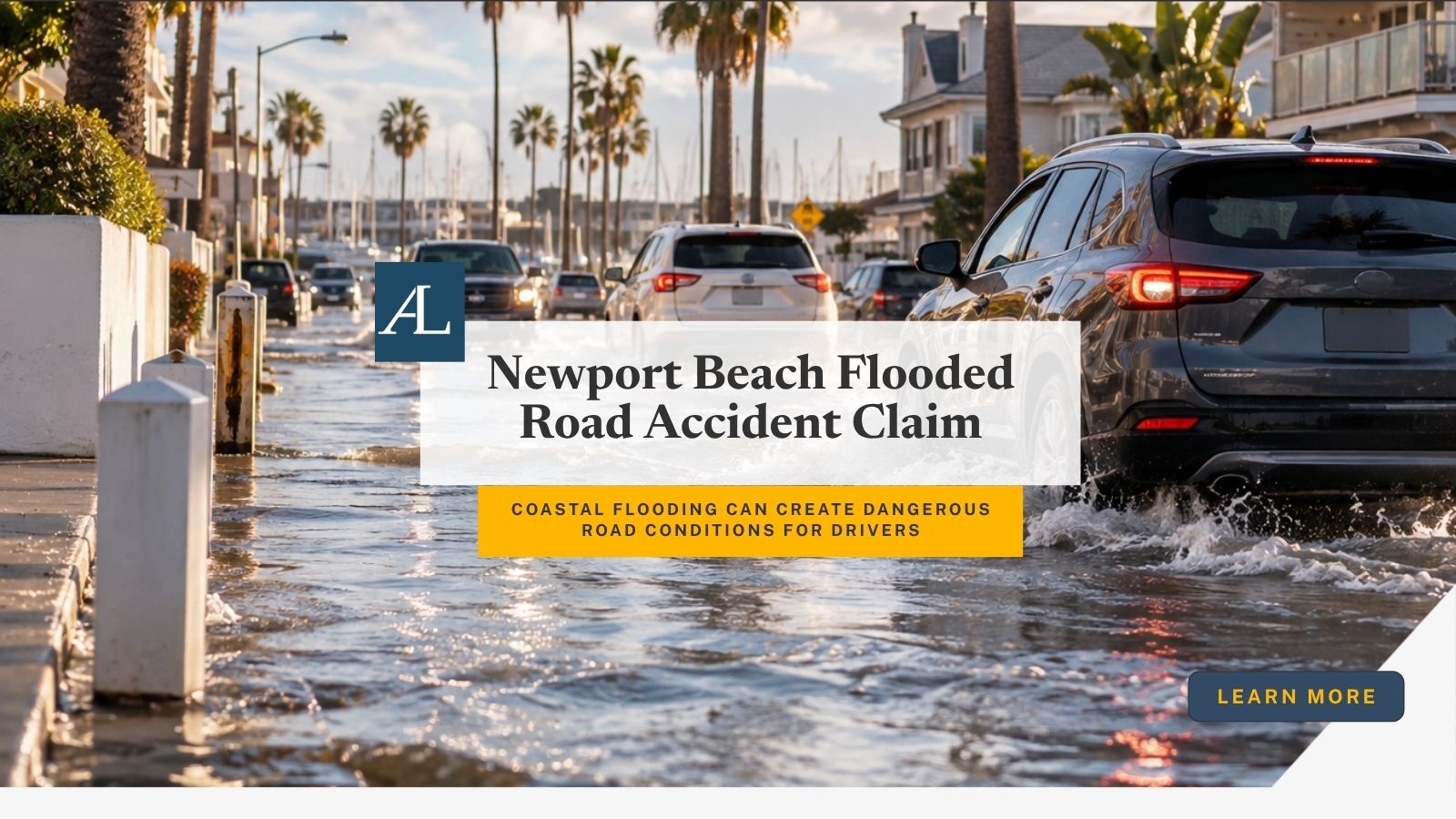
A Newport Beach flooded road accident claim can involve more than a driver losing control on a wet street. Coastal flooding can place standing water across traffic lanes, conceal pavement damage, reduce visibility, interrupt normal traffic patterns, and create unexpected hazards for motorists, pedestrians, cyclists, and passengers. When unusually high tides push ocean water into low-lying neighborhoods, drivers may encounter dangerous conditions even when it is not raining heavily at the location of the accident. Determining who may be responsible requires examining the roadway, weather conditions, warning signs, driver behavior, available insurance, and the evidence preserved before the water recedes.
Recent flooding in Newport Beach has brought these concerns into focus. On October 9, 2026, the City of Newport Beach declared a local emergency after elevated ocean water levels and high surf contributed to street flooding along the Balboa Peninsula. City officials reported that crews were reinforcing beach berms, monitoring water levels, opening tide valves, and operating pumping systems to address the conditions. The city’s October 9 community update identified vulnerable locations including portions of Balboa Boulevard, streets along the peninsula, the Wedge, and Corona del Mar.
Local news coverage showed vehicles navigating flooded streets and described traffic disruptions along the Balboa Peninsula. The Los Angeles Times reported flooding around West Balboa Boulevard and 19th Street, while other coverage documented vehicles becoming stranded as water reached surrounding neighborhoods. These reports establish that hazardous roadway conditions occurred, although they do not establish that any specific injury collision resulted from the flooding.
A Newport Beach flooded road accident claim must be evaluated according to the facts of the individual collision. A driver who enters deep standing water despite visible warnings may face different liability questions from a motorist struck by another vehicle that hydroplanes into an adjacent lane. A crash involving a poorly marked closure may require a different investigation from one involving a driver who was traveling too fast for the conditions. Flooding itself does not automatically establish negligence, and the presence of water does not necessarily eliminate responsibility for unsafe driving.
California’s basic speed law, Vehicle Code Section 22350, requires drivers to operate at a speed that is reasonable for the weather, visibility, traffic, roadway surface, and width. This means a posted speed limit is not necessarily a safe speed when a street is partially submerged, visibility is reduced, or other vehicles are slowing or turning around to avoid flooding.
For someone injured during a flood-related collision, an experienced Newport Beach personal injury lawyer and Newport Beach car accident lawyer at Avrek Law Firm can help investigate the circumstances, preserve roadway and vehicle evidence, identify potentially responsible parties, and evaluate insurance coverage.
Call 866-598-5548, start a live chat, or request a free injury consultation today. There are no upfront legal fees, and you do not pay unless we win.
Why Coastal Flooding Creates Unique Roadway Hazards in Newport Beach
A Newport Beach flooded road accident claim may involve conditions that differ substantially from an ordinary rain-related collision. Coastal flooding can develop when elevated ocean water levels, unusually high tides, surf, and other weather conditions combine to push water into streets. A roadway may become hazardous without the familiar warning signs of a heavy rainstorm, and drivers may underestimate the depth or extent of the water because nearby streets remain relatively dry.
Newport Beach’s coastal geography creates particular exposure in low-lying areas near the Balboa Peninsula and Newport Harbor. The October 2026 emergency demonstrated how elevated water levels could affect local roads and require an extensive municipal response. The city described its work to protect emergency access, reinforce vulnerable shoreline areas, and operate drainage-related systems.
These conditions create several possible accident mechanisms. A vehicle may lose traction while braking or turning, a driver may swerve into another lane to avoid deeper water, or traffic may stop unexpectedly near a flooded intersection. Water can also conceal road edges, potholes, debris, and pavement markings, making it harder to determine where a vehicle should travel.
High Tides, Standing Water, and Reduced Tire Traction
Standing water can interfere with tire contact with the pavement. When enough water separates the tire from the road surface, a vehicle may hydroplane, reducing steering and braking control. The risk depends on several factors, including vehicle speed, tire condition, tread depth, water depth, and roadway characteristics.
A Newport Beach flooded road accident claim involving suspected hydroplaning should document more than the presence of water. Investigators may need photographs showing water depth, tire condition, roadway slope, drainage locations, traffic speed, and the driver’s attempted response. Dashcam footage or nearby surveillance may show whether the vehicle began sliding before the collision or whether another event caused the loss of control.
Saltwater presents additional concerns for vehicles and electrical components after exposure. However, post-flood mechanical damage should be evaluated separately from the cause of an injury collision. A damaged electrical system discovered days later does not automatically prove that the same problem caused the original crash.
The central question is whether the driver responded reasonably to the conditions and whether the flooding contributed to the collision in a way supported by the evidence.
Flooded Intersections, Hidden Lane Markings, and Unexpected Traffic Stops
A Newport Beach flooded road accident claim can become particularly complicated when standing water covers lane markings, curbs, turn arrows, stop lines, or the edge of the roadway. Drivers may move toward the center of a street to avoid deeper water, enter an opposing lane, or make an unexpected turn to find a safer route.
The collision sequence matters. A vehicle may be struck from behind after slowing for flooding, sideswiped by another driver attempting to avoid water, or involved in a multi-vehicle collision when traffic stops abruptly near a flooded area. In each situation, the investigation should determine where the vehicles were traveling and whether the movements were reasonable under the circumstances.
Photographs of the roadway before and after the water recedes can be useful, but they serve different purposes. Images taken during the flooding show the actual hazard, while later photographs may reveal the lane markings, curb boundaries, drainage structures, and road layout that were concealed.
A Newport Beach flooded road accident claim should preserve both sets when available. Together, they may show how the roadway’s appearance changed and why a driver had difficulty identifying the correct travel path.
Poor Visibility, Coastal Weather, and Drivers Unfamiliar With Local Conditions
Newport Beach attracts residents, commuters, beach visitors, and tourists who may have different levels of familiarity with local streets. During coastal flooding, an unfamiliar driver may not recognize which roads are prone to standing water or where a safer alternative route exists.
Unfamiliarity does not eliminate the obligation to drive carefully. A Newport Beach flooded road accident claim should examine whether warning signs, barricades, emergency instructions, visible water, stopped traffic, or other indicators provided reasonable notice of the hazard.
Reduced visibility may also result from darkness, spray from passing vehicles, reflections on wet pavement, or changing weather. Drivers who cannot see lane boundaries or other vehicles clearly may need to slow substantially or avoid entering the affected roadway.
The investigation should document the driver’s actual viewpoint rather than assume that every hazard was equally visible from every direction.
Determining Liability in a Newport Beach Flooded Road Accident Claim
A Newport Beach flooded road accident claim requires distinguishing between a natural hazard and conduct that may have contributed to the resulting injuries. Coastal flooding may create the dangerous condition, but liability depends on whether a driver, business, property owner, or public entity had an applicable duty, failed to meet that duty, and caused legally compensable harm.
The fact that a collision occurred during an emergency does not automatically make another person responsible. Likewise, a driver cannot necessarily avoid responsibility simply by blaming the weather. The evidence must establish what happened and how each potentially responsible party acted.
Driver Responsibility When Road Conditions Become Dangerous
California Vehicle Code Section 22350 requires drivers to adjust their speed to prevailing conditions. A motorist traveling below the posted limit may still be driving too fast if the roadway is covered in water, visibility is poor, or nearby vehicles are moving unpredictably.
A Newport Beach flooded road accident claim should examine the driver’s speed, braking, steering, following distance, tire condition, and response to visible hazards. Video, witness statements, vehicle data, photographs, and the driver’s own statements may help establish whether the motorist had time to recognize the flooding and respond safely.
The investigation should also consider whether the driver attempted to pass another vehicle, changed lanes without adequate clearance, entered a flooded intersection, or ignored a barricade. Each action must be evaluated in the context of the actual road conditions.
A driver who reasonably loses control because of a sudden, unavoidable hazard may present a different liability question from someone who continues at an unsafe speed through clearly visible standing water. A Newport Beach flooded road accident claim should preserve evidence that distinguishes those situations.
When Another Driver Hydroplanes or Loses Control
Hydroplaning can be part of a collision sequence, but the word itself does not determine fault. An insurer may describe the event as unavoidable because the road was wet, while another party may argue that the driver should have reduced speed or maintained safer tires.
The investigation should determine whether the driver encountered a sudden change in conditions, whether the water was visible, how fast the vehicle was traveling, and whether other motorists navigated the same area without losing control.
A Newport Beach flooded road accident claim may also involve more than one impact. A sliding vehicle could strike another car, which then contacts a third vehicle or roadside object. The resulting damage and injuries may need to be reconstructed separately.
An experienced car accident lawyer can help evaluate competing accounts and identify the evidence needed to determine whether unsafe driving contributed to the crash.
Can the City Be Responsible for a Flooded Road?
A Newport Beach flooded road accident claim may raise questions about public roadway conditions, but public-entity liability is not automatic. California law provides specific rules for claims involving dangerous conditions of public property, including requirements concerning the condition, causation, foreseeable risk, and the public entity’s responsibility or notice.
The relevant legal framework includes California Government Code Section 835, which addresses injuries caused by dangerous conditions of public property. Whether a particular flooded roadway satisfies that standard requires careful review of the facts and applicable defenses.
Investigators may examine whether warning signs or barricades were present, whether the city received prior complaints, whether flooding was recurring at the location, whether drainage infrastructure was functioning, and what response measures were undertaken. Public records, maintenance logs, emergency communications, roadway inspections, and photographs may become relevant.
However, the October 2026 emergency declaration itself does not establish that Newport Beach acted negligently. City records describe active flood-response measures, including pumping, tide-valve operations, and reinforcement of protective berms.
A Newport Beach flooded road accident claim involving possible public-entity responsibility must consider statutory immunities, emergency-response circumstances, and the specific cause of the accident before drawing conclusions.
Evidence to Preserve After a Flooded Road Collision
A Newport Beach flooded road accident claim can be difficult to reconstruct because the roadway may look completely different only hours after the collision. Water levels can fall, pumps may remove standing water, emergency crews may clear debris, barricades may be moved, and vehicles may be towed away.
Evidence should therefore be preserved as soon as it is safe to do so. No one should enter deep or moving floodwater, remain in active traffic, or delay emergency medical care to collect photographs.
Photographs of Water Depth, Road Conditions, and Warning Signs
Photographs should document the roadway from several angles. A Newport Beach flooded road accident claim may benefit from images showing the extent of standing water, submerged curbs, lane markings, traffic signals, barricades, warning signs, debris, and nearby drainage structures.
Water depth should not be estimated solely from memory when other evidence is available. Photographs showing water against tires, curbs, fixed structures, or other reference points may help investigators evaluate the conditions.
The time photographs were taken also matters because coastal flooding can change with tide levels and emergency pumping activity. Preserve original image files when possible, including their timestamps and metadata.
A later photograph showing a dry street does not necessarily contradict an earlier report of flooding. The investigation should establish when each image was created.
Dashcams, Business Surveillance, and Witness Statements
Dashcam footage can show when the driver first encountered water, whether traffic slowed, whether warning devices were visible, and how the vehicles moved before impact.
A Newport Beach flooded road accident claim may also involve surveillance from nearby businesses, homes, parking areas, hotels, or other properties. Those recordings may capture the collision or the changing flood conditions.
Witnesses can provide information about traffic speed, vehicle movements, water depth, road closures, and whether drivers received warnings. Their accounts should be recorded independently and as soon as practical.
If a witness only saw the aftermath, that observation may still help establish vehicle positions or flooding conditions, but it should not be presented as direct evidence of the collision itself.
Weather Alerts, Tide Records, and Emergency Communications
Coastal flooding investigations may require records beyond an ordinary collision report. A Newport Beach flooded road accident claim can benefit from tide observations, National Weather Service advisories, city emergency notices, road-closure announcements, and contemporaneous photographs.
The National Weather Service provides official weather information, while NOAA Tides and Currents provides coastal water-level observations and related data.
These sources can help establish the environmental conditions at the time of a collision, although a regional tide reading may not show the exact water depth at a particular intersection.
The City of Newport Beach’s October 9 updates provide a useful example of public emergency communications identifying vulnerable areas and describing protective measures. A Newport Beach flooded road accident claim should preserve the notices relevant to the precise location and time of the accident.
Vehicle Damage, Tow Records, and Electronic Data
Floodwater can create mechanical and electrical problems, but a collision may also damage the vehicle independently of water exposure. A Newport Beach flooded road accident claim should preserve repair estimates, diagnostic scans, photographs, towing invoices, storage records, and any available vehicle data.
Some vehicles record information associated with qualifying crashes. Depending on the vehicle and event, this may include speed, braking, restraint status, or other limited data. Avrek’s article about event data recorder evidence after a car accident explains why electronic information may become useful when drivers disagree about the collision sequence.
The vehicle should be evaluated by qualified repair professionals before being driven after significant water exposure. A flooded vehicle may have safety-related problems that are not obvious from exterior photographs.
Insurance Questions After a Flooded Road Accident
A Newport Beach flooded road accident claim can involve two separate insurance issues: coverage for damage caused by floodwater and liability coverage for injuries or damage resulting from a collision.
Those questions should not be treated as interchangeable. A policy may respond differently to water entering a parked vehicle than to a crash caused by another driver’s unsafe conduct.
Comprehensive Versus Collision Coverage
Comprehensive coverage commonly addresses certain noncollision losses, including direct flood damage, subject to the policy’s terms and exclusions. Collision coverage generally addresses damage from impact with another vehicle or object, again depending on the policy.
A Newport Beach flooded road accident claim may involve both kinds of damage. For example, water may damage a vehicle’s electrical system while a separate collision causes body damage. The insurer may need to distinguish the cause and extent of each loss.
The California Department of Insurance’s automobile insurance resources explain different types of auto coverage and the importance of reviewing policy terms.
An injured person should not assume that comprehensive coverage pays bodily injury claims against another driver or that a collision claim automatically resolves flood-related mechanical damage.
Liability Insurance When Another Driver Causes the Crash
If another driver acted negligently and caused a collision, that driver’s liability insurance may become relevant. A Newport Beach flooded road accident claim should preserve the other driver’s identifying information, insurance details, police report, photographs, and witness information.
An insurer may argue that the flooding, rather than the insured driver, caused the collision. That position should be evaluated through the driver’s conduct and the available evidence.
The presence of hazardous weather does not necessarily eliminate liability. The legal question is whether the driver acted reasonably under the circumstances and whether any unreasonable conduct caused the injuries.
Uninsured or Underinsured Motorist Questions
A Newport Beach flooded road accident claim may also involve uninsured or underinsured motorist coverage when another driver causes the crash and lacks sufficient applicable liability insurance.
Coverage depends on the policy, the circumstances, and the applicable legal requirements. A hit-and-run collision during flooding can present additional identification and coverage issues.
The injured person should preserve all insurance communications and avoid assuming that a claim is unavailable simply because the at-fault driver lacks adequate insurance.
Injury Documentation After a Flood-Related Collision
A Newport Beach flooded road accident claim should document the injured person’s medical condition separately from the weather and roadway investigation. A collision involving a vehicle that slides, stops abruptly, strikes another car, or leaves the roadway may cause injuries that require medical evaluation.
Possible injuries depend on the specific event and may include head trauma, neck or back injuries, fractures, shoulder or knee injuries, soft-tissue injuries, and other conditions. Diagnosis and treatment should come from qualified healthcare professionals.
Preserve emergency records, imaging, specialist evaluations, therapy notes, prescriptions, work restrictions, and follow-up recommendations. The injured person should explain how the collision occurred, including the direction of impact, seating position, restraint use, and any secondary impacts.
A Newport Beach flooded road accident claim should also document wage loss, transportation expenses, damaged personal property, caregiving needs, and changes in daily activity. The property-damage claim and injury claim may proceed on different timelines, and a repair estimate should not be treated as a medical opinion.
Early settlement offers deserve caution when treatment remains ongoing, coverage is disputed, or roadway evidence has not been preserved.
What to Do After a Newport Beach Flooded Road Accident
Safety should come first after a collision involving floodwater. Do not attempt to drive through deep or moving water, enter a submerged vehicle when electrical hazards may be present, or stand in an active traffic lane to photograph damage. If anyone is injured or trapped, contact emergency services and follow instructions from responding personnel.
Once the immediate danger has passed, a Newport Beach flooded road accident claim should be documented through photographs, video, witness information, and the relevant emergency notices. Preserve the vehicle’s position when it can be photographed safely, the water level, roadway markings, warning signs, barriers, debris, and damage to all involved vehicles. Record the exact location and approximate time because water levels and traffic conditions may change rapidly.
Report the collision to the appropriate law-enforcement agency and insurer. California DMV requires an SR-1 accident report within 10 days when a collision causes injury or death or property damage exceeding $1,000, subject to the reporting rules. The SR-1 is separate from police and insurance reports.
If the vehicle was exposed to substantial floodwater, arrange for qualified inspection before attempting to operate it. Keep towing, storage, diagnostic, repair, and insurance records. A Newport Beach flooded road accident claim may require distinguishing mechanical water damage from damage caused by the collision itself.
Medical evaluation should be based on the person’s symptoms and professional guidance. Continue documenting treatment, work restrictions, transportation expenses, and other losses while the liability investigation proceeds.
California Deadlines for Flood-Related Accident Claims
A Newport Beach flooded road accident claim may be subject to different deadlines depending on the potentially responsible parties. Under California Code of Civil Procedure Section 335.1, many personal injury actions generally have a two-year filing period. However, different rules and exceptions may apply, so the precise deadline should be evaluated for the individual case.
When a public entity may be responsible, shorter procedures can become important. California Government Code Section 911.2 generally requires certain claims involving personal injury or property damage to be presented to the public entity within six months of accrual, subject to applicable exceptions and procedures.
A Newport Beach flooded road accident claim involving possible public roadway liability should therefore receive prompt legal review. A city emergency declaration does not automatically establish responsibility, and submitting an insurance claim or police report does not necessarily satisfy the requirements for a government claim.
The evidence-preservation deadline can be even shorter. Floodwater may recede within hours, road crews may remove barriers or debris, vehicles may be towed, and camera footage may be overwritten. Those changes can make reconstruction difficult long before a lawsuit deadline approaches.
Frequently Asked Questions About a Newport Beach Flooded Road Accident Claim
Who is responsible if I crash on a flooded road in Newport Beach?
Responsibility depends on the specific circumstances. A driver may be responsible for traveling too fast for the conditions, following too closely, or making an unsafe maneuver. Other circumstances may raise questions about roadway conditions or another party’s conduct. A Newport Beach flooded road accident claim requires evidence establishing negligence and causation rather than assuming the flooding itself determines fault.
Can I file a claim if another driver hydroplanes into my car?
Potentially. Hydroplaning does not automatically excuse a driver from responsibility. The investigation should examine speed, tire condition, water depth, visibility, and whether the driver adjusted to the roadway conditions. A Newport Beach flooded road accident claim may be supported when evidence shows that unreasonable driving contributed to the collision.
Is Newport Beach responsible for flooding on city streets?
Not automatically. Public-entity liability depends on California law, the condition of the roadway, notice, causation, and applicable defenses or immunities. The city declaring an emergency does not itself establish negligence.
What if the road was flooded but there were no warning signs?
The absence of warning signs may be relevant, but it does not automatically establish liability. Investigators should determine who controlled the roadway, whether the hazard was known, whether warnings were required under the circumstances, and whether the absence of warnings contributed to the collision.
Does car insurance cover flood damage?
Comprehensive coverage commonly applies to certain direct flood-related vehicle damage, subject to policy terms. Collision coverage generally addresses impact damage. A Newport Beach flooded road accident claim involving injuries caused by another driver may also involve liability coverage.
What if I drove into standing water and my engine stopped?
An engine failure caused by water exposure is not necessarily a collision-related personal injury claim. Vehicle coverage may depend on the policy and the circumstances. A qualified mechanic should inspect the vehicle, and the insurer should be notified of the damage.
Can a flooded road cause a multi-vehicle accident?
Yes. Drivers may brake suddenly, lose traction, swerve, or enter another lane to avoid standing water. A Newport Beach flooded road accident claim involving multiple vehicles should reconstruct the order of impacts and each driver’s conduct rather than automatically assigning responsibility to the first vehicle that lost control.
What evidence should I photograph after a flooded road collision?
Photograph the water level, roadway, vehicles, damage, signs, barricades, lane markings, nearby drainage structures, and surrounding cameras when it is safe. Preserve original files with timestamps because conditions may change rapidly.
Can tide records help prove the roadway was flooded?
Tide observations and official weather information can provide useful environmental context. However, a coastal water-level reading may not establish the exact depth of water at a particular intersection. A Newport Beach flooded road accident claim is stronger when official records are combined with scene photographs, witnesses, and local video.
What if the insurance company blames the weather?
The insurer’s explanation should be compared with the driver’s actions and the complete evidence. Weather and flooding may contribute to an accident without eliminating the possibility that unsafe driving also contributed.
Can I recover compensation for injuries even if my car has limited damage?
Potentially. Vehicle damage is one part of the evidence, but injury diagnosis and treatment should be evaluated by healthcare professionals. A Newport Beach flooded road accident claim should document both the collision and the injured person’s medical condition.
What if the other driver was uninsured?
The injured person’s own uninsured or underinsured motorist coverage may become relevant depending on the policy and facts. Additional coverage questions can arise when the vehicle was used for work or another commercial purpose.
How long do I have to file a flood-related injury claim?
Many California personal injury actions generally have a two-year limitations period, but claims involving public entities may require action substantially sooner. A Newport Beach flooded road accident claim should be reviewed promptly to identify the correct deadline.
Do I need a lawyer after a flooded road accident?
Legal assistance may be useful when another driver disputes responsibility, insurance coverage is unclear, roadway conditions changed before evidence was preserved, or a public entity may be involved. A Newport Beach car accident lawyer can help evaluate the evidence and applicable claims.
Call or Contact Avrek Law Firm 24/7 for a Free Consultation and Pay Nothing Unless We Win
A Newport Beach flooded road accident claim can become complicated because the central roadway evidence may disappear quickly. Water levels change, streets reopen, warning devices move, vehicles are towed, and insurance companies may reach different conclusions about whether the collision resulted from unsafe driving, a roadway condition, or an unavoidable event.
The October 2026 coastal flooding highlights why these cases require careful investigation. Newport Beach’s emergency response involved multiple low-lying areas, flood-control measures, and warnings about dangerous conditions. Those circumstances provide important local context, but responsibility for any particular injury accident must be established through the evidence.
Avrek Law Firm can help investigate a Newport Beach flooded road accident claim by reviewing available photographs, weather and tide records, emergency notices, police reports, witness accounts, vehicle damage, insurance policies, and medical documentation. When appropriate, our team can also evaluate whether another driver, commercial entity, or public entity may bear legal responsibility.
If you or someone you love was injured in a Newport Beach motor vehicle accident involving flooded streets, standing water, or hazardous coastal conditions, contact Avrek Law Firm today. Call 866-598-5548, start a live chat, or complete our online consultation form. Your consultation is free, and you do not pay unless we win.
Serving People Injured in Flood-Related Accidents Throughout Newport Beach
A Newport Beach flooded road accident claim may arise on the Balboa Peninsula, near Newport Harbor, along coastal commercial corridors, or in other low-lying areas affected by unusually high water levels. Conditions can vary considerably from one street to another, making location-specific evidence essential.
During the October 2026 emergency, city officials identified vulnerable areas including sections of Balboa Boulevard, streets from 6th through 15th and 44th through 52nd, the Wedge, and Corona del Mar. Those locations illustrate the range of coastal areas that may require monitoring and emergency precautions, not a verified list of injury-accident locations.
For a Newport Beach flooded road accident claim, local evidence may include municipal emergency updates, business surveillance, roadway photographs, drainage and maintenance records, witness accounts, tide observations, and the conditions at the precise time of the collision. A Newport Beach personal injury lawyer can help evaluate those records while Avrek’s car accident lawyers address the injury and insurance questions.
The goal is to establish what happened, which conditions contributed to the crash, whether anyone failed to act reasonably, and how the collision affected the injured person’s health and financial stability.
- 📩 Submit a request through our online form
- 📞 Call 866-598-5548 now to speak with our team
- 💬 Start a live chat for immediate assistance
There are no upfront fees, and you don’t pay unless we win.