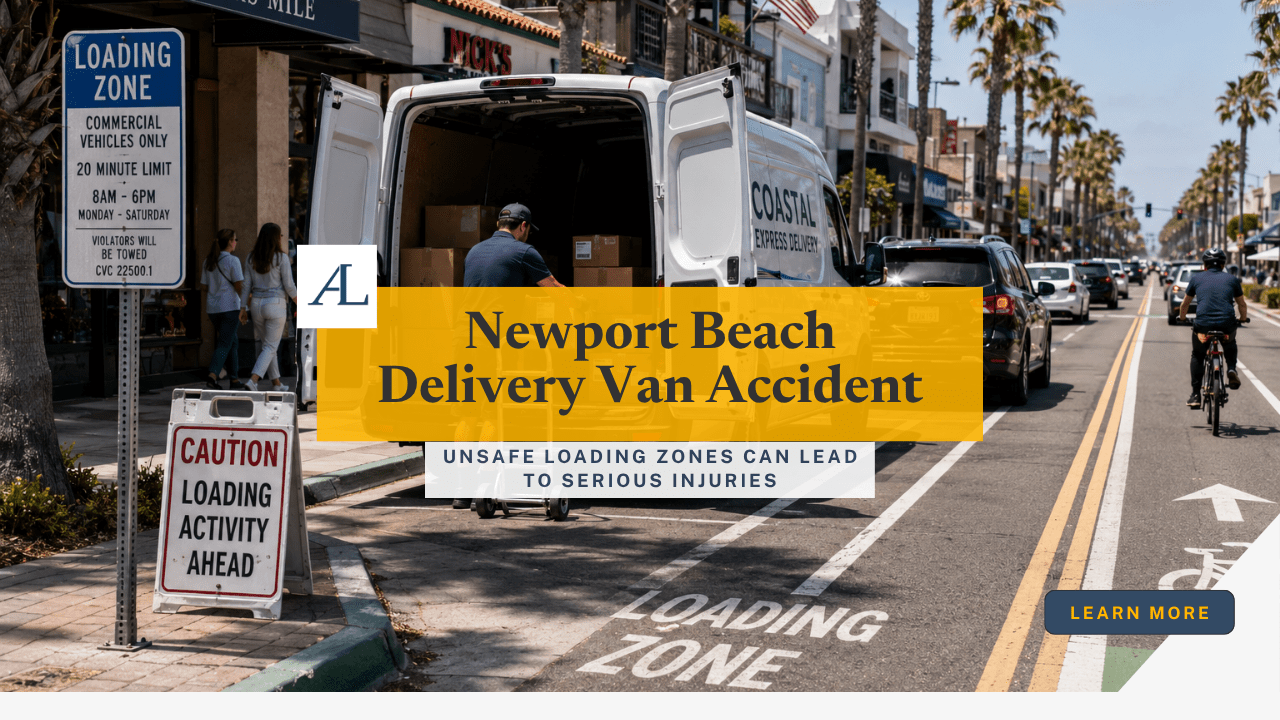
A Newport Beach delivery van loading zone accident claim can become far more complicated than a typical motor vehicle collision because these crashes often involve commercial drivers operating under demanding delivery schedules, multiple insurance policies, employer safety procedures, and business districts where traffic congestion is already high. Throughout Newport Beach, delivery vans constantly move between restaurants, luxury hotels, shopping centers, grocery stores, office buildings, and waterfront businesses. While these deliveries help local commerce operate efficiently, they also create situations where a single improperly parked commercial van can place everyone nearby at risk.
Unlike private passenger vehicles, delivery vans frequently stop in designated loading areas, valet zones, curbside pickup spaces, and commercial service entrances. Drivers may park only briefly while unloading packages, restaurant supplies, retail merchandise, or hotel deliveries. However, when those stops occur outside authorized loading zones—or when a delivery vehicle blocks a travel lane, bicycle lane, driveway, or crosswalk—the consequences can be severe. Motorists may suddenly change lanes to avoid the obstruction, cyclists may be forced into moving traffic, and pedestrians may lose visibility while attempting to cross the street. In many cases, the delivery van never physically strikes another vehicle, yet its unsafe position becomes one of the primary causes of the collision.
When someone is injured under these circumstances, choosing the right legal representation matters. A knowledgeable Newport Beach truck accident lawyer at Avrek Law Firm understands that a Newport Beach delivery van loading zone accident claim involves far more than reviewing a standard police report. Commercial vehicle cases often require the preservation of company records, delivery schedules, vehicle telematics, surveillance footage, driver training documents, and evidence that may disappear long before an injured victim realizes its importance. Our attorneys move quickly to protect your rights, investigate every responsible party, and pursue the full compensation you deserve under California law.
Call 866-598-5548, start a chat, or request a free case review today. There are no upfront fees, and you pay nothing unless we win.
Why Newport Beach Delivery Van Loading Zone Accident Claims Are More Complex Than They Appear
A Newport Beach delivery van loading zone accident claim is rarely limited to determining which driver caused a collision. Commercial delivery operations function very differently from ordinary passenger traffic, and those differences often become central to determining liability. Delivery companies rely on strict routing software, customer delivery windows, GPS monitoring, productivity quotas, and scheduling systems that encourage drivers to complete as many deliveries as possible within a limited period. While these systems improve efficiency, they may also create pressure that encourages unsafe parking decisions and hurried deliveries.
Throughout Newport Beach, this issue is especially noticeable around Fashion Island, Balboa Peninsula, Cannery Village, Mariners Mile, Pacific Coast Highway, Newport Center Drive, and the city’s numerous luxury hotels and waterfront restaurants. These areas attract thousands of residents, tourists, rideshare drivers, cyclists, pedestrians, valet attendants, and commercial vehicles every day. Curb space is limited, loading areas are frequently occupied, and drivers often make quick decisions about where to stop so they can complete a delivery before moving to the next location.
Unfortunately, those decisions sometimes place convenience ahead of safety. A delivery van may stop partially inside a bicycle lane because the designated loading space is occupied. Another driver may double-park outside a hotel entrance while unloading luggage or food deliveries. A commercial vehicle may temporarily block a travel lane near a restaurant because there are no immediately available loading spaces. Although these stops are often intended to last only a few minutes, they can create dangerous traffic conditions almost instantly.
Unlike a standard traffic accident, a Newport Beach delivery van loading zone accident claim frequently requires investigators to determine not only whether the driver acted negligently, but also whether the delivery company created workplace expectations that encouraged unsafe stopping practices. Internal company policies, delivery quotas, dispatcher communications, GPS routing instructions, and driver performance evaluations may all become relevant evidence during the investigation.
California Laws May Affect a Newport Beach Delivery Van Loading Zone Accident Claim
California law regulates where commercial vehicles may stop, stand, and park while conducting business. Although loading zones exist to support deliveries, drivers remain responsible for ensuring that their vehicles do not create unreasonable hazards for surrounding traffic. Simply activating hazard lights or claiming that a stop lasted only a few minutes does not eliminate the duty to operate safely.
California Vehicle Code provisions governing stopping, standing, and parking establish where vehicles may legally stop and under what circumstances commercial loading activities may occur.
For a Newport Beach delivery van loading zone accident claim, investigators frequently evaluate whether the delivery driver:
- stopped outside a designated loading zone;
- blocked a bicycle lane;
- obstructed a travel lane;
- interfered with pedestrian access;
- limited visibility at an intersection or driveway;
- violated local parking or commercial loading regulations.
These issues become especially important when the delivery van itself is not the vehicle that directly struck the injured victim. A delivery vehicle positioned unsafely can trigger chain reactions that involve several motorists, cyclists, or pedestrians without ever making physical contact itself.
Commercial Vehicle Operations Create Different Liability Questions
One reason a Newport Beach delivery van loading zone accident claim differs from an ordinary automobile accident is that commercial drivers operate within a structured business environment. Their actions are often influenced by employer expectations rather than personal convenience. Many drivers work under strict performance standards that measure delivery speed, route completion, customer satisfaction, and overall productivity. Missing delivery windows may result in disciplinary action, reduced compensation, or poor performance ratings.
Because of these pressures, investigators often examine much more than the driver’s actions immediately before the collision. Company dispatch records, GPS tracking data, delivery schedules, driver training materials, commercial insurance policies, and employer safety procedures may all become relevant evidence. In some cases, the company itself may share responsibility if unrealistic scheduling or inadequate training contributed to unsafe parking decisions.
Federal Motor Carrier Safety Administration regulations also establish numerous safety responsibilities for commercial vehicle operators and employers, particularly regarding driver qualifications, vehicle inspections, and operational safety.
Commercial vehicle investigations therefore extend far beyond what most people expect after an ordinary traffic accident. That is one of the primary reasons a Newport Beach delivery van loading zone accident claim should be investigated promptly before critical company records become unavailable.
Evidence That Can Make or Break a Newport Beach Delivery Van Loading Zone Accident Claim
A Newport Beach delivery van loading zone accident claim depends heavily on evidence because the condition that caused the crash may disappear within minutes. A delivery van that blocked a lane outside a restaurant may leave before police arrive. A hotel valet zone may return to normal after traffic clears. A loading area that was crowded at the time of the crash may look completely safe when an insurance adjuster reviews the scene days later. This is why injured victims should not assume that a police report alone will tell the full story.
The strongest evidence in a Newport Beach delivery van loading zone accident claim usually shows the position of the delivery van before the collision, the nearby traffic flow, the available loading areas, the visibility conditions, and the path the injured person was forced to take. If the delivery vehicle created the hazard but did not physically strike the injured person, evidence becomes even more important. Insurance companies often argue that the delivery van was only “background” to the crash, while the injured person must prove that the unsafe stop caused the chain of events.
A properly investigated Newport Beach delivery van loading zone accident claim should identify every record that can show what happened before vehicles were moved. That may include photos, video footage, witness statements, delivery records, GPS data, driver logs, app timestamps, business surveillance, property management records, and commercial insurance information. Without early preservation, some of the most useful evidence may be lost before the injured person knows it exists.
Scene Photos and Loading Zone Layout
Scene photos are one of the first forms of evidence that can strengthen a Newport Beach delivery van loading zone accident claim. The photos should show more than vehicle damage. They should document the loading zone, curb markings, posted signs, nearby driveways, crosswalks, bike lanes, valet areas, traffic lanes, and the location where the delivery van was stopped. The goal is to show how the delivery van affected the entire traffic environment, not just the final point of impact.
For example, a delivery van stopped near a restaurant entrance on Pacific Coast Highway may block the view between a pedestrian and an approaching driver. A van outside a hotel near Newport Center Drive may force rideshare vehicles to pull into moving traffic. A delivery vehicle near Mariners Mile may cause cyclists to merge out of a protected space and into a faster travel lane. These details matter because a Newport Beach delivery van loading zone accident claim often turns on whether the van’s position created a foreseeable hazard.
California Vehicle Code Section 22500 prohibits stopping, parking, or leaving a vehicle standing in several locations, including within intersections, on crosswalks, in front of driveways, on sidewalks, alongside obstructions when traffic would be blocked, and on the roadway side of a vehicle stopped or parked at the curb. The same section also includes rules related to stopping near crosswalks and certain commercial loading areas.
In a Newport Beach delivery van loading zone accident claim, this statute can help frame whether the delivery driver stopped in a location that created risk for nearby drivers, cyclists, or pedestrians. The statute alone does not automatically decide the case, but it gives the investigation a legal framework for evaluating whether the stop was unsafe or prohibited.
Surveillance Footage From Coastal Businesses and Parking Areas
Video footage can be the most important evidence in a Newport Beach delivery van loading zone accident claim because it may show what happened before the injured person had any chance to react. Newport Beach has many businesses with exterior cameras, including restaurants, retail stores, hotels, parking garages, office buildings, banks, apartment communities, and shopping centers. A crash near Fashion Island, Balboa Village, Cannery Village, Newport Pier, or a coastal shopping corridor may have been captured from more than one angle.
A business camera may show the delivery van pulling into a loading zone, blocking a bike lane, stopping beside a red curb, or leaving its rear doors open into a travel path. A hotel camera may show valet congestion that forced pedestrians into a dangerous crossing position. A parking garage camera may show a delivery driver stopping near an exit and reducing visibility for vehicles entering Coast Highway. Even when video does not capture the exact impact, it can still prove that a delivery van created the dangerous condition that led to the crash.
In a Newport Beach delivery van loading zone accident claim, video preservation should happen quickly because many businesses overwrite footage within days or weeks. An injured person may not know which cameras exist, and businesses are not always obligated to save footage unless they receive a proper preservation request. This is one reason early legal involvement matters. Avrek Law Firm can identify nearby camera sources, send preservation letters, and work to secure footage before it disappears.
Delivery Company Records and Vehicle Data
A Newport Beach delivery van loading zone accident claim may involve evidence controlled by the delivery company rather than evidence available at the scene. Many delivery operations use GPS tracking, route software, package scan timestamps, delivery confirmation photos, fleet telematics, dashcams, dispatch communications, and driver performance data. These records can show why the driver stopped where they did, how long the van remained in the loading area, whether the driver was behind schedule, and whether company pressure contributed to the unsafe stop.
If the driver was using a company-owned delivery van, the employer may have maintenance records, training documents, vehicle inspection logs, and safety policies that become relevant. If the driver was working for a contractor or logistics partner, the claim may require identifying the relationship between the driver, the vehicle owner, the delivery platform, and the business receiving the delivery. That relationship can affect available insurance coverage and liability.
The California DMV Commercial Driver Handbook explains that commercial drivers must know safe driving information, and its cargo section discusses the importance of securing cargo so it does not shift or affect vehicle handling.
These resources may matter in a Newport Beach delivery van loading zone accident claim when the crash involves delivery operations, unsafe parking practices, vehicle movement, backing, unloading, open doors, unsecured cargo, or a driver rushing through a commercial route. The more company records reveal about the delivery system, the harder it becomes for an insurer to treat the crash as a simple accident caused by one driver.
Bicycle Lane, Crosswalk, and Curbside Evidence in a Newport Beach Delivery Van Loading Zone Accident Claim
A Newport Beach delivery van loading zone accident claim often involves more than one road user. The injured person may be a driver, passenger, cyclist, scooter rider, pedestrian, hotel guest, delivery worker, valet attendant, or restaurant customer. This is especially true in Newport Beach because many commercial areas mix vehicle traffic with heavy pedestrian and bicycle activity.
Bike lanes and crosswalks deserve special attention. Newport Beach has coastal routes where cyclists and e-bike riders move near parked cars, loading zones, restaurant entrances, and hotel driveways. A delivery van blocking a bicycle lane may not hit the cyclist directly, but it may force the rider into traffic where another vehicle causes the impact. A delivery van parked too close to a crosswalk may block the view between a pedestrian and an approaching driver. These conditions can transform a simple curbside stop into the foundation of a serious Newport Beach delivery van loading zone accident claim.
When a Delivery Van Blocks a Bicycle Lane
A delivery driver may claim they stopped in or near a bicycle lane for only a moment. That argument should not end the investigation. California Vehicle Code Section 21209 generally prohibits a person from driving a motor vehicle in a bicycle lane except in limited situations, including parking where permitted, entering or leaving the roadway, or preparing for a turn within 200 feet of an intersection.
This law can become important in a Newport Beach delivery van loading zone accident claim when a delivery van blocks, crosses, or occupies a bike lane without a lawful reason. If a cyclist or e-bike rider had to leave the bike lane because of the delivery van and was struck by another vehicle, the delivery driver’s conduct should be investigated as part of the crash sequence.
A Newport Beach delivery van loading zone accident claim involving a blocked bike lane may require photos of the lane markings, the van’s location, traffic flow, nearby curb signs, and the cyclist’s path. Helmet camera footage, dashcam video, business surveillance, and witness statements can help show whether the rider had any safe option other than moving around the obstruction.
Crosswalk and Intersection Visibility
Crosswalk visibility is another major issue in a Newport Beach delivery van loading zone accident claim. Delivery vans are larger than ordinary cars and can block a driver’s view of pedestrians, especially near hotels, restaurants, beach access points, and shopping centers. A pedestrian may step into a marked or unmarked crosswalk believing they are visible, while an approaching driver cannot see them because a delivery van is stopped too close to the crossing.
California’s rules on stopping near crosswalks have become more safety-focused in recent years. Vehicle Code Section 22500 includes restrictions on stopping within certain distances of marked or unmarked crosswalks, with exceptions for properly authorized and marked commercial loading areas. That distinction matters because a delivery driver cannot assume that every curbside space near a crosswalk is a safe loading area.
In a Newport Beach delivery van loading zone accident claim, investigators should examine whether the delivery van was stopped in a place that reduced pedestrian visibility. This includes reviewing curb markings, signs, crosswalk placement, traffic light timing, pedestrian signal position, nearby valet activity, and whether the driver had safer alternatives. If a van created a blind spot that contributed to a pedestrian impact, the van driver, employer, delivery company, or property owner may need to be investigated.
Insurance Issues in a Newport Beach Delivery Van Loading Zone Accident Claim
Insurance coverage can be one of the most confusing parts of a Newport Beach delivery van loading zone accident claim. The driver may have personal auto insurance, but that policy may not apply if the driver was working. The delivery company may have commercial coverage, but the insurer may argue that the driver was an independent contractor or outside the scope of employment. A logistics contractor may have a separate policy. A business receiving the delivery may have premises coverage if the loading area was unsafe.
These disputes can delay payment and confuse injured victims. One insurance company may blame another. A commercial carrier may deny that the driver was acting within the scope of work. A personal insurer may deny coverage because the vehicle was being used for business. A property insurer may argue that the roadway, not the property, caused the crash. A Newport Beach delivery van loading zone accident claim should be handled with a complete coverage investigation rather than relying on the first insurer that responds.
Why the Driver’s Personal Insurance May Not Be Enough
If a delivery driver was using their own vehicle for work, the insurance situation may become complicated quickly. Many personal auto policies exclude or limit coverage for commercial delivery activity. If the driver was delivering packages, food, groceries, retail goods, or business supplies at the time of the crash, the injured person may need to pursue coverage through a commercial policy, delivery platform policy, employer policy, contractor policy, or multiple policies at once.
A Newport Beach delivery van loading zone accident claim involving a personal vehicle used for deliveries may require app records, delivery screenshots, route data, customer communications, driver status records, and payment records. These documents can show whether the driver was actively working when the crash occurred.
If the vehicle was a company-branded van, coverage may still be disputed. The company may claim the driver was off duty, outside the assigned route, or working for a subcontractor. These defenses should not be accepted without reviewing company records, dispatch data, driver agreements, vehicle ownership records, and insurance documents.
Employer, Contractor, and Logistics Company Liability
A Newport Beach delivery van loading zone accident claim may involve several business entities. The driver may work for a local courier company, a national delivery brand, a third-party logistics contractor, a food delivery platform, a retail store, a hotel vendor, or a package distribution company. The name on the van may not be the same as the company responsible for the driver’s route, training, or insurance.
Employer liability may arise when the driver was acting within the scope of employment. Contractor liability may arise when a logistics company controlled the delivery schedule, route, training, vehicle, or performance requirements. Company negligence may arise when unsafe policies encouraged drivers to double-park, block lanes, rush deliveries, or stop in dangerous areas near coastal businesses.
A strong Newport Beach delivery van loading zone accident claim should examine whether the company trained drivers on safe loading practices, whether drivers were warned not to block bike lanes or crosswalks, whether route schedules were realistic, and whether prior complaints had been made about unsafe deliveries at the same business or loading area.
Property Owner and Business Liability
Not every Newport Beach delivery van loading zone accident claim is only about the driver and delivery company. Some crashes are connected to poor property design, unsafe loading-zone placement, inadequate signage, valet congestion, blocked sight lines, or business practices that direct delivery vehicles into dangerous curbside positions.
A restaurant may instruct delivery drivers to stop at a rear service entrance that forces vehicles to block a sidewalk. A hotel may have a loading area that overlaps with rideshare and pedestrian activity. A retail center may lack a safe delivery route, causing vans to stop near crosswalks or bike lanes. If the property owner or business knew about repeated unsafe delivery patterns and failed to correct them, that issue may become part of the claim.
In a Newport Beach delivery van loading zone accident claim, premises liability may overlap with commercial vehicle liability. The investigation should identify who controlled the loading area, who maintained the curbside space, who designed the traffic flow, and who had authority to correct the dangerous condition.
What Injured Victims Should Do After a Newport Beach Delivery Van Loading Zone Accident
A Newport Beach delivery van loading zone accident claim can be strengthened or weakened in the first hours after the crash. Victims are often shaken, in pain, and unsure what evidence matters. The safest approach is to focus on medical care first, then preserve information before vehicles leave and records disappear.
If emergency assistance is needed, call 911 immediately. If the crash occurred on a major roadway such as Pacific Coast Highway or near a shopping center, hotel, or restaurant district, law enforcement may help document the scene, identify drivers, and create a report. If a delivery van was involved, the injured person should try to identify the driver, company name, vehicle license plate, vehicle number, and any visible delivery markings.
The California DMV states that a driver, insurance agent, broker, or legal representative must complete and send an SR-1 report to DMV within 10 days if someone is injured, killed, or property damage is over $1,000, and the SR-1 is required in addition to any report made to police, CHP, or an insurance company.
This reporting requirement may apply after a Newport Beach delivery van loading zone accident claim, even when the delivery company’s insurer says it is handling the matter. Filing requirements and injury documentation should not be left entirely to the other side.
Medical Care and Injury Documentation
Medical documentation is essential in a Newport Beach delivery van loading zone accident claim because insurance companies may argue that the crash was minor, the van did not directly cause the impact, or the injury was unrelated. Prompt care helps connect symptoms to the crash and creates a clear medical record.
Victims may suffer neck injuries, back injuries, fractures, concussions, shoulder trauma, knee injuries, hip injuries, nerve symptoms, road rash, internal injuries, or emotional distress. Cyclists and pedestrians may suffer especially serious injuries when forced into traffic by a blocked lane or hidden by a delivery vehicle near a crosswalk. Even a low-speed collision can cause significant harm if a person falls onto pavement, strikes a curb, or is hit by a moving vehicle while avoiding the van.
A Newport Beach delivery van loading zone accident claim should include emergency room records, urgent care notes, imaging, orthopedic evaluations, neurologic assessments, physical therapy records, prescriptions, work restrictions, and follow-up appointments. If symptoms worsen after the initial visit, those changes should be documented rather than ignored.
Preserve Communications and Avoid Recorded Statements
After a Newport Beach delivery van loading zone accident claim, the injured person may receive calls from a driver’s insurer, a commercial insurance adjuster, a delivery company representative, or a business involved in the loading area. These communications can seem routine, but they may be designed to limit liability before the injured person has access to the full evidence.
An adjuster may ask whether the delivery van actually hit the injured person, whether the injured person could have avoided the van, whether the cyclist should have slowed down, whether a pedestrian crossed carefully, or whether another driver caused the final impact. These questions may later be used to shift blame or minimize the delivery company’s role.
In a Newport Beach delivery van loading zone accident claim, victims should save every email, letter, voicemail, claim number, text message, and insurer contact. They should avoid guessing about speed, distance, timing, or fault before video, company records, and medical evidence are reviewed. A recorded statement given too early can create problems even when the injured person is telling the truth.
Compensation Available in a Newport Beach Delivery Van Loading Zone Accident Claim
A Newport Beach delivery van loading zone accident claim may include compensation for the full impact of the crash, not just the first medical bill or vehicle repair estimate. Commercial insurers often try to settle early before future treatment, lost income, and long-term symptoms are understood. Accepting an early settlement can be risky if injuries continue to develop.
Compensation may include emergency care, hospital bills, specialist treatment, surgery, physical therapy, prescriptions, future medical care, lost wages, reduced earning capacity, property damage, transportation costs, pain and suffering, emotional distress, and loss of enjoyment of life. If the crash involved a cyclist, scooter rider, or pedestrian, compensation may also include damaged gear, bicycle or scooter replacement, helmet damage, and mobility-related expenses.
A Newport Beach delivery van loading zone accident claim may also involve higher coverage limits than a typical car accident because commercial policies may apply. However, higher coverage does not mean the insurer will pay fairly. Commercial insurers often defend aggressively, especially when they believe fault can be shifted to another driver, a cyclist, a pedestrian, or the property owner.
Economic Damages
Economic damages in a Newport Beach delivery van loading zone accident claim are the measurable financial losses caused by the crash. These include medical bills, rehabilitation costs, lost wages, vehicle damage, bicycle damage, transportation expenses, prescription costs, and future care expenses. The more serious the injury, the more important it becomes to document future treatment needs before settlement discussions begin.
A person who suffers a herniated disc, fracture, concussion, ligament injury, or nerve damage may need months of treatment. Some injuries require injections, surgery, pain management, assistive devices, or long-term therapy. If the injured person works in hospitality, retail, construction, food service, healthcare, delivery, or another physically demanding job, even a temporary injury may create significant wage loss.
A Newport Beach delivery van loading zone accident claim should not be valued based only on the first few bills. The proper analysis should consider what the injury has already cost and what it is likely to cost in the future.
Non-Economic Damages
Non-economic damages in a Newport Beach delivery van loading zone accident claim address the human impact of the crash. Pain, anxiety, reduced mobility, sleep problems, emotional distress, inability to exercise, fear of cycling, difficulty walking, and loss of independence may all matter. These losses can be especially significant when a delivery van created a sudden hazard in a place where the injured person had no realistic way to avoid danger.
A cyclist forced out of a blocked lane may lose confidence riding near traffic. A pedestrian struck near a hotel or restaurant district may become afraid to walk in crowded commercial areas. A driver injured after swerving around a delivery van may experience ongoing pain and stress whenever returning to the crash location.
Insurance companies often undervalue these harms because they do not appear on a receipt. A complete Newport Beach delivery van loading zone accident claim should document how the injury changed daily life, work, family responsibilities, recreation, and emotional well-being.
Frequently Asked Questions About a Newport Beach Delivery Van Loading Zone Accident Claim
Can a delivery van driver be liable for blocking a curb, bike lane, or loading area in Newport Beach?
Yes. A delivery van driver may be liable if an unsafe stop created the conditions that caused or contributed to a crash. A Newport Beach delivery van loading zone accident claim does not require the delivery van to be the vehicle that directly struck the injured person in every situation. If the van blocked a bike lane, obstructed visibility, forced a driver to swerve, caused a cyclist to merge into traffic, or made a pedestrian harder to see near a crosswalk, the van’s position may become a key part of the liability analysis.
The driver’s excuse that they were “only stopped for a minute” should not end the investigation. A brief stop can still create a dangerous traffic condition, especially near restaurants, hotels, valet zones, shopping centers, beach access points, and busy coastal roads. In a Newport Beach delivery van loading zone accident claim, the important questions are whether the stop was legal, whether it was reasonably safe, whether safer loading options were available, and whether the delivery company’s route pressure contributed to the driver’s decision.
An experienced Newport Beach truck accident lawyer can help determine whether the delivery driver, delivery company, logistics contractor, property owner, or another party contributed to the unsafe curbside condition. These cases often require fast evidence preservation because the delivery vehicle may leave the scene before police arrive.
What if the delivery van did not hit me directly?
You may still have a Newport Beach delivery van loading zone accident claim if the van created the hazard that led to your injury. Many loading zone crashes involve chain reactions. For example, a delivery van may block a travel lane on Pacific Coast Highway, causing another driver to suddenly change lanes and hit your vehicle. A van may block a bike lane near a coastal business, forcing an e-bike rider into traffic where another vehicle strikes them. A van may block the view near a crosswalk, making it harder for a driver and pedestrian to see each other in time.
Insurance companies often try to focus only on the final impact. They may argue that the delivery van did not physically contact you, so the delivery company is not responsible. That argument ignores how negligence works in many traffic cases. A party can contribute to a crash by creating an unsafe condition, even if another vehicle delivers the final impact.
A strong Newport Beach delivery van loading zone accident claim should reconstruct the full sequence. Photos, surveillance video, dashcam footage, witness statements, lane markings, curb signs, and the delivery van’s position can help prove whether the unsafe stop set the crash in motion. Without that evidence, insurers may try to simplify the case in a way that protects the delivery company.
Who may be responsible in a Newport Beach delivery van loading zone accident claim?
A Newport Beach delivery van loading zone accident claim may involve several responsible parties. The delivery driver may be liable for stopping illegally, blocking traffic, failing to use a safe loading area, opening doors into traffic, or leaving the vehicle in a position that obstructed visibility. The delivery company may be liable if the driver was working at the time, if the company failed to train drivers properly, or if delivery schedules encouraged unsafe stopping practices.
A logistics contractor may also be involved if a third-party company controlled the route, vehicle, driver, or delivery schedule. Many delivery operations use subcontractors, and the company name on the package may not be the same as the company that employed the driver or insured the van. A property owner may also share responsibility if unsafe loading zone design, poor signage, valet congestion, blocked sight lines, or inadequate traffic control contributed to the crash.
A complete Newport Beach delivery van loading zone accident claim should not rely only on the driver’s statement. It should examine company records, property records, commercial insurance policies, delivery data, and scene evidence. Identifying every liable party is especially important when injuries are serious and one insurance policy may not fully cover the damages.
What evidence is most important after a delivery van loading zone accident?
The most important evidence in a Newport Beach delivery van loading zone accident claim is the evidence that shows the delivery van’s position before the crash. This may include photos of the van, curb markings, loading signs, bike lanes, crosswalks, driveways, traffic lanes, and any obstruction created by the vehicle. Wide-angle photos are especially useful because they show how the van affected traffic flow and visibility.
Video footage may be even more valuable. Newport Beach businesses, hotels, restaurants, parking structures, retail centers, and apartment communities may have cameras facing the street. Dashcams, rideshare cameras, delivery vehicle cameras, and nearby security systems may also capture the van stopping, unloading, blocking a lane, or causing another road user to move around it. This footage can disappear quickly, so preservation requests should be sent as soon as possible.
Company records can also be critical in a Newport Beach delivery van loading zone accident claim. GPS data, delivery timestamps, route assignments, dispatch communications, driver app screenshots, package scans, and vehicle telematics may show whether the driver was working, whether they were behind schedule, and whether company pressure contributed to the unsafe stop. These records are usually controlled by the company, not the injured person, which is why early legal action matters.
How long do I have to file a Newport Beach delivery van loading zone accident claim?
In most California personal injury cases, the general deadline to file a lawsuit is two years from the date of injury. California Code of Civil Procedure Section 335.1 applies a two-year deadline to actions for injury to, or death of, a person caused by the wrongful act or neglect of another.
However, some cases have much shorter deadlines. If a public entity may be involved, such as a city-operated vehicle, a dangerous public roadway condition, a public parking structure, or a government-controlled loading area, California Government Code Section 911.2 generally requires a claim relating to injury to a person or personal property to be presented within six months after the cause of action accrues.
This is why a Newport Beach delivery van loading zone accident claim should be reviewed quickly. Even when the main claim appears to be against a private delivery company, the facts may reveal a public roadway issue, curb design issue, parking enforcement issue, or public property condition that triggers different deadlines. Waiting too long can also make the evidence harder to recover because video may be overwritten, vehicles may be repaired, and witnesses may become difficult to locate.
Can I still recover compensation if I was partly at fault?
Yes. California follows a pure comparative negligence system, which means an injured person may still recover compensation even if they are assigned part of the fault. The California Supreme Court adopted pure comparative negligence in Li v. Yellow Cab Co., replacing the old all-or-nothing contributory negligence rule. Under comparative negligence, damages are generally reduced in proportion to the injured person’s percentage of fault.
This rule can become important in a Newport Beach delivery van loading zone accident claim because insurers often try to shift blame. They may argue that a cyclist should have slowed down sooner, a pedestrian should not have crossed near the delivery van, or another driver should have avoided the obstruction. Those arguments may reduce the value of the claim if they are not challenged with evidence.
A strong Newport Beach delivery van loading zone accident claim should focus on why the delivery van created the hazard in the first place. If the van blocked a legal path of travel, obstructed visibility, or forced others into an unsafe maneuver, the delivery driver and company may still be responsible even if the insurer tries to assign some fault to the injured person.
What damages can be recovered after a Newport Beach delivery van loading zone accident?
A Newport Beach delivery van loading zone accident claim may include compensation for both financial losses and personal harms. Financial losses may include emergency medical care, hospital treatment, imaging, surgery, specialist visits, physical therapy, prescriptions, lost wages, reduced earning capacity, vehicle repairs, bicycle replacement, rideshare expenses, and future medical care. These damages are often documented through bills, pay records, repair estimates, receipts, and medical reports.
The claim may also include non-economic damages. These damages address pain, suffering, emotional distress, anxiety, reduced mobility, loss of independence, sleep disruption, inability to exercise, and loss of enjoyment of life. For a cyclist, pedestrian, or driver injured because a delivery van created a sudden hazard, the emotional impact can be significant. A person may feel anxious returning to the same road, riding near delivery vehicles, walking near hotel loading areas, or driving through coastal business districts.
A Newport Beach delivery van loading zone accident claim should not be settled before the full injury picture is understood. Commercial insurers may offer quick settlements before future care needs, ongoing pain, work restrictions, or long-term symptoms are clear. Once a release is signed, it may prevent the injured person from seeking additional compensation later.
Do I need a lawyer for a Newport Beach delivery van loading zone accident claim?
Yes. A Newport Beach delivery van loading zone accident claim is usually more complicated than an ordinary car accident because it may involve commercial insurance, employer liability, delivery platform records, property owner responsibility, and disputed fault. The delivery company may have access to driver records, GPS data, app logs, vehicle information, and insurance documents that the injured person cannot obtain alone.
A lawyer can send preservation letters, investigate nearby cameras, obtain the crash report, identify the correct insurance policies, review company records, and handle adjuster communications. This matters because insurers may try to argue that the delivery van was not the cause of the crash, that another driver was solely responsible, or that the injured person failed to avoid the hazard.
Speaking with a Newport Beach personal injury lawyer early can help protect the claim before evidence disappears. Avrek Law Firm can investigate the driver, company, property, loading area, and crash sequence so the injured person does not have to fight multiple insurers alone.
Don’t Let a Delivery Company Control the Outcome
A Newport Beach delivery van loading zone accident claim can become difficult when the delivery company, driver, insurer, property owner, and other motorists each try to shift responsibility. Commercial insurers often act quickly after a crash. They may speak with the driver, collect company records, inspect the vehicle, contact witnesses, and begin shaping the defense before the injured person has even completed medical treatment.
That imbalance matters. The delivery company may know whether the driver was behind schedule, whether the van had GPS tracking, whether prior complaints were made about unsafe loading, or whether the route encouraged stopping in dangerous places. The injured person usually does not have access to that information unless legal steps are taken to preserve and request it.
A Newport Beach delivery van loading zone accident claim should be built around evidence, not assumptions. The van’s location, the loading zone layout, the business district traffic pattern, company records, surveillance footage, and medical documentation should all be reviewed before an insurer is allowed to decide what the claim is worth.
Call or Contact Avrek Law Firm 24/7 for a Free Consultation and Pay Nothing Unless We Win
A Newport Beach delivery van loading zone accident claim can involve more than a careless stop. These cases may include commercial delivery pressure, unsafe curbside loading, blocked bike lanes, obstructed crosswalks, poor property design, delivery app data, employer liability, and multiple insurance policies. When injuries are serious, the stakes are too high to let a commercial insurer control the investigation.
Avrek Law Firm helps injured victims investigate delivery van and commercial vehicle crashes, preserve critical evidence, identify every responsible party, and pursue compensation for medical bills, lost income, pain, future care, and long-term recovery needs. Our team understands how quickly evidence can disappear and how aggressively commercial insurers may defend these claims.
Speaking with a Newport Beach truck accident lawyer may help you understand whether a delivery driver, delivery company, logistics contractor, business owner, property manager, or another driver may be responsible. These cases may also overlap with issues handled by a Newport Beach car accident lawyer or Newport Beach personal injury lawyer, especially when multiple vehicles, pedestrians, cyclists, or businesses are involved.
If you or someone you love was injured because a delivery van blocked a loading zone, curb, bike lane, crosswalk, or travel lane near a Newport Beach business, Avrek Law Firm is ready to help.
📞 Call 866-598-5548, start a chat, or complete our online form today for a free, no-obligation consultation. There are no upfront fees, and you don’t pay unless we win.
Serving the Newport Beach Community
Avrek Law Firm’s principal office is located in Newport Beach, and our team has a long-standing history of representing residents, commuters, visitors, cyclists, pedestrians, and workers throughout Newport Beach and surrounding coastal communities. We understand the local traffic conditions near Pacific Coast Highway, Balboa Peninsula, Fashion Island, Mariners Mile, Newport Center Drive, Cannery Village, hotel loading areas, restaurant corridors, and busy waterfront commercial zones.
A Newport Beach delivery van loading zone accident claim requires local knowledge because the location of the crash often shapes the evidence. A van stopped near a coastal restaurant, hotel entrance, valet zone, shopping center, or bike route creates different visibility and traffic issues than a van stopped on a wide suburban road. Local context helps explain why the crash happened and why the delivery driver’s stop may have been unsafe.
Avrek Law Firm can arrange consultations by phone, video, or in person, and our team can assist clients who are unable to travel because of their injuries. A Newport Beach delivery van loading zone accident claim should be handled with urgency, care, and attention to the details that commercial insurers often try to overlook.
- 📩 Submit a request through our online form
- 📞 Call 866-598-5548 now to speak with our team
- 💬 Start a live chat for immediate assistance
There are no upfront fees, and you don’t pay unless we win.