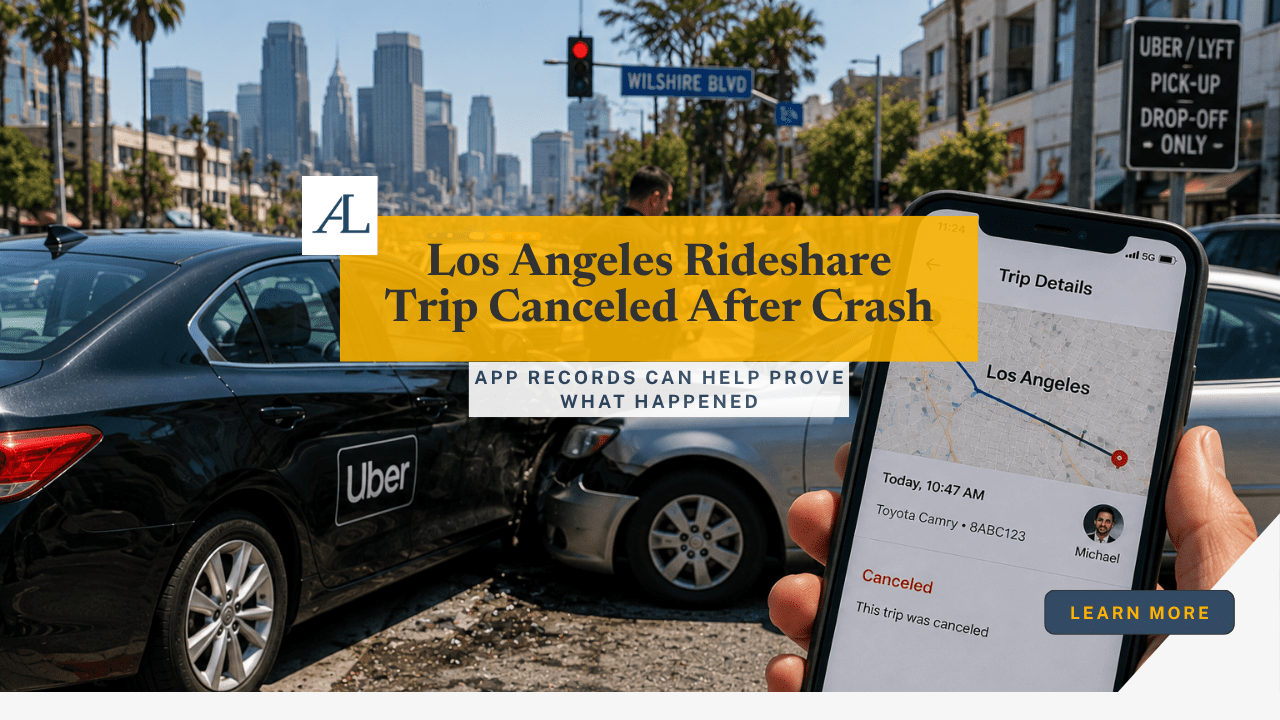
A Los Angeles rideshare driver cancels trip accident claim can become confusing almost immediately because the ride may disappear from the passenger’s app, the driver may try to end the trip before police arrive, and the insurance company may later dispute whether the crash happened during an active Uber or Lyft ride. A passenger may be injured on the 405, 101, 10, 110, 5, Sunset Boulevard, Hollywood Boulevard, Wilshire Boulevard, La Cienega, near LAX, Downtown Los Angeles, Koreatown, West Hollywood, Santa Monica, or outside a hotel, restaurant, concert venue, office building, or rideshare pickup zone. Then, instead of helping document the incident, the driver cancels or ends the ride.
That detail matters. Rideshare insurance coverage often depends on app status, ride status, pickup status, whether the passenger was already inside the vehicle, whether the driver had accepted the ride, and whether the trip was still active in the platform records. If the driver cancels the trip after the collision, the passenger may worry that there is no proof the ride existed. In reality, a Los Angeles rideshare driver cancels trip accident claim can still be supported by screenshots, bank records, app notifications, GPS data, messages, support chats, crash reports, medical records, vehicle photos, and company-controlled trip logs.
Rideshare companies and insurers may try to narrow the claim. They may argue that the trip was canceled before the crash, that the driver was offline, that the passenger was not yet picked up, that another driver caused the collision, or that the passenger’s injuries were unrelated. Those arguments should not be accepted without evidence. A Los Angeles rideshare driver cancels trip accident claim should focus on the complete timeline, including when the ride was accepted, when the passenger entered the vehicle, when the crash happened, when the trip was canceled, and what the app showed before and after the incident.
When a rideshare crash leaves you injured, choosing the right legal representation matters. An experienced Los Angeles rideshare accident lawyer at Avrek Law Firm can preserve app records, identify insurance coverage, communicate with Uber or Lyft, investigate the crash sequence, and pursue compensation for your injuries.
Why a Los Angeles Rideshare Driver Cancels Trip Accident Claim Is Often Disputed
A Los Angeles rideshare driver cancels trip accident claim is often disputed because the rideshare app may become the center of the case. In a regular car accident, the injured person usually collects driver information, insurance information, license plate numbers, photos, and a police report. In a rideshare crash, the passenger may also need proof of the ride request, driver assignment, pickup location, route, trip status, fare, cancellation time, support messages, and platform response. If the driver cancels the ride, some of that information may become harder for the passenger to access.
The California Public Utilities Commission explains that transportation network company services are divided into different periods, including when the app is open and waiting for a match, when a match is accepted and the driver is on the way to pick up the passenger, and when the passenger is in the vehicle until the passenger exits. The CPUC also states that TNCs must cooperate with insurers involved in a claims coverage investigation to exchange information.
That is why app records matter so much. A driver canceling the ride after an accident does not automatically erase the trip or eliminate coverage. It may create a dispute, but it also creates an evidence issue that should be investigated. A Los Angeles rideshare driver cancels trip accident claim should preserve every digital clue before the app screen changes, the receipt updates, or the passenger loses access to messages.
Canceling the Ride Does Not Automatically Cancel the Passenger’s Legal Rights
A driver may cancel a ride after a crash for several reasons. Some drivers panic. Some want to avoid platform consequences. Some believe ending the trip will make the crash look like a private accident. Some may tell the passenger to handle the claim through ordinary insurance. None of those actions automatically defeats a Los Angeles rideshare driver cancels trip accident claim.
The law and insurance coverage analysis look at what was happening at the time of the crash, not only what the app shows after the driver tries to end the trip. If the passenger was already in the vehicle, if the ride was active, or if the driver had accepted the ride and was transporting the passenger, that status can be proven through records. Screenshots, app notifications, driver details, text messages, location history, payment records, and support reports may all help prove that the crash happened during rideshare activity.
A Los Angeles rideshare driver cancels trip accident claim should be handled quickly because the passenger may not know which records Uber, Lyft, the driver, and third-party insurers possess. Early legal action can help request and preserve trip data before the rideshare company or insurer frames the case too narrowly.
The Insurance Period May Determine Available Coverage
California Public Utilities Code Section 5433 requires transportation network company insurance from the moment a participating driver accepts a ride request until the driver completes the transaction on the platform or the ride is complete, whichever is later. The statute states that this coverage must be primary and at least $1,000,000 for death, personal injury, and property damage during that accepted-ride period. It also sets different requirements for the period when the driver is logged on but has not yet accepted a ride.
This is one of the most important issues in a Los Angeles rideshare driver cancels trip accident claim. If the crash happened while the ride was active or after the driver accepted the ride, coverage may be very different than if the driver was completely offline. If the driver cancels the trip after the crash, the insurer may attempt to argue that the ride was not active at the time of the collision. The passenger’s evidence should be organized to show the true sequence.
A Los Angeles rideshare driver cancels trip accident claim should document the ride period carefully. The exact moment of pickup, the passenger’s entry into the vehicle, route progress, support messages, cancellation timestamp, and crash time can all matter.
Uber and Lyft Coverage Pages May Help Frame the Investigation
Uber states that drivers are insured from the moment they tap “Go” to wait for a trip request through the time they are driving to pick up a rider or goods and until the trip ends. Uber’s insurance page also describes coverage during different app stages, including third-party liability while available and $1,000,000 third-party liability while en route to pick up a rider or on a trip.
Lyft explains that when the app is off, Lyft does not have a policy that applies, while different coverage applies when the app is on and the driver is receiving rides versus when the driver is picking up a passenger or during a ride. Lyft states that for covered accidents when the driver is picking up a passenger or during a ride, Lyft maintains at least $1,000,000 in third-party auto liability coverage in most markets.
These company pages are not a substitute for legal analysis, but they show why a Los Angeles rideshare driver cancels trip accident claim should focus on app status and trip status. The question is not simply whether the driver says the ride was canceled. The question is what the platform records show about the ride when the crash occurred.
Evidence That Can Strengthen a Los Angeles Rideshare Driver Cancels Trip Accident Claim
A Los Angeles rideshare driver cancels trip accident claim can be won or lost based on evidence preserved in the first hours after the crash. Passengers are often hurt, shaken, and unsure what to do. The driver may discourage them from calling police. The driver may say the app “glitched.” The driver may end the trip and drive away. The passenger may not realize until later that the canceled ride created an insurance dispute.
The strongest evidence usually comes from combining passenger-controlled records with company-controlled records. The passenger may have screenshots, notifications, receipts, bank charges, text messages, photos, and witness names. Uber, Lyft, or another rideshare company may have GPS data, driver status, route history, cancellation timestamps, support logs, and insurance claim information. The driver may have dashcam footage, app records, or vehicle data. A Los Angeles rideshare driver cancels trip accident claim should pursue all of these records.
Screenshots, Ride Receipts, and App Notifications
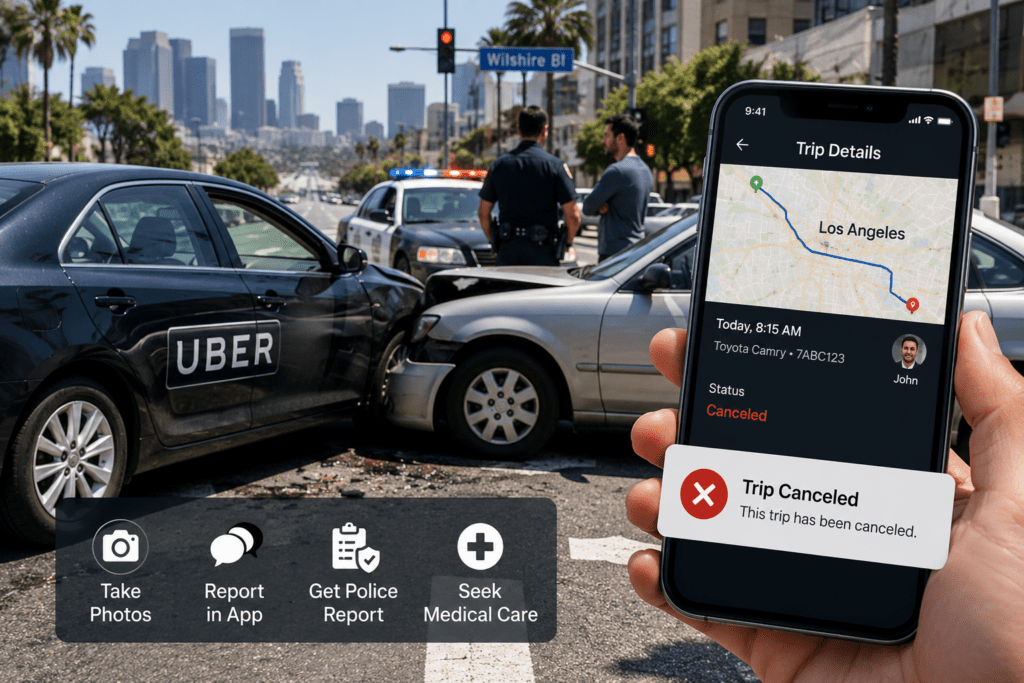
Screenshots can be critical in a Los Angeles rideshare driver cancels trip accident claim. Passengers should save the driver’s name, vehicle make and model, license plate, pickup location, destination, route map, estimated fare, trip ID if visible, cancellation notice, ride receipt, support messages, and any post-crash app prompts. If the app shows that the driver canceled, that screenshot should be preserved too because it may help prove that the cancellation happened after the incident began.
Payment records may also help. A passenger’s bank or credit card statement may show a temporary authorization, cancellation fee, ride charge, or refund. Email receipts may show timestamps and trip details. Push notifications may still appear in the phone’s notification history. A Los Angeles rideshare driver cancels trip accident claim can use these records to show that the ride existed even if the app screen later changes.
The passenger should not rely on memory alone. In Los Angeles, rideshare crashes may happen after a night out, during airport travel, outside a work event, or in chaotic traffic. A precise digital record can be stronger than a later statement about what the app showed.
Photos, Videos, and Driver Information at the Scene
A Los Angeles rideshare driver cancels trip accident claim should include ordinary crash evidence too. Photos should show the vehicles, license plates, rideshare decals, crash location, street signs, traffic signals, lane markings, skid marks, debris, visible injuries, and surrounding businesses. If the crash happened near LAX, a hotel, restaurant, stadium, concert venue, office building, or rideshare pickup area, photos should show the curbside layout and pickup zone.
Video may be available from dashcams, nearby businesses, apartment buildings, hotel entrances, rideshare vehicles, delivery vans, buses, parking garages, and traffic corridors. A passenger may also record a short video after the crash showing the driver, vehicle, app screen, and damage. That type of evidence can be especially important if the driver cancels the trip and later disputes whether the passenger was in the vehicle.
The driver’s personal auto insurance card may not be enough. A Los Angeles rideshare driver cancels trip accident claim should also identify the rideshare platform and preserve any proof that the driver was operating through the app.
Support Chats and Incident Reports
Passengers should report the crash through the rideshare platform and save written proof. In a Los Angeles rideshare driver cancels trip accident claim, app support messages may show when the passenger reported the collision, what the passenger said, whether the company acknowledged the incident, and whether a claim number was created. Screenshots of support chats can become valuable if later records are incomplete.
Passengers should also be careful with early statements. They should report facts, not guesses. They should avoid estimating speed, assigning fault, or minimizing injuries before medical care. A short, accurate support report can help create a timestamped record without giving the insurer unnecessary language to use against the claim.
A Los Angeles rideshare driver cancels trip accident claim may also involve police reports, DMV reports, medical records, and insurance communications. The more complete the paper trail, the harder it is for an insurer to claim the ride status is unclear.
Who May Be Liable in a Los Angeles Rideshare Driver Cancels Trip Accident Claim?
A Los Angeles rideshare driver cancels trip accident claim may involve more than one responsible party. The rideshare driver may have caused the crash. Another motorist may have hit the rideshare vehicle. A delivery driver, bus driver, truck driver, valet driver, scooter rider, cyclist, or pedestrian may have contributed. A dangerous pickup zone, public road condition, or property layout may also matter.
The claim should begin by identifying who caused the collision and what insurance coverage applies. If the rideshare driver caused the crash, rideshare insurance may be central. If another driver caused the crash while the passenger was in the rideshare vehicle, the at-fault driver’s insurance may apply, and rideshare uninsured or underinsured motorist coverage may also need review depending on the facts and current policy terms. If the driver canceled the trip after the crash, the rideshare company’s records may be needed to prove that the passenger was still covered.
The Rideshare Driver
The rideshare driver may be liable if they rear-ended another vehicle, changed lanes unsafely, ran a red light, made an unsafe turn, drove distracted, followed too closely, stopped in an unsafe pickup area, or failed to use reasonable care while transporting a passenger. A Los Angeles rideshare driver cancels trip accident claim should review whether the driver was watching the app, following GPS, rushing to the next ride, or distracted by passenger communications.
A driver who cancels the trip after a crash may also create credibility issues. The cancellation does not prove fault by itself, but it may raise questions about why the driver ended the ride and whether they were trying to avoid documentation. That conduct should be compared with app data, passenger screenshots, support messages, and crash timing.
Uber, Lyft, or Another Transportation Network Company
The rideshare company may be involved because it controls trip records, insurance information, driver status data, and platform communications. A Los Angeles rideshare driver cancels trip accident claim may require the company to confirm whether the ride was accepted, active, canceled, completed, or changed after the crash. The company may also have claim procedures and insurer information that the passenger cannot easily access alone.
California law states that transportation network company insurance coverage under Section 5433 is not dependent on a personal auto insurer first denying the claim, and if a driver’s TNC insurance has lapsed or ceased to exist, the transportation network company must provide the required coverage beginning with the first dollar of the claim.
That legal framework can be important when a Los Angeles rideshare driver cancels trip accident claim turns into a coverage dispute. The passenger should not be bounced between insurers without a real investigation into the app status and applicable policy.
Another Driver or Commercial Vehicle
Sometimes the rideshare driver cancels the trip even though another driver caused the crash. A Los Angeles rideshare driver cancels trip accident claim may still require rideshare records because they prove the passenger’s status, route, and presence in the vehicle. The at-fault driver’s insurance may be responsible, but rideshare coverage may still become relevant if the other driver is uninsured, underinsured, unidentified, or disputes liability.
This can happen in Los Angeles when a rideshare vehicle is hit near LAX, Downtown Los Angeles, a freeway exit, a hotel driveway, a restaurant valet zone, a concert venue, or a congested pickup area. The passenger may not know who caused the crash because they were seated in the back, looking at their phone, or reacting after impact. A complete investigation should identify all drivers and all available policies.
Public Entity or Dangerous Road Condition
A Los Angeles rideshare driver cancels trip accident claim may involve a public entity if the crash was connected to a dangerous public property condition, defective traffic signal, unsafe road design, broken streetlight, poor lane markings, public bus, government vehicle, or city-controlled pickup zone. These issues are not present in every rideshare case, but they should be considered when the location itself contributed to the collision.
California Government Code Section 911.2 generally requires a claim relating to injury to a person or personal property against a public entity to be presented within six months after the cause of action accrues.
Because that deadline is much shorter than the ordinary personal injury deadline, a Los Angeles rideshare driver cancels trip accident claim should be reviewed quickly when public property or a government vehicle may have played a role.
Medical Records and Damages in a Los Angeles Rideshare Driver Cancels Trip Accident Claim
A Los Angeles rideshare driver cancels trip accident claim should document medical care immediately. Passengers may suffer whiplash, concussions, back injuries, neck injuries, shoulder trauma, knee injuries, hip injuries, fractures, nerve symptoms, anxiety, headaches, dizziness, or post-crash pain that worsens after the adrenaline fades. If the driver cancels the ride and the passenger delays treatment, the insurer may argue that the injuries were not related to the crash.
Medical records help connect the injury to the incident. Emergency room records, urgent care notes, imaging, specialist referrals, physical therapy, prescriptions, work restrictions, and follow-up visits all matter. A Los Angeles rideshare driver cancels trip accident claim should include the full medical timeline, not only the first appointment.
Damages may include ambulance bills, emergency care, hospital treatment, ongoing medical care, future treatment, lost wages, reduced earning capacity, pain and suffering, emotional distress, transportation expenses, and out-of-pocket costs. If the passenger was traveling for work, vacation, school, an event, or airport transportation, the crash may also create missed flights, canceled reservations, or additional expenses that should be documented.
What Passengers Should Do After a Rideshare Driver Cancels the Trip
A passenger involved in a Los Angeles rideshare driver cancels trip accident claim should first focus on safety and medical care. If anyone is injured, call 911. If the driver discourages calling police, that should not prevent the passenger from seeking emergency help. A police report or traffic collision report may help identify the driver, vehicle, insurance, crash location, and witnesses.
The passenger should then preserve app evidence. Screenshots should be taken immediately. If the ride disappears, open email, payment records, notification history, bank records, and app support. Report the crash to Uber or Lyft in writing and save the response. Take photos of the vehicle and license plate. Get the driver’s name and phone number if possible. Save the pickup and destination address.
After a traffic collision in California, the DMV states that an SR-1 report must be completed and sent within 10 days if anyone is injured or killed, or property damage is over $1,000. The DMV also states that the SR-1 is required in addition to any report made to police, CHP, or an insurance company.
A passenger may not always be the person required to file an SR-1 if they were not driving, but a Los Angeles rideshare driver cancels trip accident claim should still preserve all crash reports, medical records, insurance communications, app records, and platform claim numbers.
Deadlines in a Los Angeles Rideshare Driver Cancels Trip Accident Claim
A Los Angeles rideshare driver cancels trip accident claim should be handled before evidence disappears and before legal deadlines create risk. California Code of Civil Procedure Section 335.1 provides a two-year deadline for actions involving injury to, or death of, a person caused by the wrongful act or neglect of another.
Two years may sound like a long time, but the most important evidence in a Los Angeles rideshare driver cancels trip accident claim can disappear much faster. App screens change, drivers repair vehicles, dashcam footage is overwritten, business cameras delete recordings, and platform records may require formal requests. Waiting can make the coverage dispute harder even if the legal deadline has not passed.
If a public entity or dangerous public property condition may be involved, the six-month claim presentation rule under Government Code Section 911.2 may apply. That is why early review matters in rideshare crashes involving public buses, government vehicles, unsafe public pickup zones, public road defects, or dangerous public property.
Frequently Asked Questions About a Los Angeles Rideshare Driver Cancels Trip Accident Claim
Can I still file a claim if my Uber or Lyft driver canceled the trip after the crash?
Yes. You may still have a Los Angeles rideshare driver cancels trip accident claim even if the driver canceled the ride after the collision. The cancellation may create a dispute, but it does not erase the crash, your injuries, or the records that may prove the ride was active. The key is to preserve evidence showing the trip timeline.
Screenshots, payment records, push notifications, ride receipts, bank authorizations, support messages, photos of the driver’s vehicle, and witness statements can all help prove the ride existed. Uber or Lyft may also have internal records showing when the driver accepted the ride, when the passenger entered the vehicle, when the crash happened, and when the trip was canceled.
Why does the driver’s app status matter so much?
App status matters because rideshare insurance often depends on whether the driver was offline, logged into the app and waiting for a match, en route to pick up a passenger, or actively transporting a passenger. A Los Angeles rideshare driver cancels trip accident claim may involve very different insurance coverage depending on those facts.
If the driver canceled the ride after the crash, the insurer may try to argue that the ride was not active. That is why trip records, app screenshots, and platform data are so important. The passenger’s claim should focus on what was happening when the crash occurred, not only what the app displayed after the cancellation.
What evidence should I save if the rideshare driver canceled the trip?
In a Los Angeles rideshare driver cancels trip accident claim, save screenshots of the ride request, driver name, license plate, route map, pickup location, destination, cancellation notice, receipt, fare, support messages, and claim number. Also save bank or credit card records showing the ride charge, cancellation fee, authorization, refund, or ride-related transaction.
You should also preserve ordinary crash evidence. Take photos of the vehicles, license plates, damage, street signs, traffic signals, injuries, and surrounding area. Get witness names and phone numbers. Report the incident through the app in writing and save the response. Seek medical care and keep all records.
What if the rideshare driver tells me not to report the accident?
Do not let the driver control the situation. A Los Angeles rideshare driver cancels trip accident claim should be documented properly, especially if you were injured. Drivers may worry about deactivation, insurance consequences, or platform discipline, but your health and legal rights come first.
If you are hurt, call 911 or seek medical care. Report the crash through the rideshare app and save written confirmation. Avoid making side agreements with the driver. Do not accept cash at the scene in exchange for not reporting the crash. Those decisions can make the claim harder later.
Who pays if another driver hit the rideshare vehicle?
If another driver caused the crash, that driver’s insurance may be responsible. However, a Los Angeles rideshare driver cancels trip accident claim may still require Uber or Lyft records because those records show you were a rideshare passenger at the time. If the at-fault driver is uninsured, underinsured, or unidentified, rideshare-related coverage may also need review depending on the facts and applicable policy terms.
The claim should not be limited to one insurer too early. The rideshare driver, another driver, a commercial vehicle, a public entity, or a property owner may all need review depending on the crash location and sequence.
Can Uber or Lyft deny coverage because the driver canceled the trip?
Uber, Lyft, or an insurer may dispute coverage if the app status is unclear, but a cancellation after the crash should not automatically decide the issue. A Los Angeles rideshare driver cancels trip accident claim should request the platform records and compare them against passenger evidence. The time of the crash, accepted ride data, GPS route, pickup confirmation, passenger entry, and cancellation time may all matter.
If the insurer claims the ride was not active, ask for the records supporting that position. A lawyer can help request preservation of trip data, driver records, claim records, and app logs before the company’s version becomes the only version.
How long do I have to file a rideshare accident injury claim in California?
Most California personal injury lawsuits must be filed within two years, but a Los Angeles rideshare driver cancels trip accident claim should be investigated much sooner. App records, video footage, and witness information can disappear long before the two-year lawsuit deadline. If a public entity is involved, a government claim may need to be presented within six months.
The safest approach is to preserve evidence immediately. Medical care, app screenshots, support reports, police reports, and insurance communications should be organized as soon as possible.
Do I need a lawyer for a canceled-trip rideshare accident claim?
Yes. A Los Angeles rideshare driver cancels trip accident claim can involve disputed app status, multiple insurance policies, driver statements, platform records, medical documentation, and aggressive coverage defenses. The driver may say one thing, the app may show another, and the insurer may try to avoid responsibility by focusing on the cancellation.
A Los Angeles rideshare accident lawyer can preserve app records, contact insurers, request trip data, identify coverage, obtain video, organize medical evidence, and protect you from giving statements that weaken your claim. These cases are especially important when injuries are serious, the ride disappeared from the app, or the driver left the scene.
Call or Contact Avrek Law Firm 24/7 for a Free Consultation and Pay Nothing Unless We Win
A Los Angeles rideshare driver cancels trip accident claim can become complicated when a driver cancels the ride, the app record changes, the insurer disputes coverage, or multiple parties blame each other. These cases often depend on evidence that passengers may not know how to obtain, including trip logs, GPS data, app status, cancellation timestamps, support chats, insurance records, vehicle photos, dashcam footage, and medical documentation.
Avrek Law Firm helps injured rideshare passengers investigate crashes, preserve critical records, identify every available insurance policy, and pursue compensation for medical bills, lost income, pain, future care, and long-term recovery needs. Our team understands how Uber and Lyft crash claims can become complicated when the ride status is disputed.
Speaking with a Los Angeles rideshare accident lawyer may help you understand whether the rideshare driver, rideshare company, another driver, commercial vehicle operator, public entity, or property owner may be responsible. These cases may also overlap with issues handled by a Los Angeles car accident lawyer or Los Angeles personal injury lawyer, especially when injuries are serious or multiple insurers are involved.
If you or someone you love was injured after a rideshare driver canceled the trip following a crash in Los Angeles, Avrek Law Firm is ready to help.
Call 866-598-5548, start a chat, or complete our online form today for a free, no-obligation consultation. There are no upfront fees, and you do not pay unless we win.
Serving the Los Angeles Community
Avrek Law Firm represents injured passengers, drivers, pedestrians, cyclists, and families throughout Los Angeles and surrounding communities. Local context matters in a Los Angeles rideshare driver cancels trip accident claim because rideshare crashes often happen in high-pressure pickup and drop-off areas where app records, curbside conditions, and traffic patterns shape the evidence.
A crash near LAX may involve airport pickup rules and heavy rideshare staging. A crash near Downtown Los Angeles may involve buses, delivery vehicles, scooters, pedestrians, and dense traffic. A crash near Hollywood, Koreatown, West Hollywood, Santa Monica, or a hotel and restaurant corridor may involve sudden stops, valet congestion, rideshare double-parking, and complicated witness issues.
A Los Angeles rideshare driver cancels trip accident claim should be handled quickly, carefully, and with attention to the digital records that make rideshare cases different from ordinary car accidents.
- 📩 Submit a request through our online form
- 📞 Call 866-598-5548 now to speak with our team
- 💬 Start a live chat for immediate assistance
There are no upfront fees, and you don’t pay unless we win.