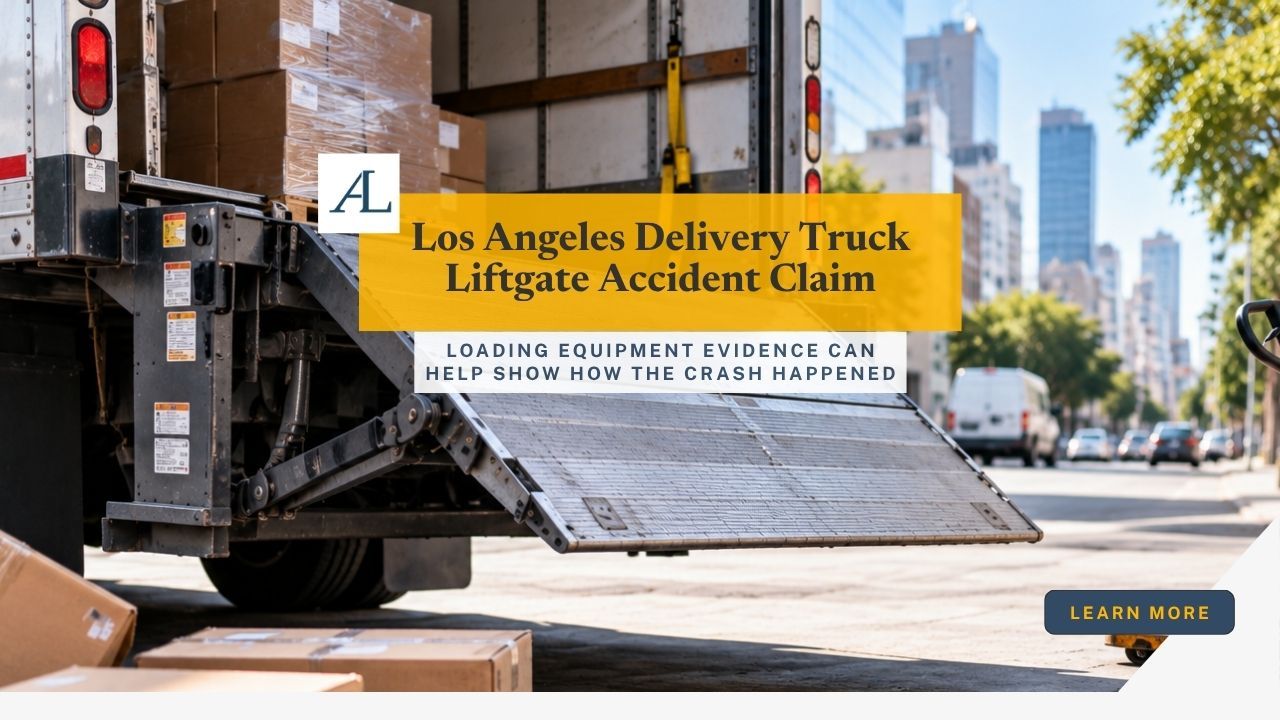
A Los Angeles delivery truck liftgate accident claim can become complicated quickly because loading equipment changes how a commercial truck moves, stops, and operates around people. A liftgate may be lowered, extended, or in motion while the truck is parked in a roadway, alley, driveway, loading area, or curbside location. That can create a hazard for drivers, cyclists, pedestrians, or workers nearby. OSHA warns that loading docks can be dangerous places and recommends slow movement, clear work surfaces, and awareness of tail swing and dock edges. FMCSA also says cargo securement devices and vehicle structures must be in proper working order, and that the motor carrier and driver are responsible for ensuring cargo is properly loaded and secured.
When a crash like this leaves you injured, choosing the right legal representation matters. An experienced Los Angeles truck accident lawyer at Avrek Law Firm can help preserve evidence, identify every responsible party, and pursue the compensation you deserve.
Call 866-598-5548, start a live chat, or request a free case review today. There are no upfront fees, and you do not pay unless we win.
How Loading Equipment Becomes Part of the Accident Investigation
A Los Angeles delivery truck liftgate accident claim often turns on the exact role the loading equipment played in the crash. The liftgate may have blocked a lane, extended into a walkway, moved while a person was nearby, or created an unexpected blind spot. The truck may have been parked in a delivery position that forced other traffic to react suddenly. The question is not only what the truck driver was doing. It is also whether the liftgate or loading setup created the danger that led to the injury.
Loading equipment can change the way a truck occupies space. A liftgate may extend behind the truck or swing outward during use. A driver may be focused on packages, a dock, or a delivery stop rather than the traffic moving around the truck. If the truck was operating in a tight delivery area, the risk may have come from the combination of the truck’s position, the liftgate’s movement, and the surrounding traffic conditions.
Whether a Liftgate Was Lowered, Extended, or Moving
One of the first questions in a Los Angeles delivery truck liftgate accident claim is whether the liftgate was lowered, extended, or moving when the crash happened. A lowered liftgate may block part of a lane, a sidewalk, or a driveway. An extended liftgate may create a visible barrier but also a less visible hazard if another road user does not expect equipment to be sticking out from the truck. A moving liftgate can be especially dangerous if someone is walking behind the truck or approaching the loading area.
That detail matters because the liftgate itself may be the physical feature that caused the crash, even if the driver insists the truck was “just parked.” The claim should document the liftgate position from multiple angles as soon as possible.
The Truck’s Position in a Roadway, Alley, Driveway, or Loading Area
The truck’s position is often central to a Los Angeles delivery truck liftgate accident claim. A delivery truck may stop in a roadway because there is no loading zone, or it may pull partially into an alley, driveway, or service area. If the truck blocked visibility, forced another vehicle to merge suddenly, or took up more space than expected, that position may help explain the crash.
The surrounding layout matters too. A truck parked near a curb, behind another vehicle, beside a loading dock, or across from a drive-through area can create a different risk profile than a truck parked in an open lot. The exact location should be photographed before the truck moves.
Warning Lights, Cones, Reflectors, and Visibility Conditions
Warning lights, cones, reflectors, and visibility conditions can all affect a Los Angeles delivery truck liftgate accident claim. A truck may have hazard lights on, but that does not necessarily make the stop safe. Cones may be present but not placed far enough around the truck to warn others. Reflectors may be dirty, broken, or blocked by cargo. Lighting conditions may also matter if the crash happened at dusk, at night, in rain, or in a narrow delivery corridor.
If the liftgate or loading area was hard to see, the claim should document the visibility from the viewpoint of the injured person. That can help show whether the truck’s setup created an unreasonable hazard.
Company and Equipment Records to Identify
A Los Angeles delivery truck liftgate accident claim should not rely only on the scene itself. Company records may show whether the liftgate had problems before the crash, whether the driver had been trained, and whether the vehicle was supposed to be in that location at that time. These records can help prove whether the accident was caused by a one-time mistake or by a broader pattern of unsafe operations.
The records that matter often include inspection reports, maintenance logs, dispatch communications, route schedules, loading notes, and training files. Those materials may be controlled by the driver’s employer, the vehicle owner, a leasing company, or a contractor involved in the delivery operation.
Liftgate Inspection, Maintenance, and Repair Materials
Liftgate inspection and maintenance records are important in a Los Angeles delivery truck liftgate accident claim because they can show whether the equipment was working properly before the crash. If the liftgate had prior repairs, a worn hydraulic system, damaged hinges, or repeated malfunction complaints, that history may support the claim. If the liftgate had not been inspected recently, that may also matter.
Repair materials can help show whether the equipment was fixed after the crash because it was unsafe, damaged, or out of compliance. The condition of the liftgate should be documented before repairs are made if possible.
Delivery Schedules, Loading Logs, and Dispatch Communications
Delivery schedules and loading logs may help explain why the truck was in a particular place in a Los Angeles delivery truck liftgate accident claim. If the driver was under pressure to complete a delivery quickly, that may help explain why the truck stopped where it did or why the liftgate was being used at that time. Dispatch communications can show whether the company directed the driver to stop in a tight location or complete a curbside delivery under a deadline.
Those records can help connect the crash to the delivery process itself. They may also show whether the driver was operating on company instructions at the time of the accident.
Training Records and Instructions for Equipment Operation
Training records are especially important in a Los Angeles delivery truck liftgate accident claim if the driver was using loading equipment in a busy environment. A company should know whether the driver had training on safe liftgate use, loading dock procedures, trailer connections, and visibility precautions. If the driver was not properly trained, or if the training did not cover the type of equipment involved, that may matter for liability.
Instructions for equipment operation may also help show whether the driver was expected to follow a specific loading process. If the driver deviated from those instructions, the claim may become stronger.
Questions About Which Company Controlled the Operation
A Los Angeles delivery truck liftgate accident claim often requires figuring out who controlled the operation at the time of the crash. The truck driver may have been working for an employer, the equipment may have belonged to another company, and the delivery location may have been controlled by a business or property owner. If more than one entity was involved, the claim should identify each one early.
This is important because the wrong company may be blamed if the records are not reviewed carefully. Control, ownership, and instructions can all affect liability.
The Driver’s Employer and the Vehicle Owner
The driver’s employer and the vehicle owner may be different entities in a Los Angeles delivery truck liftgate accident claim. The driver may have been operating a vehicle owned by a leasing company, a logistics company, or a fleet manager. If the driver was working at the time, the employer’s role may also matter.
That means the claim should not stop at the driver’s name. It should also identify who owned the truck, who controlled the route, and who was responsible for the operation of the liftgate.
Equipment Leasing, Maintenance, or Loading Contractors
Equipment leasing, maintenance, and loading contractors may also be involved in a Los Angeles delivery truck liftgate accident claim. If the liftgate was leased or maintained by a third party, that party may have records showing prior defects or service issues. If a loading contractor helped operate or position the equipment, their conduct may matter too.
These records can be crucial when the truck company tries to shift blame. The more clearly the equipment chain is documented, the easier it becomes to determine responsibility.
Businesses or Properties Directing the Delivery Location
Sometimes the business or property receiving the delivery contributes to the risk in a Los Angeles delivery truck liftgate accident claim. A business may direct drivers to stop in a lane, back into a tight alley, or use a curb area that was not really safe for loading. A property may have poor lighting, narrow access, or no clear loading zone. If the delivery location itself helped create the hazard, that should be investigated.
The scene layout should be documented before the property changes the area or moves the delivery point. If there was a loading dock, curb zone, alley, or alley ramp, those details should be photographed and preserved.
Evidence and Injury Documentation After the Accident
A Los Angeles delivery truck liftgate accident claim needs strong evidence because loading equipment may be removed quickly after the crash. The truck may be driven away, the liftgate may be folded up, and the surrounding area may be cleaned before the injured person has a chance to document what happened. That is why scene photos, surveillance footage, witness statements, and medical records are so important.
The outline for this blog highlights photos of equipment position, vehicle damage, the surrounding area, surveillance footage, witnesses, truck camera records, medical treatment, work restrictions, and long-term physical limitations. Those items should be preserved as early as possible.
Photos of Equipment Position, Vehicle Damage, and the Surrounding Area
Photos are one of the most important pieces of evidence in a Los Angeles delivery truck liftgate accident claim. The photos should show the truck, the liftgate, the vehicle damage, the lane layout, the curb area, the loading zone, the sidewalk, the drive path, and anything that may have blocked visibility. If the liftgate was down or extended, that should be captured clearly.
The surrounding area should also be documented. A loading dock, alley, driveway, red curb, crosswalk, or bike lane may all help explain why the truck’s position was dangerous. Wide shots and close-up shots together often tell the best story.
Surveillance Footage, Witnesses, and Truck Camera Records
Surveillance footage can make a major difference in a Los Angeles delivery truck liftgate accident claim. Business cameras, apartment cameras, parking lot cameras, dashcams, and truck cameras may show how long the truck was stopped, whether the liftgate was moving, and how other vehicles or pedestrians reacted. Even a short clip can help explain whether the equipment created the hazard.
Witnesses can also be important. Someone may have seen the truck stop, the liftgate move, or the injured person get forced into traffic. Truck camera records may show what the driver could see before the crash, which can help determine whether the equipment or vehicle blocked the view.
Medical Treatment, Work Restrictions, and Long-Term Physical Limitations
Medical treatment is critical in a Los Angeles delivery truck liftgate accident claim because liftgate and loading-area crashes can cause serious injuries. A person may suffer fractures, back injuries, shoulder injuries, neck injuries, head injuries, soft tissue injuries, nerve symptoms, or crush-related trauma. Those injuries can require emergency care, imaging, specialist treatment, therapy, or surgery.
Work restrictions should also be documented. If the injured person cannot lift, stand, drive, walk, or use their arms normally, that limitation affects wages and daily life. Long-term physical limitations may also matter if the injury does not heal quickly or leads to lasting pain.
Frequently Asked Questions About a Los Angeles Delivery Truck Liftgate Accident Claim
What makes a liftgate accident different from a regular truck crash?
A Los Angeles delivery truck liftgate accident claim focuses on the equipment itself. The liftgate may have been lowered, extended, or moving, and that equipment may have created the hazard even if the truck was not traveling fast.
Why do loading records matter so much?
Loading records can show who controlled the truck, where it was supposed to stop, and whether the driver was following company instructions. They can also help explain why the liftgate was in use at the time.
Can the company be responsible, not just the driver?
Yes. The employer, vehicle owner, equipment lessor, maintenance company, or loading contractor may also matter depending on who controlled the operation.
What should I save after the crash?
Save photos of the truck, liftgate, and scene, along with witness names, camera locations, medical records, and insurance communications. Those items can help build a Los Angeles delivery truck liftgate accident claim.
How long do I have to report the crash in California?
California DMV says the SR-1 report generally must be filed within 10 days if someone is injured or property damage is over $1,000. You can review that requirement here: California DMV SR-1 Accident Reporting.
Do I need a lawyer for this kind of case?
Yes, especially when the liftgate, loading records, and company records are involved. A Los Angeles truck accident lawyer can help identify the responsible parties and preserve the evidence before it disappears.
Call or Contact Avrek Law Firm 24/7 for a Free Consultation and Pay Nothing Unless We Win
A Los Angeles delivery truck liftgate accident claim can become difficult when the liftgate is moved, the company controls the records, or several parties may share responsibility. These cases often depend on fast evidence preservation, equipment photos, inspection and maintenance records, witness statements, surveillance footage, and medical documentation.
Avrek Law Firm helps injured people after serious commercial truck crashes throughout Los Angeles. Our team can move quickly to preserve evidence, identify every liable party, communicate with insurers, and pursue compensation for medical bills, lost income, pain and suffering, and long-term recovery needs.
If you or someone you love was injured in a Los Angeles liftgate or loading-equipment crash, Avrek Law Firm is ready to help.
Call 866-598-5548, start a chat, or complete our online form today for a free, no-obligation consultation. There are no upfront fees, and you do not pay unless we win.
Serving the Los Angeles Community
Avrek Law Firm represents injured people throughout Los Angeles and surrounding communities. Local context matters in a Los Angeles delivery truck liftgate accident claim because the roadway, delivery zone, and traffic flow often shape the evidence.
A crash near downtown Los Angeles, industrial districts, apartment loading areas, restaurant corridors, warehouse routes, or busy commercial streets may involve narrow access, curbside deliveries, alley pickups, and truck equipment that should be documented quickly. If the crash happened near a loading dock, parking structure, or service driveway, the liftgate position and surrounding layout may be especially important.
A Los Angeles truck accident lawyer can help make sure that evidence is preserved before it is lost, and a Los Angeles personal injury lawyer can help document the full impact of the injuries on work, mobility, and daily life.
- 📩 Submit a request through our online form
- 📞 Call 866-598-5548 now to speak with our team
- 💬 Start a live chat for immediate assistance
There are no upfront fees, and you don’t pay unless we win.