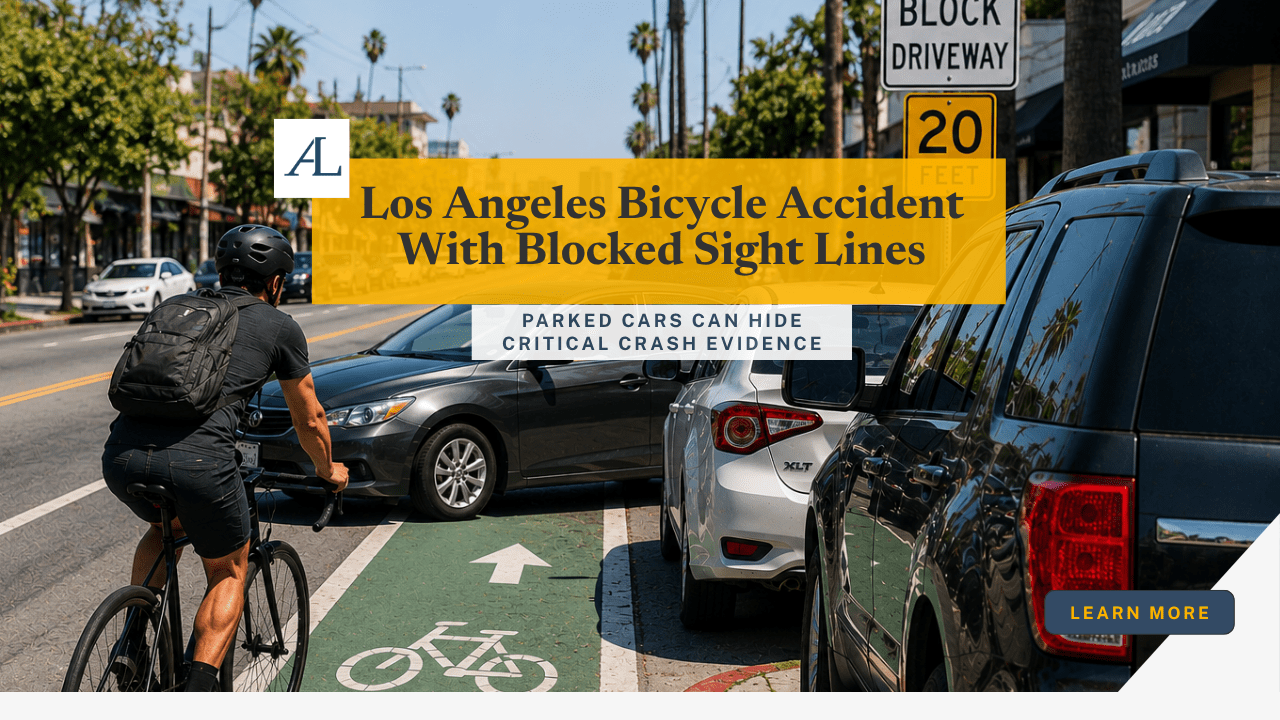
A Los Angeles bicycle accident blocked sight line claim can become complicated because the parked vehicle that helped create the crash may not be the vehicle that actually hit the cyclist. A driver may pull out of a driveway without seeing a rider because a parked SUV blocked the view. A cyclist may leave a bike lane to avoid a parked car, delivery van, rideshare vehicle, or open door and then be struck by passing traffic. A driver may turn across a cyclist’s path because curbside vehicles hid the rider until the last second. When visibility is blocked, insurers often try to blame the cyclist instead of investigating why the crash became unavoidable.
In Los Angeles, blocked sight lines are a serious issue because bicycles, parked cars, delivery vehicles, rideshare pickups, buses, scooters, pedestrians, and fast-moving traffic often share limited street space. These crashes may happen in Downtown Los Angeles, Hollywood, Koreatown, Westwood, Venice, Santa Monica, Silver Lake, Echo Park, Highland Park, Mid-City, Boyle Heights, South LA, and along corridors such as Sunset Boulevard, Wilshire Boulevard, Figueroa Street, La Brea Avenue, Vermont Avenue, Pico Boulevard, Olympic Boulevard, and Melrose Avenue. A Los Angeles bicycle accident blocked sight line claim should examine the entire street environment, not only the moment of impact.
The injuries can be severe. A cyclist may suffer fractures, concussions, traumatic brain injuries, spinal injuries, shoulder trauma, knee injuries, wrist injuries, road rash, dental injuries, nerve damage, and long-term pain. Even a low-speed impact can cause serious harm if the rider is knocked into the pavement, a curb, a parked vehicle, or another lane of traffic. A Los Angeles bicycle accident blocked sight line claim should document the rider’s injuries, the bicycle damage, the parked vehicle’s location, roadway markings, visibility limits, and every party that may have contributed to the crash.
When a bicycle crash leaves you injured, choosing the right legal representation matters. An experienced Los Angeles bicycle accident lawyer at Avrek Law Firm can investigate sight lines, preserve evidence, identify liable drivers or property owners, handle insurers, and pursue compensation that reflects the full impact of the injury.
Call 866-598-5548, start a live chat, or request a free case review today. There are no upfront fees, and you do not pay unless we win.
Why a Los Angeles Bicycle Accident Blocked Sight Line Claim Is Often Disputed
A Los Angeles bicycle accident blocked sight line claim is often disputed because the cause of the crash may not be obvious after vehicles move. The parked car that blocked visibility may be gone. The delivery van may have finished unloading. The rideshare driver may have left the curb. The hedge, sign, dumpster, or construction barrier that limited visibility may look less obvious later in the day. By the time an insurance adjuster reviews the scene, the street may look normal.
Insurance companies may focus only on the final impact. They may claim the driver who hit the cyclist could not see the rider, the cyclist should have slowed down, or the cyclist should not have moved around the obstruction. That approach ignores the key issue in a Los Angeles bicycle accident blocked sight line claim: whether the blocked visibility was foreseeable, whether another party created the hazard, and whether the driver or cyclist had any reasonable chance to avoid the crash.
Los Angeles has a significant bicycle network and active mobility infrastructure. LADOT states that it is building dedicated bike lane projects across the city and working on bicycle projects along corridors with a high rate of serious bicycle-related crashes, while also supporting bike parking and bike-share access.
That context matters because bicycle crashes in Los Angeles do not happen in a vacuum. A Los Angeles bicycle accident blocked sight line claim should be evaluated with the reality of city riding in mind: riders may be lawfully using a bike lane, drivers may be entering from driveways, parked cars may limit visibility, and curbside activity may force quick decisions.
Parked Cars Can Hide Cyclists From Drivers
A Los Angeles bicycle accident blocked sight line claim may involve a driver who never saw the cyclist before impact. That does not automatically excuse the driver. Drivers exiting parking lots, alleys, garages, private driveways, gas stations, apartment buildings, shopping centers, or restaurant lots must anticipate that cyclists may be traveling on the roadway or in a bike lane. If parked cars block the driver’s view, the driver should move cautiously until they can see clearly.
This issue often appears when a cyclist rides in a bike lane beside parked vehicles. A driver leaving a driveway may inch forward between parked cars and cross the bike lane before fully checking for bicycle traffic. A cyclist may have the right of way and still be struck because the driver only looked for cars in the travel lane. In a Los Angeles bicycle accident blocked sight line claim, the driver’s field of view and the cyclist’s position before impact can become central evidence.
The fact that visibility was limited may actually strengthen the claim if it shows the driver needed to use extra caution. A driver who cannot see should not simply enter the roadway and hope the path is clear. Scene photos, video footage, and driver perspective images can help prove whether the blocked sight line required a slower, safer movement.
Parked Vehicles May Force Cyclists Into Traffic
A Los Angeles bicycle accident blocked sight line claim may also arise when a parked vehicle forces a cyclist out of a bike lane or normal travel path. The obstruction may be a parked SUV, delivery van, rideshare vehicle, moving truck, construction vehicle, utility truck, or a car stopped in a no-parking area. The cyclist may move left to avoid the vehicle and then be sideswiped by passing traffic.
Insurers may argue the cyclist left the bike lane and caused the crash. That argument should be examined carefully. A cyclist may have had no safe choice if the lane was blocked. The question becomes whether the parked vehicle created a dangerous condition, whether the passing driver gave enough space, and whether the cyclist’s movement was reasonable under the circumstances.
California Vehicle Code Section 21208 generally requires a bicyclist traveling slower than traffic to use an established bicycle lane, but it also allows the cyclist to move out of the lane when passing another bicycle, vehicle, or pedestrian cannot be done safely within the lane, when preparing for a turn, when reasonably necessary to avoid debris or other hazardous conditions, or when approaching a place where a right turn is authorized.
This law can become important in a Los Angeles bicycle accident blocked sight line claim because it shows that leaving a bike lane may be lawful when necessary to avoid a hazard. A blocked bike lane or dangerous visibility obstruction should be investigated before an insurer blames the cyclist for moving around it.
Sight Line Disputes Require Scene Evidence
A Los Angeles bicycle accident blocked sight line claim should be supported by scene evidence because visibility is difficult to explain with words alone. A driver may say the cyclist appeared suddenly. The cyclist may say the driver pulled out without looking. Both accounts may feel incomplete unless the street layout, parked vehicles, shadows, signage, and travel paths are documented.
Photos should show the parked vehicles from multiple angles. The best evidence often includes images from the driver’s viewpoint, the cyclist’s viewpoint, and a wide view of the entire roadway. These photos can show whether a parked vehicle blocked the bike lane, whether the driver had to nose into the street to see, whether a crosswalk or driveway was hidden, and whether another party created the hazard.
A Los Angeles bicycle accident blocked sight line claim may also use measurements. The distance between the parked car and driveway, the width of the bike lane, the height of the parked vehicle, the position of signs or landscaping, and the location of the impact may all help explain why the collision occurred.
California Bicycle Laws That May Affect a Los Angeles Bicycle Accident Blocked Sight Line Claim
A Los Angeles bicycle accident blocked sight line claim may involve several California bicycle and traffic laws. These laws help establish the duties of cyclists, drivers, and sometimes property owners or public entities. The laws do not automatically determine fault, but they help frame the investigation.
California Vehicle Code Section 21200 states that a person riding a bicycle on a highway generally has all the rights and is subject to all the provisions applicable to the driver of a vehicle, except those provisions that by their nature do not apply.
This matters because cyclists are not second-class road users. A Los Angeles bicycle accident blocked sight line claim should begin with the understanding that a cyclist may have the legal right to ride in the roadway, use a bike lane, pass through an intersection, or proceed past parked vehicles when doing so is lawful and safe.
Cyclists Have Roadway Rights and Duties
A Los Angeles bicycle accident blocked sight line claim should evaluate both cyclist duties and driver duties. Cyclists must follow applicable traffic rules, but drivers must also respect cyclists’ right to use the roadway. A driver cannot ignore a bike lane, fail to check before entering traffic, or crowd a cyclist simply because a bicycle is smaller than a car.
When a parked vehicle blocks visibility, the analysis should ask whether the cyclist was riding predictably, whether the driver entered the path too quickly, and whether other drivers gave the cyclist adequate space. The cyclist’s conduct matters, but it should not be isolated from the conditions created by parked vehicles and curbside obstructions.
Insurance companies may try to focus on whether the cyclist could have done something differently. A strong Los Angeles bicycle accident blocked sight line claim focuses equally on what the driver, parked vehicle owner, business, property owner, or public entity could have done to prevent the crash.
Safe Passing Rules May Apply When Cyclists Move Around Parked Cars
A Los Angeles bicycle accident blocked sight line claim may involve a driver passing too close after a cyclist leaves a blocked bike lane. California Vehicle Code Section 21760, known as the Three Feet for Safety Act, requires drivers overtaking and passing a bicycle to pass at a safe distance, generally prohibits passing within less than three feet, and requires a lane change into another available lane when practicable and safe before passing a bicycle traveling in the same lane.
This rule may become important when a cyclist moves left around a parked vehicle and a driver tries to squeeze by instead of slowing down. A driver may claim the cyclist moved unexpectedly, but if the bike lane was blocked or visibility was limited, the driver should have recognized the risk and passed only when safe.
A Los Angeles bicycle accident blocked sight line claim should document lane width, parked vehicle position, driver path, cyclist path, and whether the driver had room to pass lawfully. If a driver failed to give enough clearance, that evidence may support the cyclist’s claim.
Unsafe Movement Rules May Apply to Drivers Pulling Out Around Parked Cars
A Los Angeles bicycle accident blocked sight line claim may also involve a driver pulling out from the curb, changing lanes, moving around a parked car, or turning across a cyclist’s path. California Vehicle Code Section 22107 states that a person may not turn from a direct course or move right or left on a roadway until the movement can be made with reasonable safety, and then only after giving an appropriate signal if another vehicle may be affected.
This law can matter if a driver swerved around a parked vehicle and struck a cyclist, merged into a bike lane, turned across a cyclist near a curb, or moved right without checking for bicycle traffic. A driver’s movement must be reasonably safe under the actual conditions, including the presence of bikes.
In a Los Angeles bicycle accident blocked sight line claim, the insurer may say the cyclist was hard to see because of parked cars. That explanation may confirm that the driver should have moved more carefully, not that the cyclist was at fault.
Parking, Crosswalk, and Driveway Rules That May Affect a Blocked Sight Line Bicycle Crash
A Los Angeles bicycle accident blocked sight line claim may involve a parked vehicle that was legally parked, illegally parked, or positioned in a way that created an unreasonable hazard. The legality of the parking matters, but it is not the only issue. A legally parked vehicle can still affect visibility, while an illegally parked vehicle may be stronger evidence of negligence.
California Vehicle Code Section 22500 prohibits stopping, parking, or leaving a vehicle standing in several locations, including within intersections, on crosswalks, in front of driveways, on sidewalks, alongside obstructions when stopping would obstruct traffic, and on the roadway side of a vehicle stopped or parked at the curb. The same statute also includes California’s crosswalk “daylighting” provisions, which restrict stopping, standing, or parking within 20 feet of the vehicle approach side of many marked or unmarked crosswalks, or within 15 feet where a curb extension is present, subject to statutory exceptions.
This can become central in a Los Angeles bicycle accident blocked sight line claim if a parked car, delivery van, rideshare vehicle, or commercial vehicle blocked visibility near a crosswalk, driveway, bike lane, or intersection. A vehicle that is stopped where it should not be may create a hazard for both cyclists and drivers.
Daylighting Rules Can Matter Near Crosswalks and Corners
A Los Angeles bicycle accident blocked sight line claim may involve a cyclist who was hidden near a corner because a parked vehicle blocked the approach. The daylighting rules in Vehicle Code Section 22500 are designed to improve visibility near crosswalks and intersections by keeping certain approach areas clear. When drivers, businesses, or delivery vehicles ignore these spaces, they can create blind spots.
This is especially relevant in dense Los Angeles neighborhoods where parked cars extend close to intersections and driveways. A cyclist may be riding along the curb or through a bike lane when a driver turns or pulls out without a clear view. If the parked vehicle blocked a corner where visibility should have been protected, the claim may involve not only the striking driver but also the vehicle that obstructed the sight line.
A Los Angeles bicycle accident blocked sight line claim should document curb colors, signs, parking position, crosswalk markings, and the distance between the parked vehicle and the crossing or driveway. These details can help show whether the obstruction violated safety rules or created a foreseeable danger.
Driveway Exits and Private Property Entrances Can Create Blind Conflicts
A Los Angeles bicycle accident blocked sight line claim may involve a driver exiting an apartment garage, restaurant lot, gas station, office driveway, alley, parking structure, school driveway, or retail parking lot. California Vehicle Code Section 21804 requires a driver about to enter or cross a highway from public or private property or from an alley to yield to traffic close enough to create an immediate hazard and continue yielding until they can proceed with reasonable safety.
This law matters when a driver pulls across a sidewalk, bike lane, or roadway while their view is blocked by parked cars. The driver may say they had to move forward because they could not see. That may be true, but the driver still had to yield until they could proceed safely.
In a Los Angeles bicycle accident blocked sight line claim, the investigation should consider whether the driveway design was unsafe, whether parked vehicles were allowed too close to the exit, whether the business or property owner knew visibility was poor, and whether the driver entered too quickly.
Property Owners and Businesses May Need Review
A Los Angeles bicycle accident blocked sight line claim may involve a property owner or business if the crash was connected to poor driveway design, unsafe curbside operations, overgrown landscaping, valet congestion, delivery staging, trash bins, construction barriers, or parking layouts that blocked bicycle visibility. Not every nearby business is responsible, but the investigation should identify who controlled the condition.
For example, a restaurant may allow delivery vans to stop near a driveway and block the bike lane. A retail property may have landscaping that hides cyclists from exiting vehicles. An apartment building may have a garage exit where parked vehicles repeatedly block visibility. If the danger was recurring and foreseeable, the property’s role should be examined.
A Los Angeles bicycle accident blocked sight line claim should not be limited to the driver who struck the cyclist until the full environment is reviewed. The dangerous condition may have been created by a business practice, property layout, public parking rule, or repeated curbside obstruction.
Who May Be Liable in a Los Angeles Bicycle Accident Blocked Sight Line Claim?
A Los Angeles bicycle accident blocked sight line claim may involve several responsible parties. The driver who struck the cyclist may be liable, but the parked vehicle owner, delivery company, rideshare driver, employer, property owner, public entity, or another driver may also contribute depending on the facts. These claims require a broader investigation than a simple two-vehicle crash.
Liability depends on control and causation. Who blocked visibility? Who failed to yield? Who moved into the bike lane? Who allowed vehicles to park near the corner? Who controlled the driveway or curbside space? Who had notice of a recurring blind spot? A Los Angeles bicycle accident blocked sight line claim should answer these questions before accepting any insurance company’s version of fault.
The Driver Who Hit the Cyclist
The driver who struck the cyclist may be liable if they failed to yield, pulled out of a driveway too quickly, turned across the bike lane, opened a door into the rider’s path, passed too closely, changed lanes unsafely, or failed to watch for bicycle traffic. A Los Angeles bicycle accident blocked sight line claim should compare the driver’s statement with physical evidence.
If the driver says parked cars blocked the view, that statement does not automatically excuse them. Drivers must adjust to limited visibility. A driver who cannot see a bike lane clearly should not accelerate through it. A driver passing a cyclist should not crowd the rider just because a parked car narrowed the available space.
A Los Angeles bicycle accident blocked sight line claim may become stronger when video, photos, or witness statements show that the driver had time to stop or should have expected cyclists in the area.
The Owner or Operator of the Parked Vehicle
A Los Angeles bicycle accident blocked sight line claim may involve the owner or operator of the parked vehicle if the vehicle was illegally stopped, blocking a bike lane, parked too close to a crosswalk, obstructing a driveway, double-parked, or positioned in a way that created a foreseeable hazard. This is especially true when the parked vehicle was a delivery van, rideshare car, moving truck, commercial vehicle, or valet vehicle.
A parked vehicle does not need to hit the cyclist to contribute to the crash. If it forced the cyclist into traffic or blocked the view between the cyclist and a driver, its role should be evaluated. Photos, parking citations, business records, delivery timestamps, dashcam footage, and witness statements can help prove where the vehicle was located.
A Los Angeles bicycle accident blocked sight line claim should identify the vehicle owner, driver, company, and insurance coverage before the obstruction disappears from the record.
Delivery Companies, Rideshare Drivers, and Employers
A Los Angeles bicycle accident blocked sight line claim may involve a driver who was working when the obstruction was created. A delivery van may block a bike lane while unloading packages. A rideshare driver may stop near a corner for pickup. A moving truck may double-park near an apartment building. A food delivery driver may park at a driveway entrance. If the driver was working, employer or platform-related records may matter.
These records may include app status, delivery logs, route data, package scans, pickup instructions, customer communications, employer policies, and commercial insurance information. If a company’s practices encouraged drivers to stop in unsafe places, the company may need review.
A Los Angeles bicycle accident blocked sight line claim involving a working driver should be investigated quickly because app records and company records may not remain easy to access.
Public Entities and Road Design Issues
A Los Angeles bicycle accident blocked sight line claim may involve a public entity if a dangerous public property condition contributed to the crash. Potential issues may include unsafe parking rules, poor intersection design, faded bike lane markings, inadequate daylighting, confusing curb regulations, unsafe public road layout, broken signals, or public construction barriers that blocked visibility.
California Government Code Section 911.2 generally requires claims for injury to person or personal property against a public entity to be presented within six months after the cause of action accrues.
This deadline can be important if a Los Angeles bicycle accident blocked sight line claim involves a dangerous city street condition, public bike lane design issue, public parking layout, or public construction zone. These cases should be reviewed quickly so the proper notices and evidence preservation steps happen on time.
Evidence That Can Strengthen a Los Angeles Bicycle Accident Blocked Sight Line Claim
A Los Angeles bicycle accident blocked sight line claim depends on evidence because the visibility problem may disappear quickly. The parked car may leave. The delivery vehicle may finish unloading. The rideshare driver may move to another pickup. The driver’s view may look different once traffic clears. If the scene is not documented early, insurers may argue there is no proof that a sight line problem existed.
The strongest evidence usually explains the street from multiple viewpoints. Where was the cyclist? Where was the parked vehicle? Where was the driver? What could each person see? Was a bike lane blocked? Was a driveway hidden? Was a corner obscured? Was there a crosswalk, curb ramp, bus stop, or delivery zone nearby? A Los Angeles bicycle accident blocked sight line claim should preserve evidence that answers these questions clearly.
Photos From the Driver’s View and the Cyclist’s View
Photos should show the crash location from the driver’s viewpoint and the cyclist’s viewpoint. In a Los Angeles bicycle accident blocked sight line claim, these two perspectives can explain why the crash happened. The driver’s view may show how a parked car blocked the bike lane. The cyclist’s view may show that the rider had no warning before a vehicle pulled out.
Wide photos should show the entire street, bike lane, curb, driveway, parked vehicles, lane markings, crosswalks, signs, and nearby businesses. Close photos should show vehicle damage, bicycle damage, skid marks, debris, paint transfer, curb markings, and any objects blocking visibility. If the crash happened near a corner, photos should show the distance between the parked vehicle and the crosswalk or intersection.
A Los Angeles bicycle accident blocked sight line claim becomes much easier to explain when photos show the obstruction clearly. Without photos, insurers may reduce the issue to competing memories.
Video Footage From Businesses, Dashcams, and Doorbell Cameras
Video may be one of the strongest forms of evidence in a Los Angeles bicycle accident blocked sight line claim. Cameras may be located at storefronts, apartment buildings, parking garages, gas stations, restaurants, hotels, buses, delivery vehicles, rideshare vehicles, private dashcams, or homes. A camera may capture the parked vehicle blocking the view, the cyclist’s lawful approach, or the driver pulling out without stopping.
Even partial footage can help. A video may show that the delivery van had been blocking the bike lane for several minutes. It may show that the driver exiting a driveway could not see until they were already in the bike lane. It may show that a cyclist had to merge left because of a parked vehicle. A Los Angeles bicycle accident blocked sight line claim should identify camera sources quickly because footage may be overwritten within days or weeks.
Preservation letters should be sent as soon as possible. Waiting for the insurance company to investigate may allow valuable footage to disappear.
Bicycle Damage, Helmet Damage, and Medical Records
A Los Angeles bicycle accident blocked sight line claim should preserve the bicycle, helmet, clothing, shoes, bag, phone, and any other damaged items. The bicycle damage may show impact direction. A cracked helmet may support a head injury claim. Torn clothing and road rash patterns may help explain how the rider fell. Broken lights, damaged handlebars, bent wheels, and scraped pedals can help reconstruct the crash.
Medical records are equally important. Cyclists may suffer fractures, concussions, back injuries, neck injuries, shoulder trauma, wrist injuries, knee injuries, hip injuries, dental injuries, and road rash. Emergency records, imaging, specialist referrals, physical therapy, prescriptions, work restrictions, and follow-up care should all be preserved.
A Los Angeles bicycle accident blocked sight line claim should connect the crash mechanics to the injuries. If the rider was forced out of a bike lane, sideswiped, thrown over handlebars, or struck by a car exiting a driveway, medical records should reflect the mechanism and symptoms clearly.
Insurance Defenses in a Los Angeles Bicycle Accident Blocked Sight Line Claim
A Los Angeles bicycle accident blocked sight line claim may face several insurance defenses. The insurer may argue that the cyclist was riding too fast, left the bike lane, failed to stop, rode too close to parked cars, was not visible, or should have anticipated the driver’s movement. These arguments are common, but they should not be accepted without evidence.
The insurer may also try to separate the parked vehicle from the crash. If a delivery van blocked visibility but another car struck the cyclist, the delivery company may argue it was not involved. If a business allowed unsafe curbside parking, the business may argue the driver alone caused the crash. A Los Angeles bicycle accident blocked sight line claim should examine causation carefully so every responsible party is identified.
Claims That the Cyclist Left the Bike Lane
An insurer may argue that a cyclist caused the crash by leaving a bike lane. In a Los Angeles bicycle accident blocked sight line claim, that argument often ignores why the rider moved. If a parked car, delivery van, open door, debris, or unsafe obstruction blocked the lane, the cyclist may have been legally and reasonably allowed to leave the bike lane to avoid the hazard.
Evidence should show the obstruction and the cyclist’s path. Photos, video, witness statements, and lane markings can help prove that the rider did not leave the lane carelessly. The movement may have been a necessary response to a dangerous condition created by someone else.
A driver behind the cyclist still had a duty to pass safely. The fact that a cyclist moved around a blocked lane does not give a motorist permission to crowd, sideswipe, or strike the rider.
Claims That the Driver Could Not See the Cyclist
A driver may say they could not see the cyclist because a parked vehicle blocked the view. A Los Angeles bicycle accident blocked sight line claim should treat that statement as the beginning of the investigation, not the end. If visibility was blocked, the driver may have needed to proceed more slowly, stop again, or wait until the path was clear.
The claim should also examine who created the blocked view. Was the parked vehicle too close to the crosswalk? Was it blocking a driveway? Was it stopped in a bike lane? Was it a commercial vehicle making a delivery? Was it parked because a business allowed unsafe curbside operations? Visibility defenses can reveal additional liable parties.
A Los Angeles bicycle accident blocked sight line claim should not allow the driver and the parked vehicle owner to blame each other while the injured cyclist is left without compensation.
What to Do After a Los Angeles Bicycle Accident Involving Blocked Sight Lines
After a bicycle crash, medical care comes first. A cyclist should call 911 or seek emergency treatment if injured. If possible, the cyclist or a witness should photograph the scene before the parked vehicle moves. The photos should show the obstruction, bike lane, driveway, crosswalk, signs, curb markings, vehicle positions, bicycle damage, and injuries.
A Los Angeles bicycle accident blocked sight line claim should also preserve witness information. Bystanders, nearby business employees, delivery workers, rideshare passengers, pedestrians, and other cyclists may have seen the parked vehicle or the driver’s movement. Their statements can help prove that the obstruction existed before the crash.
The California DMV states that an SR-1 report must be completed and sent to DMV within 10 days if someone is injured or killed, or if property damage is over $1,000. The DMV also states that an SR-1 is required in addition to any report made to police, CHP, or an insurance company.
A cyclist may not always be the person required to file an SR-1 if they were not driving a motor vehicle, but a Los Angeles bicycle accident blocked sight line claim should still preserve all crash reports, medical records, insurance communications, bicycle repair estimates, and evidence of the blocked sight line.
Deadlines After a Los Angeles Bicycle Accident Blocked Sight Line Claim
A Los Angeles bicycle accident blocked sight line claim must be handled before legal deadlines and evidence deadlines create problems. California Code of Civil Procedure Section 335.1 provides a two-year deadline for actions involving injury to, or death of, an individual caused by the wrongful act or neglect of another.
Two years may sound like a long time, but sight line evidence can vanish immediately. The parked vehicle may leave within minutes. Business video may be overwritten. Witnesses may disappear. The bike may be repaired. Road conditions may change. A Los Angeles bicycle accident blocked sight line claim should be investigated quickly because the most important proof may not be available later.
If the claim involves a public entity, public roadway design, public parking layout, dangerous bike lane condition, public construction barrier, or government vehicle, the six-month claim presentation rule under Government Code Section 911.2 may apply. These deadline issues should be reviewed early, especially when the roadway itself contributed to the crash.
Frequently Asked Questions About a Los Angeles Bicycle Accident Blocked Sight Line Claim
Can a parked vehicle share fault if it blocked visibility before a bicycle crash?
Yes. A parked vehicle may share fault in a Los Angeles bicycle accident blocked sight line claim if its position created a foreseeable visibility hazard that contributed to the crash. This may happen when a car, truck, delivery van, rideshare vehicle, or commercial vehicle blocks a bike lane, driveway view, crosswalk approach, intersection corner, or cyclist’s path of travel.
The key is proving causation. The claim should show how the parked vehicle affected what the driver or cyclist could see and how that blocked view contributed to the collision. Photos, video, witness statements, curb markings, parking signs, and scene measurements can help prove the connection.
What if the driver says they could not see me because of parked cars?
A driver’s statement that parked cars blocked their view does not automatically defeat a Los Angeles bicycle accident blocked sight line claim. Drivers are expected to use extra caution when visibility is limited. If a driver cannot see whether a bike lane or roadway is clear, they should proceed slowly and yield until the movement can be made safely.
The statement may actually support the need for a deeper investigation. If parked cars blocked visibility, the claim should examine whether those vehicles were legally parked, whether a driveway or crosswalk was obstructed, whether a business created the hazard, and whether the driver entered traffic too quickly.
Can I still recover compensation if I left the bike lane before the crash?
Possibly. A Los Angeles bicycle accident blocked sight line claim may still be valid if the cyclist left the bike lane because it was blocked or unsafe. California law recognizes that cyclists may move out of a bike lane under certain circumstances, including when necessary to avoid hazards or when passing cannot be done safely within the lane.
The insurer may argue that leaving the bike lane proves fault, but the evidence may show the opposite. If a parked car, open door, delivery van, debris, or visibility hazard forced the rider out, the rider’s movement may have been reasonable. The passing driver still had to give safe clearance.
What evidence should I save after a blocked sight line bicycle accident?
Important evidence in a Los Angeles bicycle accident blocked sight line claim includes photos of the parked vehicle, bike lane, driveway, crosswalk, curb signs, vehicle damage, bicycle damage, helmet damage, clothing damage, injuries, and surrounding businesses. It is also important to save witness names, police report information, medical records, repair estimates, and insurance communications.
Video footage may be especially important. Nearby businesses, apartments, buses, rideshare cars, delivery vehicles, dashcams, and doorbell cameras may have recorded the parked vehicle, the cyclist’s approach, or the driver’s movement. Footage should be requested quickly before it is overwritten.
Can a delivery company or rideshare driver be responsible for blocking the sight line?
Yes. A delivery company, rideshare driver, employer, or commercial vehicle operator may be responsible if a working driver parked or stopped in a way that blocked visibility and contributed to the crash. A Los Angeles bicycle accident blocked sight line claim involving a working driver may require app records, delivery timestamps, GPS data, employer policies, commercial insurance information, and witness statements.
These cases can involve more than one insurer. The driver who hit the cyclist may be responsible, while the driver who blocked the sight line may also share responsibility. A full investigation helps identify every available insurance source.
What if the parked car was legally parked?
A Los Angeles bicycle accident blocked sight line claim may still need investigation even if the parked car was legally parked. Legal parking status matters, but it does not always answer every liability question. The driver who struck the cyclist may still be responsible for failing to proceed carefully when visibility was limited.
However, if the vehicle was legally parked and not creating an unreasonable hazard, the claim may focus more heavily on the moving driver, roadway design, property layout, or other conditions. The exact placement, visibility, bike lane design, driveway location, and driver conduct all matter.
How long do I have to file a Los Angeles bicycle accident blocked sight line claim?
Most California personal injury lawsuits must be filed within two years, but a Los Angeles bicycle accident blocked sight line claim should be investigated much sooner. The key evidence may disappear within minutes or days. Parked vehicles move, video is overwritten, witnesses leave, and road conditions change.
If a public entity may be involved because of street design, bike lane layout, public parking rules, or a dangerous public property condition, a government claim may need to be presented within six months. Early review helps protect both evidence and deadlines.
Do I need a lawyer after a bicycle crash involving blocked visibility?
Yes. A Los Angeles bicycle accident blocked sight line claim can involve disputed visibility, bicycle laws, driver negligence, parked vehicle liability, commercial drivers, public entity deadlines, medical documentation, and aggressive insurance defenses. These cases are often more complicated than they appear because the parked vehicle may not be the vehicle that hit the cyclist.
A Los Angeles bicycle accident lawyer can preserve evidence, identify video sources, contact witnesses, review roadway laws, investigate business or commercial vehicle involvement, handle insurers, and pursue compensation for the full impact of the crash. This is especially important when the cyclist suffered fractures, head injury, surgery, lost wages, road rash, or long-term pain.
Call or Contact Avrek Law Firm 24/7 for a Free Consultation and Pay Nothing Unless We Win
A Los Angeles bicycle accident blocked sight line claim can become complicated when drivers, parked vehicle owners, businesses, insurers, and public entities each try to shift responsibility. These cases often depend on evidence that disappears quickly, including scene photos, video footage, witness statements, curb markings, bike lane evidence, vehicle damage, bicycle damage, helmet damage, and medical documentation.
Avrek Law Firm helps injured cyclists investigate blocked-visibility crashes, preserve critical evidence, challenge unfair insurance arguments, and pursue compensation for medical bills, lost income, pain, future care, and long-term recovery needs. Our team understands how insurers defend bicycle claims and how important it is to prove the full street environment, not just the final impact.
Speaking with a Los Angeles bicycle accident lawyer may help you understand whether a driver, parked vehicle owner, delivery company, rideshare driver, employer, property owner, public entity, or another party may be responsible. These cases may also overlap with issues handled by a Los Angeles personal injury lawyer or Los Angeles car accident lawyer, especially when injuries are serious or multiple parties are involved.
If you or someone you love was injured because parked cars, delivery vehicles, rideshare stops, or curbside obstructions blocked visibility before a bicycle crash in Los Angeles, Avrek Law Firm is ready to help.
Call 866-598-5548, start a chat, or complete our online form today for a free, no-obligation consultation. There are no upfront fees, and you do not pay unless we win.
Serving the Los Angeles Community
Avrek Law Firm represents injured cyclists, pedestrians, drivers, passengers, commuters, workers, students, and families throughout Los Angeles and surrounding communities. Local knowledge matters in a Los Angeles bicycle accident blocked sight line claim because the crash location often shapes the evidence.
A blocked sight line crash in Downtown Los Angeles may involve delivery zones, bike lanes, and bus corridors. A crash in Hollywood may involve rideshare pickups, tourists, nightlife traffic, and protected bike lanes. A crash in Koreatown, Westwood, Venice, Silver Lake, or Mid-City may involve dense parking, apartment driveways, retail lots, and curbside loading. A Los Angeles bicycle accident blocked sight line claim should be handled with attention to the local street details that insurers often overlook.
Avrek Law Firm can meet with injured clients by phone, video, or in person, and our team can assist cyclists who are unable to travel because of their injuries. A Los Angeles bicycle accident blocked sight line claim requires urgency, precise documentation, and a legal team prepared to investigate beyond the first insurance company’s explanation.
- 📩 Submit a request through our online form
- 📞 Call 866-598-5548 now to speak with our team
- 💬 Start a live chat for immediate assistance
There are no upfront fees, and you don’t pay unless we win.