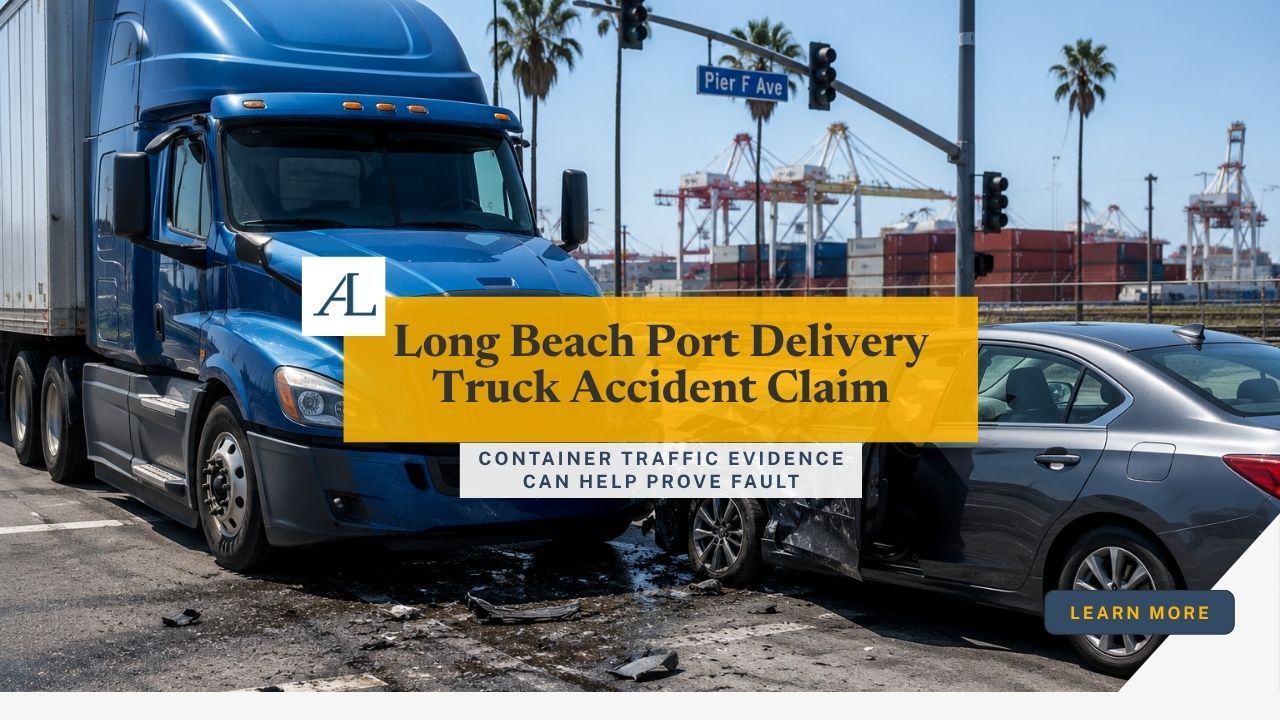
A Long Beach port delivery truck accident claim can become complicated quickly because port-area crashes often involve commercial vehicles, container traffic, tight delivery schedules, terminal access rules, drayage companies, cargo records, and multiple insurance carriers. When a delivery truck, container truck, semi-truck, chassis, or port-area commercial vehicle causes a serious crash, the injured person may be left dealing with medical treatment, missed work, vehicle damage, and insurer pressure while trucking companies begin protecting their own records and drivers.
Crashes near the Port of Long Beach are not ordinary traffic accidents. The area is shaped by container terminals, freight corridors, warehouse routes, bridge approaches, industrial streets, terminal gates, chassis yards, and heavy commercial movement. A passenger vehicle, cyclist, motorcyclist, pedestrian, rideshare passenger, or local worker may be injured when a truck driver changes lanes without enough clearance, turns across traffic, backs near a loading area, loses control of a container chassis, blocks visibility, or enters a public roadway from a terminal or freight facility.
The Port of Long Beach is widely recognized as a major U.S. gateway for trans-Pacific trade and one of the country’s most important container seaports, which helps explain why port-area truck traffic can be so concentrated around Long Beach roadways and freight routes. In a Long Beach port delivery truck accident claim, that local freight context matters because the crash may involve more than the truck driver’s final movement. It may involve dispatch pressure, terminal appointment timing, container pickup or drop-off records, vehicle maintenance, cargo handling, chassis ownership, route planning, and company safety practices.
When a port delivery truck crash leaves you injured, choosing the right legal representation matters. An experienced Long Beach truck accident lawyer at Avrek Law Firm can move quickly to preserve trucking records, identify every responsible party, investigate port-area evidence, and pursue compensation for the full impact of your injuries.
Call 866-598-5548, start a live chat, or request a free case review today. There are no upfront fees, and you do not pay unless we win.
Why a Long Beach Port Delivery Truck Accident Claim Is More Complex Than a Regular Crash
A Long Beach port delivery truck accident claim is more complex than a standard car accident because port trucking often involves several companies and several layers of control. The driver may be operating a tractor owned by one company, hauling a container connected to another company, using a chassis owned or maintained by a separate provider, following dispatch instructions from a carrier or broker, and entering or leaving a terminal controlled by yet another entity. When a crash happens, each party may try to limit its role and shift blame elsewhere.
That complexity matters for injured victims. A truck driver may say they were following dispatch instructions. A trucking company may say the driver was an independent contractor. A broker may deny control over the route. A chassis provider may deny responsibility for equipment failure. A terminal operator may say the crash happened outside its controlled area. A cargo handler may argue that loading or container handling had nothing to do with the collision. A strong Long Beach port delivery truck accident claim must investigate each of these possibilities instead of accepting the first insurance company’s version of events.
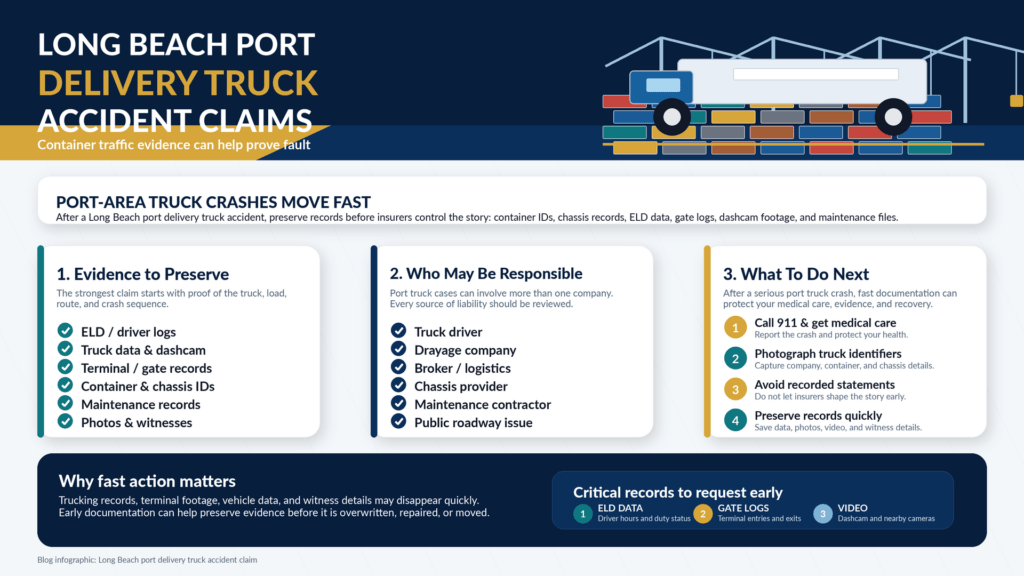
Port-area crashes also require faster evidence preservation. Trucking records, gate records, GPS logs, dashcam footage, terminal access data, dispatch messages, chassis inspection records, and electronic logging data may be available for only a limited time. If the injured person waits too long, evidence can be overwritten, vehicles can be repaired, containers can be moved, and records can become harder to obtain. This is why early action is critical after a serious crash involving container traffic, drayage trucks, or delivery vehicles near the Long Beach port.
Port of Long Beach Facts & FAQs — https://polb.com/port-info/port-facts-faqs/
Port Trucking Often Involves Multiple Companies
A Long Beach port delivery truck accident claim may involve a driver, motor carrier, drayage company, logistics broker, shipping company, cargo owner, terminal operator, maintenance company, chassis provider, or warehouse operator. These roles can overlap, and the party most visible at the crash scene may not be the only party responsible. The truck driver may have caused the immediate impact, but the company that controlled the route, schedule, vehicle condition, or equipment may also share fault.
This is one reason port truck accident claims are often contested. The defense may attempt to narrow the case to one driver and one insurance policy, even when the evidence shows a larger chain of responsibility. A Long Beach port delivery truck accident claim should examine who assigned the driver, who owned the tractor, who controlled the chassis, who scheduled the pickup, who maintained the truck, and whether delivery pressure or equipment problems contributed to the crash.
Container Traffic Creates Unique Roadway Hazards
Container trucks create risks that ordinary passenger vehicles do not. They have larger blind spots, longer stopping distances, wide turning paths, heavier loads, and reduced maneuverability. A loaded container chassis may behave differently than an empty chassis, especially during braking, turning, or sudden evasive movement. If the driver is moving through traffic near a terminal gate, bridge, warehouse, or port access road, even a small mistake can cause severe injuries.
A Long Beach port delivery truck accident claim may involve a truck entering traffic from a terminal, merging near industrial roadways, crossing multiple lanes to reach a freeway ramp, or turning near a pedestrian or cyclist. These movements should be reviewed carefully because commercial truck drivers are expected to account for the size and limitations of their vehicles. A driver cannot safely treat a container truck like a passenger car, especially around Long Beach port traffic.
Insurers May Try to Treat the Crash Like a Simple Traffic Accident
Insurance companies often try to simplify serious commercial truck crashes. They may argue that the injured driver was in the truck’s blind spot, that traffic near the port was unavoidable, that another vehicle caused the crash, or that the truck driver had no time to react. These arguments can reduce the value of the claim if they are not challenged with evidence.
A Long Beach port delivery truck accident claim should not rely only on the police report or the truck driver’s statement. The claim should examine electronic data, delivery records, gate activity, dashcam footage, vehicle damage, road layout, witness statements, and the driver’s work schedule. When the full commercial context is investigated, the crash may look very different from the insurer’s first explanation.
Common Port-Area Truck Accident Scenarios in Long Beach
A Long Beach port delivery truck accident claim can arise from many different crash patterns. Some crashes happen on public roads near the port. Others happen near terminal entrances, freight yards, warehouse districts, bridge approaches, or areas where container trucks mix with local traffic. The specific crash pattern matters because it can determine what evidence is needed and which parties may be responsible.
The key issue is whether the commercial vehicle was operated safely under the conditions. A container truck driver must account for road width, traffic congestion, blind spots, cargo weight, terminal access, pedestrian movement, and nearby vehicles. A company that sends drivers through busy freight corridors must also ensure that drivers are qualified, trucks are maintained, and delivery expectations do not encourage unsafe decisions.
Unsafe Lane Changes by Container and Delivery Trucks
Unsafe lane changes are a common issue in a Long Beach port delivery truck accident claim. A truck driver may need to move across lanes to reach a freeway ramp, terminal entrance, bridge approach, or warehouse route. If the driver fails to check mirrors, signals too late, moves across lanes without enough clearance, or forces a smaller vehicle out of position, the crash can cause serious injuries.
Lane-change crashes involving port trucks often turn into visibility disputes. The truck driver may claim the passenger vehicle, motorcycle, bicycle, or pedestrian was in a blind spot. The injured person may know the truck moved suddenly and left no safe escape route. Evidence such as dashcam footage, witness statements, vehicle damage, road markings, and truck data can help determine whether the driver moved before it was safe.
Wide Turns Near Terminals, Warehouses, and Industrial Streets
Container trucks and delivery trucks often require wide turns, especially near terminal gates, loading docks, warehouse entrances, and industrial intersections. A driver may swing left before turning right, cut across lanes, or turn from a position that surprises nearby traffic. When a motorcycle, cyclist, pedestrian, or passenger vehicle is caught beside the truck, the injuries can be severe.
A Long Beach port delivery truck accident claim involving a wide turn should examine the truck’s lane position, turn signal use, speed, road design, trailer path, and whether the driver checked for vulnerable road users before turning. The defense may argue that the truck needed extra room, but needing extra room does not excuse an unsafe turn. Commercial drivers must plan turns carefully and avoid trapping others in the truck’s path.
Rear-End Crashes in Heavy Port Traffic
Port-area traffic can stop suddenly because of terminal queues, traffic signals, bridge congestion, freight backups, construction, and truck staging. A delivery truck or container truck that follows too closely may not stop in time when vehicles ahead slow down. Because trucks are heavier than passenger vehicles, a rear-end impact can cause catastrophic injuries even at moderate speeds.
A Long Beach port delivery truck accident claim involving a rear-end crash should review following distance, speed, braking data, driver distraction, traffic conditions, load weight, brake maintenance, and whether the driver was looking for directions or terminal access information instead of watching traffic. The insurer may argue that the lead vehicle stopped suddenly, but a professional truck driver should leave enough distance for the truck’s size, weight, and stopping limitations.
Chassis, Container, and Equipment Problems
Port truck crashes may involve equipment issues that are not obvious at the scene. A defective chassis, worn tires, brake problems, lighting defects, coupling issues, loose components, or poorly maintained trailer equipment can contribute to a crash. If the vehicle was used in container transport, the investigation should determine who inspected the tractor, chassis, tires, brakes, lights, and securement equipment before the trip.
A Long Beach port delivery truck accident claim may become more complex when the tractor and chassis are controlled by different companies. The driver may inspect certain components, the carrier may maintain others, and the chassis provider may have separate obligations. If equipment failure contributed to the crash, maintenance and inspection records may become central to proving liability.
Fatigue, Dispatch Pressure, and Long Work Hours
Port trucking can involve long shifts, waiting time, tight delivery windows, gate appointments, warehouse deadlines, and pressure to complete multiple loads. Driver fatigue can affect reaction time, judgment, lane control, braking, and awareness of smaller vehicles. A fatigued driver operating a container truck in congested Long Beach traffic can cause devastating harm.
A Long Beach port delivery truck accident claim should review electronic logs, dispatch records, terminal appointment records, fuel receipts, GPS data, and communications between the driver and company. The question is not only whether the driver violated a rule. The question is whether the company allowed or encouraged a schedule that made safe driving difficult.
Evidence That Can Strengthen a Long Beach Port Delivery Truck Accident Claim
Evidence is the foundation of a Long Beach port delivery truck accident claim. Trucking companies and their insurers often have access to records that injured victims cannot obtain on their own. If those records are not preserved quickly, the defense may later claim they no longer exist, were overwritten, or are not relevant.
The strongest claims usually combine crash scene evidence, trucking company records, electronic data, terminal or delivery documentation, medical records, and witness testimony. A serious port truck crash should be investigated from several angles because the final impact may have been caused by decisions made hours or days earlier.
Electronic Logging Device and Driver Records
Electronic logging device records can help show whether the driver was within hours-of-service limits, whether the driver had enough rest, and whether fatigue may have contributed to the crash. FMCSA guidance states that motor carriers must retain ELD record-of-duty-status data and supporting documents for six months, and that backup ELD records must also be maintained for six months.
This retention window is one reason a Long Beach port delivery truck accident claim should be reviewed quickly. Waiting too long can make it harder to obtain driver logs, supporting documents, or backup data that may show fatigue, scheduling pressure, or inconsistencies in the driver’s account.
Truck Data, GPS, Dashcam Footage, and Telematics
Many commercial trucks record data that can help explain how a crash happened. Depending on the vehicle and company systems, records may show speed, braking, engine activity, GPS location, route history, sudden deceleration, hard braking, lane movement, and video footage. This information can be extremely important when the driver claims they were moving slowly, had no time to react, or were not responsible.
A Long Beach port delivery truck accident claim should also investigate whether the truck had a forward-facing or driver-facing camera. Video may show traffic conditions, lane position, driver distraction, signal use, or whether another vehicle truly caused the emergency. If video exists, preservation requests should be sent immediately before the footage is overwritten.
Terminal Gate Records and Delivery Documents
Port-area crashes may involve gate records, terminal appointments, bills of lading, delivery orders, container numbers, chassis numbers, proof-of-delivery documents, and dispatch instructions. These records can help establish where the truck was coming from, where it was headed, whether it was under a time deadline, and who controlled the movement of the cargo.
A Long Beach port delivery truck accident claim should identify the container, chassis, terminal, carrier, broker, and delivery destination whenever possible. These details can help reveal whether the truck was operating as part of a larger freight movement and whether other companies should be investigated.
Chassis, Maintenance, and Inspection Records
Maintenance evidence may be critical if the crash involved brake failure, tire problems, lighting issues, coupling failure, steering problems, or trailer instability. Port trucks often operate under demanding conditions, and equipment that is poorly maintained can become dangerous quickly. A delivery truck or container truck should not be on the road if its brakes, tires, lights, mirrors, or coupling components are unsafe.
A Long Beach port delivery truck accident claim should request maintenance logs, inspection reports, repair invoices, driver vehicle inspection reports, and any records connected to the tractor, trailer, or chassis. If equipment was repaired immediately after the crash, that timing may also be important.
Crash Scene Photos, Witnesses, and Nearby Video
Scene evidence can disappear quickly near the port. Vehicles are moved, debris is cleared, traffic resumes, and cargo continues moving. Photos of vehicle positions, damage, skid marks, lane markings, road signs, truck numbers, company logos, container numbers, and visible injuries can help preserve the scene before it changes.
Witnesses may include other truck drivers, dockworkers, warehouse employees, motorists, cyclists, pedestrians, rideshare drivers, security personnel, or business owners. Nearby cameras may be located on warehouses, terminals, trucks, buses, security gates, parking lots, or industrial buildings. A Long Beach port delivery truck accident claim should identify possible video sources as early as possible.
Who May Be Liable After a Long Beach Port Delivery Truck Accident?
A Long Beach port delivery truck accident claim may involve multiple liable parties. The driver may have caused the crash, but the company or companies behind the truck may have contributed through unsafe scheduling, poor training, bad maintenance, improper equipment management, or negligent routing. Identifying every responsible party is essential because serious truck accident injuries may require long-term medical care and significant compensation.
Liability should be based on evidence, not assumptions. The defense may try to isolate the blame on one driver or argue that the crash was unavoidable. A full investigation can determine whether the crash was the result of a broader failure in how the truck, route, schedule, or equipment was managed.
The Port Truck Driver
The driver may be liable for unsafe lane changes, speeding, distracted driving, fatigue, tailgating, failure to yield, unsafe turns, failure to inspect equipment, or failure to control the vehicle. A commercial truck driver must operate with the level of care required for a large vehicle moving through busy freight corridors and public roads.
A Long Beach port delivery truck accident claim should examine the driver’s actions before impact. Did the driver signal? Did the driver check blind spots? Was the truck following too closely? Was the driver distracted by dispatch messages, GPS, gate instructions, or phone use? Did the driver have enough rest? These questions help determine whether driver negligence caused the crash.
The Drayage Company or Motor Carrier
The motor carrier or drayage company may be responsible if the driver was working for the company or if company practices contributed to the crash. Potential issues include negligent hiring, inadequate training, unsafe scheduling, poor supervision, failure to monitor hours, failure to maintain equipment, or pressure to complete deliveries quickly.
A Long Beach port delivery truck accident claim should investigate the company’s role, not just the driver’s conduct. If the company assigned an unrealistic schedule, ignored maintenance problems, failed to train the driver on port-area safety, or allowed an unsafe vehicle to operate, the company may share liability.
A Broker, Logistics Company, or Cargo Owner
A freight broker, logistics company, shipper, or cargo owner may become relevant if it influenced the route, schedule, carrier selection, or delivery pressure. These parties often deny control over the driver, but records may show whether they selected an unsafe carrier, imposed tight timing, or contributed to a chain of decisions that made the crash more likely.
A Long Beach port delivery truck accident claim involving logistics companies can be document-heavy. Contracts, emails, dispatch instructions, load tenders, appointment records, and delivery requirements may help determine whether a company’s decisions contributed to the dangerous conditions.
A Chassis Provider, Maintenance Company, or Equipment Owner
If equipment failure contributed to the crash, a chassis provider, maintenance contractor, truck owner, trailer owner, or repair company may be liable. Brake defects, tire failure, lighting problems, coupling failures, or steering issues can turn a routine port trip into a serious collision.
A Long Beach port delivery truck accident claim should preserve the truck and equipment before repairs are made. Once the tractor, chassis, or trailer is repaired or returned to service, it may be harder to prove that a mechanical condition contributed to the crash.
A Public Entity or Roadway Contractor
Some port-area crashes may involve roadway design, construction zones, missing signs, poor lighting, public road hazards, traffic signal issues, or unsafe lane configurations. These cases require quick review because claims involving public entities may have shorter deadlines and special procedures.
Not every Long Beach port delivery truck accident claim involves a public entity. Many are caused by private trucking companies and drivers. However, if the crash involved a dangerous public roadway condition, construction activity, or public vehicle, that issue should be evaluated early.
Insurance Disputes in Long Beach Port Delivery Truck Accident Claims
A Long Beach port delivery truck accident claim may involve more than one insurance policy. The truck driver may have coverage through a motor carrier. The tractor may be insured separately from the chassis. A broker may have coverage. A cargo company may have separate policies. A maintenance provider may have liability insurance. If multiple vehicles were involved, passenger vehicle insurers may also become part of the dispute.
Insurance companies may use this complexity to delay payment. One insurer may blame another. The trucking company may deny that the driver was acting within the scope of work. A carrier may say a contractor was responsible. A chassis provider may deny equipment involvement. These disputes can leave injured victims waiting while medical bills and lost income continue to grow.
A strong Long Beach port delivery truck accident claim should identify coverage early and prevent insurers from controlling the timeline. The claim should be supported by physical evidence, commercial records, medical documentation, and a clear theory of liability that explains how the crash happened and why each responsible party should be held accountable.
Insurers May Try to Blame the Injured Person
Insurance companies often argue comparative fault in truck accident claims. They may say the injured driver was in a blind spot, followed too closely, cut off the truck, ignored traffic conditions, or failed to avoid the crash. If the injured person was a cyclist, motorcyclist, or pedestrian, the insurer may argue they were difficult to see or were moving unpredictably.
A Long Beach port delivery truck accident claim should push back against blame-shifting with evidence. Commercial truck drivers are trained to account for blind spots, stopping distance, and roadway conditions. A truck driver cannot move unsafely and then blame the injured person for being smaller, more vulnerable, or harder to see.
The Full Value of the Claim May Be Disputed
Truck accidents often cause serious injuries, which means insurers may fight hard over damages. They may argue that injuries were preexisting, treatment was excessive, lost wages are unsupported, future care is speculative, or pain and suffering is exaggerated. These arguments can reduce compensation if the claim is not documented carefully.
A Long Beach port delivery truck accident claim should include medical records, specialist reports, imaging, work restrictions, wage documentation, future care estimates, and evidence of how the injuries affect daily life. The goal is to show the true impact of the crash, not just the first emergency room bill.
What to Do After a Long Beach Port Delivery Truck Accident
After a serious truck crash, medical safety comes first. Call 911 or ask someone nearby to call. If you are in traffic or near an active port route, move to safety only if you can do so without worsening your injuries. Truck crash scenes can remain dangerous because other vehicles may continue moving through freight corridors, bridge approaches, or industrial streets.
If you are able, take photos of the truck, license plate, company name, USDOT number, container number, chassis number, trailer number, cargo markings, vehicle damage, road signs, lane markings, skid marks, debris, and visible injuries. Get the truck driver’s name, employer, insurance information, and any identifying details for the tractor, trailer, and container. If witnesses saw what happened, collect names and phone numbers before they leave.
Do not rely on the trucking company to preserve evidence voluntarily. A Long Beach port delivery truck accident claim may depend on records that the injured person cannot access without legal help. A lawyer can send preservation letters, request electronic data, identify potential defendants, and protect the claim before critical evidence disappears.
Seek Medical Care Immediately
Truck accidents can cause traumatic brain injuries, spinal injuries, fractures, internal injuries, shoulder injuries, knee injuries, nerve damage, chronic pain, and emotional trauma. Some symptoms appear immediately, while others worsen over time. Prompt medical treatment protects your health and creates records connecting the injuries to the crash.
Delays in treatment can give insurers an excuse to argue that the injuries were not serious or were unrelated to the truck accident. A Long Beach port delivery truck accident claim should include consistent medical documentation from the beginning, including emergency care, follow-up visits, imaging, therapy, referrals, and work restrictions.
Avoid Recorded Statements Before Legal Review
Truck insurers may contact injured victims quickly. The adjuster may sound helpful, but recorded statements are often used to limit claims. Questions about speed, distance, lane position, pain level, prior injuries, or what you could have done differently may later be used to shift blame.
Before giving a recorded statement, speak with a Long Beach truck accident lawyer. An attorney can handle insurance communications, protect you from unfair questions, and make sure the claim is supported by evidence rather than rushed statements.
Preserve the Vehicle and Damaged Property
The damaged passenger vehicle, motorcycle, bicycle, helmet, clothing, phone, and other property may contain important evidence. Do not repair, sell, or discard key items before they are documented. Vehicle damage patterns can help show the angle of impact, force of collision, and whether the truck driver’s story matches the physical evidence.
A Long Beach port delivery truck accident claim may also require inspection of the truck, tractor, chassis, or trailer. Early legal action can help prevent the defense from repairing or returning the commercial vehicle to service before relevant conditions are documented.
Deadlines in a Long Beach Port Delivery Truck Accident Claim
A Long Beach port delivery truck accident claim must be handled before legal deadlines expire. California Code of Civil Procedure Section 335.1 generally provides two years for an action involving injury to, or death of, an individual caused by the wrongful act or neglect of another.
The legal deadline is important, but evidence deadlines are often much shorter. Truck data may be overwritten. ELD records may have limited retention periods. Video footage may disappear. Terminal records may become harder to obtain. Witnesses may move on. Vehicles may be repaired. A Long Beach port delivery truck accident claim should be investigated as soon as possible so evidence is preserved while it is still available.
If a public entity or public roadway issue may be involved, additional notice rules may apply and deadlines may be shorter. This is another reason to get legal review quickly after a serious port-area truck crash.
Frequently Asked Questions About a Long Beach Port Delivery Truck Accident Claim
Who may be liable after a crash involving port-area delivery, drayage, or container trucks?
A Long Beach port delivery truck accident claim may involve the truck driver, drayage company, motor carrier, broker, logistics company, cargo owner, chassis provider, maintenance contractor, terminal-related company, equipment owner, or another driver depending on how the crash happened. The driver may have caused the immediate collision, but a company may have contributed through unsafe scheduling, poor training, inadequate maintenance, or defective equipment.
The claim should investigate every party connected to the truck, load, route, and equipment. Serious truck accident cases should not be limited to the first insurance policy identified at the scene.
What evidence matters most after a Long Beach port truck accident?
Important evidence may include truck data, ELD records, dispatch records, terminal gate records, container numbers, chassis records, maintenance logs, inspection reports, GPS data, dashcam footage, surveillance video, police reports, witness statements, crash scene photos, and medical records. In a Long Beach port delivery truck accident claim, commercial records can be just as important as the police report.
Because trucking evidence can disappear quickly, preservation requests should be sent as soon as possible. Waiting too long may make it harder to prove driver fatigue, equipment problems, dispatch pressure, or unsafe company practices.
What if the truck company says the driver was an independent contractor?
Independent contractor arguments are common in port and drayage trucking cases. A company may try to avoid responsibility by claiming the driver was not an employee. That defense should be investigated carefully because liability may still depend on control, dispatch instructions, vehicle ownership, insurance coverage, route requirements, company branding, equipment maintenance, and the relationship between the driver and company.
A Long Beach port delivery truck accident claim should review contracts, dispatch records, insurance documents, and company practices before accepting an independent contractor defense.
Can a chassis or container company be responsible for a crash?
Possibly. If a defective chassis, brake problem, tire failure, coupling issue, lighting defect, or equipment problem contributed to the crash, the company responsible for the equipment may need to be investigated. Port truck crashes can involve separate companies for the tractor, chassis, container, cargo, and maintenance.
A Long Beach port delivery truck accident claim involving equipment failure should preserve the tractor, chassis, trailer, inspection records, maintenance records, and repair history before anything is altered.
What if the truck driver says I was in a blind spot?
A blind spot claim does not automatically excuse the truck driver. Commercial truck drivers are trained to account for blind spots before turning, merging, backing, or changing lanes. If the driver moved without checking properly or failed to leave enough space, the driver may still be responsible.
A Long Beach port delivery truck accident claim should use vehicle damage, witness statements, video, lane markings, and truck data to determine whether the truck driver made an unsafe movement.
How long do I have to file a Long Beach truck accident claim?
Many California personal injury claims are subject to a two-year filing deadline, but evidence can disappear much sooner. If a public entity may be involved, shorter notice rules may apply. The safest step is to speak with an attorney quickly so the correct deadlines can be identified and evidence can be preserved.
A Long Beach port delivery truck accident claim should not wait until the statute of limitations is close. Trucking records, video, ELD data, and equipment evidence may be critical long before a lawsuit is filed.
Do I need a lawyer for a Long Beach port delivery truck accident claim?
Yes, especially if the crash caused serious injuries, involved a container truck or drayage vehicle, or fault is being disputed. Port truck cases often involve multiple companies, commercial insurance, electronic data, terminal records, maintenance evidence, and aggressive defense tactics.
A Long Beach truck accident lawyer can preserve evidence, identify responsible parties, handle insurer communications, and pursue compensation for medical bills, lost income, pain and suffering, future care, and long-term recovery needs.
Call or Contact Avrek Law Firm 24/7 for a Free Consultation and Pay Nothing Unless We Win
A Long Beach port delivery truck accident claim can become difficult when the trucking company blames traffic, the driver claims a blind spot, the broker denies control, or multiple insurers argue over who should pay. These cases often depend on records that injured victims cannot obtain alone, including ELD data, dispatch messages, GPS records, terminal gate records, chassis inspection records, maintenance logs, dashcam footage, and company safety policies.
Avrek Law Firm helps injured drivers, passengers, pedestrians, cyclists, motorcyclists, workers, and families investigate serious truck crashes involving port-area delivery vehicles, drayage trucks, container traffic, and commercial carriers. Our team can move quickly to preserve evidence, identify every available insurance policy, and pursue compensation for the full impact of your injuries.
Speaking with a Long Beach truck accident lawyer may help you understand whether your case also involves a Long Beach personal injury lawyer, depending on the severity of your injuries and the number of responsible parties involved.
If you or someone you love was injured by a delivery truck, container truck, semi-truck, drayage vehicle, or commercial vehicle near the Long Beach port, Avrek Law Firm is ready to help.
Call 866-598-5548, start a chat, or complete our online form today for a free, no-obligation consultation. There are no upfront fees, and you do not pay unless we win.
Serving the Long Beach Community
Avrek Law Firm represents injured people throughout Long Beach and surrounding communities. Local context matters in a Long Beach port delivery truck accident claim because the location often shapes the evidence, the defendants, and the insurance issues.
A crash near the Port of Long Beach may involve container traffic, terminal access, bridge routes, industrial corridors, warehouse deliveries, drayage companies, and commercial vehicle staging. A truck accident near Downtown Long Beach, West Long Beach, Wilmington-adjacent routes, Terminal Island access roads, the 710 corridor, Ocean Boulevard, Anaheim Street, or nearby freight routes may involve different sources of video, witnesses, traffic data, and commercial records.
A Long Beach port delivery truck accident claim should be handled with urgency, precision, and attention to the port-area evidence that insurers often minimize. Avrek Law Firm can meet with injured clients by phone, video, or in person, and our team can assist clients who are unable to travel because of their injuries.
- 📩 Submit a request through our online form
- 📞 Call 866-598-5548 now to speak with our team
- 💬 Start a live chat for immediate assistance
There are no upfront fees, and you don’t pay unless we win.