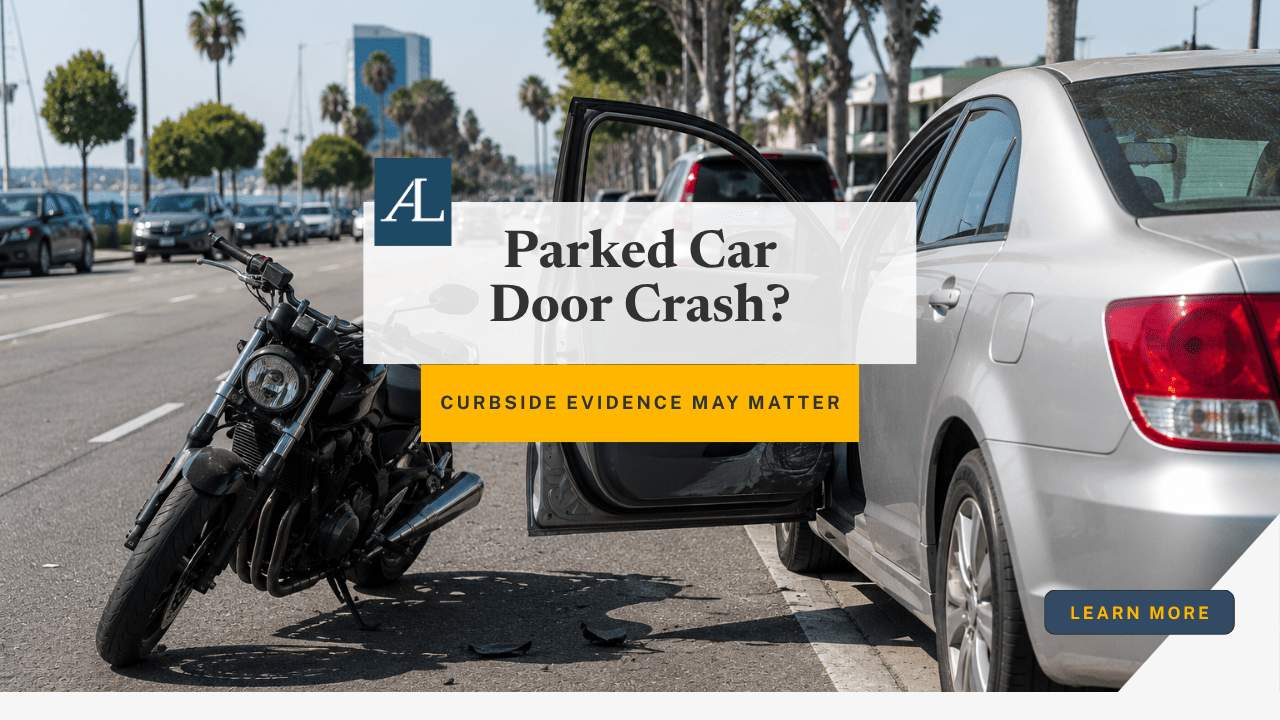
Long Beach motorcycle accident parked car door claim cases can become complicated because these crashes often happen without warning. A motorcyclist may be riding along a busy street, passing curbside parking, or moving through traffic when a driver or passenger suddenly opens a vehicle door into the rider’s path. In another situation, a parked car may pull out from the curb, a passenger may step into the lane, or a driver may move the vehicle before checking for motorcycles. The result can be a serious crash that leaves the rider with little time to react.
Motorcyclists have far less physical protection than people inside passenger vehicles. When a door opens into traffic, the rider may strike the door directly, swerve into another lane, lose control, or be thrown from the motorcycle. Even when the vehicle was parked or moving slowly, the injuries can be severe. Riders may suffer fractures, road rash, shoulder injuries, wrist injuries, knee trauma, back and neck injuries, head injuries, or long-term mobility problems.
A Long Beach motorcycle accident parked car door claim should be reviewed carefully because insurance companies may try to shift blame onto the rider. An adjuster may ask whether the rider was traveling too fast, riding too close to parked cars, lane splitting, filtering through traffic, or failing to react quickly enough. Those questions may matter, but they should not erase the responsibility of drivers and passengers to check before opening doors or moving from the curb.
When a motorcycle crash leaves you injured, choosing the right legal representation matters. Avrek Law Firm helps injured riders preserve scene evidence, identify responsible parties, and challenge insurance arguments after parked-vehicle motorcycle collisions.
Call 866-598-5548, start a chat, or request a free case review today. There are no upfront fees, and you pay nothing unless we win.
Why Parked Vehicle Motorcycle Crashes Can Be Disputed
A Long Beach motorcycle accident parked car door claim is often disputed because the crash may involve several competing stories. The rider may say the door opened suddenly. The driver may say the rider was too close or moving too fast. A passenger may claim they looked before opening the door. A witness may have seen only the impact, not the seconds before it. The insurance company may focus on the rider’s speed while ignoring the person who created the sudden hazard.
These claims often require more than a general accident report. The door position, vehicle location, lane layout, road width, traffic flow, parking conditions, video footage, and physical damage may all help explain what happened. A parked vehicle can still create a dangerous condition when someone opens a door into traffic or pulls into a rider’s path without looking.
California Vehicle Code Section 22517 states that a person must not open a vehicle door on the side available to moving traffic unless it is reasonably safe and can be done without interfering with traffic, and the door cannot be left open longer than necessary to load or unload passengers. This statute can become important in a motorcycle dooring case because it addresses the exact type of curbside hazard that may cause a crash.
Opening Doors, Sudden Pullouts, and Curbside Vehicle Movement
A Long Beach motorcycle accident parked car door claim may involve more than one type of parked-vehicle movement. The most obvious scenario is a door opening directly into the rider’s path. This can happen when a driver exits a parked vehicle, when a passenger opens a door on the traffic side, or when someone opens the door to load or unload property without checking for motorcycles.
Sudden pullouts can also cause serious crashes. A driver parked along the curb may pull into traffic without seeing a motorcycle approaching from behind. A rideshare passenger may exit into the roadway. A delivery driver may open a door while unloading. A parked vehicle may angle out from the curb and block part of the lane before the rider has a safe chance to stop or move away.
These crashes are not always simple. A rider may swerve to avoid the door and collide with another vehicle. The motorcycle may go down without direct contact with the car door. The parked vehicle owner may deny that the door caused the crash because the rider did not strike it. A Long Beach motorcycle accident parked car door claim should therefore consider both direct impact and evasive-action evidence.
Rider Speed, Lane Position, and Reaction Time Questions
Insurance companies often focus on rider speed after a parked-car-door motorcycle crash. They may argue that the rider was traveling too fast, too close to parked vehicles, or in a position where the crash could have been avoided. These arguments should be reviewed through evidence rather than assumption.
A motorcycle rider’s lane position may depend on traffic, parked cars, road width, bike lanes, lane markings, delivery vehicles, buses, and surrounding hazards. In Long Beach, curbside parking, downtown streets, beach-area traffic, retail corridors, and residential neighborhoods can create tight spaces where riders must constantly evaluate risks.
The California DMV Motorcycle Handbook explains that riders should choose lane positions that improve visibility, preserve space, and help avoid hazards. It also advises that when passing parked vehicles, riders should generally stay toward the left portion of the lane to avoid problems caused by opening doors, people exiting vehicles, or pedestrians stepping from between parked cars.
A Long Beach motorcycle accident parked car door claim should not assume the rider was at fault simply because the motorcycle was near parked cars. The real question is whether the door, vehicle movement, or curbside activity created an unreasonable hazard and whether the rider had enough time and space to respond.
Why Drivers May Claim They Did Not See the Motorcyclist
Drivers and passengers often say they did not see the motorcyclist before opening a door or moving from the curb. That statement may describe their perspective, but it does not automatically excuse the collision. A person who opens a vehicle door into traffic must check carefully before creating a hazard.
A Long Beach motorcycle accident parked car door claim may involve visibility disputes. The driver may say the rider was hidden by traffic, moving too quickly, or in a blind spot. The rider may say the door opened suddenly and left no safe path. A witness may confirm that the door opened immediately before impact. Damage to the door, motorcycle, helmet, clothing, or roadway may also help determine whether the rider had a realistic opportunity to avoid the crash.
The issue is not only whether the person opening the door personally saw the motorcycle. The issue is whether they should have looked carefully enough before opening the door or moving into the lane. That distinction can become central to liability.
Scene Evidence Riders Should Preserve After the Crash
A Long Beach motorcycle accident parked car door claim often depends on scene evidence that can disappear quickly. The parked vehicle may be moved. The door may be closed. The motorcycle may be towed. Skid marks may fade. Debris may be cleared. Witnesses may leave before their contact information is collected. Nearby video may be overwritten.
Riders should focus first on safety and medical care. If possible, evidence should be preserved before the scene changes. Even simple photographs can help reconstruct how the crash occurred.
Photos of Door Position, Vehicle Location, and Lane Layout
Photos can help show whether a car door was open, how far it extended into traffic, where the vehicle was parked, and where the motorcycle came to rest. In a Long Beach motorcycle accident parked car door claim, pictures of the door position may be extremely important because once the door is closed, the scene may look very different.
Photos should also capture lane markings, curbside parking spaces, traffic lanes, bike lanes if present, road width, nearby signs, lighting conditions, and surrounding vehicles. The location of the parked car relative to the motorcycle can help explain whether the rider had a safe path.
Wide photos can show the full roadway environment. Close-up photos can show damage to the door edge, mirror, handlebar, motorcycle fairing, foot pegs, brake lever, helmet, gloves, jacket, pants, and boots. Together, these images can help establish whether the crash involved an opened door, sudden vehicle movement, or another curbside hazard.
Business Cameras, Dashcams, and Nearby Witnesses
Video footage can be especially useful in a Long Beach motorcycle accident parked car door claim. Nearby businesses, apartment buildings, dashcams, parked vehicles, rideshare vehicles, buses, and delivery vehicles may have captured the crash or the moments before impact.
The challenge is time. Many surveillance systems overwrite footage quickly. A camera that recorded the door opening or the vehicle pulling out may delete that footage within days. Riders should not assume that an insurance company will automatically find and preserve video. Early investigation may be necessary to identify camera locations and request preservation.
Witnesses can also help clarify what happened. Someone walking nearby may have seen the door open. A driver behind the motorcycle may have seen the rider react. A business employee may have watched from a storefront. A passenger may admit that the door opened suddenly. Witness accounts can be important when the driver later claims the rider was at fault.
Motorcycle Damage, Gear Damage, and Skid or Impact Marks
Motorcycle damage can help explain the direction and force of the collision. In a Long Beach motorcycle accident parked car door claim, damage to the front wheel, handlebars, mirrors, fairings, brake lever, clutch lever, engine guard, or foot pegs may show how the motorcycle contacted the door or roadway.
Protective gear should also be preserved. Helmet damage, torn gloves, scraped jackets, damaged boots, and road-worn pants may help show how the rider fell and what parts of the body absorbed the impact. Gear damage may support medical records by showing the force and direction of the fall.
Skid marks, scrape marks, debris, broken glass, and paint transfer may also matter. If the rider swerved or braked suddenly, those marks may help show that the door or vehicle movement created an immediate hazard. Physical evidence can challenge an insurer’s claim that the rider simply lost control without cause.
Insurance Issues After a Parked-Vehicle Motorcycle Collision
Insurance disputes are common in a Long Beach motorcycle accident parked car door claim because the crash may involve a driver, passenger, vehicle owner, rideshare user, delivery driver, or employer. The insurance company may also argue that the rider shared fault because of speed, lane position, lane splitting, or reaction time.
These disputes should be evaluated carefully. The presence of a parked vehicle does not make the crash minor. A sudden door opening or curbside movement can cause severe injuries and long-term losses.
Driver, Passenger, and Vehicle Owner Policy Questions
A parked-car-door motorcycle crash may involve more than one person. The driver may have parked the vehicle. A passenger may have opened the door. The registered owner may be different from the person who used the vehicle. In a rideshare situation, the passenger may have opened the door while exiting. In a delivery or work setting, a company vehicle may be involved.
A Long Beach motorcycle accident parked car door claim should identify who opened the door, who controlled the vehicle, who owned the vehicle, and whether any commercial or employer-related insurance may apply. If a passenger opened the door, the driver’s insurance may still need review. If the vehicle was being used for work, additional coverage may exist.
Insurance companies may try to narrow the claim to one person or one policy. A complete investigation should review all possible sources of coverage before accepting an insurer’s position.
Disputes Over Whether the Door or Vehicle Movement Caused the Crash
One common insurance argument is that the door did not actually cause the crash. The insurer may say the rider overreacted, was traveling too fast, or failed to maintain control. This argument can be especially common if the motorcycle avoided direct contact with the door but crashed while swerving.
A Long Beach motorcycle accident parked car door claim does not always require direct door impact to be serious. If a door opened suddenly and caused the rider to brake or swerve, that movement may still be central to the collision. Video, witness statements, road marks, motorcycle damage, and the final positions of the vehicles may help establish the sequence.
The insurance company’s interpretation should be tested against the evidence. A rider’s evasive action may actually support the claim if it shows the rider was trying to avoid a sudden hazard created by someone else.
Recorded Statement Questions About Visibility and Speed
Insurance adjusters may request a recorded statement soon after the crash. In a Long Beach motorcycle accident parked car door claim, questions may focus on the rider’s speed, lane position, visibility, distance from parked cars, braking, reaction time, protective gear, and whether the rider saw the door before impact.
These questions can affect the claim. A rider may still be in pain, medicated, confused, or unsure about exact distances and timing. If the rider guesses during a recorded statement, the insurer may later use that answer to dispute liability.
It is better to be accurate than fast. Riders should avoid speculation about speed, distance, visibility, or fault when those details require evidence review. Recorded statements may later be compared against photos, video, witness accounts, medical records, and police reports.
Injury Documentation for Long Beach Motorcycle Accident Claims
A Long Beach motorcycle accident parked car door claim often involves more than proving how the crash happened. The rider also needs documentation showing the injuries, treatment, recovery timeline, missed work, and daily-life impact.
Motorcycle injuries can be severe even when the crash occurs at relatively low speed. A dooring collision can throw the rider from the bike, cause a fall into traffic, or lead to a secondary impact with another vehicle or the pavement.
Emergency Care, Orthopedic Treatment, and Follow-Up Appointments
Riders should seek medical care as soon as possible after a crash. Some injuries are obvious immediately, such as fractures, deep abrasions, or shoulder trauma. Others may develop over hours or days, including neck pain, back pain, concussion symptoms, numbness, dizziness, or soft tissue injuries.
Emergency records may document the first symptoms after the crash. Orthopedic treatment may be needed for fractures, ligament injuries, joint damage, or surgical repair. Follow-up appointments may show whether the rider’s condition improved, worsened, or required specialist care.
A Long Beach motorcycle accident parked car door claim becomes stronger when medical records clearly connect the crash to the injuries and treatment timeline. Delayed treatment or inconsistent reporting may give insurers an opportunity to question the claim.
Road Rash, Fractures, Soft Tissue Injuries, and Mobility Limits
Common injuries in parked-car-door motorcycle crashes include road rash, broken wrists, shoulder injuries, collarbone fractures, knee injuries, ankle injuries, back injuries, neck pain, and head trauma. Even road rash can involve infection risk, scarring, wound care, and painful recovery.
A Long Beach motorcycle accident parked car door claim may also involve soft tissue injuries that do not immediately appear on basic imaging. Neck, back, shoulder, and joint pain should be documented through medical visits, therapy records, and follow-up care.
Mobility limits can affect nearly every part of daily life. A rider may have difficulty walking, driving, working, sleeping, lifting, dressing, or caring for children. Those limitations should be documented as part of the claim.
Missed Work, Transportation Problems, and Daily Activity Changes
A motorcycle crash can disrupt income and transportation immediately. The rider may miss work, lose the use of the motorcycle, need rides to appointments, pay for alternate transportation, or rely on family members for help. If the rider works a physical job, even a temporary injury may create major financial pressure.
A Long Beach motorcycle accident parked car door claim should include records showing missed work, reduced hours, medical appointments, transportation costs, motorcycle repair estimates, gear replacement costs, and household limitations. Employer letters, pay records, appointment calendars, and receipts can help support these losses.
Daily activity changes may also matter. Pain journals, physical therapy notes, and family observations can help explain how the crash affected sleep, movement, hobbies, caregiving, and independence.
Frequently Asked Questions About a Long Beach Motorcycle Accident Parked Car Door Claim
A Long Beach motorcycle accident parked car door claim often raises questions because these crashes can involve unusual facts. The vehicle may have been parked, but the door or curbside movement may still create serious danger for riders.
Who may be responsible if a car door opens into a motorcyclist?
The person who opened the door may be responsible if they failed to check whether it was safe before opening it into traffic. The vehicle owner, driver, passenger, employer, rideshare user, or another party may also need review depending on the circumstances. A Long Beach motorcycle accident parked car door claim should identify who opened the door, who controlled the vehicle, and what insurance coverage may apply.
Can a rider still have a claim if they swerved and did not hit the door?
Yes, a rider may still have a claim if the door or parked vehicle movement created a sudden hazard that caused the crash. Direct impact is helpful evidence, but it is not the only way to show causation. Video, witnesses, skid marks, scrape marks, and the rider’s injuries may help explain why evasive action was necessary.
What evidence matters most after a parked-car-door motorcycle crash?
Important evidence may include photos of the door position, vehicle location, lane layout, motorcycle damage, gear damage, witness information, nearby video footage, medical records, police reports, and insurance communications. A Long Beach motorcycle accident parked car door claim is often strongest when scene evidence is preserved before vehicles are moved and footage is overwritten.
Call or Contact Avrek Law Firm 24/7 for a Free Consultation and Pay Nothing Unless You Win
A Long Beach motorcycle accident parked car door claim can leave an injured rider facing medical bills, missed work, motorcycle damage, pain, mobility limits, and pressure from insurance companies. These claims often turn on details that can disappear quickly, including door position, vehicle location, camera footage, witness accounts, gear damage, and curbside evidence.
Avrek Law Firm helps injured motorcyclists investigate parked-vehicle crashes, preserve critical records, and challenge unfair insurance arguments. Our team understands how insurers may try to blame riders after dooring collisions, sudden pullouts, and curbside crashes.
Speaking with a Long Beach motorcycle accident lawyer may help you understand what evidence should be preserved after a parked-car-door crash. These cases may also overlap with issues handled by a Long Beach personal injury lawyer, especially when injuries are serious, fault is disputed, or insurance companies push for an early settlement.
If you or someone you love was injured in a Long Beach motorcycle accident involving an opening car door or parked vehicle, Avrek Law Firm is ready to help.
- 📩 Submit a request through our online form
- 📞 Call 866-598-5548 now to speak with our team
- 💬 Start a live chat for immediate assistance
There are no upfront fees, and you don’t pay unless we win.