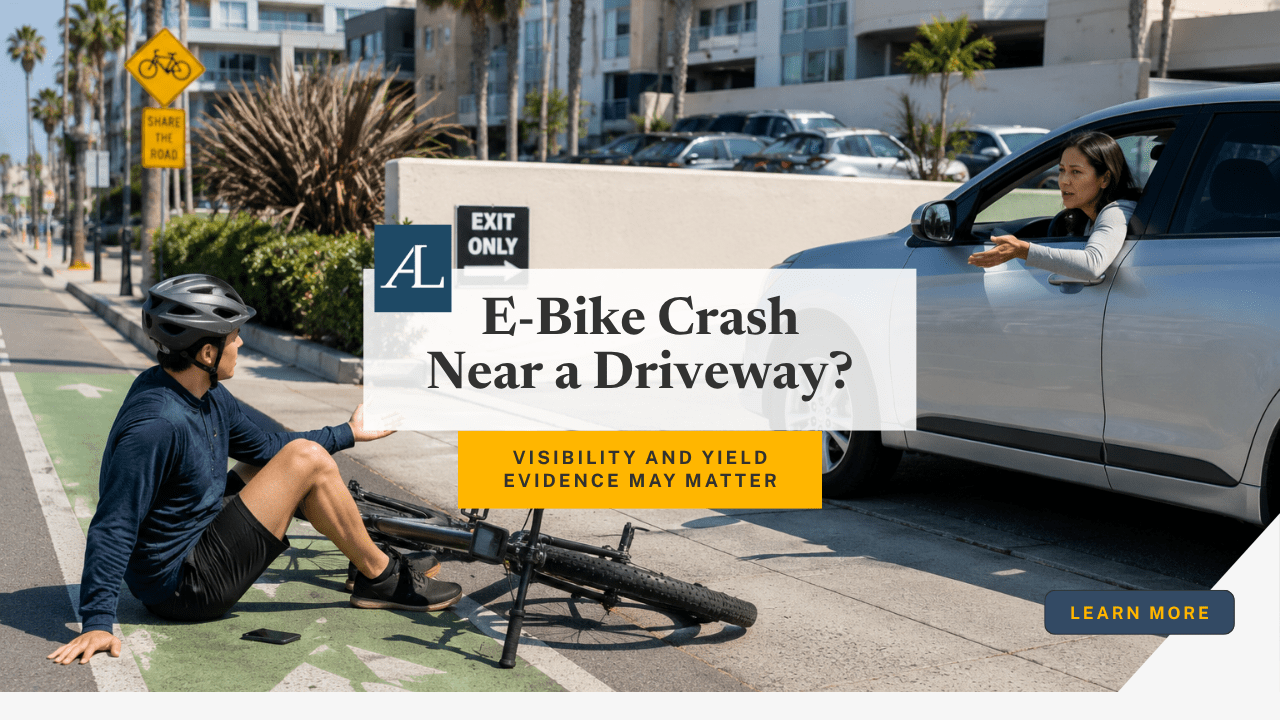
Long Beach e-bike accidents at driveways and parking lots can become complicated because the crash often happens in a space where drivers, cyclists, pedestrians, delivery vehicles, and parked cars all move through the same area. A rider may be traveling in a bike lane, along a sidewalk-adjacent path, or through a commercial corridor when a vehicle suddenly pulls out of a driveway, exits a parking structure, backs across a path, or accelerates from a parking lot without yielding.
These crashes are especially common in areas where e-bike riders pass shopping centers, apartment driveways, beach-area parking lots, hotel entrances, parking garages, and business exits. In Long Beach, riders may be traveling near Belmont Shore, Ocean Boulevard, Atlantic Avenue, Long Beach Boulevard, the waterfront, or commercial corridors where vehicles constantly enter and leave private property. A driver may say they did not see the rider, but that statement does not automatically end the claim review.
Long Beach e-bike accidents at driveways and parking lots often involve more than the driver’s behavior alone. The physical layout of the driveway, blocked sight lines, overgrown landscaping, delivery vehicle placement, poor markings, missing warning signs, and camera footage may all affect how liability is evaluated. The e-bike’s classification, the rider’s speed, and whether the rider was using a lawful route may also become part of the insurance discussion.
When an e-bike crash leaves you injured, choosing the right legal representation matters. Avrek Law Firm helps injured riders preserve scene evidence, evaluate insurance issues, and challenge unfair fault arguments after driveway and parking lot collisions.
Call 866-598-5548, start a chat, or request a free case review today. There are no upfront fees, and you pay nothing unless we win.
Why Long Beach E-Bike Accidents at Driveways and Parking Lots Create Specific Liability Questions
Long Beach e-bike accidents at driveways and parking lots create specific liability questions because these crashes often happen where traffic rules, property design, and driver visibility overlap. The driver may be leaving private property. The rider may be traveling in a bike lane or along a path that crosses a driveway. The property owner may control the driveway layout. A nearby business or parking structure may have video. Each piece matters.
California Vehicle Code Section 21804 states that a driver entering or crossing a highway from public or private property, or from an alley, must yield to traffic that is close enough to create an immediate hazard and must continue yielding until it is reasonably safe to proceed. This rule can become important when a driver exits a driveway or parking lot and crosses into the path of an e-bike rider.
Vehicle Driver Sight Lines, Speed, and Right-of-Way Questions
A driver exiting a driveway or parking lot may argue that the e-bike appeared too quickly or that visibility was blocked. Those details may matter, but they do not automatically excuse the crash. A driver entering traffic from private property must check carefully for vehicles, bicycles, e-bikes, pedestrians, and other lawful road users before moving forward.
In Long Beach e-bike accidents at driveways and parking lots, sight lines often become central evidence. A parked delivery van may block part of the driver’s view. A wall, hedge, sign, utility box, or parked car may reduce visibility at the driveway edge. A sloped parking garage exit may create a blind approach where the driver sees the rider too late. These conditions may help reconstruct the crash and may also raise questions about whether the property layout contributed to the danger.
The rider’s speed may also be disputed. An insurer may argue that the e-bike was moving faster than expected. That argument should be tested against the actual evidence, including the e-bike classification, available sight distance, traffic conditions, and the driver’s duty to yield before entering the roadway.
Property Owner Responsibility for Layout and Visibility Conditions
Some Long Beach e-bike accidents at driveways and parking lots involve conditions controlled by a property owner or business operator. A parking lot exit with poor visibility, missing signs, faded markings, blocked mirrors, overgrown landscaping, or recurring delivery vehicle obstructions may create a foreseeable risk for cyclists and pedestrians.
A property owner may not be responsible for every crash that happens near a driveway. However, when the physical design or maintenance of the property contributes to the collision, that issue should be reviewed. A commercial property that sends vehicles across a bike lane with poor visibility may require closer investigation, especially if other similar incidents occurred nearby.
This is why photographs of the driveway layout are important. The crash scene may look different a week later if landscaping is trimmed, cones are moved, vehicles are gone, or markings are repainted. Preserving the condition of the property near the time of the crash can help explain why the driver did not see the rider or why the rider had little time to react.
E-Bike Speed, Classification, and How It May Affect the Analysis
Long Beach e-bike accidents at driveways and parking lots may also involve questions about the type of e-bike being used. California Vehicle Code Section 312.5 defines electric bicycles and separates them into different classes based on assistance type and assisted speed. Class 1 and Class 2 e-bikes generally stop assisting at 20 mph, while Class 3 e-bikes are pedal-assist and stop assisting at 28 mph.
E-bike classification does not automatically decide fault, but it may affect the analysis. If the rider was lawfully using a bike lane and traveling within the expected operating limits of the e-bike, the driver’s duty to yield remains important. If an insurer claims the e-bike was moving too fast, that claim should be supported by evidence rather than assumption.
A Long Beach e-bike accident at a driveway or parking lot should be reviewed based on the rider’s actual movement, the driver’s line of sight, the driveway geometry, and whether the driver entered the rider’s path before it was safe.
Evidence to Preserve After a Long Beach E-Bike Crash
Evidence can disappear quickly after Long Beach e-bike accidents at driveways and parking lots. Vehicles move. The e-bike may be repaired. Businesses overwrite camera footage. Witnesses leave. Property conditions change. The strongest evidence is often available closest to the crash date.
Scene Photos, Driveway Layout, and Signage or Marking Conditions
Photographs should show the location of the e-bike, vehicle, driveway, parking lot exit, bike lane, sidewalk, curb cut, signs, markings, obstructions, and debris. Wide photos can show how the driveway connects to the roadway. Close photos can show damage, scrape marks, blocked sight lines, and the exact point where the rider was struck.
In Long Beach e-bike accidents at driveways and parking lots, driveway layout is especially important. The angle of the exit, the width of the lane, the distance from the driveway to the bike lane, and the presence or absence of warning signage may all help explain what happened.
Photos taken from the driver’s perspective can also be useful. They can show whether the rider should have been visible before the vehicle entered the roadway or whether a property condition blocked the driver’s view.
Security Camera Footage from Businesses and Parking Structures
Many Long Beach commercial areas have cameras. Gas stations, restaurants, retail stores, parking structures, apartment buildings, hotels, and office properties may record driveway exits and parking lot entrances. A camera may not capture the entire crash, but it may show the vehicle leaving the lot, the rider’s path, or the seconds before impact.
Long Beach e-bike accidents at driveways and parking lots often require fast action because video retention periods may be short. Some systems overwrite footage within days or weeks. A written preservation request should identify the date, time, location, and camera angle that may have recorded the crash.
Even partial footage can help. A video showing the driver never stopped before crossing the bike lane may support the rider’s account. Footage showing a blocked driveway view may raise property-related questions. Footage showing the rider’s lawful position may help respond to claims that the rider appeared suddenly.
Vehicle and E-Bike Damage, Gear Photos, and Medical Records
The damage to the vehicle and e-bike can help reconstruct the impact. A dented fender, scraped door, bent e-bike fork, damaged wheel, broken handlebar, damaged battery mount, or cracked frame may show where contact occurred. Gear damage may also be important. A helmet, jacket, gloves, backpack, shoes, or phone damaged in the crash may support the injury and impact timeline.
Medical records are equally important. Long Beach e-bike accidents at driveways and parking lots can cause fractures, concussions, road rash, shoulder injuries, wrist injuries, knee trauma, hip injuries, back pain, and neck injuries. Emergency records may document the first symptoms, while follow-up records may show how the injury developed over time.
Riders should not discard damaged gear or repair the e-bike before photos are taken. The physical evidence may matter later if the insurance company disputes how the crash happened.
Insurance Questions That Follow a Parking Lot or Driveway E-Bike Accident
Insurance questions after Long Beach e-bike accidents at driveways and parking lots may involve the driver, property owner, business operator, commercial tenant, parking company, or the rider’s own coverage. The responsible insurance policy may not be obvious at first.
Driver Auto Insurance and Its Application to E-Bike Riders
The driver’s auto insurance is often the first policy reviewed. If a driver exits a driveway, parking lot, or alley without yielding and strikes an e-bike rider, the driver’s bodily injury liability coverage may apply. The rider will still need evidence showing how the driver’s conduct caused the crash.
A driver’s insurer may question the rider’s speed, lane position, visibility, helmet use, or whether the rider was operating the e-bike lawfully. This is why a Long Beach e-bike accident at a driveway or parking lot should be supported by photos, video, medical records, witness accounts, and e-bike details.
The stronger the evidence, the harder it becomes for the insurer to define the crash as the rider’s fault.
Property Owner Liability and Commercial Insurance Considerations
If the driveway, parking lot, or business layout contributed to the crash, commercial insurance may need review. A property owner may have premises liability coverage. A tenant may have business coverage. A parking management company may have its own policy. These layers matter when the crash was caused partly by unsafe property design, blocked visibility, or poor traffic flow.
Long Beach e-bike accidents at driveways and parking lots are not always limited to one negligent driver. If a commercial lot repeatedly creates blind exits into bike lanes, the property’s role should be reviewed. This is especially important when injuries are serious and the driver’s insurance coverage may not be enough.
Whether the E-Bike Rider’s Own Coverage May Apply
California e-bike riders generally do not carry e-bike-specific insurance, and e-bikes are not treated the same as registered motor vehicles. Still, a rider’s own insurance should be reviewed. Health insurance, uninsured or underinsured motorist coverage, homeowners coverage, renters coverage, or specialty e-bike coverage may affect the claim depending on the facts and policy language.
A Long Beach e-bike accident at a driveway or parking lot should not be evaluated with assumptions about coverage. All potentially available policies should be identified before settlement discussions begin.
Injury Documentation for E-Bike Riders After a California Crash
The injury record may determine how seriously the claim is evaluated. Long Beach e-bike accidents at driveways and parking lots can cause injuries that worsen after the initial crash, especially when the rider falls, twists, braces, or lands on pavement.
Emergency Records, Follow-Up Care, and Specialist Referrals
Emergency care records may document visible injuries, pain complaints, head trauma symptoms, fractures, and the rider’s first medical evaluation. Follow-up care may show whether the injury required orthopedic treatment, neurological evaluation, physical therapy, wound care, or additional imaging.
A Long Beach e-bike accident at a driveway or parking lot may involve delayed symptoms. Neck pain, back pain, headaches, dizziness, sleep changes, numbness, or joint pain may become more obvious after the first day. These symptoms should be discussed with a medical provider and documented.
Helmet and Gear Damage as Physical Evidence
Helmet damage can be important in e-bike crash claims. Even if the helmet looks mostly intact, impact may affect the liner or shell. A damaged helmet should be preserved and photographed. Torn clothing, damaged gloves, scraped shoes, or broken eyewear may also support the account of how the rider fell.
In Long Beach e-bike accidents at driveways and parking lots, gear damage may help connect the medical symptoms to the crash mechanics. It may also respond to insurance arguments about the force of impact.
Long-Term Symptoms That Should Be Evaluated and Documented
Some symptoms do not resolve quickly. A rider may experience ongoing pain, headaches, reduced mobility, anxiety around riding, missed work, sleep disruption, or difficulty handling daily responsibilities. These effects should be documented through medical records, symptom journals, employer notes, therapy records, and family observations.
A Long Beach e-bike accident at a driveway or parking lot may look simple from the outside, but the recovery can be long. The claim should reflect the actual impact on the rider’s health, work, transportation, and daily life.
Free Consultation Available
Long Beach e-bike accidents at driveways and parking lots involve more than a basic crash report. The driver’s duty to yield, driveway visibility, property conditions, e-bike classification, insurance coverage, medical records, and video evidence may all shape the claim.
Avrek Law Firm helps injured e-bike riders identify responsible parties, preserve critical evidence, and challenge insurance companies when they try to minimize rider injuries or shift fault unfairly.
Speaking with a Long Beach e-bike accident lawyer may help you understand what evidence should be preserved after a driveway or parking lot crash. These claims may also overlap with issues handled by a Long Beach bicycle accident lawyer or Long Beach personal injury lawyer, especially when injuries are serious or multiple insurance policies may apply.
If you were injured in a Long Beach e-bike crash near a driveway, parking structure, or parking lot, Avrek Law Firm is ready to help.
- 📩 Submit a request through our online form
- 📞 Call 866-598-5548 now to speak with our team
- 💬 Start a live chat for immediate assistance
There are no upfront fees, and you don’t pay unless we win.