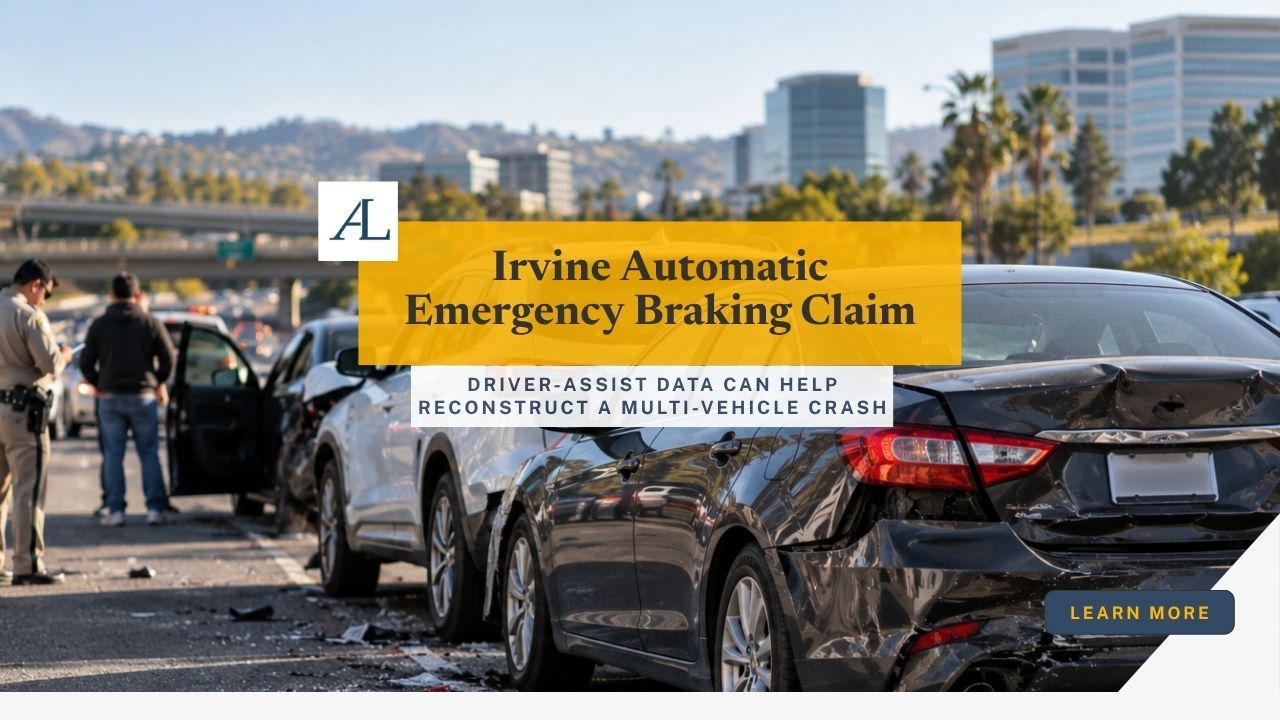
An Irvine automatic emergency braking claim can become complicated quickly because a modern vehicle may produce several different warnings, braking inputs, electronic records, and system messages during a multi-vehicle collision. One car may issue a forward-collision alert before the driver brakes. Another vehicle may activate automatic emergency braking before being struck from behind. A third vehicle may record a second impact only seconds later. When insurers begin arguing about which driver reacted first, which system activated, and which contact caused the injuries, the available vehicle data can become an important part of reconstructing the full sequence.
Automatic emergency braking does not make a vehicle self-driving, and it does not remove the driver’s responsibility to remain attentive and in control. The official NHTSA Driver Assistance Technologies resource explains that AEB can automatically apply the brakes when a forward collision is imminent, while driver-assistance features remain assistive systems that require the driver to monitor the road and operate the vehicle. That distinction matters because an insurer may wrongly argue that the technology should have prevented the crash or that activation of the system proves the driver did everything correctly.
When a multi-vehicle crash leaves you injured, choosing the right legal representation matters. An experienced Irvine car accident lawyer at Avrek Law Firm can move quickly to preserve the vehicles, identify the electronic records that may exist, compare driver-assist data with physical evidence, and pursue compensation for the full impact of the collision.
Call 866-598-5548, start a live chat, or request a free case review today. There are no upfront fees, and you do not pay unless we win.
Why an Irvine Automatic Emergency Braking Claim Can Be Hard to Reconstruct
An Irvine automatic emergency braking claim is often difficult to reconstruct because several events may occur within only a few seconds. A lead vehicle may slow suddenly. A second driver may receive a warning and begin braking. A third vehicle may fail to slow and push the second car forward. Afterward, each driver may remember only the impact closest to their own vehicle, while the available systems may record different parts of the sequence.
The presence of automatic emergency braking can create additional insurance arguments. One insurer may claim the system activated and reduced the impact. Another may argue the driver ignored a warning. A third may say the technology did not detect the hazard because of lane position, weather, road geometry, sensor obstruction, or the direction of the vehicle ahead. These explanations should not be accepted without examining the actual records, vehicle condition, physical damage, and witness evidence.
An AEB warning or activation record is only one part of the investigation. It may help establish timing, but it does not automatically establish fault. A warning may occur before the driver has a meaningful opportunity to respond, or it may occur after the driver has already started braking. Similarly, the absence of a stored AEB record does not prove the system never reacted. Data availability varies by vehicle, software, module, crash severity, and the type of information the manufacturer preserves.
Automatic Braking May Affect More Than the First Impact
In an Irvine automatic emergency braking claim, the braking system may affect the entire chain reaction, not only the first contact. A vehicle that brakes automatically may avoid the lead car but still be struck from behind. That rear impact may then push it into the vehicle ahead. Alternatively, automatic braking may reduce the first collision but position the vehicle for a second side or rear impact.
The investigation should identify whether the injured person felt one impact or several. Damage at the front and rear of the same vehicle may suggest multiple contacts. Event timing, photographs, video, witness accounts, and medical descriptions can help determine whether a later impact created additional force or worsened an injury.
This is why a multi-vehicle case should not be reduced to a simple statement that “the brakes activated.” The claim should examine what the system detected, when it reacted, what the driver did, what the surrounding vehicles did, and how the vehicle moved after each contact.
Driver-Assist Technology Uses Different Names Across Manufacturers
Driver-assist systems are not always labeled consistently. One manufacturer may use “automatic emergency braking,” while another uses a branded term for pre-collision braking, collision mitigation, active brake assist, or forward emergency braking. A warning displayed on the dashboard may also have a manufacturer-specific symbol or message.
An Irvine automatic emergency braking claim should identify the vehicle’s year, make, model, trim level, software version, and installed safety package. The owner’s manual, build information, repair records, and dealership documentation may help determine which features were actually installed and how the system was designed to operate.
Assuming that every vehicle records the same data can lead to mistakes. One car may store a diagnostic trouble code. Another may retain an event in a safety module. A third may have cloud-connected telematics or a manufacturer app. The investigation should be tailored to the specific vehicles rather than relying on a generic description of AEB.
The Driver Remains Responsible for Monitoring the Road
A driver may claim that the technology failed and therefore the crash was unavoidable. That argument should be examined carefully. Driver-assist features may supplement braking or provide a warning, but they do not give the driver permission to look away, follow too closely, or depend entirely on a sensor.
NHTSA’s driver-assistance guidance emphasizes that features such as AEB are designed to assist while the driver remains responsible for steering, braking, accelerating, and monitoring the roadway. An Irvine automatic emergency braking claim should therefore investigate both system performance and human conduct. The vehicle data may be relevant, but the driver’s following distance, attention, speed, steering, and reaction remain central questions.
What Driver-Assist Records May Exist After the Collision
An Irvine automatic emergency braking claim may involve several categories of electronic information. Potential records can include event data recorder information, airbag control module data, pre-crash speed, brake-pedal status, accelerator input, stability-control activity, steering input, diagnostic trouble codes, dashboard warnings, telematics, navigation history, app data, and scan reports.
Not every vehicle stores every category. The available information may depend on whether the crash met a recording threshold, whether airbags or restraints deployed, whether the module has nonvolatile storage, and whether the data were overwritten or changed after the event. A careful investigation should identify what may exist before assuming that a single “black box” download will answer every question.
Automatic Braking Alerts or Activation Records to Investigate
Automatic braking alerts or activation records can help determine when the system detected a possible forward collision. Depending on the vehicle, there may be records showing an alert, an intervention, a diagnostic event, or a fault that affected the system. The dashboard may also have displayed a warning before or after the collision.
In an Irvine automatic emergency braking claim, the investigation should ask whether the system issued an audible warning, visual alert, steering-wheel vibration, brake pulse, or automatic braking response. The driver and passengers should describe what they heard, saw, or felt without guessing about technical terminology. A warning sound, flashing icon, or sudden brake application may help guide the later vehicle inspection.
The absence of a visible warning after the crash does not necessarily mean no warning occurred. The dashboard may have lost power, the warning may have cleared, or the vehicle may have been restarted. Photographs and video taken immediately after the crash can be useful, especially if they show dashboard messages, warning lamps, the infotainment screen, or a manufacturer app.
Forward-Collision, Lane, or Proximity Warnings
A multi-vehicle crash may involve more than automatic braking. Forward-collision warnings, lane-departure alerts, blind-spot warnings, proximity sensors, adaptive cruise control, and lane-centering systems may also become relevant. One system may indicate that the vehicle was approaching another car. Another may show that a lane change or steering movement occurred shortly before impact.
NHTSA distinguishes between warning technologies, collision-intervention technologies, and systems that provide limited steering or speed assistance. In an Irvine automatic emergency braking claim, those categories matter because an insurer may describe a warning as if the vehicle took control, or describe an intervention as if it proved the driver had no role. The actual feature and its intended function should be identified before conclusions are drawn.
If several vehicles had driver-assist systems, each vehicle may tell a different part of the story. One may record a forward warning. Another may record brake input. Another may have dashcam footage or a collision alert sent through a connected service. Comparing those records can help identify the order of events.
Driver-Assist Settings and Vehicle System History
Driver-assist settings may show whether a feature was enabled, disabled, set to an early or late warning distance, or affected by a fault. A driver may have changed the sensitivity setting before the trip, or the system may have been unavailable because of blocked sensors, damage, maintenance, calibration, or a warning light.
An Irvine automatic emergency braking claim should preserve the settings and system history before repairs or software updates occur. Photographs of the instrument panel and settings menu may help. A pre-repair diagnostic scan may identify trouble codes or calibration problems. Maintenance records may show whether cameras, radar units, windshields, bumpers, or sensors were replaced or serviced before the crash.
These records should be interpreted carefully. A stored code does not automatically prove the system caused the collision, and a system marked “available” does not prove it responded correctly in every circumstance. Technical information must be compared with the physical crash evidence and the driver’s actions.
Preserving Vehicle Data Before Repair or Disposal
An Irvine automatic emergency braking claim can be weakened if the vehicles are repaired, released, auctioned, salvaged, or updated before the relevant data are preserved. A modern car may pass through a tow yard, insurer inspection center, dealership, body shop, storage facility, or salvage auction within days. Each transfer can create an opportunity for evidence to be changed or lost.
The owner should avoid authorizing irreversible work before the vehicle and electronic systems are documented. That does not mean the car must remain in storage indefinitely. It means the necessary photographs, scans, inspections, and preservation requests should occur before repairs, module replacement, battery disconnection, software updates, or disposal alter the evidence.
Tow Yard, Inspection, and Repair Documentation
Tow-yard documentation should include the location of the vehicle, the date it arrived, photographs of all sides, the VIN, odometer, keys, battery condition, airbag status, dashboard messages, and visible damage. If more than one vehicle is involved, similar records should be requested for each one.
An Irvine automatic emergency braking claim may depend on showing that one vehicle had front damage, another had rear damage, and a third had side damage consistent with a later contact. Tow-yard photographs may be the last clear record before components are removed or the vehicle is moved.
Repair documentation should include the initial estimate, supplemental estimates, pre-repair diagnostic scans, post-repair scans, alignment measurements, calibration records, parts lists, teardown photographs, and invoices. These records can show whether radar sensors, cameras, brake components, bumpers, windshields, steering parts, or control modules were damaged or replaced.
Whether a Qualified Data Download Should Be Requested
A qualified data download may be necessary when the collision sequence, braking input, or impact timing is disputed. Federal rules in 49 CFR Part 563 Event Data Recorders establish national requirements for vehicles equipped with EDRs and address the collection, storage, and retrievability of crash-event data. Depending on the vehicle and applicable recording conditions, data may include pre-crash speed, accelerator input, service-brake status, changes in velocity, multi-event information, and certain additional variables.
An ordinary repair-shop scan is not necessarily the same as a forensic EDR download. A scan may reveal diagnostic trouble codes, while an EDR retrieval may capture crash-related information from a specific module. Separate manufacturer tools may be needed for ADAS or AEB information.
An Irvine automatic emergency braking claim should identify which download methods are appropriate for each vehicle and who is qualified to perform them. The process should also be documented so insurers cannot later challenge where the data came from, how the vehicle was handled, or whether the information belongs to the correct crash event.
For more background on this evidence category, Avrek’s related article explains how an attorney may use event data recorder evidence after a car accident to examine speed, braking, steering, and other objective crash information. The new Irvine article goes further by focusing on how that data interacts with AEB and several vehicles in one collision sequence.
Software Updates, Part Replacement, or Vehicle Total-Loss Decisions
Software updates may change system settings, clear diagnostic codes, or alter the information available through a later inspection. Repairs may also require replacing a camera, radar sensor, windshield, bumper, brake module, steering component, or control unit. If those parts are removed before the original condition is documented, the claim may lose evidence about whether the system was damaged or functioning.
Total-loss decisions create another risk. Once an insurer declares a vehicle a total loss, it may be transferred rapidly to a salvage facility. The owner may be asked to release the vehicle before realizing that its electronic systems need inspection.
An Irvine automatic emergency braking claim should therefore address preservation before the title, possession, or vehicle is transferred. Written notice may be needed to the insurer, tow yard, repair facility, vehicle owner, and other involved parties. The goal is not to delay the claim unnecessarily; it is to prevent evidence from disappearing before the collision can be reconstructed.
Comparing Technology Records With Physical Evidence
Technology records should never be evaluated in isolation. An Irvine automatic emergency braking claim is strongest when electronic information is compared with damage patterns, debris, tire marks, final vehicle positions, photographs, dashcams, witness accounts, and police diagrams.
If electronic data suggest the brakes were applied, the physical evidence should be reviewed to determine how the vehicle moved afterward. If a warning occurred, the timeline should be compared with video to determine how much time the driver had. If one module recorded two events, the vehicle damage should be examined for evidence of separate impacts.
Damage Patterns and the Sequence of Vehicle Contacts
Damage patterns can help determine the order in which the vehicles made contact. A middle car with rear and front damage may have been pushed forward after being struck. However, the same damage pattern could also occur if the middle driver first hit the vehicle ahead and was then rear-ended. The timing matters.
An Irvine automatic emergency braking claim should compare the height, direction, location, and severity of damage on every vehicle. Paint transfer, broken lights, bumper deformation, wheel damage, sensor damage, airbag deployment, seat-belt pretensioner activation, and debris may all help establish which surfaces contacted each other.
AEB data may show that a vehicle started braking before an impact, but that does not necessarily prove the car avoided responsibility. The driver may still have been following too closely, or the braking may have started too late. Conversely, evidence that the system activated may support a driver’s statement that traffic changed suddenly. The records must be interpreted within the full collision sequence.
Dashcams, Traffic Cameras, Witnesses, and Police Diagrams
Dashcam footage may show brake lights, warning sounds, lane changes, the distance between vehicles, and whether traffic had already slowed. Traffic cameras and nearby surveillance may capture the broader movement of the vehicles. Witnesses may describe whether a car stopped normally, swerved, accelerated, or was pushed after the initial contact.
Police diagrams can be helpful, but they may not capture every impact. Officers often arrive after vehicles have moved, and drivers may give incomplete accounts while they are shaken or injured. An Irvine automatic emergency braking claim should compare the report with independent video and physical evidence rather than treating any single diagram as the final answer.
For broader guidance on reconstructing a chain reaction, Avrek’s Los Angeles multi-vehicle freeway accident claim article explains why the first impact is not always the only cause of injury and why multiple insurers may disagree about the order of contacts.
Driver Statements About Braking, Steering, and Warning Signals
Driver statements should be preserved, but they should be tested against the data. One driver may say the vehicle never warned them. Another may remember hearing an alert but not know whether it came before or after braking. A passenger may remember the vehicle stopping suddenly before the first impact.
An Irvine automatic emergency braking claim should separate what each person actually remembers from technical conclusions. A driver can describe hearing a tone or feeling the brakes engage, but should not be expected to identify the specific module or algorithm involved. Likewise, an insurer should not convert a driver’s uncertain recollection into proof that the system failed or worked perfectly.
Statements made at the scene, in the police report, during medical treatment, and in recorded insurance calls should be compared carefully. Small differences may reflect stress, multiple impacts, or unfamiliarity with the vehicle’s warning sounds rather than dishonesty.
Medical and Financial Records Still Matter
Electronic vehicle data may help explain how the collision happened, but it does not replace medical and financial documentation. An Irvine automatic emergency braking claim must still show that the collision caused injuries, treatment needs, missed work, property damage, and other losses.
A vehicle may brake automatically and still be struck hard enough to injure the occupants. A reduced-speed impact can still cause neck, back, head, shoulder, knee, or soft-tissue injuries, especially when the occupant experiences more than one collision force. Insurers may use the presence of AEB to argue that the system reduced the crash so much that serious injury was impossible. Medical evidence is needed to respond to that assumption.
Emergency Care and Symptoms After Multiple Impacts
Emergency records should describe the complete collision sequence as accurately as possible. If the vehicle was rear-ended and pushed into another car, the patient should explain both impacts. If the body moved forward, backward, and sideways, that history may help providers understand the injury pattern.
An Irvine automatic emergency braking claim may involve headaches, dizziness, neck stiffness, back pain, shoulder injuries, wrist pain, knee trauma, numbness, tingling, or concentration problems. Some symptoms may appear immediately, while others may worsen after inflammation and adrenaline change.
Follow-up records should show whether the injured person needed imaging, orthopedics, neurology, physical therapy, pain management, surgery consultation, or work restrictions. The treatment timeline should be organized alongside the collision evidence so the insurer cannot isolate one low-speed data point and ignore the complete medical record.
Repair Costs, Rental Expenses, and Missed Work
Property and financial records also matter. A driver-assist sensor can be expensive to repair or recalibrate even when exterior damage appears limited. Repair estimates may include cameras, radar units, bumpers, windshields, brackets, wiring, steering components, diagnostic scans, and calibration procedures.
An Irvine automatic emergency braking claim should preserve repair invoices, towing and storage charges, rental receipts, diminished-value information where applicable, and documentation of personal property damaged in the crash. Wage records should show missed shifts, reduced hours, lost overtime, used leave, or work restrictions.
These financial losses should remain organized separately from medical damages, even though they arise from the same collision. A complete claim explains both what happened to the vehicle and how the crash affected the injured person’s health, employment, transportation, and daily life.
AEB Data Does Not Measure Pain or Daily Limitations
Vehicle systems may record speed, brake input, or impact timing, but they do not measure pain, sleep disruption, difficulty lifting, inability to drive, missed childcare, emotional distress, or reduced mobility. Those effects require medical records and daily-life documentation.
A symptom journal, work notes, appointment calendar, caregiver log, and provider restrictions may help show how the injuries affected everyday activities. An Irvine automatic emergency braking claim should not allow the technical evidence to overshadow the person who was hurt.
The best claim presents the technology and the human losses together. Electronic records may explain the crash mechanics, while medical and financial records show the consequences.
Insurance Disputes About Driver Action and System Performance
An Irvine automatic emergency braking claim may lead to competing insurance theories. One insurer may claim the driver ignored a warning. Another may say the system activated too late because another vehicle changed lanes abruptly. A third may argue that no AEB record exists and therefore the claimant’s account is unreliable.
These arguments can begin before all vehicles have been inspected. That is why the injured person should not assume the first liability decision is final or complete. A carrier may be forming its position from only its own insured’s statement and the data from one vehicle.
Whether the Driver Braked Before or After a Warning
The timing between a warning and driver braking can become a central dispute. If the driver braked before the warning, that may support the statement that they had already recognized the hazard. If the warning occurred first, the insurer may argue the driver reacted too slowly. However, that timing must be interpreted carefully.
An alert may occur only a short time before impact. Traffic may have changed too quickly for a complete stop. The system may have supplemented braking the driver had already initiated. Another vehicle may have entered the lane after the original warning calculation began.
An Irvine automatic emergency braking claim should compare the warning timeline with distance, speed, road layout, video, and the movement of every vehicle. A timestamp without context can be misleading.
Incomplete or Unavailable Data From One of the Vehicles
One vehicle may have useful data while another has none. A module may be damaged, the crash may not meet a recording threshold, the vehicle may not be equipped with the same systems, or records may have been overwritten. The absence of matching data does not mean one driver’s version should automatically control.
Insurers may still try to use incomplete information selectively. They may highlight one vehicle’s brake status while ignoring another vehicle’s lane movement. They may cite an absence of AEB activation without showing whether the system was installed, enabled, calibrated, or capable of detecting that particular crash configuration.
An Irvine automatic emergency braking claim should clearly identify what was searched, what was found, what was unavailable, and why. That is more credible than pretending the technology provides a perfect record.
Attempts to Assign Fault Before All Vehicles Are Examined
Premature fault decisions are especially risky in a multi-vehicle case. The rear driver may appear responsible at first, but another car may have made an unsafe lane change that triggered the sudden braking. The middle vehicle may claim it was pushed, while damage or data may show it struck the lead car first.
Every involved vehicle should be considered before the collision sequence is finalized. An Irvine automatic emergency braking claim may require photographs, inspections, downloads, repair records, and statements from several drivers and passengers.
If one insurer controls an important vehicle, preservation demands may be necessary before it is repaired or sold. The injured person should not wait for the insurers to coordinate voluntarily, because each company is focused primarily on protecting its own insured and limiting its own payment.
What to Do After an Irvine Driver-Assist Accident
After a multi-vehicle collision, medical care and scene safety come first. Call 911 when anyone may be injured or the vehicles create a roadway hazard. Move to a safe location only when doing so is possible without worsening injuries or creating another risk.
Photograph every vehicle, license plate, damage area, final resting position, debris field, skid or tire marks, lane markings, signals, signs, weather conditions, and visible injuries. Take photographs of dashboard warnings and infotainment messages before restarting or powering down the vehicle when it is safe to do so.
An Irvine automatic emergency braking claim can benefit from early records of exactly what appeared inside the car. Save app notifications, connected-vehicle alerts, emails from the manufacturer, emergency-call records, and screenshots showing system status. Ask passengers what they heard or felt, but do not coach them or try to create one shared version of the crash.
Preserve Every Involved Vehicle That May Contain Data
The claimant’s vehicle is not the only evidence source. A lead vehicle, rear vehicle, company car, rental car, rideshare vehicle, or delivery vehicle may also contain data. Record the year, make, model, VIN, plate, registered owner, driver, insurer, and tow location whenever possible.
An attorney can determine whether formal preservation notices or inspections are appropriate. Acting quickly is important because insurers may authorize repairs or move total-loss vehicles to auction within a short period.
Save Repair, Tow, Medical, and Insurance Documents
Keep towing receipts, storage notices, estimates, photographs, scan reports, calibration records, medical bills, discharge papers, work restrictions, claim numbers, adjuster emails, and recorded-statement requests. Organizing these documents by date makes it easier to compare what happened to the vehicle with what happened medically.
The claim file should also include a log of every insurer contact. Write down the adjuster’s name, company, phone number, claim number, date, request, and any decision communicated. In an Irvine automatic emergency braking claim, several insurers may be investigating different vehicles and reaching different conclusions.
Avoid Guessing During Recorded Statements
An adjuster may ask whether the brakes activated, whether a warning sounded, or whether the driver touched the pedal first. Answering from memory can be difficult after a sudden multi-impact crash. The injured person should not guess about system behavior or technical data that have not yet been inspected.
A recorded statement given before the records are preserved may later be used to challenge the claim. Speaking with an Irvine personal injury lawyer before detailed insurer interviews can help protect the evidence and prevent technical questions from being answered inaccurately.
Deadlines in an Irvine Automatic Emergency Braking Claim
An Irvine automatic emergency braking claim should be investigated well before the legal filing deadline because vehicle evidence can disappear quickly. Software may be updated, diagnostic codes may be cleared, vehicles may be repaired, modules may be replaced, and total-loss cars may be transferred to salvage.
For many California injury cases, California Code of Civil Procedure Section 335.1 provides a two-year limitations period for an action involving injury to, or death of, an individual caused by another person’s wrongful act or neglect. Different or shorter procedures may apply in certain cases, including claims involving public entities.
The existence of a two-year filing period should not be treated as permission to wait. A vehicle may be sold within weeks, camera footage may be overwritten within days, and witnesses may become difficult to locate. Early investigation protects the claim long before a lawsuit deadline becomes the immediate concern.
Frequently Asked Questions About an Irvine Automatic Emergency Braking Claim
What data may exist after an AEB-related multi-vehicle crash?
Potential information may include event data recorder records, pre-crash speed, brake-pedal status, accelerator input, changes in velocity, multi-event timing, steering input where recorded, stability-control activity, diagnostic codes, warning messages, telematics, app notifications, pre-repair scans, and manufacturer-specific driver-assist records.
An Irvine automatic emergency braking claim should be evaluated vehicle by vehicle because data availability varies. Not every car stores the same information, and AEB records may be located separately from traditional EDR data.
Does automatic emergency braking prove that the driver was not at fault?
No. AEB activation does not automatically prove the driver acted reasonably. The driver may still have been distracted, speeding, following too closely, or reacting late. The system may also have reduced the severity of the collision without preventing it.
The driver’s actions, system behavior, traffic conditions, video, physical damage, and statements should all be reviewed together.
Can a driver still be responsible when the vehicle issued no warning?
Yes. A missing warning does not automatically excuse a driver. The feature may not have been installed or enabled, the crash geometry may have been outside the system’s operating conditions, or the relevant data may not have been preserved.
Drivers remain responsible for monitoring the roadway. NHTSA’s Driver Assistance Technologies guidance explains that these features assist the driver rather than replace the driver.
What happens if the vehicle has already been declared a total loss?
A total-loss vehicle may still contain important evidence, but action may be needed quickly before it is sold or transferred. The owner or attorney should identify where it is stored, who controls it, and whether inspection or data retrieval is appropriate.
An Irvine automatic emergency braking claim can become harder if the vehicle reaches a salvage auction before preservation requests are made.
Does an event data recorder contain video or audio?
Federal EDR rules define crash-event data separately from audio and video. An EDR may record vehicle dynamics and inputs, but dashcam or cabin-camera footage usually comes from another system. The official 49 CFR Part 563 Event Data Recorders provisions describe the regulated EDR data categories and retrieval requirements.
What if the vehicles contain conflicting information?
Conflicting information is possible. One vehicle may show braking while another driver says no brake lights were visible. A dashcam may show a lane change that one driver did not remember. The records should be synchronized as closely as possible and compared with physical evidence.
One unexplained conflict should not determine the entire case. A qualified investigation looks at the limitations and timing of every source.
How long do I have to file an Irvine car accident claim?
Many California personal injury actions are subject to the two-year period in California Code of Civil Procedure Section 335.1. Evidence preservation should begin much sooner because vehicle data, scans, video, and physical components may not remain available.
Do I need a lawyer for a driver-assist data claim?
Yes, especially when several vehicles are involved, fault is disputed, or electronic information needs to be preserved. An Irvine car accident lawyer can identify the vehicles and systems that may contain evidence, coordinate inspections, communicate with insurers, and connect the technical findings to the medical and financial losses.
Call or Contact Avrek Law Firm 24/7 for a Free Consultation and Pay Nothing Unless We Win
An Irvine automatic emergency braking claim can become difficult when insurers rely on incomplete data, blame the technology, or assign fault before every vehicle is inspected. These claims may depend on fast preservation of EDR information, AEB alerts, diagnostic codes, pre-repair scans, dashcam footage, damage patterns, witness statements, and medical records.
Avrek Law Firm helps injured drivers and passengers after serious multi-vehicle collisions throughout Irvine and Orange County. Our team can move quickly to identify the electronic evidence, preserve the vehicles, review the collision sequence, handle competing insurers, and pursue compensation for medical bills, lost income, property damage, pain and suffering, future treatment, and long-term recovery needs.
If you or someone you love was injured in an Irvine crash involving automatic emergency braking or another driver-assist system, Avrek Law Firm is ready to help.
Call 866-598-5548, start a live chat, or complete our online consultation form today for a free, no-obligation case review. There are no upfront fees, and you do not pay unless we win.
Serving the Irvine Community
Avrek Law Firm represents injured drivers, passengers, pedestrians, cyclists, and families throughout Irvine and Orange County. Local context matters in an Irvine automatic emergency braking claim because the roadway, traffic speed, lane configuration, and vehicle mix can affect how driver-assist systems respond.
A multi-vehicle crash on I-405, I-5, SR-133, Jamboree Road, Culver Drive, Sand Canyon Avenue, Alton Parkway, Irvine Center Drive, or near the Irvine Spectrum may involve abrupt congestion, freeway merging, signal timing, lane changes, and several vehicles equipped with different generations of safety technology. Irvine’s local car-accident page also emphasizes the importance of preserving surveillance footage, vehicle event data, damage evidence, and witness information before those materials disappear.
An Irvine car accident lawyer can help determine which vehicles and records need immediate attention, while an Irvine personal injury lawyer can document how the collision affected medical care, work, mobility, and everyday life.
- 📩 Submit a request through our online form
- 📞 Call 866-598-5548 now to speak with our team
- 💬 Start a live chat for immediate assistance
There are no upfront fees, and you don’t pay unless we win.