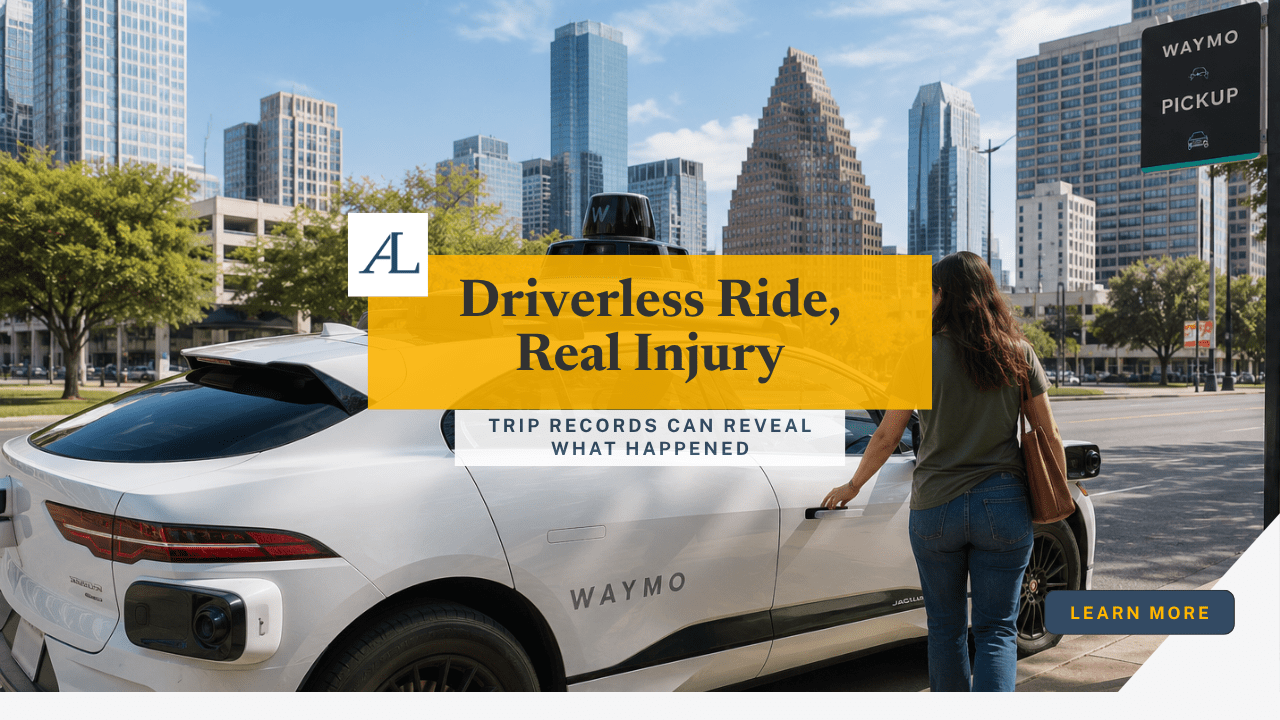
A Houston Waymo robotaxi passenger injury claim can become complicated quickly because there may be no human driver to question after a crash, sudden stop, unsafe pickup, or curbside incident. Injured passengers may be left dealing with pain, medical bills, missed work, and confusing insurance questions while key evidence sits inside app records, trip logs, vehicle data, camera footage, and company-controlled systems.
Waymo announced in February 2026 that it was welcoming first public riders into its fully autonomous ride-hailing service in Houston, Dallas, San Antonio, and Orlando, with select riders invited on a rolling basis as the company scaled operations. That makes Houston a valid local robotaxi topic, but the legal questions are still very different from a standard Uber, Lyft, or two-car crash.
When a driverless rideshare injury happens, choosing the right legal representation matters. An experienced Houston rideshare accident lawyer at Avrek Law Firm can act quickly to preserve app records, trip data, vehicle evidence, crash reports, medical documentation, and every available insurance source.
Call 866-598-5548, start a chat, or request a free case review today. There are no upfront fees, and you don’t pay unless we win.
Why a Houston Waymo Robotaxi Passenger Injury Claim Is More Complex Than a Regular Rideshare Crash
A Houston Waymo robotaxi passenger injury claim is different from a typical rideshare accident because the vehicle may be operating without a human driver inside. In a regular rideshare crash, the investigation often begins with the driver’s actions, app status, pickup status, and insurance period. In a Waymo claim, the case may turn on vehicle data, trip records, passenger app screenshots, route behavior, remote support communications, sensor information, and whether another driver caused or contributed to the crash.
Texas also has a specific regulatory framework for automated vehicles. The Texas Department of Motor Vehicles explains that Senate Bill 2807 created authorization requirements for commercial automated vehicle operations on Texas roads, with TxDMV holding administrative authority to issue and revoke authorizations and restrict operations while law enforcement agencies retain on-road enforcement authority.
There May Be No Human Driver Statement
In a standard crash, police and insurers may collect statements from both drivers. A driver may admit they failed to brake, changed lanes suddenly, or did not see another vehicle. In a robotaxi crash, there may be no human driver available to explain what happened.
That does not mean there is no evidence. It means the evidence may be digital. A Houston Waymo robotaxi passenger injury claim may involve ride receipts, app screenshots, support messages, vehicle ID numbers, route history, pickup and drop-off records, crash data, and any available camera footage from surrounding businesses or vehicles.
Because much of this evidence may be controlled by a company or third party, it should be preserved quickly.
Trip Status May Affect the Claim
Trip status can matter in a robotaxi injury case. The passenger may have been waiting for pickup, entering the vehicle, riding inside, exiting at a drop-off point, or reporting an issue through the app. Each stage may raise different questions about responsibility, insurance, and evidence.
A Houston Waymo robotaxi passenger injury claim should document exactly when the injury happened. Was the ride already active? Had the vehicle arrived at the pickup point? Was the passenger stepping into or out of the robotaxi? Did another driver hit the vehicle? Did the robotaxi stop suddenly? Did the app or support team acknowledge an incident?
Screenshots can help prove what the app showed before information changes or disappears.
Vehicle Data May Be More Important Than Memory
Passengers may not see the full crash sequence. They may be looking at their phone, checking a bag, sitting in the back seat, or stepping out at the curb. That makes vehicle data and outside footage especially important.
The National Highway Traffic Safety Administration says its Standing General Order requires identified manufacturers and operators to report certain crashes involving vehicles equipped with automated driving systems or Level 2 advanced driver assistance systems. NHTSA states that the order helps the agency receive timely crash notifications involving these technologies.
In a Houston Waymo robotaxi passenger injury claim, crash reporting may not replace the injured passenger’s own evidence, but it can be one more reason to preserve data early and investigate what records may exist.
Evidence Passengers Should Preserve After a Houston Robotaxi Incident
A Houston Waymo robotaxi passenger injury claim can become harder if evidence is not saved quickly. App screens change. Vehicles leave. Camera footage may be overwritten. Witnesses disappear. Medical symptoms may worsen after the initial shock fades.
The best approach is to document everything immediately.
App Screenshots, Trip Receipts, and Support Messages
Passengers should save screenshots of the ride request, vehicle information, route map, pickup point, drop-off point, fare receipt, trip time, support messages, cancellation notices, and any in-app incident report. If the app shows a vehicle number, license plate, pickup instructions, or trip confirmation, those details should be saved.
In a Houston Waymo robotaxi passenger injury claim, these records can help prove that the passenger was using the service, where the vehicle was located, whether the ride had started, and how the company responded after the incident.
Do not rely only on the app. Save screenshots to your phone, email, or cloud storage.
Photos of the Vehicle, Scene, and Pickup Location
If it is safe, passengers should photograph the robotaxi, any other vehicle involved, visible damage, license plate or vehicle identifiers, curb location, traffic signals, crosswalks, lane markings, nearby signs, road conditions, and visible injuries. Wide photos show the full scene. Close photos show damage and identifying details.
A Houston Waymo robotaxi passenger injury claim may involve more than a moving collision. A passenger may be hurt during pickup, while exiting, while loading belongings, after a sudden stop, or because another driver struck the robotaxi near the curb.
Scene photos help explain whether the stop location was safe and whether other traffic contributed to the injury.
Witnesses and Nearby Camera Sources
Witnesses may include pedestrians, other passengers, valet workers, security guards, delivery drivers, rideshare drivers, nearby motorists, hotel staff, restaurant employees, or business owners. Their information should be saved as soon as possible.
Houston businesses, apartments, hotels, parking garages, restaurants, traffic corridors, and nearby vehicles may have cameras. A Houston Waymo robotaxi passenger injury claim may depend on footage showing vehicle movement, traffic flow, passenger entry or exit, or another driver’s actions.
Video requests should be made quickly because many systems overwrite footage within days or weeks.
Who May Be Liable After a Houston Waymo Robotaxi Passenger Injury?
A Houston Waymo robotaxi passenger injury claim may involve several possible responsible parties. The facts determine whether the claim focuses on the robotaxi operator, another driver, a property owner, a pickup location operator, or multiple insurance policies.
The Autonomous Vehicle Operator or Related Company
If the robotaxi’s operation, route behavior, stop location, braking, door function, passenger instructions, or support response contributed to the injury, the autonomous vehicle operator and related entities may need to be investigated.
That does not mean every robotaxi injury automatically proves company liability. It means the company may control critical evidence. A Houston Waymo robotaxi passenger injury claim may require trip logs, support records, incident reports, vehicle data, maintenance records, and communications with insurers.
Without early preservation, injured passengers may only have their memory while the company controls the technical record.
Another Driver or Road User
Another driver may cause or contribute to the crash. A car may rear-end the robotaxi, sideswipe it, cut across its path, run a red light, or strike a passenger entering or exiting. A cyclist, scooter rider, delivery vehicle, rideshare driver, or commercial truck may also be involved depending on the location.
In that situation, the other driver’s insurance may be part of the claim. However, the robotaxi trip data may still matter because it can show where the vehicle was, whether the ride was active, and how the crash sequence unfolded.
A Property Owner, Hotel, Garage, or Pickup Location
Some robotaxi injuries happen at pickup or drop-off, not during the main part of the ride. A passenger may be hurt because the vehicle stopped near an unsafe curb, blocked lane, driveway, parking garage, hotel entrance, apartment complex, or poorly marked loading area.
A Houston Waymo robotaxi passenger injury claim may therefore overlap with property or premises liability issues. A hotel, apartment complex, restaurant, event venue, parking operator, or property owner may need review if the location contributed to the injury.
The key questions are who controlled the pickup area, whether the hazard was foreseeable, and whether safer instructions or traffic control should have been used.
Texas Law Issues That May Affect a Robotaxi Passenger Claim
A Houston Waymo robotaxi passenger injury claim may involve ordinary injury law, insurance law, automated vehicle rules, and proportionate responsibility. These issues can affect claim value and settlement strategy.
Texas Proportionate Responsibility
Texas uses a proportionate responsibility system. Under Texas Civil Practice and Remedies Code Section 33.001, a claimant may not recover damages if their percentage of responsibility is greater than 50 percent.
This matters because insurers may try to shift fault onto the passenger, another driver, the pickup location, or another party. In a Houston Waymo robotaxi passenger injury claim, evidence can help prevent unfair blame-shifting.
Texas Automated Vehicle Oversight
Texas has updated automated vehicle rules and a regulatory program for commercial AV operations. TxDMV’s Automated Vehicles Regulatory Program explains that companies must receive authorization before operating vehicles controlled by automated driving systems commercially on Texas roads.
For injured passengers, this makes company identity, authorization status, incident records, vehicle data, and operating records important evidence categories. A standard insurance exchange may not be enough.
Texas Personal Injury Deadlines
Texas Civil Practice and Remedies Code Section 16.003 generally requires personal injury lawsuits to be brought within two years after the cause of action accrues. Deadlines can vary depending on the facts, especially if a public entity or other special issue is involved.
A Houston Waymo robotaxi passenger injury claim should be reviewed quickly so evidence and deadlines are not missed.
What to Do After a Houston Waymo Robotaxi Injury
A Houston Waymo robotaxi passenger injury claim can be affected by the steps taken immediately after the incident. Health comes first, but documentation also matters.
Get Medical Care Immediately
Passengers should seek medical care after a crash, sudden stop, fall, door incident, or curbside injury. Symptoms may include neck pain, back pain, headaches, dizziness, shoulder pain, hip pain, knee trauma, numbness, anxiety, or concussion symptoms.
Some symptoms may appear later. Medical records help connect the injury to the incident and reduce insurer arguments that the injury was unrelated.
Report the Incident and Save Written Confirmation
Report the incident through the app or company support channel, but save written proof. Keep emails, claim numbers, chat transcripts, screenshots, support messages, and any insurance contact information.
In a Houston Waymo robotaxi passenger injury claim, company communications may show when the incident was reported and what information was requested. Written records are easier to use than phone-call memories.
Avoid Giving Detailed Statements Too Early
Insurance representatives may ask what happened, whether the passenger was seated, whether a seatbelt was used, whether pain started immediately, whether another car caused the impact, or whether the vehicle stopped suddenly.
These questions can affect liability and claim value. Injured passengers should avoid guessing about speed, timing, vehicle movement, or fault before app records, medical records, and vehicle evidence are reviewed.
Frequently Asked Questions About a Houston Waymo Robotaxi Passenger Injury Claim
Can I file a claim if I was injured in a Waymo robotaxi in Houston?
Yes. You may have a claim if you were injured during a Waymo ride, pickup, drop-off, sudden stop, crash, door incident, or curbside event in Houston. A Houston Waymo robotaxi passenger injury claim may involve the robotaxi operator, another driver, a property owner, or multiple insurers.
What evidence matters most after a robotaxi injury?
Important evidence includes app screenshots, trip receipts, vehicle identification, pickup and drop-off records, support messages, scene photos, witness names, medical records, nearby camera footage, and insurance communications.
What if another driver hit the robotaxi?
Another driver may be responsible, but robotaxi trip data can still help prove the vehicle’s location, route, timing, and movement before impact. Both the other driver’s insurance and robotaxi-related records may need review.
Does Texas law treat autonomous vehicles differently?
Texas has specific automated vehicle rules and a TxDMV regulatory program for commercial AV operations. These rules may affect what company records, authorizations, vehicle data, and reporting records should be preserved.
Should I speak with a lawyer before dealing with insurance?
Yes. Driverless rideshare claims can involve technical data, company-controlled records, multiple insurers, and disputed liability. A Houston rideshare accident lawyer can help preserve evidence and protect the claim from being narrowed too early.
Call or Contact Avrek Law Firm 24/7 for a Free Consultation and Pay Nothing Unless We Win
A Houston Waymo robotaxi passenger injury claim can involve app data, autonomous vehicle records, support communications, crash reports, medical documentation, third-party drivers, pickup location evidence, and insurance disputes. These cases are not always handled like ordinary rideshare accidents because there may be no human driver statement and much of the strongest evidence may be digital.
Avrek Law Firm helps injured passengers investigate robotaxi and rideshare accident claims, preserve trip records, identify all available coverage, and challenge insurers when they try to shift responsibility or minimize injuries.
Speaking with a Houston rideshare accident lawyer may help you understand what evidence should be preserved after a driverless ride injury. These cases may also overlap with issues handled by a Houston car accident lawyer or Houston personal injury lawyer, especially when injuries are serious, fault is disputed, or multiple companies may be involved.
If you or someone you love was injured during a Waymo robotaxi ride, pickup, or drop-off in Houston, Avrek Law Firm is ready to help.
- 📩 Submit a request through our online form
- 📞 Call 866-598-5548 now to speak with our team
- 💬 Start a live chat for immediate assistance
There are no upfront fees, and you don’t pay unless we win.