A Houston pedestrian accident lawyer evaluates these cases by focusing on how right-of-way is interpreted under real-world traffic conditions, not just assumptions made at the scene.
After a pedestrian accident, many people expect the situation to be straightforward. Either the driver was at fault, or the pedestrian was. But in reality, these cases are rarely that simple. What matters most is not just who was present in the roadway, but how the law defines responsibility in that moment.
In a city like Houston, where traffic conditions, roadway design, and pedestrian activity vary significantly from one intersection to another, right-of-way disputes are common. What may seem clear at the scene often becomes much less certain once insurance companies begin evaluating the claim.
At Avrek Law, we regularly work with injured pedestrians who are surprised to learn that fault is not determined by assumption. It is determined by how the law applies to the specific circumstances of the crash.
📞 Call 866-598-5548, start a chat, or request a free case review today. You don’t pay unless we win.
When Drivers Are Required to Yield to Pedestrians
Drivers are required to yield to pedestrians in specific situations, particularly at marked and unmarked crosswalks.
However, what many people don’t realize is that a crosswalk does not automatically resolve every question of fault. The timing of the pedestrian’s movement, the driver’s speed, and the overall traffic conditions all play a role in how the situation is evaluated.
In some cases, a driver may argue that they did not have enough time to react. In others, the pedestrian’s position may become the focus of the dispute. These factors create a layer of interpretation that goes beyond simply identifying the location of the crossing. This is why a Houston pedestrian accident lawyer will look closely at whether the driver had a reasonable opportunity to see and respond to the pedestrian before the collision.
When Pedestrians May Be Expected to Yield
There are also situations where pedestrians are expected to yield to vehicles.
This typically applies when a pedestrian crosses outside of a designated crosswalk or enters the roadway in a way that does not give drivers enough time to respond.
What makes these cases complex is that the distinction is not always clear in practice. A pedestrian may believe they crossed safely, while a driver may claim the movement was sudden or unexpected.
We often see that these cases are not about clear violations, but about how each party’s actions are interpreted after the fact.
How Right-of-Way Disputes Develop After a Crash
A Houston pedestrian accident lawyer often sees these disputes turn on small details, such as timing, visibility, and how each party’s actions are interpreted after the fact. Right-of-way disputes often arise because both parties believe they acted reasonably.
A driver may feel they were traveling at a safe speed and could not avoid the pedestrian. A pedestrian may feel they had already entered the roadway and should have been seen.
This creates a situation where fault is not obvious. Instead, it becomes a matter of analyzing visibility, timing, and reaction.
We regularly see insurance companies use this uncertainty to assign shared responsibility. This reduces the amount they are required to pay and shifts part of the burden onto the injured person.
What Most People Don’t Realize About Pedestrian Fault
Many people assume that pedestrians always have the right-of-way. But that assumption is not always accurate.
We often see cases where:
- The pedestrian is outside a crosswalk
- The timing of the crossing is disputed
- Visibility conditions affect perception
These factors are used to argue that the pedestrian contributed to the accident. This does not necessarily eliminate the claim, but it can affect how compensation is calculated.
How Insurance Companies Evaluate Right-of-Way
Insurance companies approach right-of-way disputes by analyzing risk.
They look at:
- Location of the pedestrian
- Movement timing
- Driver reaction
- Available evidence
Their goal is not just to determine what happened, but to assign percentages of responsibility. This allows them to reduce claim value, even when the driver’s actions played a significant role.
Why Evidence Matters in Pedestrian Cases
Because right-of-way disputes are based on interpretation, evidence becomes critical. Photos of the intersection, traffic signals, crosswalk markings, and surrounding conditions all help clarify the situation.
Witness statements and camera footage can also provide context that is not obvious from the scene alone. Without this evidence, the claim may rely heavily on conflicting accounts, which often leads to shared fault.
A Houston pedestrian accident lawyer will often rely on this type of evidence to clarify how the incident occurred and counter assumptions made by insurance companies.
How Texas Law Applies to Pedestrian Accidents
Texas law defines right-of-way rules for both drivers and pedestrians, but it also allows for shared responsibility. For general civil case guidance, see Texas Courts: https://www.txcourts.gov
This means that even if a pedestrian is partially at fault, they may still recover compensation, depending on how responsibility is assigned.
What Changes When a Lawyer Gets Involved Early
When a Houston pedestrian accident lawyer becomes involved early, the focus shifts from assumptions to analysis.
Instead of relying on initial interpretations, the case is built around:
- What the driver should have seen
- Whether the pedestrian’s actions were reasonable
- How the conditions affected both parties
We often see that early involvement helps prevent the claim from being defined by incomplete or biased interpretations. In many cases, working with a Houston pedestrian accident lawyer helps ensure that these details are properly evaluated rather than assumed.
📞 Call 866-598-5548, start a chat, or request a free case review today.
Frequently Asked Questions — Pedestrian Right-of-Way
Do pedestrians always have the right-of-way in Houston?
No. Right-of-way depends on where and how the pedestrian enters the roadway.
Can a pedestrian still recover compensation if they were partially at fault?
Yes. Texas allows shared responsibility in many cases.
Why do insurance companies argue about right-of-way?
Because it allows them to reduce liability and limit payouts.
What evidence is most important in these cases?
Intersection layout, signals, and witness accounts are often critical.
What is the biggest mistake after a pedestrian accident?
Not documenting the scene and relying on assumptions about fault.
Before Right-of-Way Becomes a Dispute
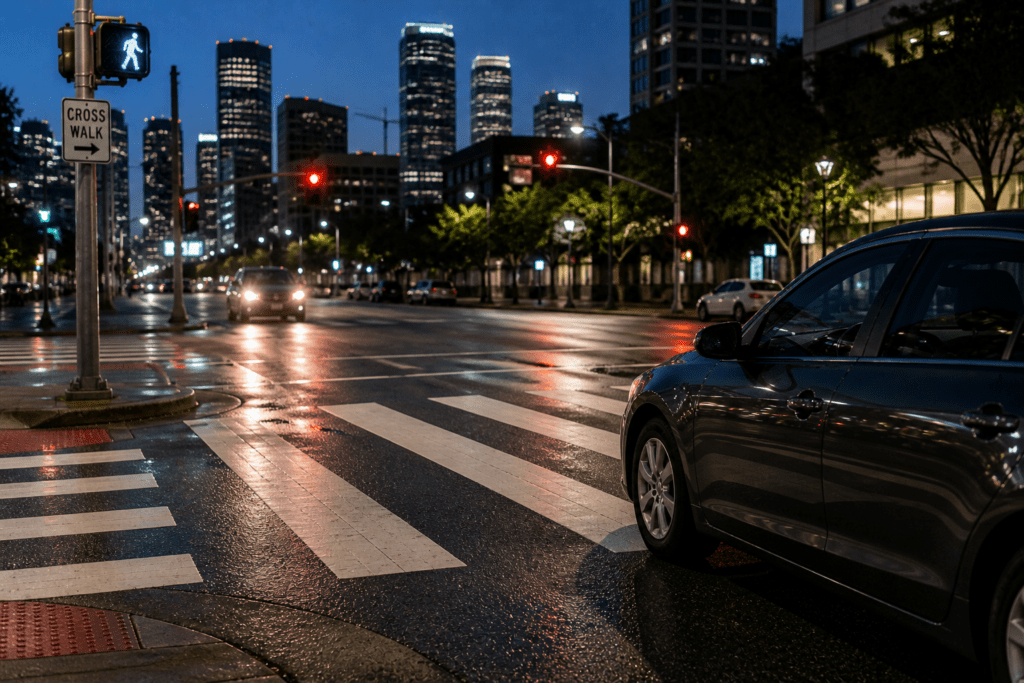
Pedestrian accident claims are not just about where someone was standing—they are about how responsibility is interpreted. If that interpretation is incomplete, it can affect the outcome of the claim.
If you were injured, speaking with a Houston pedestrian accident lawyer can help ensure your case reflects what actually happened—not just how it is initially interpreted.
📞 Call 866-598-5548, start a chat, or request a free case review today.